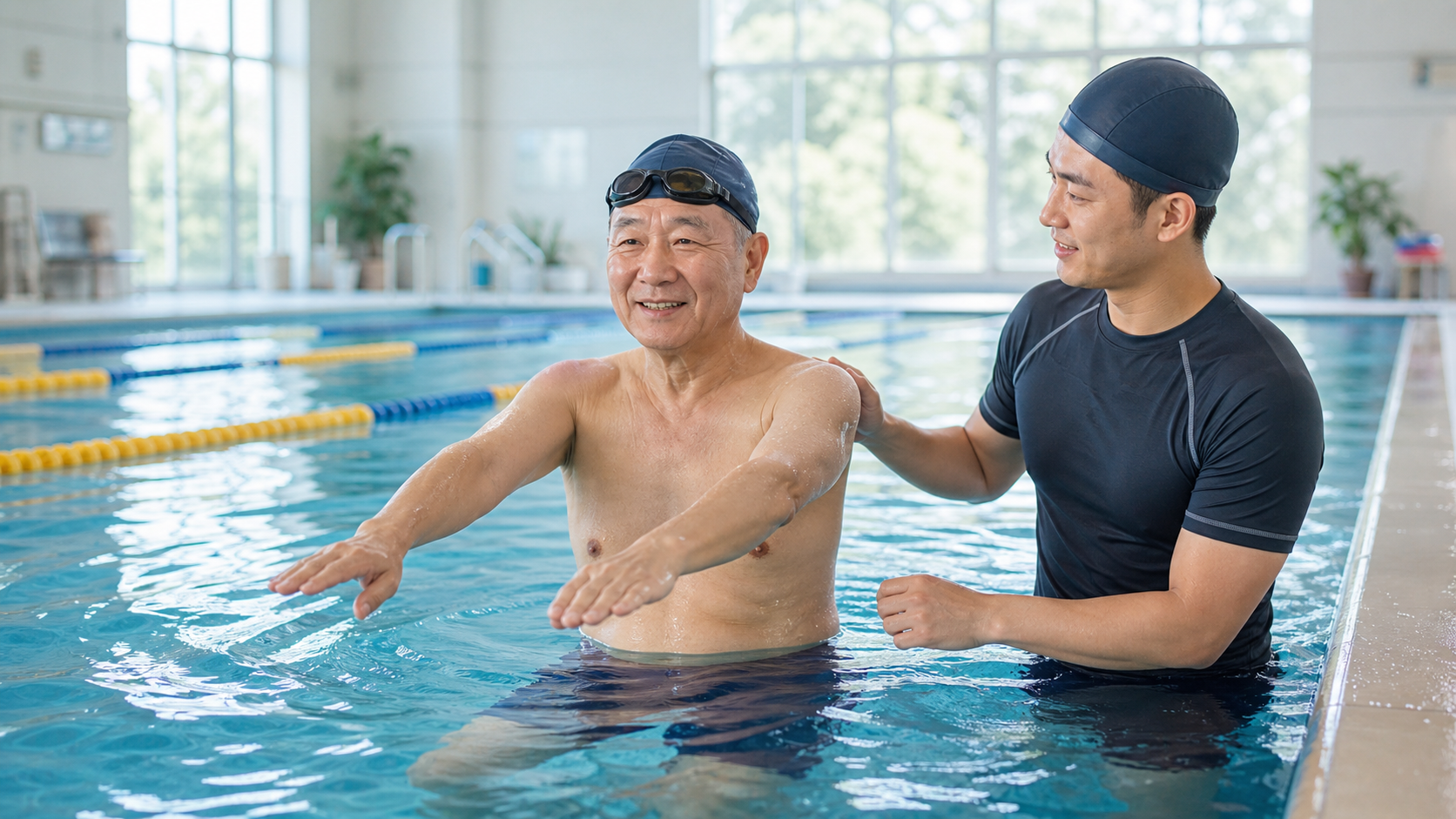
Senior Swimming Safety Guide: A Complete Training Plan for Beginners Over 65
Introduction
Taiwan is rapidly entering a super-aged society. According to statistics from the National Development Council, the proportion of people aged 65 and above in Taiwan has already exceeded 20% in 2025. Helping seniors maintain an active physical state and delay functional decline is a major public health issue.
Among the many exercise options available, swimming offers particularly outstanding advantages for seniors: buoyancy reduces joint loading, water resistance provides safe full-body strength stimulation, and the properties of water make the risk of falling almost zero. However, swimming for seniors also comes with its own unique precautions that require careful planning and appropriate safety measures.
Physical Benefits of Swimming for Seniors
| Benefit | Mechanism | Level of Research Support |
|---|---|---|
| Improved aerobic capacity | Increased cardiac output and VO₂max | Strong |
| Maintenance of muscle mass | Water resistance provides resistance training effects | Moderate to strong |
| Improved balance | Proprioceptive training in water | Moderate |
| Lowered blood pressure | Vasodilation and autonomic nervous system regulation | Strong |
| Improved joint mobility | Joint movement in a weight-reduced water environment | Moderate to strong |
| Reduced fall risk | Strengthened core muscles and lower limb strength | Moderate |
| Improved mood and sleep | Exercise-induced endorphin release | Moderate to strong |
Pre-Program Health Assessment: A Safety Gate That Cannot Be Skipped
Before seniors aged 65 and above begin swimming training, it is recommended that they complete the following assessments:
Necessary Medical Clearance
- History of heart disease or coronary artery disease: Requires evaluation by a cardiologist to determine whether water exercise is suitable and what the recommended intensity ceiling should be
- Blood pressure control status: If resting blood pressure exceeds 160/100 mmHg, medication control must be adjusted before starting
- Diabetes: Confirm that blood sugar is stable; hypoglycemia may occur during swimming, so a response plan is needed
- Skin conditions: Open wounds or severe eczema should not be exposed to water until fully healed
- Ear problems: After a perforated eardrum or middle ear surgery, confirmation is needed on whether entering the water is permitted
Baseline Physical Fitness Assessment (Can Be Done Independently)
- 30-second sit-to-stand test: Count the number of times you stand up from and sit back down on a chair. Normal values for men aged 60–69 are ≥ 14 repetitions; for women, ≥ 12 repetitions
- Single-leg stance test: Maintain standing on one leg (eyes open); the normal value should exceed 10 seconds
- Walking speed: A 10-meter walking speed below 0.6 meters/second is a warning sign of functional decline
Senior-Friendly Stroke Selection
For most seniors new to the water, it is recommended to start with back floating and water walking, then gradually progress to formal strokes.
Recommended Stroke Progression
First choice: Backstroke
- Face always points upward, no breathing anxiety
- Spine remains near a neutral position, with low lumbar stress
- Suitable for those with limited cardiopulmonary function; rest can be taken at any time
Second choice: Breaststroke
- Slower movement rhythm, making breathing timing easier to manage
- Less stress on the cervical spine (compared to butterfly)
- Note: Those with degenerative knee arthritis should be cautious, as the outward rotation kick of breaststroke may aggravate knee pain
Not recommended for now: Freestyle
- Side breathing places higher demands on cervical spine flexibility
- Attempt only after basic water sense is established
Recommended to avoid: Butterfly
- High lumbar stress, unsuitable for seniors
12-Week Beginner Training Plan
Weeks 1–4: Adaptation Phase (Building Water Sense)
Each session is 20–25 minutes, twice per week.
- Warm-up (5 minutes): Arm circles on deck, gentle knee bends, walking in the water
- Main set (15 minutes):
- Water walking (shallow area): 5 minutes walking forward/backward, 2 minutes side-stepping
- Kicking practice at the wall: 2 × 25 meters (backstroke kick)
- Assisted gliding with kickboard: 3 × 15 meters
- Cool-down (5 minutes): Slow walking in the water, shoulder and leg stretches
Weeks 5–8: Progression Phase (Movement Integration)
Each session is 30 minutes, 2–3 times per week.
- Warm-up (5 minutes): Water walking + arm swings
- Main set (20 minutes):
- Backstroke: 4 × 25 meters, 60 seconds rest between reps
- Breaststroke (if knees allow): 2 × 25 meters, 90 seconds rest between reps
- Choice: kickboard kicking or easy gliding for 50 meters
- Cool-down (5 minutes): In-water stretching, focusing on hips and shoulders
Weeks 9–12: Consolidation Phase (Building the Habit)
Each session is 35–40 minutes, 3 times per week.
- Warm-up (5 minutes)
- Main set (30 minutes):
- Backstroke: 6 × 25 meters or 2 × 50 meters, 60 seconds rest between reps
- Breaststroke: 4 × 25 meters, 90 seconds rest between reps
- Optional: Try freestyle 25 meters × 2
- Cool-down (5 minutes)
Safety Rules: Protecting Yourself in the Water
- Never swim alone: Ensure the venue has a lifeguard on duty, or swim with a companion
- Inform the lifeguard of your condition: If you have a history of heart disease or limited mobility, proactively inform the staff upon entry
- Use appropriate aids: Kickboards and pool noodles are good friends, not a sign of weakness
- Do not dive: Enter the water slowly using steps or handrails to avoid cervical spine impact
- Watch the water temperature: Seniors are sensitive to temperature changes; it is recommended to choose a heated pool with water at 28–32°C
- Watch for hypoglycemia: If taking blood sugar-lowering medication, measure blood sugar before and after swimming and carry candy with you
- Get out of the water immediately if you experience: chest pain, shortness of breath, dizziness, or irregular heartbeat
Complementary Recommendations: Making Swimming Safer and More Effective
- Choose senior swimming classes at community pools: Having an instructor lead and peers to encourage each other improves both safety and consistency
- Eat a light snack before swimming: Swimming on an empty stomach may cause hypoglycemia or gastrointestinal discomfort; eat a small amount of carbohydrates 1–1.5 hours before swimming
- Combine with land-based balance training: Pairing swimming with balance board training or tai chi produces more significant fall-prevention effects
- Keep a training log: Recording distance and how you feel each session helps track progress and prevent overtraining
Conclusion
“Life begins at seventy—and so can swimming.” Whether you are trying swimming for the first time at 65 or returning to the pool after many years away, the door to water exercise is always open to you. The key lies in thorough safety assessment, a progressive training plan, and a relaxed mindset that does not push for speed or distance. Supported by the buoyancy of the water, your body will find its own rhythm—and that rhythm can carry you through your most active senior years.
Related Reading
- Senior Swimming Training: A Safe Beginner’s Plan and Precautions for Ages 65 and Above
- Senior Swimming Training Plan: Low-Intensity Water Exercise Design for Ages 65 and Above
- Senior Swimming: An Aerobic Exercise Guide Even 75-Year-Olds Can Do
- Senior Swimming Guide: Safe Water Entry and Training Advice After Age 50
滑雪新手們慘摔學習全紀錄(請開字幕),滑雪好好玩 | Snowboard + Ski | 岩原 スキー場 | 滑雪APP使用 | GoPro Max
6 年前
一日北高/長距離團騎 常見問題補充篇 / 組團或跟團的眉角 / 壯車友容易被瘦車友慢性拉爆 / 原來屁股痛可能是這個原因...? / 風場配速法 / 公路車 / CT Yeh
2 年前
一日北高常見問題大集合 | 攻略 | 路線 | 訓練 | 補給 | 自行車 單車 | 一日雙城 | 雙塔 | TWB北高360 | 屁股痛
6 年前
靠單車減肥35公斤 心得分享與整理
7 年前
西進武嶺 免費訓練分析服務 Intervals | 練不夠還是練過頭?你哪一種類型選手?AI模型告訴你! | 備戰神器 | 公路車 訓練 | CT Yeh
4 年前
嘉義大埔、阿婆灣挑戰賽,美到以為在日本!ft. 環騎5 Cool 西拉雅188 / 公路車 / CT Yeh
7 個月前
單車 一日北高 ( 雙城 ) 肥宅雙人瘋狂行 紀錄片 REACTO
10 年前
入門車錶王者 iGPSPORT BSC100S 一千元的售價! 超大螢幕、連續兩趟北高的續航、藝術般的APP! Bryton Garmin 兩王地位撼動? | 公路車 | CT Yeh
3 年前