Taroko Gorge Marathon: Climbing Strategy and Altitude Adaptation for Mountain Races
Introduction
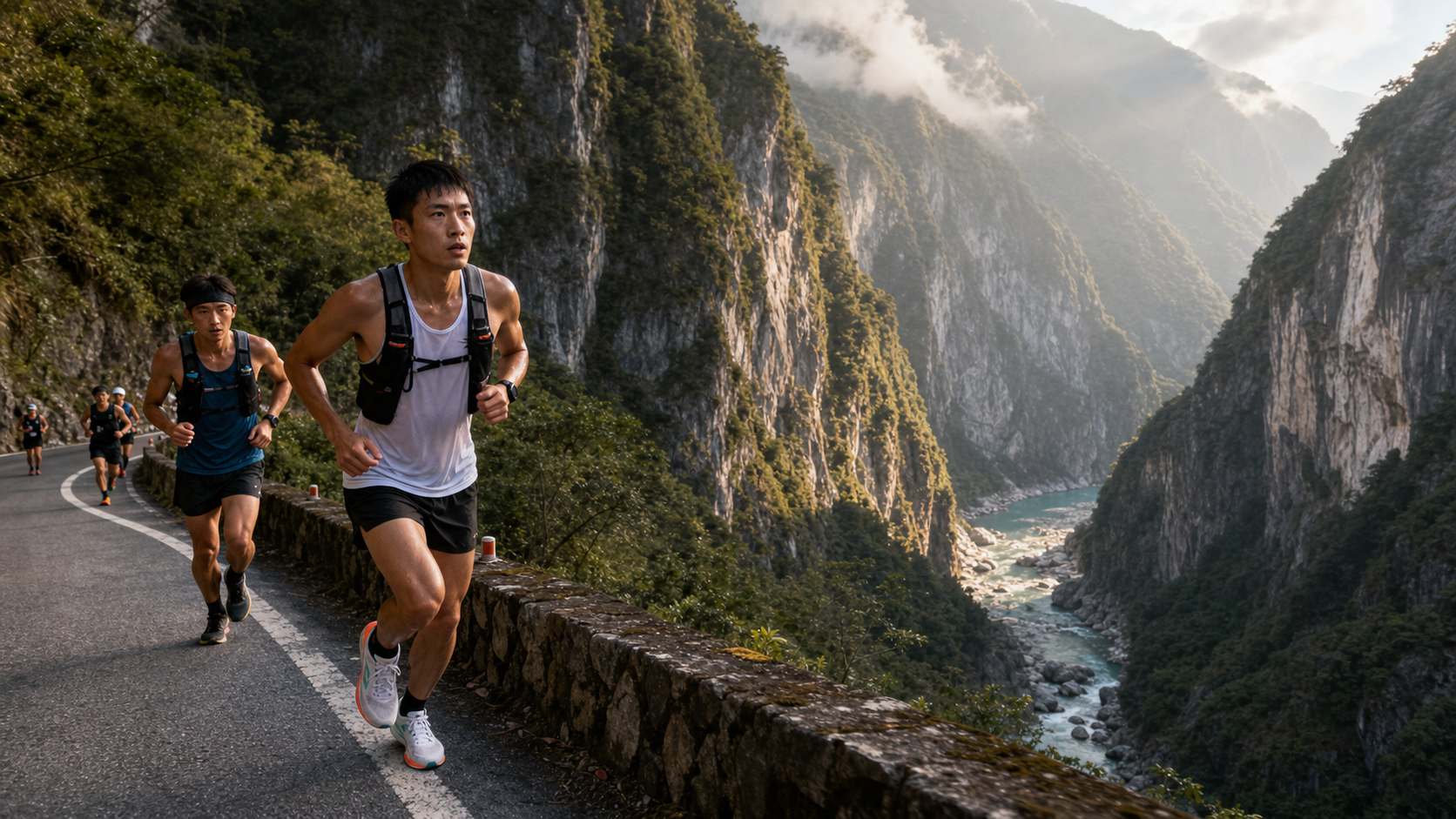
The Taroko Gorge Marathon is hailed as Taiwan’s most spectacular road race. Held annually in Hualien’s Taroko National Park, the course follows the Central Cross-Island Highway through a deep gorge, with cliffs, waterfalls, and turquoise streams accompanying runners the entire way. However, it is also one of Taiwan’s most challenging marathons: the total cumulative elevation gain exceeds 1,000 meters, with significant elevation differences between start and finish. The demands on the cardiorespiratory system and muscles far exceed those of a flat marathon. This article provides a complete mountain marathon guide, covering climbing strategy, altitude adaptation, and downhill knee protection.
Course Elevation Profile Analysis
The Taroko Marathon’s course features complex elevation changes. Below is an overview of the main sections:
| Section | Start Elevation | End Elevation | Key Characteristics |
|---|---|---|---|
| 0–8 km | Approx. 30 m | Approx. 200 m | Gentle warm-up climb, entering the gorge mouth |
| 8–18 km | Approx. 200 m | Approx. 650 m | Main climbing section, continuous ascent |
| 18–28 km | Approx. 650 m | Approx. 900 m | Gentle climb followed by short descent |
| 28–36 km | Approx. 900 m | Approx. 500 m | Long descent, high-pressure section for knees |
| 36–42 km | Approx. 500 m | Approx. 30 m | Rapid descent returning to the exit |
The actual route is adjusted slightly each year; be sure to check the official elevation profile before race day.
Altitude Adaptation: Preparation Before Race Day
The highest point of Taroko approaches 1,000 meters. While this does not reach the hypoxic threshold of high altitude (above 3,000 meters), it still affects runners who typically train at near-sea-level elevations in cities. Recommendations:
- Arrive in Hualien two days before the race: Stay in the flatlands of Hualien to acclimate to the humidity and temperature; do not do intense training on the first day
- Easy hike the day before the race: Walk a short section into Taroko to let your lungs get used to the mountain air quality
- Avoid staying up late the night before: Mountain races drain far more energy than flat races; adequate sleep is fundamental
- Increase fluid intake by 20% compared to usual: The mountain air is dry, and you lose water imperceptibly faster
Uphill Strategy: Protect Your Heart Rate, Run with Your Head
The biggest mistake in a mountain race is following fast runners up the hills in the early stages, causing your heart rate to spike and your energy to deplete later on. The correct uphill strategy:
- Use heart rate rather than pace to control intensity: Your pace will inevitably drop on climbs; aim to keep your heart rate in the aerobic zone (70–80% of maximum heart rate)
- Consider walking when the grade exceeds 8%: In mountain races, strategic walking consumes less energy than forcing a run, and the time difference is often minimal
- Shorten your stride and increase cadence: On climbs, shorten your stride to 60–70% of your flat-road length, quicken your leg turnover, and maintain momentum
- Use your arms for leverage: Swing your arms vigorously front and back to drive your body forward and reduce the load on your lower limbs
- Keep your eyes on the ground 3–5 meters ahead: Looking up at distant scenery on climbs increases psychological pressure; a short-range focus helps maintain rhythm
Downhill Strategy: Speed Is Tempting, Injury Is the Price
The long descent in the latter half of Taroko excites many runners into accelerating, only to be forced to walk before the finish due to knee pain. The correct downhill strategy:
- Don’t let gravity fully control your speed: Actively brake with your quadriceps rather than letting your feet fall freely
- Shorten your stride and increase cadence: Short, quick steps on descents disperse the impact of each footfall
- Land softly on your forefoot, avoid heavy heel strikes: Heavy heel striking delivers a massive shock to the knees
- Only accelerate after 30 km: Be conservative on the early descents and reserve energy for the later stages
Special Considerations for the Gorge Environment
- Slow down in rockfall warning zones: Some sections of the course carry rockfall risk; runners should proceed cautiously according to official guidance
- Dim lighting in tunnel sections: Taroko has several tunnels; let your eyes adjust before entering to avoid missteps
- Gorge temperatures are lower than expected: Even in summer, temperatures at the gorge floor are about 3–5 degrees Celsius lower than outside; keep warm
- Water is plentiful but aid stations are limited: Aid stations are spaced far apart; be sure to top up on fluids at every one
Practical Recommendations
- Choose the lightest gear possible—every gram is a burden in a mountain race
- Compression calf sleeves offer significant muscle protection on long descents
- Use trekking poles as appropriate (subject to race regulations)
- Schedule weekend hikes during training to simulate the course’s climbing
Conclusion
The Taroko Gorge Marathon’s beauty is directly proportional to its difficulty. Every step upward is accompanied by the gorge’s grandeur, and every descent carries a sense of conquering achievement. Prepare thoroughly and approach it with mountain-race logic rather than flat-marathon thinking, and you will find at the finish line a satisfaction that no other race can provide.
Related Reading
- Taroko Gorge Marathon Guide: Climbing Strategy and Spectacular Scenery on the Mountain Course
- Taroko Gorge Marathon: The Ultimate Challenge in a Majestic Gorge
- The Psychological Challenge of the Taroko Gorge Marathon: Balancing Gorge Claustrophobia and Scenic Motivation
- Hualien Taroko Marathon Race Preparation Guide: The Unique Challenges of a Mountain Course
台灣登山王之路 KOM 全程參賽4K臨空錄影 PART1 穿越峽谷地形! #東進武嶺 太魯閣 / 燕子口 / 天祥 / 西寶 PART1 (公路車 / CT Yeh)
3 年前
台北闊瀨陡坡 騎旅 / 日本單車雜誌編輯車友臨時加入!/ 髮香才是最強的 / feat. 北迴歸線小隊 / 公路車 CT Yeh
6 個月前
新竹羅平 x 天湖部落 大禹嶺級變態陡坡! 4K超高畫質 空拍 | 公路車
5 年前
2023 夏季KOM 參賽實況 / 穿越空拍視角 / 整車都凸台 / 太魯閣峽谷x合歡山絕美大景 / 東進武嶺 / Taiwan KOM Challenge / 公路車 / CT Yeh
3 年前
太平山單車員工旅遊 | 這樣玩CP值最高!| 公路車
5 年前
#東進武嶺 全程實況錄影 5小時半 #夏季KOM #太魯閣 Taiwan KOM Challenge Reality Video Taroko scenery
7 年前
日本公路最高登山賽,台灣首位YT挑戰實錄,乘鞍登山賽40週年,賽前篇完整版,請到我的YT收看 #公路車 #cycling
10 個月前
2025 乘鞍 KOM 登山賽挑戰實錄 / 日本公路最高 ! 賽前探路篇 / 比富士山厲害,無敵絕景!/ 40週年 / 中文YT首發 / 公路車 / CT Yeh #乘鞍ヒルクライム
10 個月前