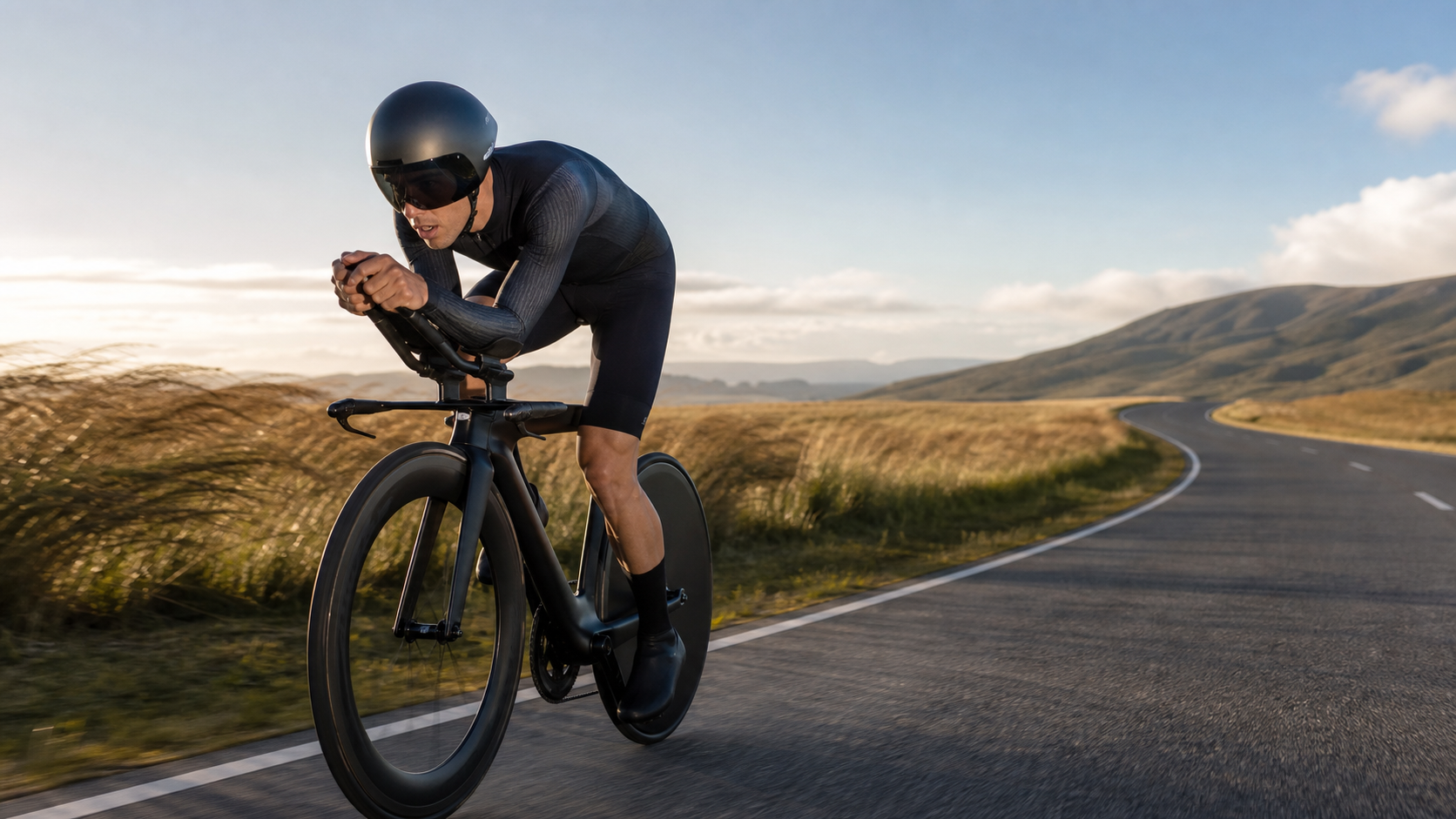
40K TT Finish Pacing: How Wind Resistance, Gradient, and Corners Affect Pacing
The 40K TT (25 mile TT) is the classic distance in road time trialing, typically taking 55–70 minutes. On the surface, it looks like simple arithmetic of “average power × time = distance,” but in reality, every change in wind direction, every gradient shift, and every corner rewrites your pacing strategy.
1. The Non-Linear Relationship Between Power and Speed
On flat roads with no wind, the relationship between power and speed is approximately:
Power ≈ 0.5 × CdA × ρ × v³ + Crr × m × g × v
The key is the v³ term—for every 10% increase in speed, aerodynamic drag increases by 33%. Real-world data:
| Speed (km/h) | Power Required on Flat Road (W) |
|---|---|
| 35 | 195 |
| 40 | 265 |
| 45 | 355 |
| 50 | 460 |
(Assuming CdA = 0.23 m², rider + bike 80kg, Crr = 0.005)
So pushing an extra 20W might only gain you 1.5 km/h—this is why “average power” matters more than “peak power” in TT pacing.
2. The Effect of Wind: Headwind and Tailwind Are Not Symmetrical
A 40K TT is usually an “out-and-back” or “loop” course. In theory, tailwind and headwind should cancel out, but in practice they don’t.
Assume you can ride 40K @ 250W in 60min with no wind. With a 5 m/s cross-tailwind / cross-headwind (i.e., a 10 m/s wind differential):
- Tailwind section: speed increases by 4–5 km/h, saving 3–4 minutes
- Headwind section: speed drops by 5–6 km/h, costing 5–6 minutes
- Net result: 1.5–2.5 minutes slower overall
Headwind pacing strategy:
- Increase power by 5–10W in headwind sections (from 250W → 257W)
- Decrease power by 5–10W in tailwind sections (from 250W → 243W)
- Use a compromise between “constant speed” and “constant power”—the theoretical optimum is “constant normalized power (NP)”
3. The Effect of Gradient
The steeper the gradient, the greater the share of gravity resistance, while aerodynamic drag becomes relatively less significant.
Relationship between gradient and required power (speed 30 km/h, rider + bike 80kg):
| Gradient (%) | Gravity Resistance (W) | Aero Drag (W) | Total Power (W) |
|---|---|---|---|
| 0 | 0 | 145 | 165 |
| 2 | 130 | 145 | 295 |
| 4 | 260 | 145 | 425 |
| 6 | 390 | 145 | 555 |
Pacing strategy:
- Start “building power” 200m before the climb to avoid a sudden drop in speed
- Briefly increase power by 10–15% on the climb (to avoid rapid lactate accumulation)
- Maintain cadence after cresting the hill—don’t ease off immediately
4. Corners: The Underestimated Time Killer
Each 90-degree corner costs an average of 3–5 km/h, plus 15–25 kJ of energy for re-acceleration.
Estimated loss from 8 corners in a 40K TT:
- Speed loss and recovery: 60–90 seconds total lost
- Extra energy expenditure: 120–200 kJ (equivalent to 5–8 minutes of FTP)
Cornering technique:
- Look ahead 100m to assess the corner and choose the widest-radius line
- Brake to a safe speed before entering the corner—do not brake while in the corner
- Immediately resume the aero position after exiting the corner and accelerate back to target speed
5. Pacing Distribution Recommendations (40K TT, FTP 280W)
Assume a target power of 250W (89% of FTP), paced in 4 segments:
| Segment | Distance | Target Power | Key Focus |
|---|---|---|---|
| Start | 0–2K | 235W | Don’t surge; settle into rhythm |
| Mid 1 | 2–20K | 250W | Hold target |
| Mid 2 | 20–35K | 252W | Feeling heavier; push through with willpower |
| Final | 35–40K | 260W | Sprint; burn whatever fuel remains |
6. Conclusion
The 40K TT is not as simple as “average power 250W.” Actively adjusting power with terrain, compromising pacing with wind direction, and handling corners strategically—these three things determine whether you finish in exactly 60 minutes or break your personal record in 58.
Related Reading
- Time Trial Power Pacing: The Science of Power Distribution in a 40K TT
- Time Trial (TT) Power Pacing: Why TT Pacing Isn’t FTP × 100%
- The Science of Time Trial Pacing: Trade-offs Between Constant Power, Negative Splits, and Gradient-Adjusted Pacing
- Flat Road TT Training Plan: The Dual Pursuit of FTP and Aerodynamics
#公路車 #西進武嶺 配速配瓦實驗 坡度分析 四小時內攻略 建大盃 NeverStop #西進武嶺攻略
6 年前
Live) 備戰2019彰化經典百K 賽前攻略 (已完賽請看新影片
7 年前
風櫃嘴時間 預測西進武嶺時間?13000名車友統計數據分析告訴你 !
5 年前
西進武嶺各路段 前8000名 大數據分析 配速攻略/功率/心律/推力比/維持率/踏頻/踏瓦比/牽車率 大公開 | 建大盃 NeverStop 可參考 | 公路車 | CT Yeh
5 年前
單車AI教練!全新 ChatGPT4o 幫你分析訓練成果!排武嶺課表,分析騎車姿勢! 太神了! / 公路車 / CT Yeh / feat. 緯緯
2 年前
西進武嶺配速器 3.0更新 / NEW 免功率FTP估算! / 大數據xAI體能模型 / 如何模擬人止關前集團效應 / 配速儲存功能 / AI全台自行車賽事行事曆 / 公路車 / CT Yeh
1 年前
血脈噴張) 2019 美利達 彰化經典百K 搖滾版 ft. Team Neko 市民的環台賽
7 年前
2024 彰化經典百K 參賽直播 / 黃亭茵集團 / 公路車 / CT Yeh
2 年前