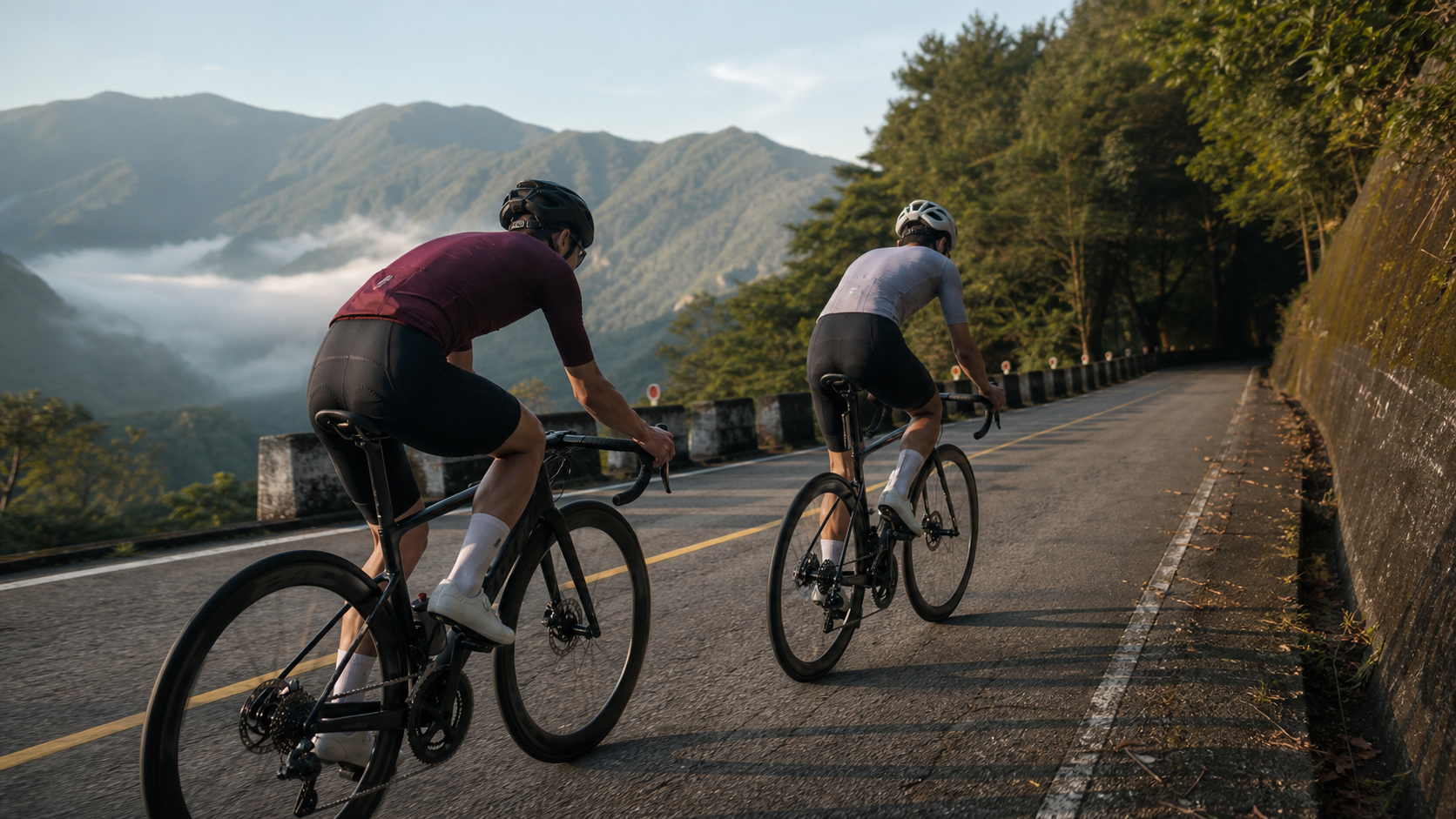
Cadence choice when climbing: 60rpm power-based vs 90rpm aerobic-based
“Is climbing better at 90rpm or 60rpm?” There is no absolute answer to this question. Among world-class riders, Froome prefers 95–100rpm (aerobic-based), Sagan prefers 75–85rpm (mixed), and Contador prefers 70–80rpm (power-based)—all three have won the Tour de France.
This article uses three perspectives—physiological data, energy expenditure, and race strategy—to help you find your optimal cadence.
1. The physical meaning of cadence
Cadence (rpm) is the number of pedal revolutions per minute.
Power = Torque × Angular velocity
So at the same power output:
- High cadence → low torque (small gear, light pedaling with fast spinning)
- Low cadence → high torque (large gear, heavy pedaling with slow spinning)
2. Low cadence (60–70rpm) power-based
Physiological characteristics:
- Primarily recruits slow-twitch fibers (Type I) and some fast-twitch oxidative fibers (Type IIa)
- Lower heart rate (about 5–8 bpm lower per watt)
- Less glycogen depletion (higher proportion of fat metabolism)
- But greater knee joint stress (higher peak torque)
Suitable scenarios:
- Sustained efforts on gentle climbs (< 6%)
- When you need to sprint on the flats after climbing and want to preserve your cardiovascular system
- Marathon-style climbs (> 60min)
Famous riders: Contador, Indurain (early career)
3. High cadence (85–100rpm) aerobic-based
Physiological characteristics:
- Primarily recruits fast-twitch oxidative fibers (Type IIa)
- Higher heart rate (about 5–8 bpm higher per watt)
- Greater glycogen depletion
- Less knee joint stress (lower torque per revolution)
- High demands on the cardiovascular system
Suitable scenarios:
- Steep climbs (> 8%) for short durations
- When frequent gear changes are needed to respond to attacks while climbing
- Short climbs (< 15min)
Famous riders: Froome, Armstrong (Lance era)
4. Comparison of experimental data
In a 2010 study by Lucia et al., professional riders performed a 60min climbing test:
| Metric | 60rpm group | 90rpm group |
|---|---|---|
| Average power | 285W | 285W |
| Average heart rate | 162 bpm | 173 bpm |
| RER (respiratory exchange ratio) | 0.92 | 0.96 |
| Perceived fatigue RPE | 7.5 / 10 | 7.0 / 10 |
| Post-effort lactate | 6.2 mmol/L | 5.4 mmol/L |
Interpretation:
- At the same power output, high cadence places greater cardiovascular demand but causes less muscle fatigue
- The 60rpm group had higher fat metabolism (lower RER)
- Perceived fatigue was similar between the two, but “the fatigue is in different places”
5. How to find your optimal cadence
Method 1: Natural cadence test
After warming up, maintain 75% FTP on flat ground, without looking at your bike computer, pedal comfortably for 10 minutes. Record the average cadence at the end—this is your “comfortable natural cadence.”
Method 2: Energy expenditure test
Use two 20min segments at 90% FTP:
- Segment 1: forced 70rpm
- Segment 2: forced 90rpm
Compare heart rate drift, RPE at the end, and next-day fatigue. Whichever makes you “feel easier at the same power output” is your preference.
Method 3: Dynamic adjustment based on climb length
| Climb duration | Recommended cadence |
|---|---|
| < 5min | 85–95 rpm (high) |
| 5–20min | 80–90 rpm (medium-high) |
| 20–60min | 75–85 rpm (medium) |
| > 60min | 70–80 rpm (medium-low) |
6. When to change cadence
A single fixed cadence is not a dogma. Professional riders switch in the following situations:
- Responding to attacks: instantly go from 80 → 100rpm, combined with short surges to launch off
- Before the summit: drop to 70rpm, “mash” to build momentum
- Descent transitioning to flats: spin up to 95–100rpm to maintain speed through the transition
- After fatigue accumulates: increase cadence by 5–10rpm to reduce muscle load (even though heart rate will rise)
7. Training recommendations
If you want to expand your cadence range:
Low-cadence training (Force):
- Climb at 6–8% @ 50–60rpm × 3 minutes × 4 reps
- Strengthens slow-twitch fibers and knee joint stability
- Caution: not suitable for those with knee pain
High-cadence training (Spin-up):
- Flat ground 6 minutes @ 100–110rpm @ 80% FTP
- Improves neuromuscular coordination and oxidative capacity of fast-twitch fibers
- 1–2 times per week
8. Conclusion
There is no “best cadence,” only “the cadence that suits you best.” Riders with strong cardiovascular systems should choose high cadence, riders with strong muscular strength should choose low cadence, and most riders should train usability across the full 70–95rpm range. On race day, adjust dynamically based on climb length, gradient, and race situation—that is the true advanced skill.
Related reading
- Small gear high cadence vs large gear low cadence: the science of choosing climbing cadence
- Climbing cadence choice: the impact of high vs low cadence on muscle groups when climbing
- Cadence strategy for climbing: choosing between high and low cadence in the mountains
- The science of cadence: is 90 RPM really the optimal cadence?
#公路車 #Vo2Max #最大攝氧量 測驗 體驗 | 心肺測試
6 年前
RAMP FTP Test 直播 究竟能撐到幾瓦 訓練台 Gravat Zwift
6 年前
如果Pogačar騎西進武嶺可以多快?會破2嗎?各種情況深度推估探討 / 公路車 / CT Yeh
2 年前
單車 梅山36灣 坡度介紹 路段介紹 空拍 (相關遊記影片,請參考說明或我的頻道喔,歡迎訂閱)
6 年前
白沙屯媽祖進香在家走!UREVO 坡度自調走步機 / 可連接訓練遊戲APP MyWhoosh / 邊看直播邊走起來 / CT Yeh
11 個月前
西進武嶺 8000名單車友數據分析 PART1 | 從新手到高手數量/瓦數/推力比/FTP推力比/功率計使用率 大解析 | 公路車 | CTYeh
5 年前
戰略) Zwift Race 如何咬在第一集團 如何評估自己要開多少推力 (請開1.5倍速看)
7 年前
全台首發!邁金P715踏板功率計!市場價格撼動者再出招 / 功率對比實測 / FAVERO ASSIOMA 可參考! / 公路車 / CT Yeh
1 年前