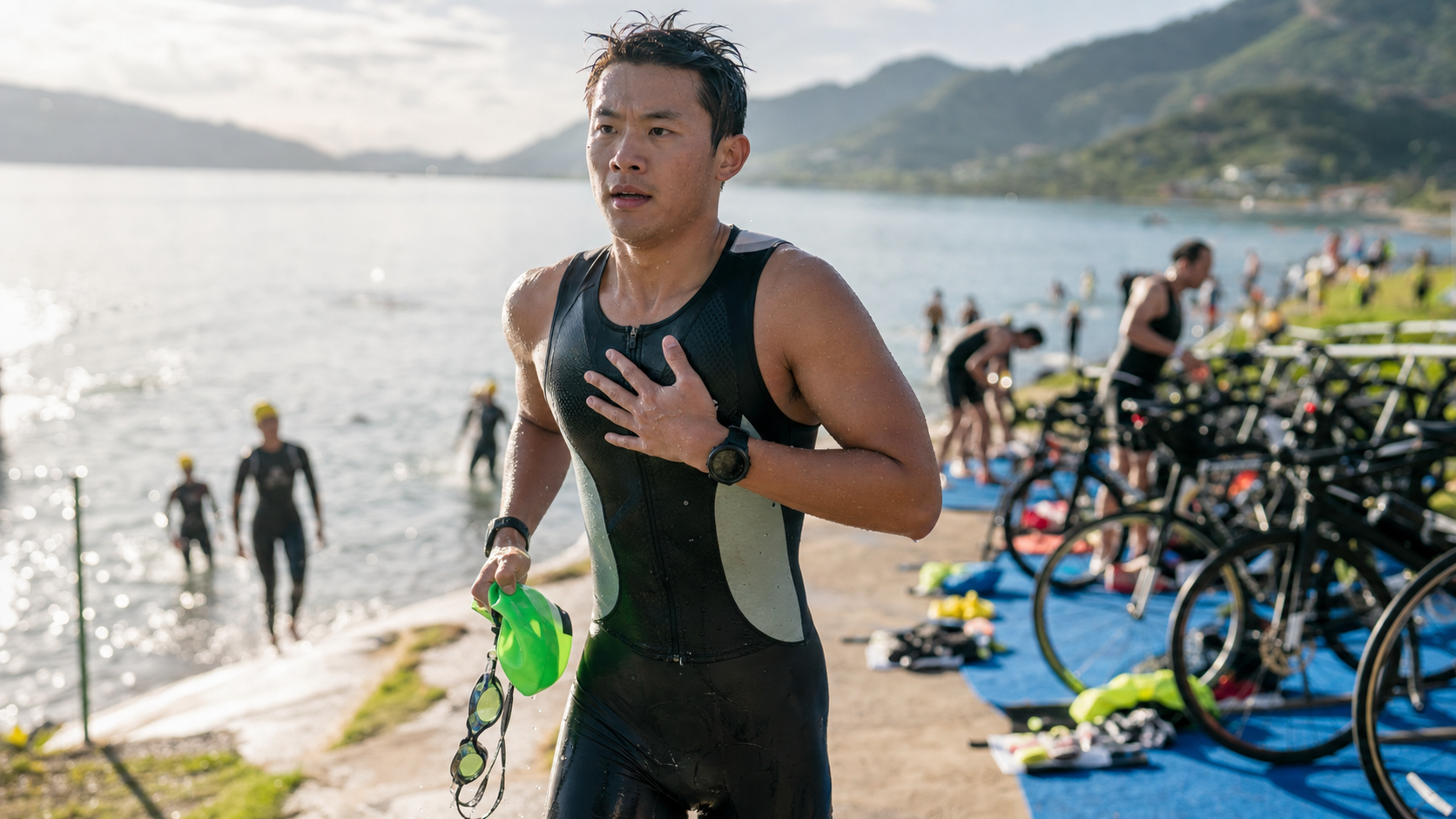
Triathlon T1 Heart Rate Recovery: Breathing Regulation After Coming Out of the Sea
The moment swimmers exit the water, most athletes have a heart rate between 170~185 bpm, nearly 90% of their maximum heart rate. If you immediately get on the bike and continue at high intensity, your heart rate will blow up in the first 5 km, and the entire race will fall apart. T1 isn’t just about changing clothes—it’s a crucial “heart rate recovery window.”
1. Why Is Heart Rate So High Coming Out of the Swim?
Multiple Factors Stacking Up
- Pre-race anxiety: Crowded mass start, getting kicked and stepped on
- Cold water stimulation: Low water temperature → sympathetic nervous system activation
- Irregular breathing rhythm: Side breathing for sighting vs. running breathing
- Anaerobic burst: The first 200 meters from the start is usually a sprint
- Goggles filling with water: Mental stress, frequent breath-holding
Actual Heart Rate Data (51.5 Age-Group Athletes)
| Stage | Heart Rate |
|---|---|
| Pre-race preparation | 90~100 bpm |
| 5 seconds before start | 110~120 bpm |
| Open water start | 165~180 bpm |
| Mid-swim (after settling) | 150~165 bpm |
| Moment of exit from water | 170~185 bpm |
| Entering transition area | 165~175 bpm |
| Before mounting the bike | 155~165 bpm |
| Steady riding | 145~155 bpm |
Heart rate must drop 15~20 bpm within T1, otherwise the bike leg will inevitably spiral out of control.
2. The Science of Breathing Regulation
Parasympathetic Nervous System Activation
- Exhale longer than inhale: Stimulates the parasympathetic nervous system
- Deep breathing: Increases lung capacity, lowers breathing rate
- Steady rhythm: Stabilizes the autonomic nervous system
4-7-8 Breathing Method (Modified Version)
Suitable for use during T1 transition:
- Inhale for 4 seconds (through the nose)
- Hold for 2 seconds (no need for 7 seconds—difficult to execute mid-race)
- Exhale for 6 seconds (through the mouth)
Repeat 4~6 times, heart rate can drop approximately 8~12 bpm.
3. Complete T1 Heart Rate Recovery Protocol
Phase 1: Exiting the Water (0~30 seconds)
Actions:
- Don’t sprint after exiting; use a “moderate run” (about 4:30/km pace)
- Pull both arms upward to tighten the tri suit (open up the chest)
- Exhale longer than inhale
Target heart rate change: 180 → 175 bpm
Phase 2: Removing the Wetsuit (30~90 seconds)
Actions:
- Remove the upper half while running
- Remove the lower half standing or sitting
- Take 2~3 deep breaths during this time
Target heart rate change: 175 → 168 bpm
Phase 3: Helmet On, Gear Organization (90~150 seconds)
Actions:
- Keep movements steady, don’t panic
- Exhale between each movement
- Mentally repeat “calm, rhythm, deep breath”
Target heart rate change: 168 → 162 bpm
Phase 4: Pushing the Bike to the Mount Line (150~180 seconds)
Actions:
- Use a steady running pace (no sprinting)
- Take 4~6 slow deep breaths
- Take a sip of water
Target heart rate change: 162 → 158 bpm
Phase 5: Mounting and Starting Out (180~210 seconds)
Actions:
- Ride the first 1 km at Z2 intensity after mounting
- Don’t immediately get into an aero position
- Drink water, adjust gear
Target heart rate change: 158 → 150 bpm (after settling)
4. Hydration and Electrolytes
Hydrate Immediately After Exiting the Water
- You’ve swallowed a lot of salt water (ocean) or chlorinated water (pool)
- Dry mouth, queasy stomach
- Immediately rinse with 200ml of plain water + swallow
Nutrition During T1
| Item | Amount | Purpose |
|---|---|---|
| Plain water | 100~200ml | Rinse mouth, hydrate |
| Salt tablet | 1 tablet | Replenish electrolytes |
| Gel | Half a pack | Replenish sugar (bike leg coming up) |
5. Posture Adjustments
Don’t Bend Over to Fasten Shoes Immediately
If you’re wearing cycling shoes (not cleat pedals), don’t bend over to put them on right after exiting the water—bending over compresses the diaphragm and can actually raise your heart rate.
Correct sequence:
- Stand tall → straighten your body
- Take 3~4 deep breaths
- Then bend over to put on shoes
Three-Point Contact Rule
When standing in the transition area, maintain “three-point contact” (both feet + one hand on the bike frame), which helps stabilize your core and lower heart rate.
6. Mental Aspects
Rehearsing the Transition
Do a mental rehearsal 1 week before the race:
- Visualize the moment you exit the water
- Visualize your breathing rhythm
- Visualize the sequence of each transition movement
- Visualize your heart rate gradually dropping
5 minutes a day—race day execution will be calmer.
Key Mantra
After exiting the water, repeat silently: “Slow, steady, deep, long”
- Slow: Don’t rush your movements
- Steady: Keep a regular pace
- Deep: Breathe deeply
- Long: Lengthen your exhale
7. Training Heart Rate Recovery Ability
Training Method A: Swim→Bike Brick
- 200m intense swim (heart rate pushed to 80% max)
- Immediately get on the bike trainer
- Time how long it takes for heart rate to return to 75% max after the swim
- Goal: Improve from 5 minutes to 90 seconds
Training Method B: Interval Swimming
- 50m × 10 reps, swimming all-out each rep
- Do 10 deep breaths between each rep
- Train the ability to “recover quickly”
Training Method C: HRV Training
- Practice diaphragmatic breathing regularly
- Use an HRV app (such as Welltory, Elite HRV) to monitor
- 5 minutes of breathing training daily
- After 4~8 weeks, heart rate variability improves and recovery speed increases
8. Special Situation Handling
Getting Kicked During Open Water Swim
- Heart rate may briefly spike to 190+
- Immediately turn over and float on your back for 5 seconds
- Take 3 deep breaths before continuing
Goggles Filling with Water
- Don’t panic
- Float on your back or grab a lifeguard
- Clean them out, take 3 deep breaths, then continue
Cramping
- Stop swimming immediately, float on your back
- Stretch the muscle
- Wait 30 seconds~1 minute
- Heart rate will come down
9. Real-World Case Studies
Case 1: 51.5 Age-Group Female Athlete
Problem: Heart rate 180+ after exiting the swim, heart rate 175 for the first 5 km of the bike, couldn’t build speed
Solution:
- Added 30 seconds of deep breathing in T1
- Used Z2 intensity for the first 2 km after mounting
- Result: Average bike heart rate dropped from 168 to 155, total time actually improved by 2 minutes
Case 2: 113 Age-Group Male Athlete
Problem: After blowing up heart rate in the swim, cramped up at 50 km into the bike leg
Solution:
- Took 1 salt tablet in T1
- Used Z2 for the first 30 km of riding
- Result: No cramping, bike leg 8 minutes faster than before
10. Summary Recommendations
- T1 isn’t just a transition—it’s a heart rate recovery window
- Keep a steady movement rhythm; don’t be influenced by surrounding athletes
- Breathing is the most effective heart rate regulation tool
- Don’t sprint in the first 1 km after mounting—it’s key to long-term stability
- This ability can be trained, but it takes 6~12 weeks
Don’t underestimate the 2 minutes of T1—it determines your performance for the next 2 hours.
Related Reading
- Recovery After the Swim in Triathlon: How to Quickly Restore Heart Rate in T1
- Rapid Cardiopulmonary Transition After a Triathlon Swim: Adjusting Breathing Rhythm from Water to Land
- 【Route Tactics】Tackling Olympic-Distance and Half-Ironman Triathlons: Power and Pace Management for Heart Rate Spikes and Posture Adjustments in the Open-Water Swim-to-Bike Transition (T1) — A Data-Driven Systematic Approach
- Optimizing Swim Exit and T1 Transition Speed in Triathlon: The Critical 120 Seconds from Water to Cycling
一起升級!海鷗盃LSD團練...JJSC Zone2招待 騎到手抖 / 公路車 / CT Yeh
1 天前
戰略) Zwift Race 如何咬在第一集團 如何評估自己要開多少推力 (請開1.5倍速看)
7 年前
JE22 百里任務體驗,心跳不能過150,三小時內有可能...? 沒有天時地利難度有多高? / 公路車 / CT Yeh
1 年前
西進武嶺 免費訓練分析服務 Intervals | 練不夠還是練過頭?你哪一種類型選手?AI模型告訴你! | 備戰神器 | 公路車 訓練 | CT Yeh
4 年前
#公路車 #Vo2Max #最大攝氧量 測驗 體驗 | 心肺測試
6 年前
CT 喇低賽) 武嶺牽車 才是王道 西進牽車四小時內秘訣 攝手位置 如何判斷 防抽筋小秘訣
7 年前
2023桃園團體繞圈賽 / 海鷗繞圈賽 | 全程空拍數據版 | 公路車 | CT Yeh
2 年前
西進武嶺 8000名單車友數據分析 PART1 | 從新手到高手數量/瓦數/推力比/FTP推力比/功率計使用率 大解析 | 公路車 | CTYeh
5 年前