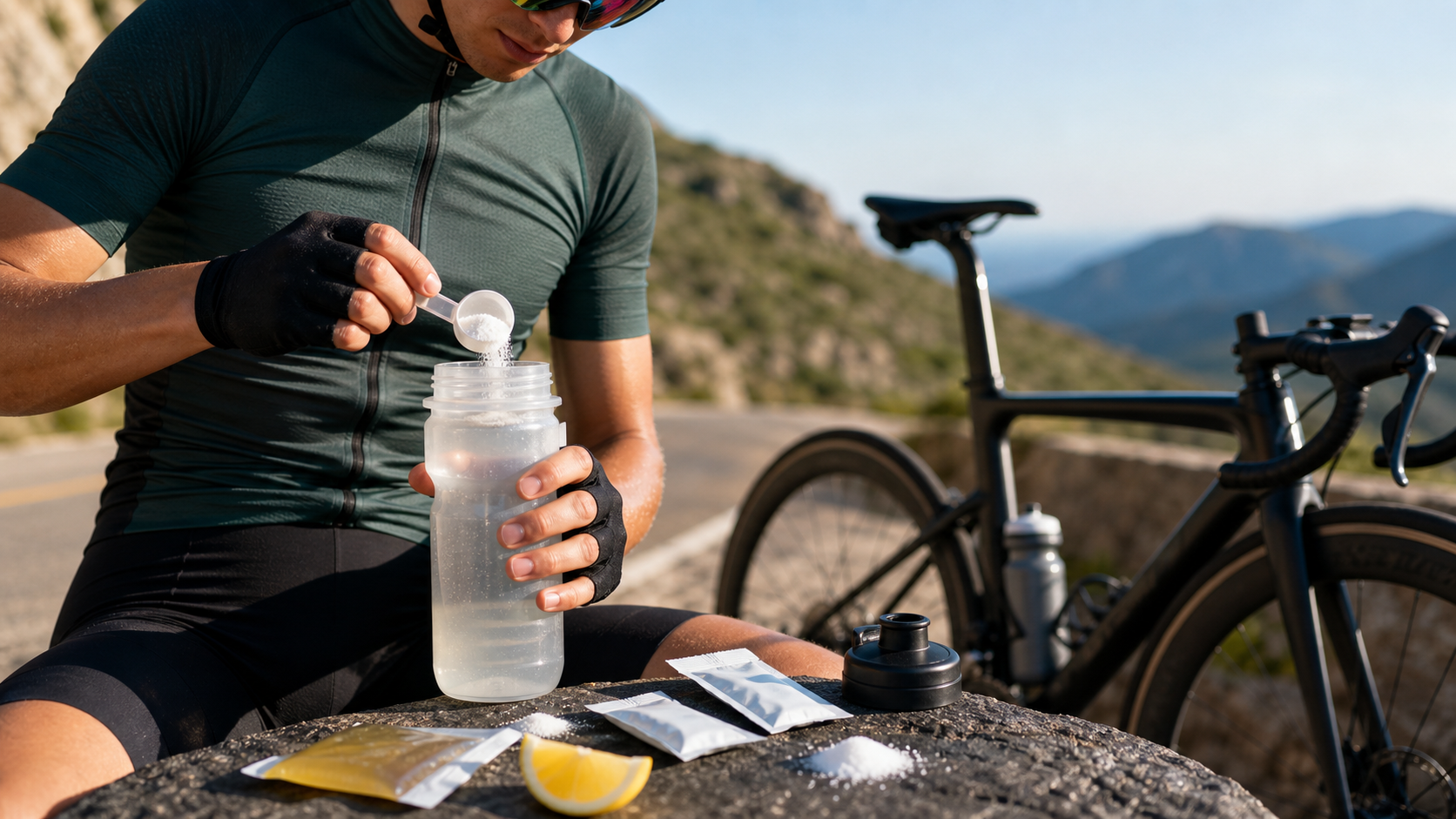
Why 90 g/hr Is the New Standard
The biggest breakthrough in sports nutrition over the past decade: dual-source carbohydrates pushed the hourly carbohydrate absorption ceiling from 60 g to 90–120 g.
Physiological principle:
- Glucose uses the SGLT1 channel, ceiling ~60 g/hr
- Fructose uses the GLUT5 channel, an independent pathway, ceiling ~30 g/hr
- Using both together = 90 g/hr total absorption
The Science of the 2:1 Ratio
Glucose:fructose = 2:1 is the ratio with the highest gastrointestinal tolerance + best absorption efficiency in research.
Example: 60 g glucose + 30 g fructose = 90 g total carbohydrates
A Specific 90 g/hr Formula (DIY Version)
Formula A: Liquid-Based (Ideal for Hot Weather)
Make 1 L of sports drink:
| Ingredient | Amount | Provides |
|---|---|---|
| Maltodextrin powder | 60 g | 60 g glucose-type |
| Fructose powder | 30 g | 30 g fructose |
| Table salt | 1.5 g | 600 mg sodium |
| Baking soda | 0.5 g | Alkaline buffer |
| Lemon juice | 30 ml | Flavor |
| Water | 1 L | Liquid |
How to drink: Finish 1 L per hour = 90 g carbohydrates + 600 mg sodium
Formula B: Solid-Liquid Mix (Ideal for Long Duration)
Per hour:
| Time | Content | Carbohydrates |
|---|---|---|
| 0:00 | 1/2 energy bar | 25 g |
| 0:20 | 250 ml sports drink (containing 30 g maltodextrin + fructose mix) | 25 g |
| 0:40 | 1 energy gel (containing maltodextrin + fructose) | 25 g |
| Plain water top-up | 250 ml | 0 g |
| Total | 75 g + salt tablet = reaching ~90 g/hr |
Formula C: Commercial Product Combination
Choose commercial products with dual-source carbohydrates:
- Maurten 320: 1 sachet = 80 g carbohydrates (ideal for a bottle)
- SiS Beta Fuel: 1 sachet = 80 g carbohydrates
- Tailwind: 1 scoop = 25 g carbohydrates
Bike-Leg Timeline (IM 226 Example, 5 Hours 20 Minutes)
| Time | Action | Cumulative Carbohydrates |
|---|---|---|
| 0:00–0:10 | Drink water after getting on the bike, no food | 0 g |
| 0:10 | Start drinking 250 ml | 22 g |
| 0:30 | 1 energy gel | 47 g |
| 0:45 | 250 ml drink | 69 g |
| 1:00 | 1/2 energy bar + water | 94 g |
| 1:20 | 250 ml drink | 116 g |
| 1:30 | 1 energy gel | 141 g |
| 1:50 | 250 ml drink | 163 g |
| 2:00 | 1/2 energy bar | 188 g |
| … | (Continue this rhythm until 5:00) | ~470 g |
5 hours 20 minutes ÷ 90 g/hr ≈ 480 g total carbohydrates (average 90 g/hr)
Hydration Pairing
90 g/hr must be paired with sufficient water to dilute the concentration:
- Drink concentration 6–9% (6–9 g carbohydrates per 100 ml)
- Additional plain water 200–300 ml/hr
- Total fluid 700–1,000 ml/hr (adjust based on temperature)
Consequences of overly high concentration: Drinks >10% will pull water back into the gut, causing diarrhea and dehydration.
Sodium Pairing
- Heavy sweaters: 600–1,000 mg/hr sodium
- Moderate sweaters: 400–600 mg/hr
- Light sweaters: 300–400 mg/hr
How to pair: sodium in drinks + salt tablets. 0–1 salt tablet per hour (each tablet about 200–400 mg sodium).
Caffeine Strategy
Introduce caffeine in the later part of the bike leg (final 90 minutes):
- Hour 4: caffeinated energy gel (50 mg)
- Hour 5: another sachet (50 mg)
- Before dismounting: 100 mg total, just enough to carry over into the run leg
Common Mistakes
Mistake 1: Using Only Glucose (Single Source)
Result: bloating and nausea once exceeding 60 g/hr.
Fix: Choose products containing maltodextrin + fructose.
Mistake 2: Concentration Too High
Result: gut osmotic imbalance, cramping, diarrhea.
Fix: Pair every 25 g of carbohydrates with at least 250 ml of water.
Mistake 3: Fueling Too Late
Start fueling as soon as you get on the bike; don’t wait until you “feel hungry.” If you’re hungry, it’s already too late.
Mistake 4: Neglecting Practice
90 g/hr isn’t something you can just eat. You must do Gut Training during training (see another article), progressing gradually over 8–12 weeks.
Adjustments for Different Body Sizes
| Body Weight | Recommended g/hr | Corresponding Fluid |
|---|---|---|
| 50–60 kg | 60–75 g/hr | 700 ml/hr |
| 60–75 kg | 75–90 g/hr | 800 ml/hr |
| 75–90 kg | 90–110 g/hr | 900 ml/hr |
| 90+ kg | 100–120 g/hr | 1,000 ml/hr |
Conclusion
The 90 g/hr dual-source carbohydrate approach on the bike leg is standard equipment in modern triathlon. A 2:1 ratio, 6–9% concentration, paired with sufficient hydration, plus 12 weeks of Gut Training, and you’ll find yourself no longer hitting the wall on the run leg.
Related Reading
- 90 or 120 Grams of Carbs Per Hour on Race Day? Interpreting the Latest Intake Limits
- Decoding Pro Riders’ 120 g/hr Carbohydrate Strategy: The Latest Sports Nutrition Science
- The High-Fueling Era of 90–120 g/hr: Glucose and Fructose Dual Pathways, Gut Training, and Who Really Needs It
- 70.3 Fueling Engineering: The Feeding Assembly Line for the 90 km Bike Leg
單車 一日北高 ( 雙城 ) 肥宅雙人瘋狂行 紀錄片 REACTO
10 年前
靠單車減肥35公斤 心得分享與整理
7 年前
一日北高前的高裝檢 | 北高 360 | 挑戰11小時的裝備 | 一日雙塔 | 補給
6 年前
西進武嶺 免費訓練分析服務 Intervals | 練不夠還是練過頭?你哪一種類型選手?AI模型告訴你! | 備戰神器 | 公路車 訓練 | CT Yeh
4 年前
車錶新黑馬? / 超狂續航 / 超好用錶冠 / 無敵準定位 / Dash圖表合成!?/ COROS DURA 評測!/ 公路車 / CT Yeh
2 年前
武嶺配速表最佳使用方式 #bike
1 年前
CT暗黑廚房) 車友必備 宇宙無敵鮮蚵湯 幫助訓練恢復 天然食補 好市多 超肥鮮蚵 破PR
7 年前
4K 東眼山 x 水蜜桃冰沙 百人單車約騎! 操完再吃冰 多爽快
7 年前