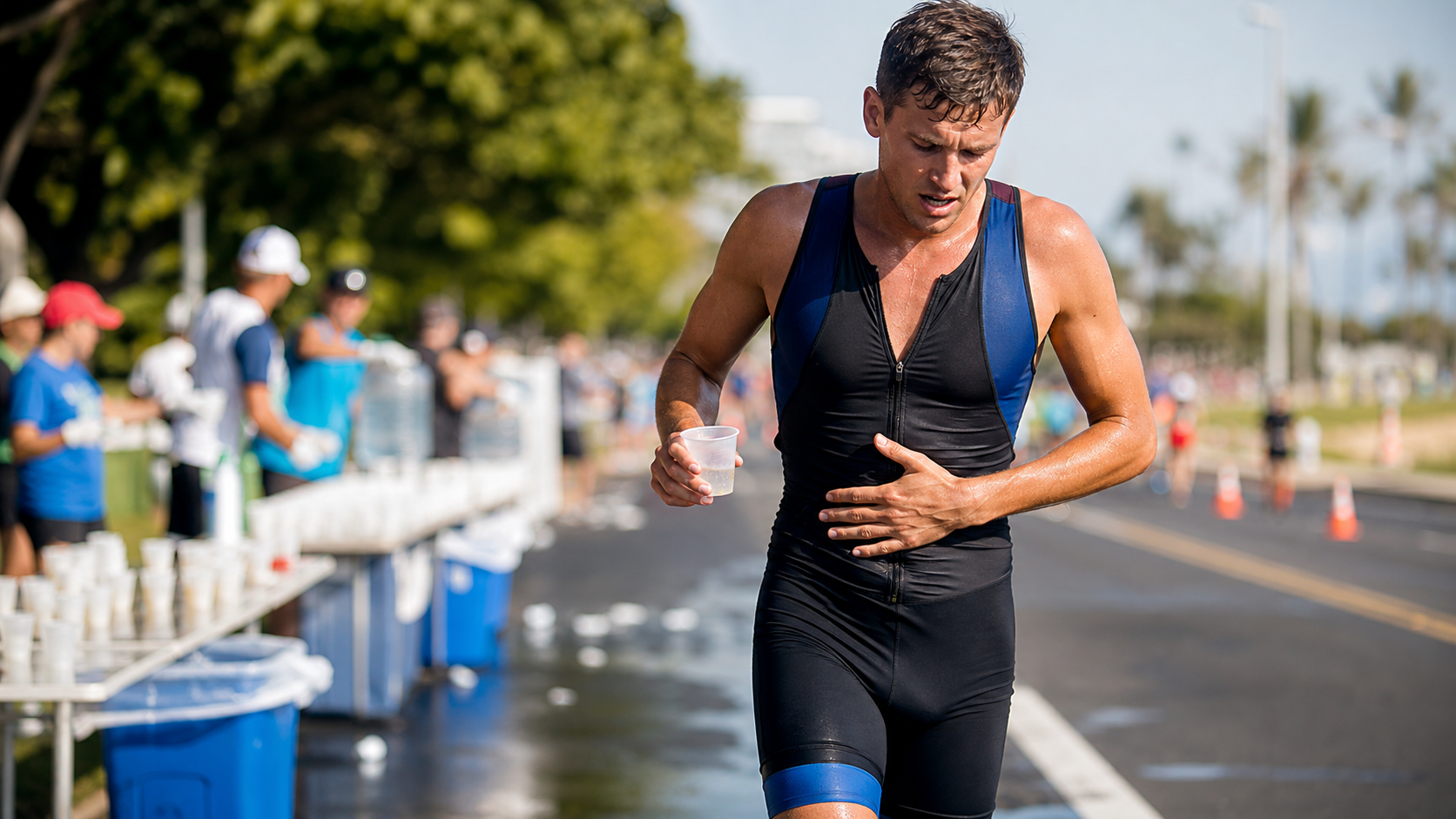
Same 60 g/hr Intake, Bike Is Fine but Run Falls Apart?
The most common collapse scenario for triathletes:
- Absorbing 80 g per hour on the Bike segment is no problem
- Nausea starts 5 km after T2
- At 10 km, the stomach feels heavy, and Bike-segment fuel is vomited out
- The rest of the half marathon is sustained by water alone
Why? Four physiological mechanisms make fueling the Run segment far harder than the Bike.
Mechanism 1: Vertical Impact
Each running step impacts the ground for about 0.15 seconds, and the body absorbs 2.5–3 times body weight in impact force. Stomach contents are jostled up and down, causing:
- Slower gastric emptying
- Weakened tension in the lower esophageal sphincter between the esophagus and stomach (increased vomiting risk)
- Disrupted intestinal motility (diarrhea risk)
Mechanism 2: Rising Core Temperature
Running dissipates heat less efficiently than cycling (cycling benefits from wind cooling). For every 1°C rise in core temperature, intestinal blood flow drops by 20%. In the latter stages of an IM marathon, core temperature can reach 39°C, and intestinal blood flow may drop to just 50% of normal.
Mechanism 3: Cumulative Dehydration
Fluid losses accumulated during the Bike segment only fully manifest in the Run segment. Dehydration causes:
- Increased blood viscosity
- Further reduction in splanchnic blood flow
- Reduced dilution of fuel (concentration passively rises)
Mechanism 4: Cumulative Fatigue
The 5–6 hours of high-intensity exercise before the run has already depleted large amounts of glycogen and produced significant lactate and metabolic waste. The gastrointestinal tract is also in a “worn out” state.
6 Fueling Strategies for the Run Segment
Strategy 1: Liquids First
Solid food is nearly impossible to digest during the Run segment. Get 80% of fuel in liquid form (energy gels, sports drinks, cola).
Strategy 2: Small Sips, High Frequency
Only drink 100–150 ml at each aid station (don’t chug 300 ml). Switch to a small sip every 1.5 km—total intake stays the same, but gastrointestinal stress drops by 50%.
Strategy 3: Dilute the Concentration
Mix energy gels with 200 ml of water. Lowering the concentration from the original 30% to 10% speeds up gastric emptying.
Strategy 4: The Cola Ace
Switch to cola in the latter part of the race (after 25 km):
- Contains caffeine (30 mg/can): boosts alertness
- Contains simple sugars (22 g/200 ml): quick energy
- Contains carbonation: helps with burping and releasing gas, reducing gastrointestinal pressure
Note: Open the cola and let some fizz escape before drinking.
Strategy 5: Lower the Total
Carbohydrate target for the Run segment is 30–60 g/hr (far less than the Bike’s 90 g/hr). Those who try to maintain Bike-level intake will mostly blow up.
Strategy 6: The Mental Switch
When you feel discomfort, pause fueling for 2 km (water only), let the gut recover, then resume. Forcing fuel down will make you throw up immediately.
Run Segment Timeline (IM Marathon, 4-Hour Target)
| km | Content | Cumulative Carbs |
|---|---|---|
| 0–2 | Plain water 100 ml, no food | 0 g |
| 4 | 1 energy gel + water 150 ml | 25 g |
| 7 | Sports drink 150 ml | 36 g |
| 10 | 1 energy gel + water | 61 g |
| 13 | 1 salt tablet + water 200 ml | 61 g |
| 16 | Sports drink 150 ml | 72 g |
| 19 | 1 energy gel (caffeine) + water | 97 g |
| 22 | Cola 150 ml | 114 g |
| 25 | Salt tablet + water | 114 g |
| 28 | Cola 150 ml | 131 g |
| 31 | 1 energy gel | 156 g |
| 34 | Cola 200 ml | 178 g |
| 37 | Salt tablet + water | 178 g |
| 40 | Cola 200 ml | 200 g |
| 42.2 | Finish | - |
Total: Carbs ~200 g (50 g/hr average), sodium ~1,000 mg, fluid ~2 L
Emergency Protocols When Things Go Wrong
Feeling Nauseous
- Stop all fuel intake
- Rinse your mouth with plain water (don’t swallow)
- Walk slowly for 200 m to let the stomach settle
- After 5 minutes, try 50 ml of cola
- If you’re fine, resume fueling
Cramping
- Walk slowly
- Massage your abdomen
- Try to use the toilet (portable toilets are nearby—don’t tough it out)
- Passing gas usually brings relief
Diarrhea
- Stop all sports drinks (high osmolality makes it worse)
- Switch to isotonic saline (plain water + a pinch of salt)
- Switch fuel to a lower concentration (half an energy gel + plenty of water)
Practice in Training
Key workouts to simulate race conditions:
Brick Training (Bike to Run)
- Once a week: ride 90 minutes → immediately run 30 minutes
- Fuel fully at Bike-level intake during the ride
- Practice continuing to fuel during the run while experiencing gastrointestinal discomfort
Race Pace Long Run
- Once every 2 weeks: run 25–30 km at race pace
- Simulate the full fueling rhythm throughout
- Test tolerance of various fuels under the impact of running
Race Day Tips
- Reduce Bike fueling 30 minutes before T2 (to lower stomach contents)
- Drink only 50 ml of water during the T2 transition—don’t stuff food down
- Run the first 5 km 10–15 sec/km slower than target pace to let the gut adapt
- Carry 2–3 salt tablets with you (aid stations may not have them)
- Bring a small towel to wipe off sweat (core temperature control)
Conclusion
Fueling the Run segment isn’t about “the more you eat, the better”—it’s about the right form and the right rhythm. Drop the target from 90 g/hr to 50 g/hr, swap solids for liquids, and replace chugging with small sips—your odds of blowing up will drop dramatically.
Related Reading
- Gastrointestinal Issues for Endurance Athletes: Solutions for Runner’s Diarrhea and Cyclist’s Bloating
- Gut Training for Running: How to Get Your Gut Used to Digesting Fuel While Running
- Ironman Triathlon Run Segment Fueling Guide: Conquering the Final 42.2 km with Nutrition
- Gastrointestinal Distress (GI Distress) While Running: Full Analysis of Causes and Prevention
約騎爆笑地獄梗 大腸怎麼了🤣 #公路車 #cycling
3 年前
靠單車減肥35公斤 心得分享與整理
7 年前
FTL 與 SYB 車隊專訪 西進武嶺 實用攻略分享! 2小時 如何練?!你不知道的眉角!新手準備武嶺必看 EP1 | 實力派女車友 | 精華版 | 公路車 | CTYeh
4 年前
CT 喇低賽) 武嶺牽車 才是王道 西進牽車四小時內秘訣 攝手位置 如何判斷 防抽筋小秘訣
7 年前
一日北高前的高裝檢 | 北高 360 | 挑戰11小時的裝備 | 一日雙塔 | 補給
6 年前
Never Stop 西進武嶺 前後雙機 完整全程錄影 訓練台 實境
8 年前
雨戰! 西進武嶺員工旅遊 加料 各路段大數據分析 | 同事端出5公斤的公路車來挑戰!? EP1
4 年前
一日北高/長距離團騎 常見問題補充篇 / 組團或跟團的眉角 / 壯車友容易被瘦車友慢性拉爆 / 原來屁股痛可能是這個原因...? / 風場配速法 / 公路車 / CT Yeh
2 年前