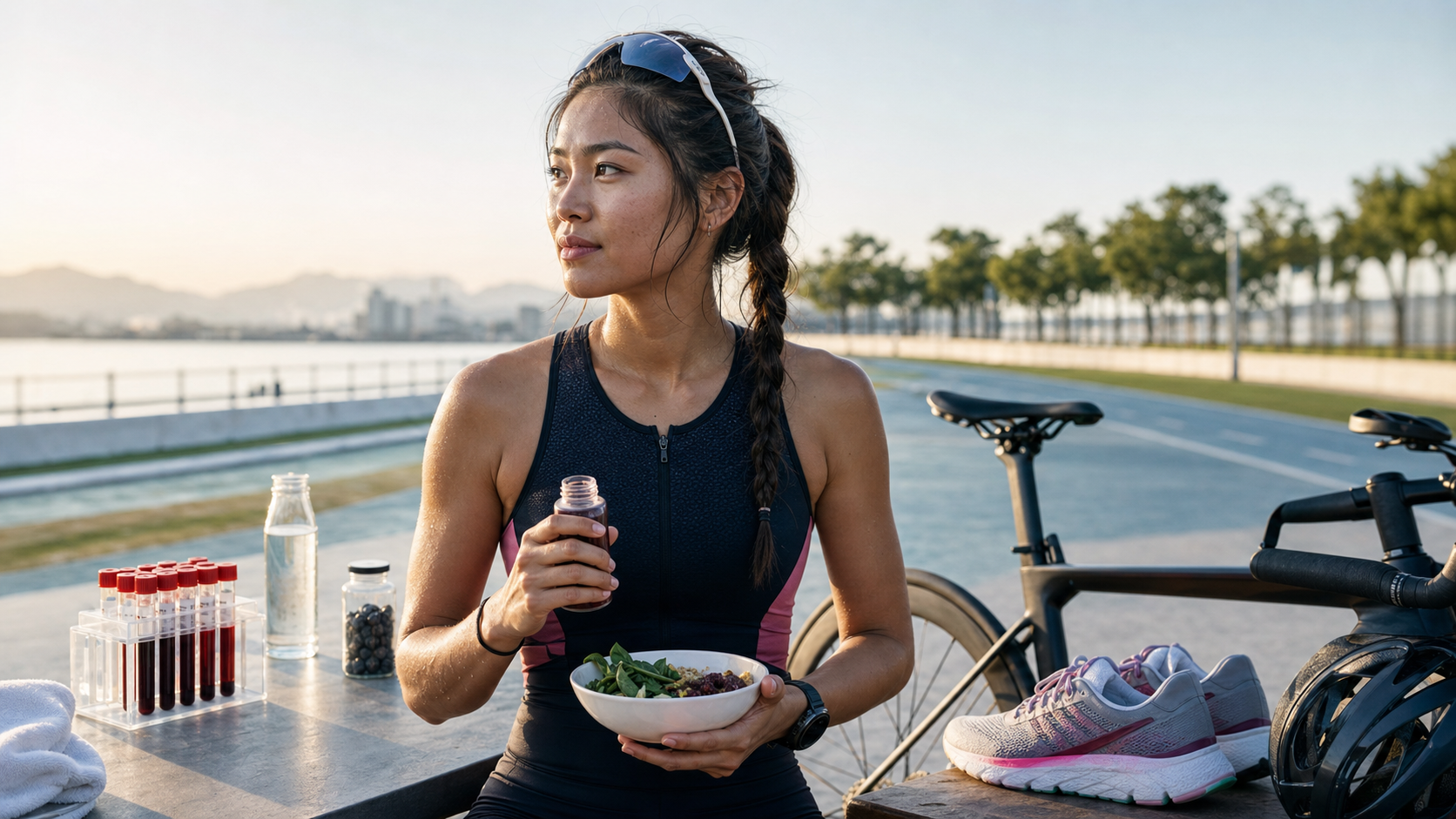
Why Are Female Triathletes Especially Prone to Iron Deficiency?
Four risk factors stack up:
- Menstrual blood loss: Each period loses 30–80 mg of iron
- Foot strike hemolysis: Red blood cells are broken apart during running
- Sweat loss: Approximately 0.5 mg of iron per liter of sweat
- Gastrointestinal micro-bleeding: High-intensity exercise causes micro-damage to the intestinal wall
Result: Up to 30–60% of female triathletes have ferritin levels <35 ng/ml (compared to 10% of the general female population).
The Three Stages of Iron Deficiency
Stage 1: Iron Depletion
- Ferritin < 35 ng/ml
- Normal hemoglobin
- Asymptomatic or mild fatigue
- Slight decline in training performance
Stage 2: Iron Deficiency Erythropoiesis
- Ferritin < 20 ng/ml
- Hemoglobin still normal but near the lower limit
- Slower recovery after training, heart rate 5–10 bpm higher than usual
- VO2max begins to decline
Stage 3: Iron Deficiency Anemia
- Ferritin < 12 ng/ml
- Hemoglobin < 12 g/dL
- Marked fatigue, dizziness, unable to maintain training intensity
- VO2max drops 10–20%
Get Blood Work Done at Least Once a Year
Key indicators:
| Indicator | General Healthy Range | Optimal Range for Triathletes |
|---|---|---|
| Ferritin | 20–200 ng/ml | >50 ng/ml |
| Hemoglobin | 12–16 g/dL | >13 g/dL |
| Transferrin saturation | 20–50% | 25–45% |
| MCV | 80–100 fL | 80–100 fL |
Note: If you experience unexplained fatigue, abnormal heart rate, or declining performance during the season, iron should be the first thing you check.
Daily Iron Requirements
| Population | Recommended mg/d |
|---|---|
| General male | 8 mg |
| General female (premenopausal) | 18 mg |
| General female (postmenopausal) | 8 mg |
| Female triathletes | 25–35 mg |
| Male triathletes | 12–18 mg |
Dietary Sources of Iron
Heme Iron (absorption rate 15–35%)
| Food | Iron content (mg/100g) |
|---|---|
| Duck blood | 30 |
| Pork liver | 11 |
| Clams | 14 |
| Oysters | 7 |
| Beef | 2.5 |
| Chicken | 1.3 |
| Salmon | 0.8 |
Non-Heme Iron (absorption rate 2–20%)
| Food | Iron content (mg/100g) |
|---|---|
| Black sesame | 24 |
| Red beans | 7 |
| Black beans | 7 |
| Spinach | 2.7 |
| Red amaranth | 12 |
| Oats | 4.7 |
| Red quinoa | 8 |
Tips to Boost Absorption
Combinations That Help
-
Pair with vitamin C: Increases absorption 3–6 times
- Example: spinach with lemon juice, beef with bell peppers
-
Animal + plant pairing: Heme iron helps absorb non-heme iron
- Example: stir-fried beef with spinach
-
Fermented foods: Reduced phytates release more iron
- Example: miso, sourdough bread
Combinations That Hinder
-
Pairing with tea or coffee: Tannins bind to iron, reducing absorption by 60%
- Avoid tea and coffee 1 hour before and after iron-rich meals
-
Pairing with calcium: Competes for absorption
- Take iron separately from milk and cheese
-
Phytates: Phytates in whole grains and nuts inhibit iron absorption
- Soaking and fermenting can reduce phytate levels
Supplement Use
When ferritin is <30 ng/ml or diet alone cannot meet the target, supplements are needed:
Common Iron Supplements
| Type | Elemental iron content | Side effects |
|---|---|---|
| Ferrous sulfate | 65 mg/tablet | Constipation, stomach discomfort |
| Ferrous bisglycinate chelate | 27 mg/tablet | Fewer side effects |
| Iron + folic acid combination | Varies | Suitable after menstruation |
Supplementation Principles
- Best absorbed on an empty stomach: But may cause stomach discomfort; can be taken after meals instead
- Take every other day: Research shows that daily vs every-other-day dosing yields similar total absorption but far fewer side effects
- Pair with vitamin C: Take with 100–200 mg of vitamin C
- Avoid calcium, coffee, and tea: Space them 2 hours apart
Strategies Around Menstruation
The Week Before Your Period
- Increase red meat intake (beef, pork liver) 2 times/week
- Increase supplement dose (e.g., from 1 tablet to 1.5 tablets)
During Your Period
- Avoid high training volume on the first day of your period
- Increase fluid intake by 500 ml/day
- Iron supplements can be paused (absorption decreases); rely on diet instead
The Week After Your Period
- Resume the normal supplement dose
- Eat more heme iron foods to replenish quickly
Iron Loss During Training
Iron Loss After a Race
An IM 226 race loses approximately:
- Sweat: 4 mg
- Foot strike hemolysis: 2–3 mg
- Gastrointestinal micro-bleeding: 1–2 mg
- Total: 7–9 mg
That is equivalent to the blood loss of one menstrual period. So make a deliberate effort to replenish iron in the week after a major race.
Hepcidin and Training Timing
Hepcidin is the hormone that regulates iron absorption. Hepcidin rises 3–6 hours after high-intensity exercise, reducing iron absorption efficiency.
So the optimal timing for iron supplements:
- On an empty stomach in the morning (before training)
- Pair with 100–200 mg of vitamin C
- Avoid taking within 3 hours after training
Conclusion
Female triathletes should treat “regular blood tests to check ferritin” as an annual health check item, and address it immediately if levels fall below 50. Training with insufficient iron yields half the results; correct supplementation can take your performance up a full level.
Related Reading
- Iron for Female Athletes: The Double Burden of Menstrual Blood Loss and Endurance Exercise
- Iron and Anemia: A Nutritional Issue Female Endurance Athletes Cannot Ignore
- Iron Deficiency and Exercise-Induced Anemia in Female Runners: You May Not Know You’re Deficient
- Anemia Risk in Female Runners: Iron Requirements and Dietary Supplementation Strategies
福隆鐵人團練隨拍
8 年前
摔車後補裝備: 好市多新款單車安全帽& Specialized Romin 北高整路屁股都不痛的坐墊 | 一千元居然有MIPS | CT Yeh | 公路車
4 年前
靠單車減肥35公斤 心得分享與整理
7 年前
西進武嶺 免費訓練分析服務 Intervals | 練不夠還是練過頭?你哪一種類型選手?AI模型告訴你! | 備戰神器 | 公路車 訓練 | CT Yeh
4 年前
FTL 與 SYB 車隊專訪 西進武嶺 實用攻略分享! 2小時 如何練?!你不知道的眉角!新手準備武嶺必看 EP1 | 實力派女車友 | 精華版 | 公路車 | CTYeh
4 年前
[防寒衣體驗] 鐵人魂 三鐵 防寒衣試穿會 於松運 深水游泳池 鯨魚池
8 年前
CT 喇低賽) 單車 比賽總是沒照片? 攝影師的觀點大公開 姿勢就是力量! 請加速1.25倍收看
7 年前
CT Talk) 數據面窺看 武嶺大神們 平時的備戰 共通點 (娛樂性質XD)
7 年前