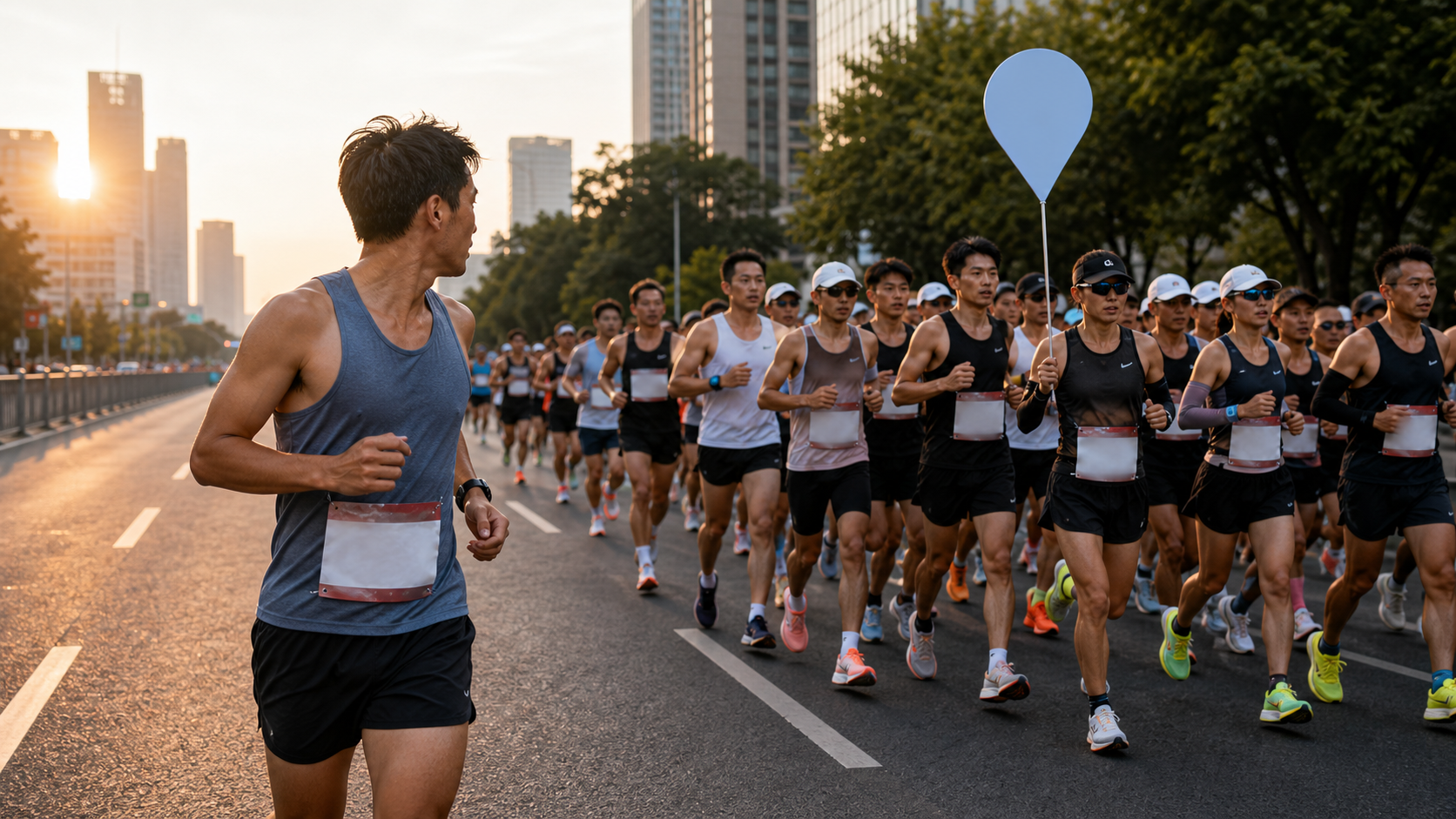
What is a Pacer Group
Large marathons typically offer Pacer Groups: led by experienced runners holding signs marked with target times like “3:00,” “3:30,” “4:00,” etc. Other runners can follow along, saving the mental effort of managing their own pace.
Advantages of Pacer Groups
Advantage 1: Saves Mental Energy
No need to check your watch every kilometer or calculate your progress. The pacer group leader adjusts the pace, and runners just need to follow.
Advantage 2: Wind Blocking
Pacer groups usually have 20-100 people, and the group effect can reduce wind resistance by 4-7%. This is especially useful when running into a headwind.
Advantage 3: Psychological Support
The sense of group reduces loneliness and self-doubt. When fatigue sets in late in the race, the atmosphere of “just 5K more, we’re all in this together” can delay thoughts of giving up.
Advantage 4: Steady Rhythm
A good pacer can maintain an even pace of ±3 seconds/km. This is more consistent than what amateur runners can achieve on their own.
Disadvantages of Pacer Groups
Disadvantage 1: Pacer Groups Usually “Make Up Time” in the First 1-2K
To absorb the congestion at the start, pacer groups often run the first 2K 5-10 seconds/km faster than the target pace. This can work against cautious runners.
Disadvantage 2: Crowded
Large pacer groups may have 50-100 people. At aid stations you might not get water, and you may get jostled at turns.
Disadvantage 3: The Pacer Might Blow Up on Race Day
Pacers are human too. If they’re not feeling well on the day, their pace may collapse in the later stages, taking the whole group down with them.
Disadvantage 4: Inflexible Pacing on Terrain
Pacer groups typically run on “average pace” and won’t slow down on uphills. This can feel restrictive for runners who are sensitive to terrain.
Disadvantage 5: Aid Station Rhythm is Dictated
Pacer groups may not stop or slow down at aid stations. If you need to slow down to refuel, you’ll fall behind and get dropped.
Should You Follow a Group: A Decision Framework
Condition A: Following the Group is Better
- First time running this distance
- Not confident in your own pace control
- The course is mostly flat
- Weather is stable
- Your goal exactly matches the pacer group’s target (not “my goal is 3:32, I’ll follow the 3:30 group”)
Condition B: Running Solo is Better
- You already have multiple experiences at this distance
- The course terrain is complex (hilly, many city turns)
- Extreme weather (high heat, strong winds)
- Your target time isn’t among the pacer group options (e.g., target 3:25)
- You’re used to running by heart rate rather than pace
Half-Following Strategy
Recommended for advanced runners:
Phase 1: 0-10K Follow the Group
Use the pacer group for wind blocking and start control, easing into your rhythm without extra mental load.
Phase 2: 10-30K Assess the Situation
If the pacer group’s pace matches your plan, keep following. If the group is running faster/slower than planned, politely break away and execute your own pacing.
Phase 3: After 30K Go Independent
Everyone hits their breaking point at different stages in the later miles. Don’t be dragged down by the pacer group, and don’t drag others down either. Run your own race, pacing by your own heart rate.
Homework Before Joining a Group
If you decide to join a group:
-
Get to know the pacers: You can meet them at the “Pacer Meet & Greet” the night before the race. Ask about their strategy:
- Even pace or negative splits?
- Maintain pace on uphills or slow down?
- Do they slow down at aid stations?
-
Check the pacer’s gear: Good pacers will have clear signs, distinct colored hats, and hand signals at the start.
-
Familiarize yourself with the course: Know where you might get separated from the group (aid stations, sharp turns, uphills).
Pacer Group Options for Different Target Times
Typical pacer groups at major Taiwanese races:
- 3:00 (elite amateur)
- 3:15
- 3:30
- 3:45
- 4:00
- 4:15
- 4:30
- 5:00
- 6:00 (recreational)
If your target falls between two groups (e.g., 3:25), you have two options:
Option A: Follow the 3:30 group, use their rhythm for the first 25K, then speed up 5 seconds/km on your own in the later stages.
Option B: Follow the 3:15 group for the first 10K to ride their momentum, then break away and run on your own.
Option A is recommended as the safer choice.
Pacer Group Culture Abroad
At major overseas races (Tokyo, New York, Boston), pacer groups are typically more professional:
- Multilingual pacers
- Dynamic adjustments (based on wind, temperature)
- Both “negative split” and “even pace” versions offered
The quality of pacer groups at Taiwanese races varies, so it’s best to research in advance.
Conclusion
Pacer groups are not a magic bullet. For those who fit well, joining the right group is a PB tool; for those who don’t, joining the wrong group is a main cause of blowing up. The core decision comes down to: whether your goal, your control ability, and the course conditions all match the pacer group.
Related Reading
- Running Community Psychology: The Psychological Support of Pacer-Runner Interaction
- Road Race Pacer Group Culture: The Sense of Achievement and Community Connection in Leading Runners
- Pacer Following Technique: How to Stay with a Pacer Most Efficiently
- Road Race Pacer Following Skills: How to Use a Pacer to Achieve Your Goal
一日北高/長距離團騎 常見問題補充篇 / 組團或跟團的眉角 / 壯車友容易被瘦車友慢性拉爆 / 原來屁股痛可能是這個原因...? / 風場配速法 / 公路車 / CT Yeh
2 年前
Live) 備戰2019彰化經典百K 賽前攻略 (已完賽請看新影片
7 年前
西進武嶺配速器 3.0更新 / NEW 免功率FTP估算! / 大數據xAI體能模型 / 如何模擬人止關前集團效應 / 配速儲存功能 / AI全台自行車賽事行事曆 / 公路車 / CT Yeh
1 年前
西進武嶺 自製新版AI配速表產生器 x 賽前攻略 抱佛腳! 沒有功率計也可以產生配速表嗎?有什麼其他眉角賽前要注意的呢? | 西進武嶺 / 東進武嶺 KOM 攻略 | 公路車 | CT Yeh
4 年前
2019 柯P 超越北高 第一集團實錄 (11小時實錄請參考另一部影片) 一日雙城 一日北高 NeverStop Taiwan Long Distance Cycling Challenge
7 年前
團練) 4K NEKO 雙崎部落 間歇 狂拉 爽飛天 19/05/11
7 年前
福隆鐵人團練隨拍
8 年前
#公路車 #Fitting 靠人工智慧APP 幫你調整單車
6 年前