Ultramarathon Fueling Calculation: Personalized Settings for Carbohydrate Grams per Hour and Fluid Intake
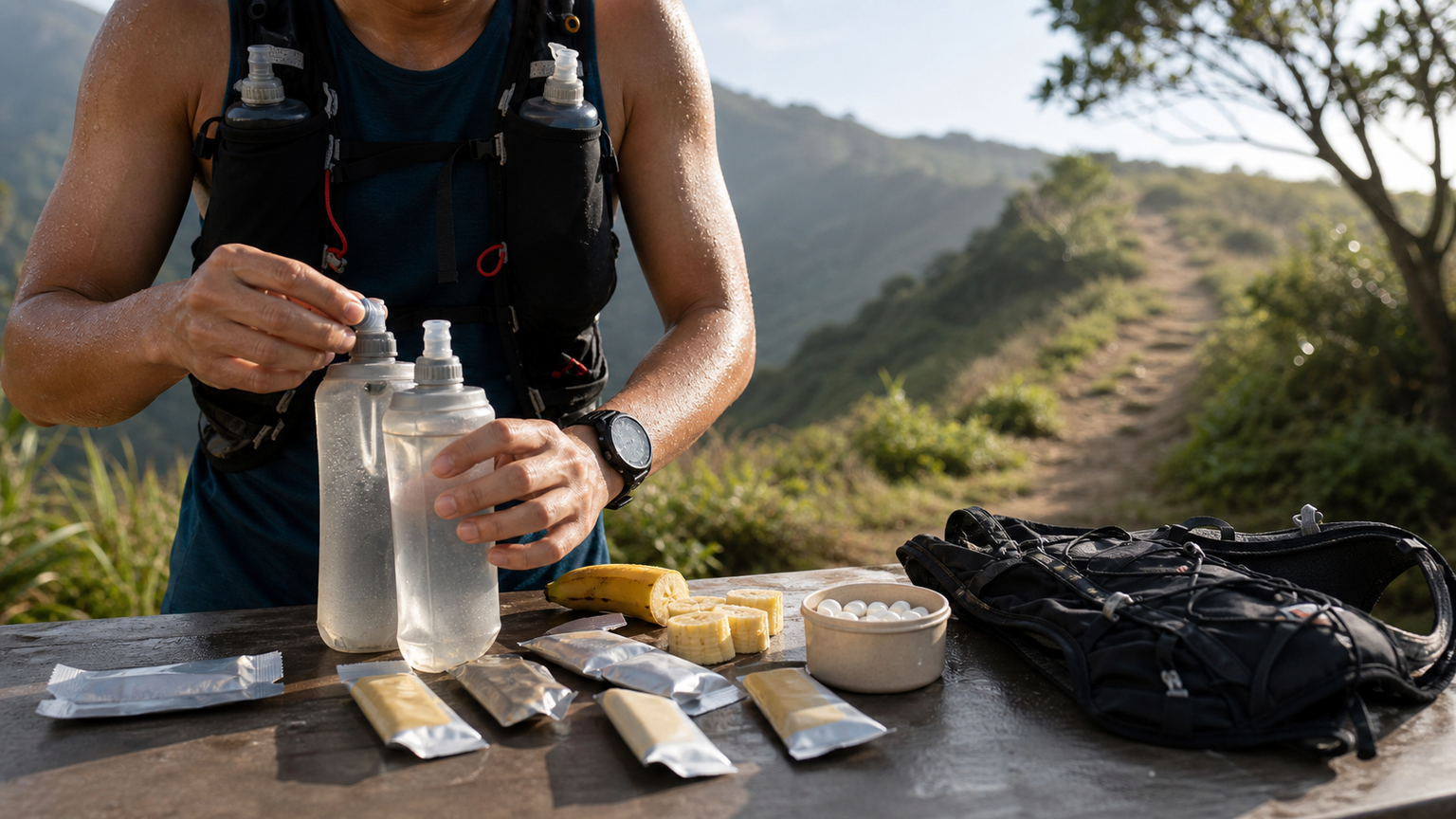
Ultramarathon Fueling Calculation: Personalized Hourly Carbohydrate Grams and Fluid Intake Settings
Introduction
“How much should I eat per hour?” This is the most common question from ultramarathon beginners, and also the hardest to give a one-size-fits-all answer to. Fueling amounts are influenced by multiple factors including body weight, pace, temperature, personal metabolic rate, and gut tolerance. Too little fuel leads to bonking; too much fuel causes gastrointestinal distress, or even hyponatremia. This article will teach you how to build your own fueling calculation framework.
1. The Basics of Carbohydrate Needs Calculation
The Role of Carbohydrates
At ultramarathon intensity (typically 50–70% of VO2max), carbohydrates and fat provide energy simultaneously. The higher the intensity, the greater the proportion of carbohydrates. In long-distance events, maintaining blood glucose stability is key to avoiding a bonk.
Estimating Individual Hourly Carbohydrate Needs
| Body Weight (kg) | Pace (min/km) | Estimated Hourly Carbohydrate Needs (g) |
|---|---|---|
| 55 | 7:00 | 45–55 |
| 65 | 7:30 | 50–60 |
| 75 | 8:00 | 55–65 |
| 85 | 8:30 | 60–70 |
Note: The above are general estimates; altitude, temperature, and individual metabolic rate can cause a ±20% difference.
Multiple Transportable Carbohydrate Strategy (Important)
Modern sports science has found that when consuming glucose (maltodextrin) and fructose simultaneously, the gut can activate dual absorption pathways (SGLT1 + GLUT5), raising the hourly ceiling from 60g to 90g or even 120g.
- Recommended glucose-to-fructose ratio = 2:1
- Common combinations: sports drink (glucose) + banana (fructose); energy gel (maltodextrin) + fruit juice
2. Personalized Fluid Intake Calculation
Sweat Rate Testing Method
The most accurate approach is to measure body weight differences before and after training:
Formula: Hourly Sweat Rate (mL) = (Pre-training Body Weight − Post-training Body Weight) × 1000 ÷ Training Duration (hours)
Example: A 65kg runner weighs 62.5kg after running for 2 hours. Hourly sweat rate = (65−62.5)×1000÷2 = 1,250 mL/hr
Hydration Goal Setting
- Basic principle: Replace 70–80% of sweat loss (no need to fully replace)
- Taiwan summer ultramarathons (temperatures above 30°C): 500–800 mL per hour
- Cool autumn/winter events (temperatures below 15°C): 300–500 mL per hour
- Never exceed 1,000 mL per hour (risk of overhydration)
The Reliability of Thirst
Research shows that at reasonable intensities (not extreme heat), drinking guided by thirst is a safe and effective strategy. Over-relying on a hydration plan while ignoring thirst may actually increase the risk of hyponatremia.
3. Steps to Build Your Personal Fueling Plan
- Measure resting metabolic rate (optional): Estimate basal metabolism using respiratory analysis or the Harris-Benedict formula
- Perform 2–3 sweat rate tests: Measure under different temperature conditions and take the average
- Undertake 6–8 weeks of gut training: Gradually test your maximum hourly carbohydrate tolerance
- Develop a segmented fueling plan: Set different strategies for the early (0–50km), middle (50–80km), and late (80km+) stages
- Prepare a backup plan: A contingency for switching to liquid nutrition if you cannot eat
4. Quick Reference: Carbohydrate Content of Common Taiwanese Fueling Foods
- Banana (1 piece, approx. 120g): 27g carbs
- White rice ball (small, approx. 80g): 35g carbs
- Energy gel (1 packet): 20–25g carbs
- Sports drink (500mL): 30–35g carbs
- Soda crackers (5 pieces): 20g carbs
- Watermelon (2 slices, approx. 200g): 15g carbs
5. Practical Tips
- Create a fueling schedule before the race, marking the food and fluid amounts to consume every 30 minutes
- Set watch or phone reminders to avoid the dangerous state of “running and forgetting to eat”
- If your gut is doing well, stick to the plan; if discomfort occurs, reduce by 25% and observe for 30 minutes
- Write a post-race fueling review to adjust your plan for the next event
Conclusion
There is no perfect fueling formula, only the fueling system that works best for you. Through systematic testing and record-keeping, you will gradually find your optimal fueling rhythm. Remember, ultramarathon fueling is not an improvisation on race day—it is part of your training plan. Start calculating and testing from today.
Related Reading
- Ultramarathon Fueling Strategies: How to Actually Eat 60–90g of Carbs Per Hour Without Wrecking Your Stomach?
- Nutrition for Ultra-Distance Events: Hourly Energy Calculation
- Pre-Race Carbohydrate Loading for Ultramarathons: How to Properly Execute 48-Hour Carb Supercompensation
- Complete 100K Ultramarathon Fueling Rhythm Plan: The Scientific Formula for Hourly Calories, Sodium, and Solid-Liquid Switching
CT暗黑廚房) 車友必備 宇宙無敵鮮蚵湯 幫助訓練恢復 天然食補 好市多 超肥鮮蚵 破PR
7 年前
西進武嶺 免費訓練分析服務 Intervals | 練不夠還是練過頭?你哪一種類型選手?AI模型告訴你! | 備戰神器 | 公路車 訓練 | CT Yeh
4 年前
一日北高前的高裝檢 | 北高 360 | 挑戰11小時的裝備 | 一日雙塔 | 補給
6 年前
靠單車減肥35公斤 心得分享與整理
7 年前
#公路車 #Vo2Max #最大攝氧量 測驗 體驗 | 心肺測試
6 年前
#公路車 #Fitting 靠人工智慧APP 幫你調整單車
6 年前
西進武嶺各路段 前8000名 大數據分析 配速攻略/功率/心律/推力比/維持率/踏頻/踏瓦比/牽車率 大公開 | 建大盃 NeverStop 可參考 | 公路車 | CT Yeh
5 年前
2016/4/20 - 中社路 夜騎 半年甩肉14KG 後測
10 年前