Ultramarathon Late-Stage Energy Management: Carbohydrate-First Replenishment Strategy After 80 Kilometers
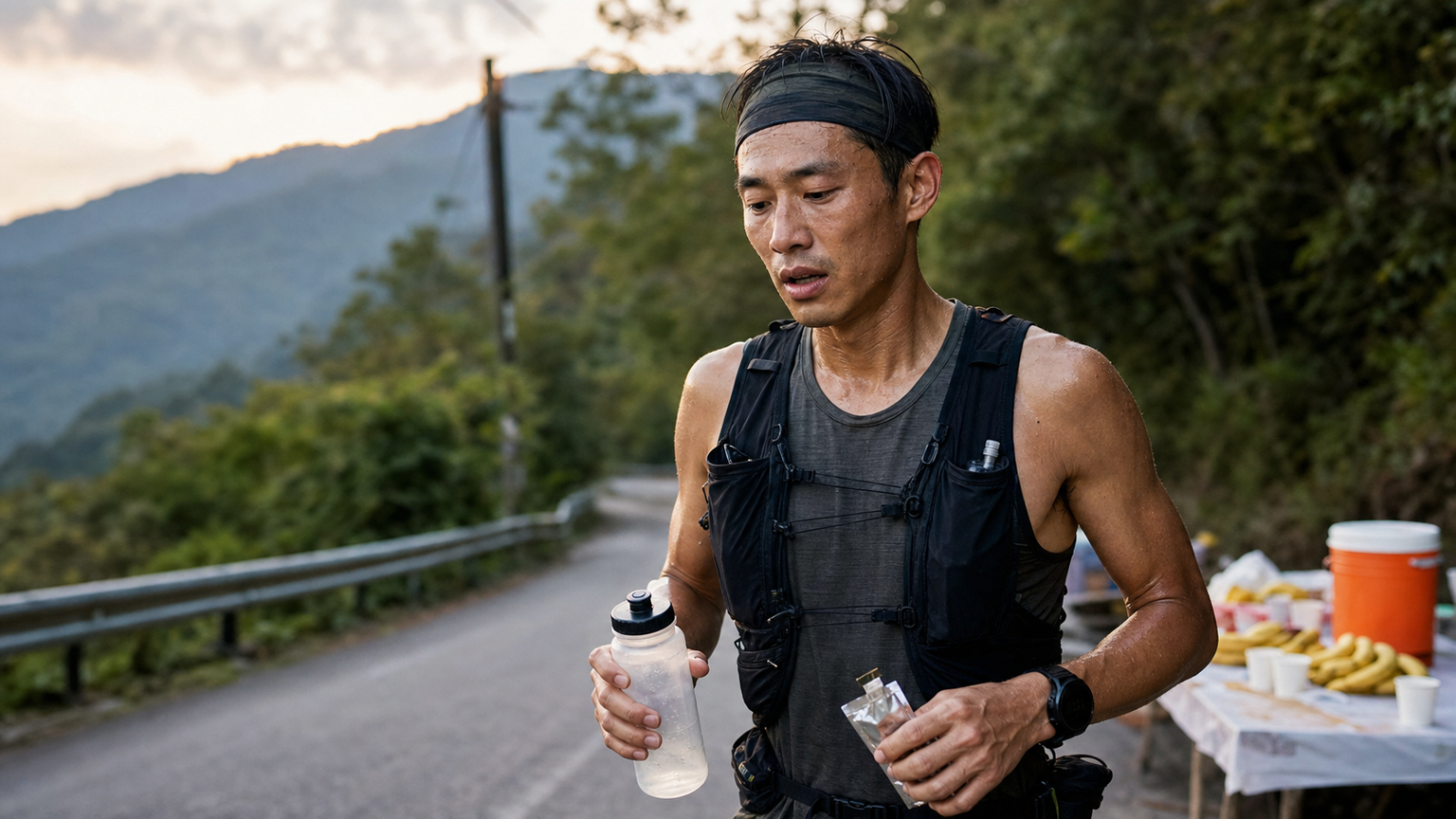
Carbohydrate-First Strategy for the Late Stages of an Ultramarathon: Fueling Priorities After 80 km
Introduction
The late stages of an ultramarathon (beyond 80 km) represent a unique physiological state. Glycogen stores are nearly depleted, muscle fatigue has accumulated, gut tolerance has declined, and there is still a considerable distance to the finish line. Many runners “hit the wall” at this stage—pace drops suddenly, brain fog sets in, legs feel like lead, and doubts about finishing begin to creep in. This is not a matter of willpower, but of energy system management. The carbohydrate strategy for the late stages requires a fundamentally different mindset from the earlier portion of the race.
1. The Physiological Reality After 80 km
What happens to the body in the late stages of an ultramarathon?
- Glycogen nearly depleted: Even with good fueling early on, after 80 km, muscle and liver glycogen stores are significantly reduced
- Fat oxidation becomes the primary fuel: Muscles rely more on fat for energy, but fat metabolism has a limited rate and cannot support higher intensities
- Reduced gut blood flow worsens: With prolonged time and accumulated fatigue, digestive capacity further declines
- Insulin sensitivity changes: After prolonged exercise, muscle glucose uptake becomes more erratic
- Central fatigue accumulates: Glucose supply to the brain becomes unstable, and cognitive function begins to deteriorate
2. Carbohydrate Priority Order in the Late Stages
When gut tolerance declines, not all carbohydrates can be effectively absorbed. Selection should follow a priority order:
| Priority | Carbohydrate Source | Reason | Recommended Amount Per Hour |
|---|---|---|---|
| 1st Priority | Liquid carbohydrates (sports drinks, diluted juice) | Fast gastric emptying, minimal gut burden | 30–45 g |
| 2nd Priority | Gels / energy gels | Highly concentrated, easy to carry, rapid absorption | 15–25 g |
| 3rd Priority | Banana (half) | Whole food, contains potassium, well tolerated by the gut | 13 g |
| 4th Priority | White rice (small amounts) | Psychological satisfaction, low fiber, but requires stopping at aid stations to eat | Depends on tolerance |
| Last Choice | Energy bars, solid sweets | Take longer to digest, not recommended in large amounts late in the race | Minimize |
3. Key Principles for Preventing Energy Crashes
1. Don’t Wait Until You’re Hungry to Eat
In the late stages, hunger often appears only after an energy crash, not before. Establish a timed fueling routine (every 20–30 minutes), and eat even if you don’t feel hungry.
2. Reduce Portion Size, Increase Frequency
- Early stages: larger portions, longer intervals
- Late stages: smaller portions, shorter intervals
- Aim for 15–20 g of carbohydrates per intake, every 20 minutes, rather than one large bolus per hour
3. Prioritize Liquid Carbohydrates Over Solids
When the gut starts to feel uncomfortable, liquid fueling is absorbed far more efficiently than solid food. Even if you can only manage sports drinks, it’s far better than no fueling at all.
4. Emergency Response to a Blood Sugar Crash
- If you feel dizzy, weak, or confused, immediately consume 25–35 g of fast-acting carbohydrates (cola, sugar water, energy gel)
- Wait 10–15 minutes for blood sugar to recover
- Once recovered, follow up with slow-release carbohydrates (banana, rice)
4. The Psychological Aspect of Late-Stage Fueling
Fueling in the late stages of an ultramarathon is not just a physiological need—it’s also psychological support. Warm food at aid stations and familiar flavors can give runners the motivation to keep going. Recommendations:
- Before the race, plan the food you “most want to eat” at the 80 km aid station as a psychological incentive goal
- Even if your gut is uncomfortable, still try to consume “comfort foods” (even just one bite of rice)
- Interact with aid station volunteers; brief social stimulation can help combat central fatigue
5. Simulating Late-Stage Energy Management in Training
- Schedule 1–2 “depleted training” sessions: perform an intense workout to partially deplete glycogen, then do a long run the next day in a similar fatigued state, practicing eating under fatigue
- In the final 2 hours of long runs, deliberately practice the liquid-first strategy
- Record your energy sensations during the late stages of each long run to build a personal late-stage fueling profile
Conclusion
Energy management in the late stages of an ultramarathon is both an art and a science. Master the logic of carbohydrate-first fueling, simulate late-stage conditions in training, and you will no longer fear the road beyond 80 km—that is the moment when your carefully prepared energy system begins to do its work.
Related Reading
- Ultramarathon Fueling Strategies: Energy and Electrolyte Rhythm from 50K to 100K
- Pre-Race Carbohydrate Loading for Ultramarathons: How to Properly Execute the 48-Hour Carb Supercompensation
- Post-Ultramarathon Recovery Nutrition: A Phased Diet Strategy for the 72 Hours After Finishing
- Ultramarathon Nutrition Strategies: An Energy Plan for 24-Hour Races
西進武嶺 免費訓練分析服務 Intervals | 練不夠還是練過頭?你哪一種類型選手?AI模型告訴你! | 備戰神器 | 公路車 訓練 | CT Yeh
4 年前
CT暗黑廚房) 車友必備 宇宙無敵鮮蚵湯 幫助訓練恢復 天然食補 好市多 超肥鮮蚵 破PR
7 年前
FTL 與 SYB 車隊專訪 西進武嶺 實用攻略分享! 2小時 如何練?!你不知道的眉角!新手準備武嶺必看 EP1 | 實力派女車友 | 精華版 | 公路車 | CTYeh
4 年前
#公路車 #Vo2Max #最大攝氧量 測驗 體驗 | 心肺測試
6 年前
CT 喇低賽) 武嶺牽車 才是王道 西進牽車四小時內秘訣 攝手位置 如何判斷 防抽筋小秘訣
7 年前
Live) 備戰2019彰化經典百K 賽前攻略 (已完賽請看新影片
7 年前
靠單車減肥35公斤 心得分享與整理
7 年前
西進武嶺 自製新版AI配速表產生器 x 賽前攻略 抱佛腳! 沒有功率計也可以產生配速表嗎?有什麼其他眉角賽前要注意的呢? | 西進武嶺 / 東進武嶺 KOM 攻略 | 公路車 | CT Yeh
4 年前