Introduction
Many cycling enthusiasts believe that pedaling itself is sufficient leg training, yet they often overlook a harsh reality: cycling is a low-impact, closed kinetic chain exercise. While it maintains cardiovascular fitness, it provides quite limited stimulation to the upper body, core, and hip musculature. For riders over 60, if they only cycle without strength training, the risk of sarcopenia remains high.
Definition and Impact of Sarcopenia
Sarcopenia refers to the syndrome of age-related loss of skeletal muscle mass, strength, and function. In Taiwan, the prevalence of sarcopenia among those aged 65 and older is approximately 3 to 7%. When including those with low muscle mass in the “pre-sarcopenia” stage, the rate exceeds 20%.
Specific impacts on cyclists include:
- Decreased pedaling power on climbs, with reduced ability to handle gradients
- Upper body and core weakness leading to worsened back pain after long rides
- Reduced balance, increasing risk during low-speed turns or on uneven surfaces
- Accelerated bone loss, raising the likelihood of fractures after falls
Principles for Choosing Strength Training for Older Cyclists
| Training Type | Recommended | Not Recommended |
|---|---|---|
| Movement Patterns | Multi-joint compound movements | Primarily single-joint isolation movements |
| Loading Method | Body weight, resistance bands, dumbbells, kettlebells | Heavy barbells (high joint stress) |
| Tempo | 2 seconds concentric, 3 to 4 seconds eccentric | Explosive fast movements (during the initial learning phase) |
| Frequency | Twice weekly, with at least 48 hours between sessions | More than 3 times per week (insufficient recovery) |
Designing the Twice-Weekly Strength Training Routine
Workout A (Lower Body Push Focus)
- Hip Bridge: 3 sets × 15 reps, strengthens the gluteus maximus and erector spinae
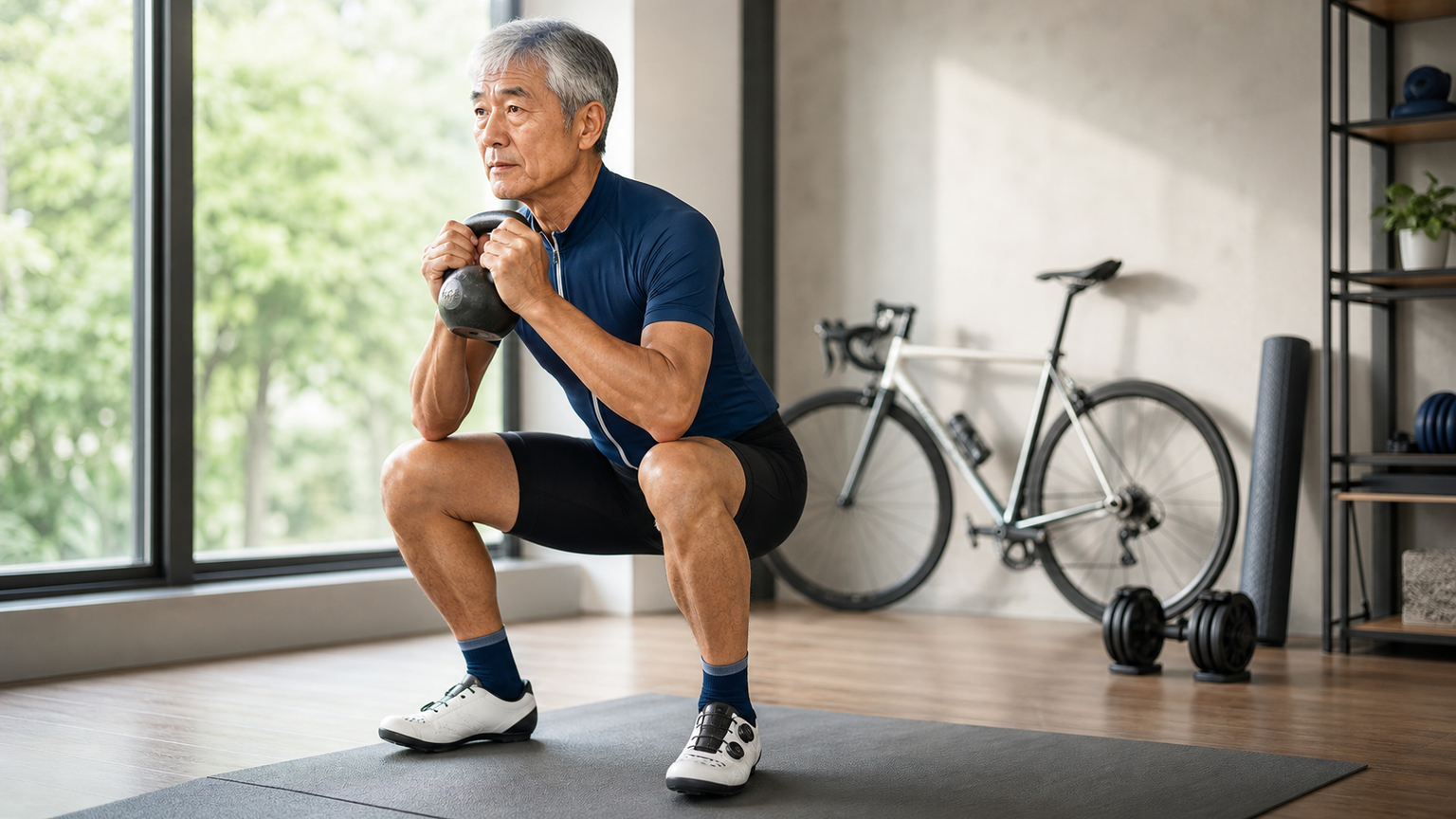
- Goblet Squat: 3 sets × 10 to 12 reps, with 5 to 12 kg of load
- Single Leg Stand: 30 seconds per side × 3 sets, trains balance
- Resistance Band Lateral Walks: 20 steps per side × 3 sets, strengthens hip abductors
- Push-ups (kneeling variation allowed): 3 sets × 8 to 12 reps, strengthens the upper chest and shoulders
Workout B (Lower Body Pull and Core Focus)
- Romanian Deadlift (Dumbbell): 3 sets × 10 reps, targets the posterior chain (hamstrings, glutes)
- Reverse Lunge: 3 sets × 8 reps per side, increases single-leg stability
- Seated Row (Resistance Band): 3 sets × 12 reps, strengthens the upper back and rhomboids
- Plank: 3 sets × 20 to 40 seconds, strengthens the core
- Side Plank: 2 sets × 20 seconds per side, strengthens the lateral core and gluteus medius
The Importance of Progressive Overload
Older athletes have slower neuromuscular adaptation rates, but the potential for adaptation still exists. It is recommended to progress gradually with the following steps:
- Weeks 1 to 2: Familiarize yourself with movement patterns using body weight, 10 to 12 reps per set
- Weeks 3 to 4: Add light external load (resistance bands or 2 to 5 kg dumbbells)
- Weeks 5 to 8: Increase load by 5 to 10% every 2 weeks, or add 1 to 2 reps
- Every 8 to 12 weeks, schedule a deload week, reducing total volume by 30%
The Synergistic Effect of Protein Supplementation
Strength training stimulates protein synthesis, but older adults have higher anabolic resistance, requiring more protein to achieve the same effect. Sports medicine in Taiwan recommends that older athletes consume 1.2 to 1.6 grams of protein per kilogram of body weight daily, distributed across three to four meals, avoiding a large single intake.
- Consume 20 to 30 grams of high-quality protein (eggs, soy milk, whey protein) within 30 minutes after training
- Consuming casein-rich foods before bed (low-fat milk, cottage cheese) aids overnight muscle repair
Practical Recommendations
- Beginners to strength training are advised to first consult a physical therapist or exercise physiologist for a Functional Movement Screen (FMS)
- If you have degenerative knee osteoarthritis, limit squat depth to thighs parallel to the ground or higher; do not force deep squats
- Scheduling strength training and cycling: cycle 4 to 6 hours after strength training, or separate cycling days from strength training days
- Record the weight and sets of each training session; visualizing progress can boost long-term motivation
Conclusion
Sarcopenia is not an inevitable fate, but a trend that can be changed through action. For older cyclists, two targeted strength training sessions per week are not a burden, but an insurance policy that allows you to continue enjoying cycling. More powerful pedaling, a more stable core, and safer joints—these are the tangible rewards that can be gained from just two hours of strength training.
Related Reading
- The Loss That Cycling Alone Can’t Stop: Why Masters Endurance Athletes Must Lift Weights, A Complete Guide to Preventing Sarcopenia
- Strength Training for Older (50+) Endurance Athletes: Preventing Sarcopenia
- Exercise and Sarcopenia: A Complete Coach’s Guide to Combating Muscle Loss
- Balance and Coordination for Older Cyclists: Core Training Programs to Prevent Falls
滑雪新手們慘摔學習全紀錄(請開字幕),滑雪好好玩 | Snowboard + Ski | 岩原 スキー場 | 滑雪APP使用 | GoPro Max
6 年前
一日北高常見問題大集合 | 攻略 | 路線 | 訓練 | 補給 | 自行車 單車 | 一日雙城 | 雙塔 | TWB北高360 | 屁股痛
6 年前
摔車後補裝備: 好市多新款單車安全帽& Specialized Romin 北高整路屁股都不痛的坐墊 | 一千元居然有MIPS | CT Yeh | 公路車
4 年前
一日北高/長距離團騎 常見問題補充篇 / 組團或跟團的眉角 / 壯車友容易被瘦車友慢性拉爆 / 原來屁股痛可能是這個原因...? / 風場配速法 / 公路車 / CT Yeh
2 年前
#公路車 #Fitting 靠人工智慧APP 幫你調整單車
6 年前
靠單車減肥35公斤 心得分享與整理
7 年前
單車 一日北高 ( 雙城 ) 肥宅雙人瘋狂行 紀錄片 REACTO
10 年前
碟煞公路車 銑面器 !? 原來銑完差這麼多! 降低蹭碟機率! | TIME 公路車 保養小記錄 | CT Yeh
3 年前