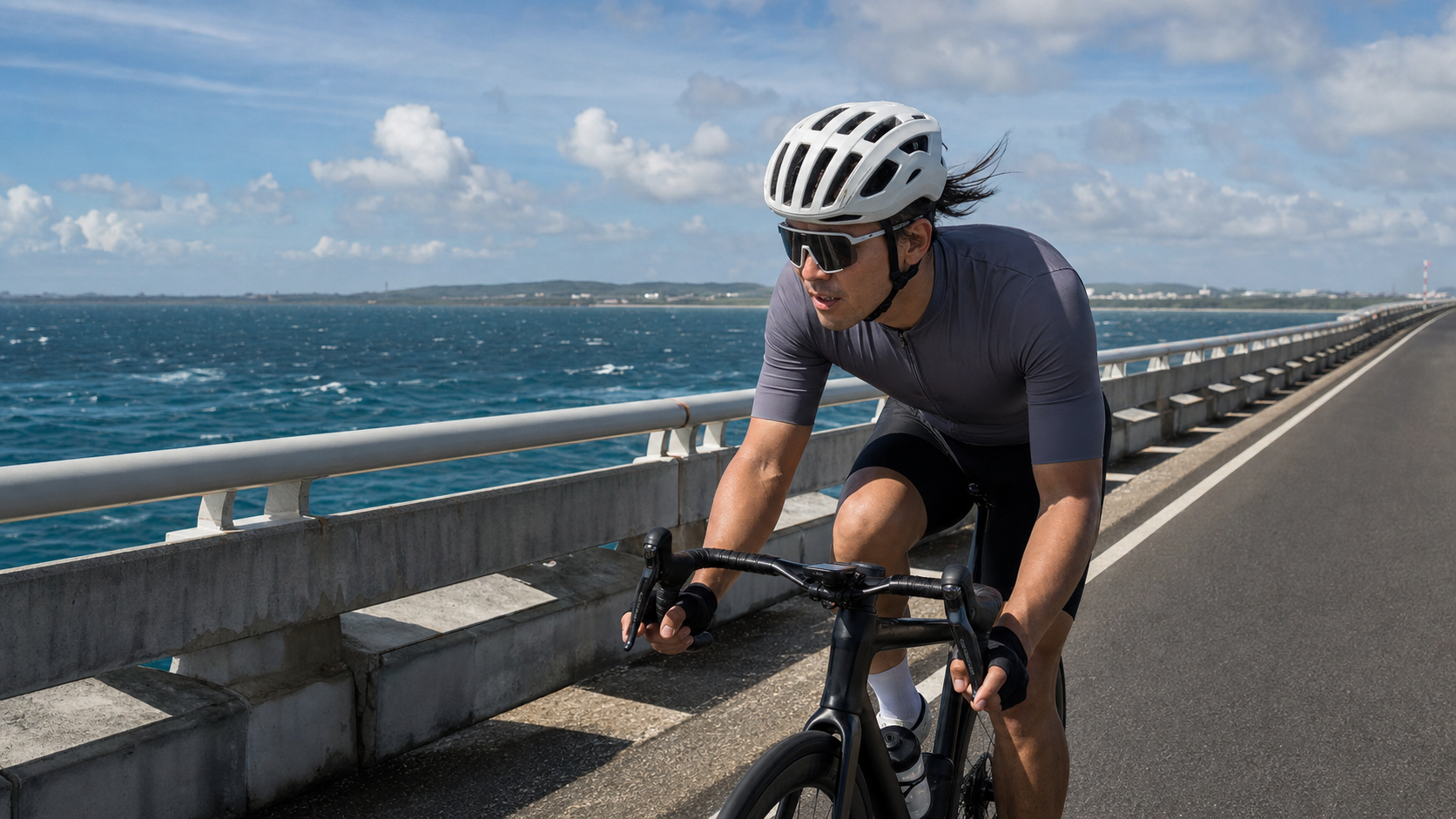
Penghu Cross-Sea Bridge Cycling Challenge: A Test of Willpower in the Sea Wind
Introduction
How strong is the wind in Penghu? Locals say, “If you can stand on the Cross-Sea Bridge without being blown away, you’re Iron Man.” Of course, that’s an exaggeration, but the northeast monsoon in Penghu is indeed the most unique challenge element of island cycling. The north bridge spans 2,478 meters in total, and the south bridge spans 1,170 meters; together, the two bridges exceed 3.6 kilometers. Riding across them, surrounded by sea on all sides, with wind coming from every direction, that expansive sense of solitude is an experience no route on the Taiwan mainland can replicate.
I stayed in Penghu for three days, with a cycling loop around the island as my main itinerary. The Cross-Sea Bridge was a must-ride pilgrimage route and the most challenging section.
Basic Knowledge of Cycling in Penghu
Penghu’s terrain is completely different from the Taiwan mainland. There are no high mountains—the highest point doesn’t exceed 80 meters—which sounds easy. But:
The challenge of cycling in Penghu isn’t the gradient; it’s the wind:
| Season | Main Wind Direction | Average Wind Speed | Cycling Difficulty |
|---|---|---|---|
| Oct–Mar (Northeast Monsoon) | NE → SW | 7–12 m/s | Extremely High |
| Apr–May (Transition Period) | Variable | 4–7 m/s | Moderate |
| Jun–Sep (Southwest Monsoon) | SW → NE | 5–8 m/s | High |
I visited in mid-November, right in the peak period of the northeast monsoon. While planning my route, the owner of the local bike rental shop said solemnly, “Think carefully about which direction you ride, because if the return leg is into the wind, riding 20 kilometers will tire you out more than someone else riding 60.”
Route Planning: Conspiring with the Wind
The owner’s advice made me change my original island-loop plan to a “wind-first” strategy:
After adjusting the three-day route:
- Day 1: Ride with the northeast wind toward the southwest (from Magong → Xiyu → Yuweng Island), enjoying the thrill of being pushed along by the wind
- Day 2: Flexible day, deciding the destination based on that day’s wind direction, mainly exploring Jibei Island and Wangan (by ferry)
- Day 3: Cross-Sea Bridge challenge day—head north into the wind in the morning, return south with the wind in the afternoon, taking advantage of the brief lull in wind strength after noon
The Actual Riding Experience on the Cross-Sea Bridge
At 8 a.m., I rode my bike to the north end of the bridge. Before officially stepping onto the bridge, I stood at the edge to gauge the wind. The wind speed was around 8–10 m/s, blowing head-on, and my hat nearly flew off.
Technical points for riding on the bridge:
- Grip the handlebars firmly: Crosswinds can cause the front wheel to shift suddenly; you must maintain a steady hold
- Lower your center of gravity: Tighten your core, reduce your frontal area facing the wind; the tucked aero position is noticeably effective
- Pace conservatively: Don’t try to sprint against the wind; steady pedaling is the right strategy
- Watch the lanes: The bridge allows bicycles, but you still need to watch out for scooters and cars passing by
The feeling on the bridge is hard to describe precisely in words. On both sides, the sea glistened a brilliant blue, and the distant basalt islands were clearly visible under the sunlight. The sea breeze carried a salty tang—every breath tasted of the ocean. Physical fatigue and mental exhilaration existed simultaneously, a very peculiar compound sensation.
The hardest moment was at the midpoint of the bridge, when the wind suddenly shifted from the side. My bike visibly drifted sideways, and my instinctive reaction was to squeeze the brakes, which nearly made me lose my balance. Later I learned: when a crosswind suddenly intensifies, you should “relax your upper body and let the bike drift naturally” rather than force a correction—going with the bike’s momentum is often safer.
Penghu Cycling Supply Guide
Store density in Penghu is far lower than on the Taiwan mainland, making supply planning even more important:
- Magong City: The most important resupply point before departure; both 7-Eleven and FamilyMart are available
- Xiyu Township: Some villages have small grocery stores, but they’re unpredictable; it’s recommended to carry backup food
- Along the Cross-Sea Bridge: No resupply points at all; stopping on the bridge is prohibited, so you must be fully prepared before and after
- Southern islands (Wangan, Qimei): Convenience stores are scarce; local eateries are the main option, so it’s recommended to have lunch early
Essentials before heading out each day:
- At least 2 liters of water (Penghu’s air is dry, and moisture evaporates quickly)
- 2–3 servings of solid food
- Sunscreen (Penghu’s UV is intense, and the sea surface reflection is even stronger)
- A lightweight windbreaker (to cope with sudden gusts)
An Unexpected Bonus: Penghu’s Slow Time
Beyond the cycling challenge, Penghu gave me an unexpected spiritual reward. At a small fishing harbor in Beiliao Village, I stopped to patch a tire, and an elderly man came over to help me on his own initiative, even bringing me a bowl of grass jelly tea. I chatted with him for half an hour in my broken Taiwanese. He said he had also cycled around the Taiwan mainland in his youth, but Penghu’s sea wind “has the most soul.”
Practical Tips
- The best season for cycling is April–May, when the wind is lighter and temperatures are moderate
- When renting a bike, choose a model with wider tires—they handle crosswinds better than skinny tires
- It’s recommended to complete the bridge ride before 10 a.m., as the sea breeze is usually stronger in the afternoon
- Bring goggles or sunglasses to protect your eyes from sea salt and windblown sand
Conclusion
The five kilometers of Penghu’s Cross-Sea Bridge are the most ceremonial five kilometers I’ve ever ridden. No elevation, no speed—just you, your bike, and that boundless sea. The wind is strong, strong enough that you must resist with your entire body, but precisely because of that resistance, you feel truly alive.
Next time I go to Penghu, I’ll still choose the northeast monsoon season, because that’s Penghu at its most authentic.
Related Reading
- Penghu Cross-Sea Bridge Loop: Taiwan’s Only Bicycle Route Crossing a Strait
- Penghu Island-Hopping by Bike: Off-Island Riding from the Main Island to Jibei and the Cross-Sea Bridge
- Penghu Cycling Loop: The Off-Island Riding Character of the Cross-Sea Bridge and Fishing Village Routes
- Penghu Cross-Sea Swim: The Windy, Wave-Ridden Strait Challenge and Race Preparation Tips
金門 ! 我騎過最棒的離島了 / 最後可以騎車上金門大橋的機會!?/ 公路車 / CT Yeh
1 年前
大武山後門26%歡樂陡坡!JJSC南台灣單車行Day2 / 被颱風追著跑 / 公路車 / CT Yeh
2 年前
嘉義大埔、阿婆灣挑戰賽,美到以為在日本!ft. 環騎5 Cool 西拉雅188 / 公路車 / CT Yeh
7 個月前
觀霧 變好騎了! | 北高車友爆笑大會師 | 公路車 | 單車旅遊 Taiwan Cycling Route GuanWu
6 年前
台北大雁西飛 約騎挑戰 feat. Doris | 公路車 | CT Yeh
3 年前
JJSC南台灣單車走春三日行 DAY 1 / 強度 x 美食 x 節慶體驗 / 公路車 CT Yeh
5 個月前
一日北高前的西濱集訓 | 跟著11小時軍團 | 300W踩不動的大逆風 | 輪車破風差幾瓦?
6 年前
台北闊瀨陡坡 騎旅 / 日本單車雜誌編輯車友臨時加入!/ 髮香才是最強的 / feat. 北迴歸線小隊 / 公路車 CT Yeh
6 個月前