Taitung Living Water Lake Swimming Race: Technical Challenges and Race Preparation in Neihu Open Water
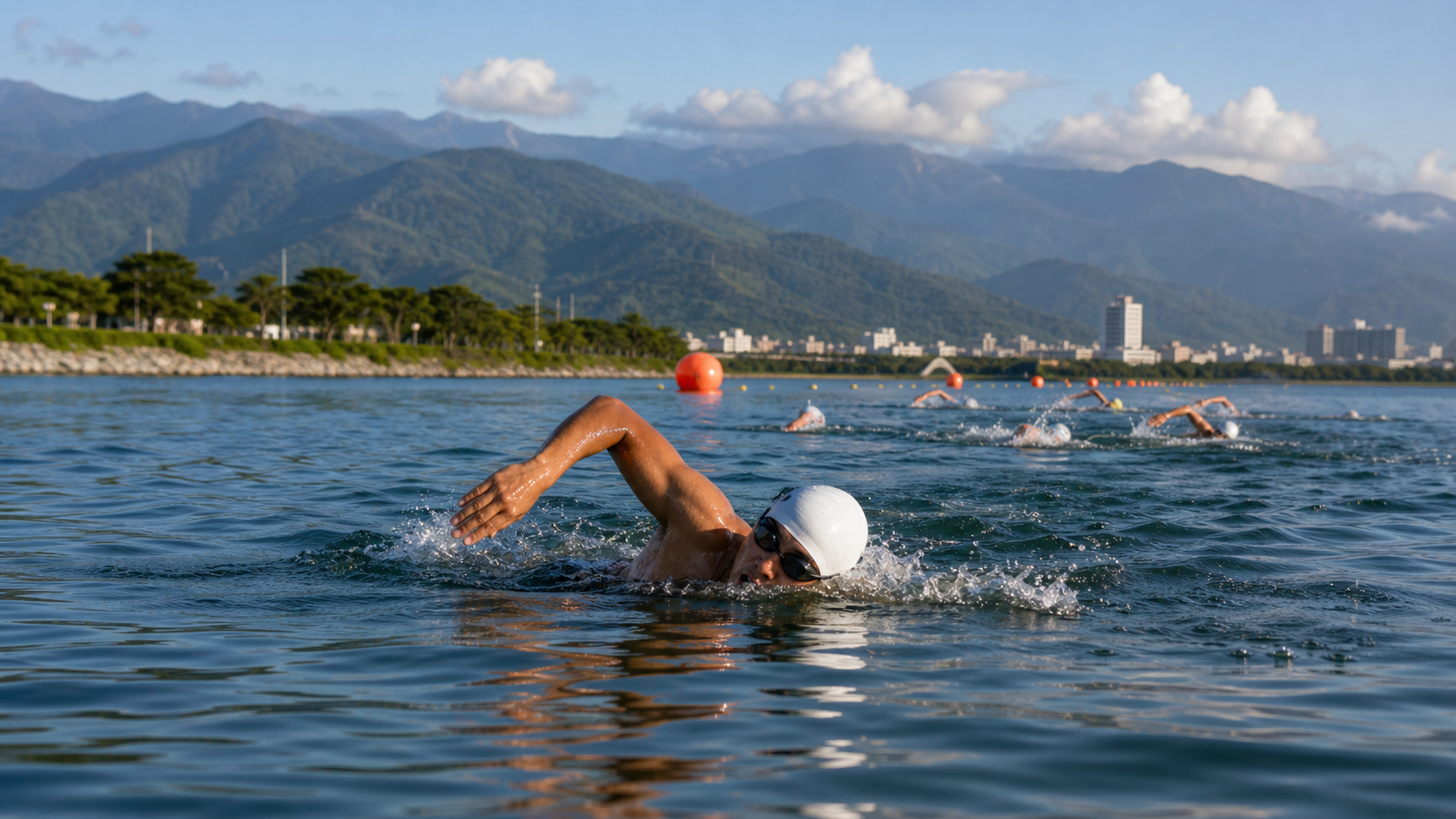
Taitung Living Water Lake Swim: Technical Challenges and Race Preparation in Open Water
Introduction
Taitung Living Water Lake is a special place. It is not as vast as Sun Moon Lake, nor does it carry the raw, untamed energy of the Penghu waters—it is calm, with clearly defined boundaries, and its surface is almost entirely free of waves, surrounded by the buildings of Taitung City and the Coastal Mountain Range in the distance.
Yet, every time I race at Living Water Lake, I feel a particular kind of technical challenge: in this seemingly placid, enclosed body of water, how do you swim efficiently? How do you find the real technical issues in an environment with no significant current interference? Living Water Lake is a mirror that reflects the fundamentals of swimming.
The Characteristics of Living Water Lake’s Waters
Located adjacent to Taitung City and bordering the Pacific Ocean, Living Water Lake maintains a seawater inflow through artificial channels, with clear water and moderate salinity. The open-water swim races and triathlon swim legs held here regularly each year make it one of the most important open-water race venues in eastern Taiwan.
| Characteristic | Description |
|---|---|
| Water temperature | Around 28-30°C in summer, comfortable |
| Waves | Almost none, occasional light breeze ripples |
| Visibility | Clear, can see 1-2 meters deep |
| Boundaries | Enclosed, clearly marked with buoys |
| Current | Very weak, nearly still |
| Bottom | Sandy, no risk of rocks |
Precisely because of these “perfect conditions,” Living Water Lake becomes a venue that exposes technical flaws. In the ocean or large lakes, where external disturbances are greater, athletes can easily blame slow times on currents or wave conditions; at Living Water Lake, all speed and efficiency directly reflect technique and fitness.
Technical Challenges in Open Water
Even in such a mild environment, open-water swimming still presents several technical issues that need special attention:
Group Swimming Contact
The chaos at the race start is a challenge unique to open water. Unlike a pool where each swimmer has their own lane, in open water hundreds of people enter the same body of water after the start, making collisions, kicks, and interference inevitable. First-time participants tend to become overly tense and breathe rapidly during this phase.
Coping strategies:
- Start from a non-central position (toward the edge, slightly further back)
- Reduce pace for the first 500 meters, then speed up once the crowd disperses
- Maintain a steady breathing rhythm, even if bumped, do not pause
Sighting Efficiency
Although Living Water Lake has clear boundaries, at water-level height, buoys and distant landmarks still require practice to identify quickly. Every time you lift your head to sight, it is a small loss of speed; practicing to reduce unnecessary sighting is a key technical focus.
Turning Buoy Technique
Open-water courses typically have several turning points, and the technique for rounding buoys directly affects route efficiency. Many swimmers take too wide an arc when turning, effectively swimming an extra several dozen meters.
My Race Preparation Plan
For the Living Water Lake race, I designed an eight-week preparation plan:
Monday to Thursday: Pool Technique Training
- Stroke technique: single-arm pulling, precise hand entry point
- Turn and breathe: bilateral breathing ratio training (50% each side)
- Pace awareness: swim 100 meters with eyes closed and estimate the time
Friday to Saturday: Open-Water Training
-
Sighting practice: lift head to sight every 10 strokes, gradually extending to 15 strokes
-
Group swimming simulation: start side-by-side with training partners, deliberately creating contact opportunities
-
Turning technique: practice minimizing turning radius by hugging the buoy
-
Confirm the race course map and turning point locations before the race
-
Try on the race swimsuit or wetsuit to confirm freedom of movement
-
Prepare waterproof goggles (recommend bringing a spare pair)
-
Warm up thoroughly before swimming, especially the shoulder rotator cuff muscles
The Actual Race Day Experience
On race morning, several hundred athletes had already gathered on the shore of Living Water Lake. Morning light fell on the water’s surface, and the sandy ripples at the bottom were clearly visible—a sight that was reassuring. After finishing my preparations, I deliberately entered the water 15 minutes before the start for a brief acclimatization swim. This habit is highly effective: it lets the body feel the water temperature and buoyancy in advance, so there is no “acclimatization shock” when the starting gun fires.
After the start, I followed the plan and started from the right side, deliberately holding back my pace for the first 300 meters to let the crowd naturally separate. After roughly the first buoy, the water opened up, and I increased my pace to the planned range.
The most interesting discovery: even in still water, the “drafting” effect from group swimming is real. Swimming 1-2 meters behind another athlete noticeably reduces drag—an open-water technique that pool training cannot replicate.
Post-Race Technical Reflection
After finishing, I recorded several reflection points on my phone:
- First-half pace was too conservative: Because I was too concerned about group swimming collisions, my speed in the first 500 meters was below training pace
- Went too wide around the second turning buoy: In an excited state, my turning radius control was off, and I estimate I swam about 15 meters extra
- Breathing rhythm was steady in the second half: Bilateral breathing training paid off; my breathing never faltered in the latter half
These concrete reflections are more valuable than “I finished and felt great”—they are the starting point for improvement next time.
Practical Advice
- Make good use of Living Water Lake as an entry-level open-water venue: The environment is mild and rescue support is well-established, making it suitable for first-time challengers
- Do not overlook turning technique: Practice on rounding buoys offers a high return on investment
- A pre-race acclimatization swim is essential: Even just 10 minutes
- Record reflections after every race: Specific technical issues are more valuable for training than vague feelings
Conclusion
Living Water Lake will not intimidate you, but it is honest. In this tranquil body of water, there is no current to blame, no big waves to explain away a slow time—only your technique and your fitness.
That is precisely why it is one of my favorite training venues. Every time I finish a race at Living Water Lake, what I bring back is not just a result, but also a clear understanding of the current state of my technique. That understanding is the truest starting point for improvement.
Related Reading
- Taitung Living Water Lake: The Calm Waters of an Artificial Lake and a Triathlon Base
- Taitung Living Water Lake Open-Water Training Guide: Training Secrets of the Triathlon Holy Land
- IRONMAN Taiwan Race Guide: Taitung Course Hydrology, Temperatures, and Special Preparation Notes
- Open-Water Training Venues: Lakes, Reservoirs, and Sea Areas Suitable for Practice in Taiwan
備戰 戀戀197 賽前關門點分析 西濱團練 #公路車 4K高畫質
6 年前
一輪盃環湖挑戰賽 | TIME新車首航 | 一輪帶我飛 | 百萬流量都在場 | 4K畫質 | 公路車 | CT Yeh
3 年前
超激烈!2025 南庄仙山KOM 賽事精華 / 男菁英A x 女菁英A / 公路車 / CT Yeh
9 個月前
Live) 備戰2019彰化經典百K 賽前攻略 (已完賽請看新影片
7 年前
#東進武嶺 全程實況錄影 5小時半 #夏季KOM #太魯閣 Taiwan KOM Challenge Reality Video Taroko scenery
7 年前
[防寒衣體驗] 鐵人魂 三鐵 防寒衣試穿會 於松運 深水游泳池 鯨魚池
8 年前
2025 海鷗團體繞圈賽 網路直播 超激烈裁判長視角 / EIPC 李廷威、Waypoint 等眾多高手競爭 / feat. 卡密兒主持 / 海鷗繞圈賽
9 個月前
嘉義大埔、阿婆灣挑戰賽,美到以為在日本!ft. 環騎5 Cool 西拉雅188 / 公路車 / CT Yeh
7 個月前