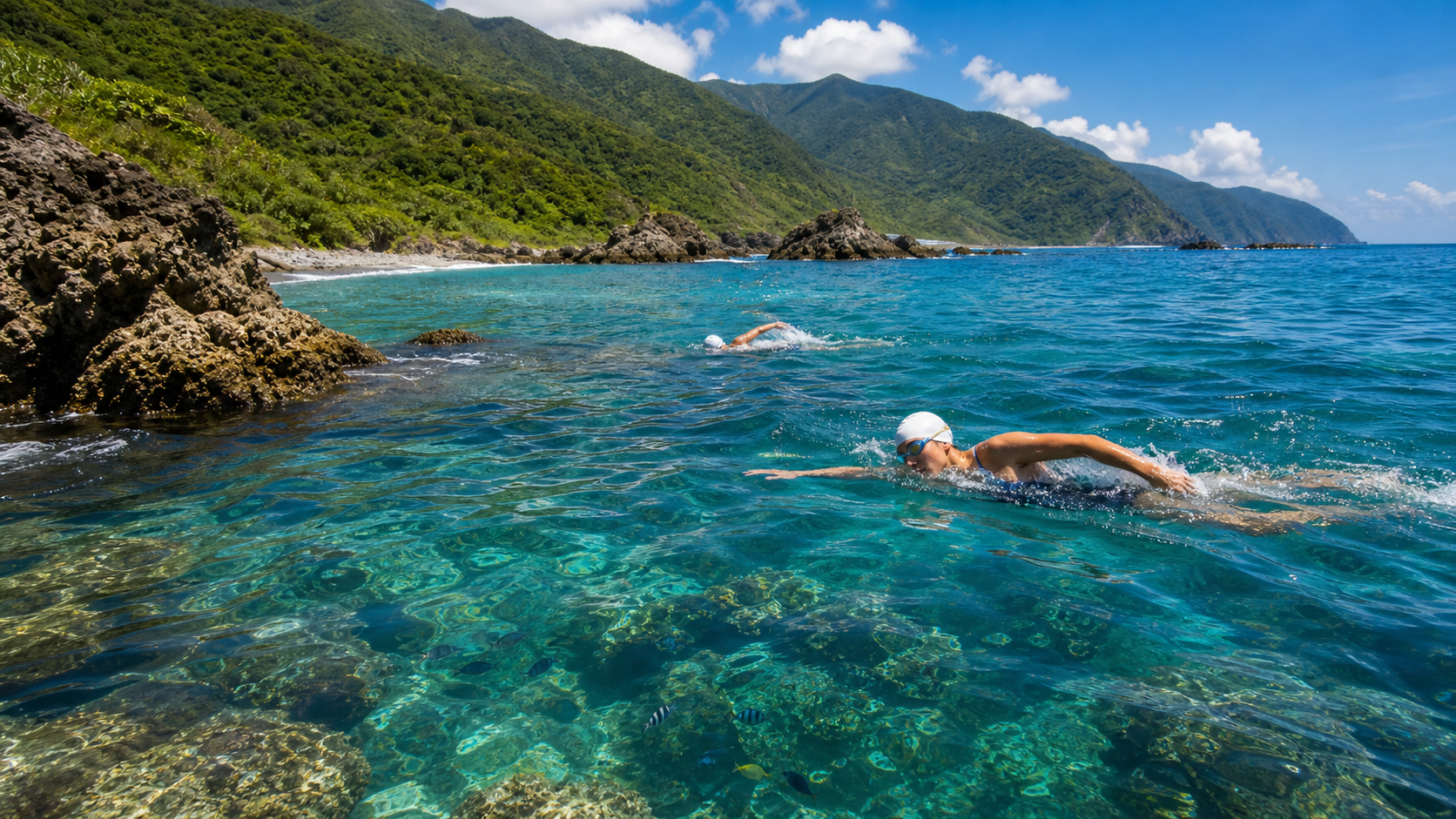
Whale Bay Swimming Challenge: My First Open-Water Swim in Yilan’s Clear Coastal Waters
Introduction
Some places make you want to dive in the moment you lay eyes on them.
Whale Bay is one of them. Standing on the shore and gazing out to sea, the water is so clear you can almost count the outline of every reef below, with fish gliding silently beneath the surface as if inviting you to join them. That urge is real, but before I jumped in, I still took some time to do my homework.
This article documents my complete first-time swimming experience at Whale Bay—from pre-swim site assessment, to the surprises in the water, to reflections after coming ashore. If you’re also considering swimming here, I hope this first-hand account gives you a useful reference.
Geography and Environment of Whale Bay
Whale Bay is located near Dong’ao in Yilan County. It is a small crescent-shaped cove surrounded by mountains on three sides, with its mouth opening toward the Pacific Ocean. The origin of the name is debated—some say it’s because the bay’s shape resembles a whale’s back, while others claim whales once stranded here in earlier years.
| Environmental Factor | Description |
|---|---|
| Water Quality | Crystal clear to the bottom, blue-green tones |
| Bottom Composition | Alternating reef and sandy bottom; sea urchins in some areas |
| Water Temperature | Approximately 27-29°C in summer |
| Waves | Significant seasonal variation; relatively gentle in summer |
| Currents | Check tide tables; some reef areas are exposed at low tide |
| Facilities | Basic parking space; no permanent lifeguards |
Important Safety Notice: Whale Bay is not an officially designated swimming area and has no permanent lifeguard on duty. All activities require self-assessment of safety conditions. It is recommended that at least three people swim together and that inflatable swim buoys be carried.
Assessment Before the First Entry
Upon arrival, I spent about 20 minutes observing the sea conditions. This is a basic habit for open-water swimming and a discipline I’ve learned from several races:
- Observe wave patterns: Are the waves regular? Are there intermittent larger swells that suddenly build up?
- Identify current direction: Toss a small leaf or observe the movement of floating debris on the surface
- Confirm entry and exit routes: Reef positions, water depth at entry point, and backup routes for emergency exit
- Assess visibility: Clear water means you can spot underwater obstacles in advance
The sea conditions that day were good: wave height around 30-40 cm, no significant lateral current, and visibility exceeding 3 meters. I decided to enter the water.
The Surprising World Beneath the Surface
The first sensation was the temperature—warmer than expected, around 28°C, no wetsuit needed. The second sensation was the peculiar psychological effect of the water’s clarity: at Sun Moon Lake or Living Water Lake, you can also see underwater, but that’s the transparency of freshwater; seawater’s clarity carries a blue depth to it. Looking down at reefs 3 meters below, you feel both their reality and their remoteness at the same time.
After swimming about 50 meters, I encountered my first technical challenge: groundswell. The swell at Whale Bay is different from typical bays—there’s no surf break zone. Instead, the entire sea surface rises and falls as a whole, with the whole expanse lifting and dropping every few seconds. This undulation is visually beautiful, but it causes:
- Reference points for navigation (landmarks on shore, distant mountains) constantly moving up and down
- Breathing timing becoming unpredictable
- Your swimming direction easily drifting off course without you noticing
The coping strategy is to “breathe with the rhythm of the swell”—breathing at the wave crest gives the best visibility, while keeping your head down to advance during the trough. This requires a negotiation between body and ocean that can only be truly understood through actual experience, far beyond any written explanation.
An Unexpected Gift Underwater
Swimming near the bay’s mouth, I looked down and saw a school of tropical fish with white bodies and blue spots darting out from between the reef crevices, sweeping past just one meter beneath my feet. That moment stopped me cold—I forgot to keep swimming and simply floated still on the surface, watching them.
This is an experience that pools and enclosed waters can never replicate: while swimming, you are simultaneously an underwater observer. The fish don’t care about you, the reefs don’t care about you—the entire underwater world operates on its own rhythm, and you are merely passing through briefly. That feeling brings a peculiar sense of humility.
In the end, I only swam about 800 meters before turning back—not because I was exhausted, but because every few dozen meters presented new underwater scenery that made me stop and look. This is perhaps the biggest difference between swimming at Whale Bay and racing: there’s no timer chasing you from behind here. You can swim at your own pace.
Safety Guidelines for Self-Guided Open-Water Swimming
Open-water swimming in non-race, unmanaged locations requires extra caution:
- Swim with at least three people to look out for one another
- Carry an inflatable swim buoy at all times—not just as a rest aid, but also as a visual marker
- Check weather and sea conditions in advance (Central Weather Bureau, Windy, and other tools)
- Inform someone on shore of your swimming plan (route, estimated duration)
- Establish return signals: if swimming in pairs, confirm each other’s status at regular intervals
- Do not enter the water at the end of an outgoing tide: the ebb current can be stronger than expected
Practical Tips
- Visit between July and September in summer: the northeast monsoon hasn’t arrived, and sea conditions are most stable
- Avoid swimming after consecutive rainy days: land runoff temporarily reduces visibility
- Wear a thin UV-protective long-sleeve swimsuit: Yilan’s summer sun is intense, and sun exposure should not be underestimated during long-distance swims
- Watch out for sea urchin areas: some reefs have sea urchins; wear non-slip water shoes when wading if necessary
Conclusion
When I came ashore at Whale Bay, the sun was approaching noon, and the sea surface shimmered under the sunlight. I sat on the reef, letting the seawater evaporate from my clothes, gazing at the expanse of blue I had just swum through.
What open-water swimming has given me has never been merely physical exertion. What it gives me is a recurring reminder: “You are just a small part of the natural world.” Those blue-spotted fish at Whale Bay probably don’t remember that a person once swam above them; but I remember. And that memory is worth all the driving and preparation.
Related Reading
- Yilan Nan’ao: Swimming Experience and Ecological Conservation at a Secluded Beach
- Swimming in Kenting Waters: Notes on the Coral Reef Areas of Nanwan and Houbihu
- Hualien Qixingtan: Challenges and Safety Tips for Sea Swimming in a Pebble Bay
- Green Island Snorkeling and Swimming: Exploring the Underwater World Among Tropical Fish
[防寒衣體驗] 鐵人魂 三鐵 防寒衣試穿會 於松運 深水游泳池 鯨魚池
8 年前
單車 梅山36灣 坡度介紹 路段介紹 空拍 (相關遊記影片,請參考說明或我的頻道喔,歡迎訂閱)
6 年前
嘉義大埔、阿婆灣挑戰賽,美到以為在日本!ft. 環騎5 Cool 西拉雅188 / 公路車 / CT Yeh
7 個月前
一定要騎一次!阿里山最深處:里佳部落!單車旅行 | 2800m爬升 | 深度部落體驗:嗨翻晚會、螢火蟲、銀河 | feat. JJSC & 廢物伙伴 | 公路車 CT Yeh
9 個月前
虎豹潭!日本老師來台一日約騎 台灣車友熱情招待私房路線 / CT Yeh
20 天前
4K單車實境) 嘉義 梅山36灣 訓練台 爬坡 輕鬆騎
6 年前
大武山20%魔王陡坡【JJSC南台灣遊騎Day2】!屁股真的要裂開了...凡士林抹滿也沒用?神秘金教堂還有超便宜夜市
3 個月前
密境!雙灣自行車道 / 環法日月潭 x YAKIMA 百人大約騎 / 公路車 / CT Yeh
11 個月前