Swimming Relay: Leg Strategy and Handoff Technique for a Four-Person Relay
Introduction
The first time I entered a swimming relay, I naturally assumed it was simply “four people each swimming their own leg well.” It wasn’t until the first race ended and I looked at the scoreboard that I realized our handoff errors had cost the team at least 6 seconds—and those 6 seconds were enough to change our placing.
A swimming relay is a sport of compound technique. Individual speed certainly matters, but handoff rhythm, leg strategy, and pacing management are what truly determine a team’s real strength. This article aims to organize the strategic thinking and technical details of a four-person swimming relay from a practical, race-day perspective.
Four Relay Distribution Models
Different team compositions call for different leg strategies. Here are several common models:
| Model | Arrangement Logic | Best Suited For |
|---|---|---|
| Strong-Weak-Strong-Weak | Fast → Average → Fast → Average | Maintains psychological advantage; suited to longer distances |
| Weak-Strong-Strong-Weak | Conservative start → Sprint middle → Strong finish | Suited to teams with one absolute ace |
| Progressive Build | Slowest to Fastest | Suited to rhythm-based races or teams with strong back-half advantage |
| Balanced | No deliberate ordering when speeds are similar | Most stable when teammates are evenly matched |
Our four-person team had A as the fastest, B second, with C and D similar to each other, so we chose the “A→C→D→B” progressive-build finish model: A opens to establish a lead, C and D hold the advantage, and B anchors with a sprint finish. Theoretically sound, but execution exposed another problem: handoff timing.
The Details of Handoff Technique
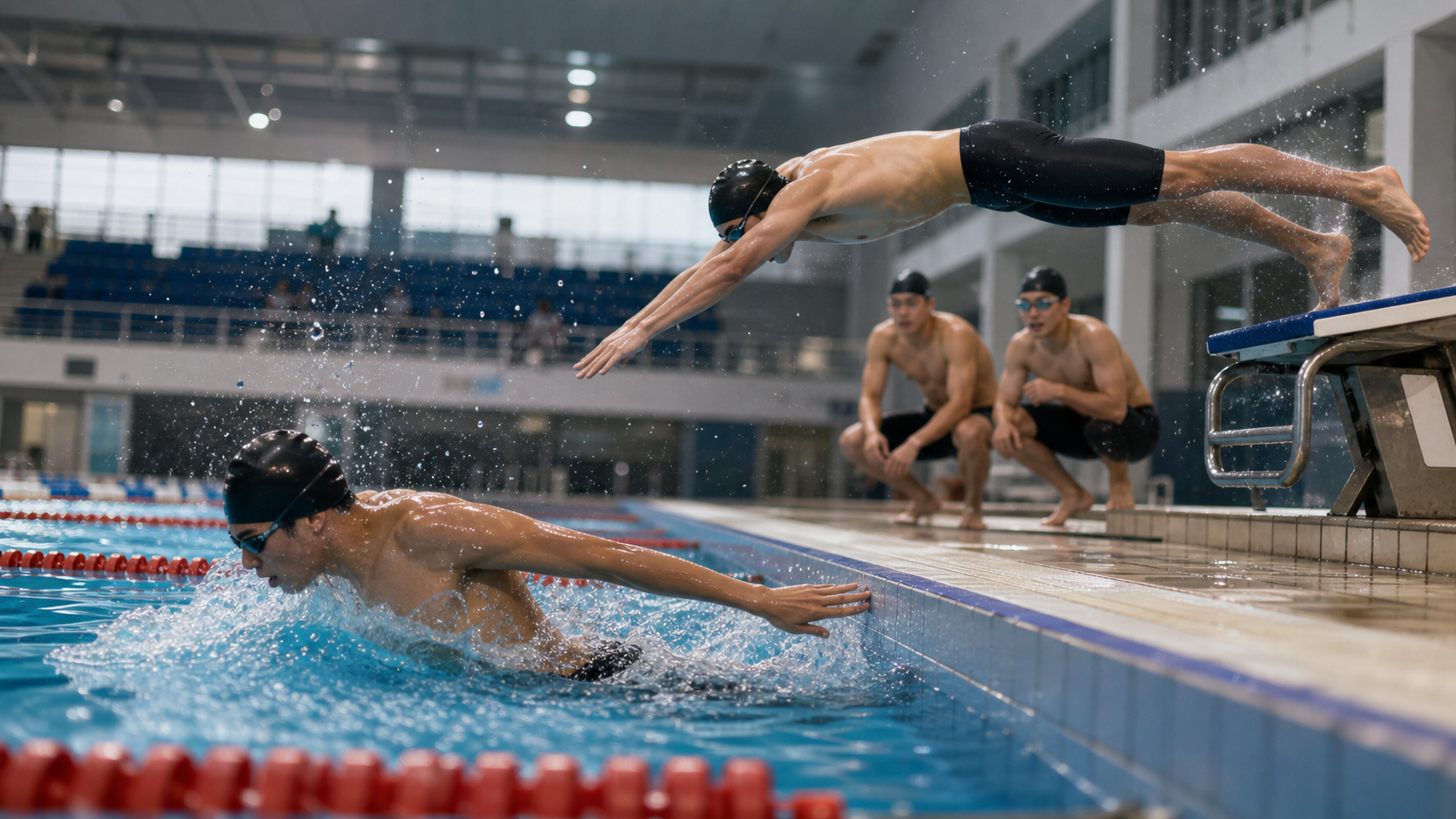
The handoff rule in a swimming relay (using a standard pool relay as an example): the next swimmer must not leave the block until the previous swimmer touches the wall.
The penalty for a false start (jumping early) is typically disqualification, which leads many teams to err on the side of caution—resulting in an obvious “dead pause” during the handoff and needlessly lost time.
Three elements of the fastest legal handoff:
1. Starting Block Takeoff Timing
The next swimmer stands on the block, eyes locked on the approaching teammate in the lane. The ideal takeoff moment: when the teammate is about 1.5 meters from the wall, begin the loading motion for the start, coordinating the airborne dive with the instant the teammate touches the wall. This requires extensive practice to execute legally with zero dead time.
2. Confirm by Position, Not Speed
Many beginners watch their teammate’s speed rather than position, and easily misjudge the takeoff because the teammate slows in the final meters. Instead, watch “distance”: when the teammate’s head reaches a set marker (such as under the flags), begin the countdown to takeoff.
3. Standardize the Starting Block Ready Position
The ready position on the block should be consistent and fixed, so that muscle memory is maximized on every handoff. Knee bend angle, arm height, and forward weight shift are all worth deliberate practice.
Special Considerations for Open Water Relays
If the relay is in open water (such as Sun Moon Lake or Living Water Lake), the situation differs from a pool:
- Handoff Zone: Usually a pontoon bridge or inflatable platform is set up; the previous swimmer touches the pontoon to complete the exchange
- Orientation and Passing: Each swimmer must know the course in advance to ensure the next swimmer can immediately find the correct direction after the exchange
- Pacing Estimation: Physical depletion after an open water swim is higher than in a pool, requiring more conservative intensity allocation per leg
- Equipment Handoff: Some events require passing a tow buoy or timing chip, which needs prior rehearsal
Open water relays are becoming increasingly common in Taiwan, especially at major events like Sun Moon Lake, which offer relay categories so participants who are not yet ready for a full solo swim can still experience the joy of open water swimming.
Team Communication Is the Key to Success
Technique matters, but a relay’s success depends heavily on the quality of communication within the team.
Before our second race, we did several things that changed our results:
- Agreed on standardized handoff signals in advance (the difference between “OK” and “Touched” had actually caused a misunderstanding)
- Practiced the full block-start sequence three times, letting muscle memory override race-day nerves
- Built a “one-second slower” mental pact: better to be one second late and safe than to be disqualified for a false start
- Reviewed footage together after the race: analyzed the handoff moment frame by frame to identify each person’s issues
This communication system made our second race nearly 10 seconds faster than the first, and more than half of that improvement came from handoff efficiency, not individual speed gains.
Suggested Pre-Race Training Plan
For a relay, it is recommended to begin the following training at least three weeks before the race:
- One to two full handoff practice sessions per week (with all four swimmers present)
- Each swimmer practices different leg positions to become familiar with both the block-start and in-water wall-touch roles
- Compare individual split times against relay times to pinpoint the exact handoff loss
- Simulate race-pressure full-effort handoff practice (race-day muscle state differs from training days)
Conclusion
The most important thing swimming relay taught me is not how fast I can swim, but this: individual strength must be recalibrated within a collective. You don’t just represent yourself—every dive in and every exit from the water is part of the team’s rhythm.
When the handoff moment is executed perfectly—the next swimmer entering the water at the exact instant of the touch, with not a single second of dead time—the satisfaction of that coordination is a very special kind of joy in swimming. It belongs to no single person, but to the entire team.
Related Reading
- Relay Leg Allocation Strategy: Order Arrangement and Handoff Technique
- Team Strategy for Medley Relay: Competitive Considerations in Order Arrangement and Handoff Technique
- Key Technical Points in Swimming Relay: Handoff Timing and Teammate Coordination
- Triathlon Relay Division Guide: Key Tactics for Three-Person Collaboration Across Swim, Bike, and Run
CT 喇低賽) 武嶺牽車 才是王道 西進牽車四小時內秘訣 攝手位置 如何判斷 防抽筋小秘訣
7 年前
戰略) Zwift Race 如何咬在第一集團 如何評估自己要開多少推力 (請開1.5倍速看)
7 年前
#公路車 #西進武嶺 配速配瓦實驗 坡度分析 四小時內攻略 建大盃 NeverStop #西進武嶺攻略
6 年前
崇越盃武嶺冠軍高手 賽前JJSC 群峰會精華!對應大數據分析,會有落差嗎?/ feat. JJSC中部公路車約騎 /公路車 / CT Yeh
2 年前
西進武嶺 免費訓練分析服務 Intervals | 練不夠還是練過頭?你哪一種類型選手?AI模型告訴你! | 備戰神器 | 公路車 訓練 | CT Yeh
4 年前
live) 超越北高 之一日北高12小時 策略
7 年前
Live) 備戰2019彰化經典百K 賽前攻略 (已完賽請看新影片
7 年前
福隆鐵人團練隨拍
8 年前