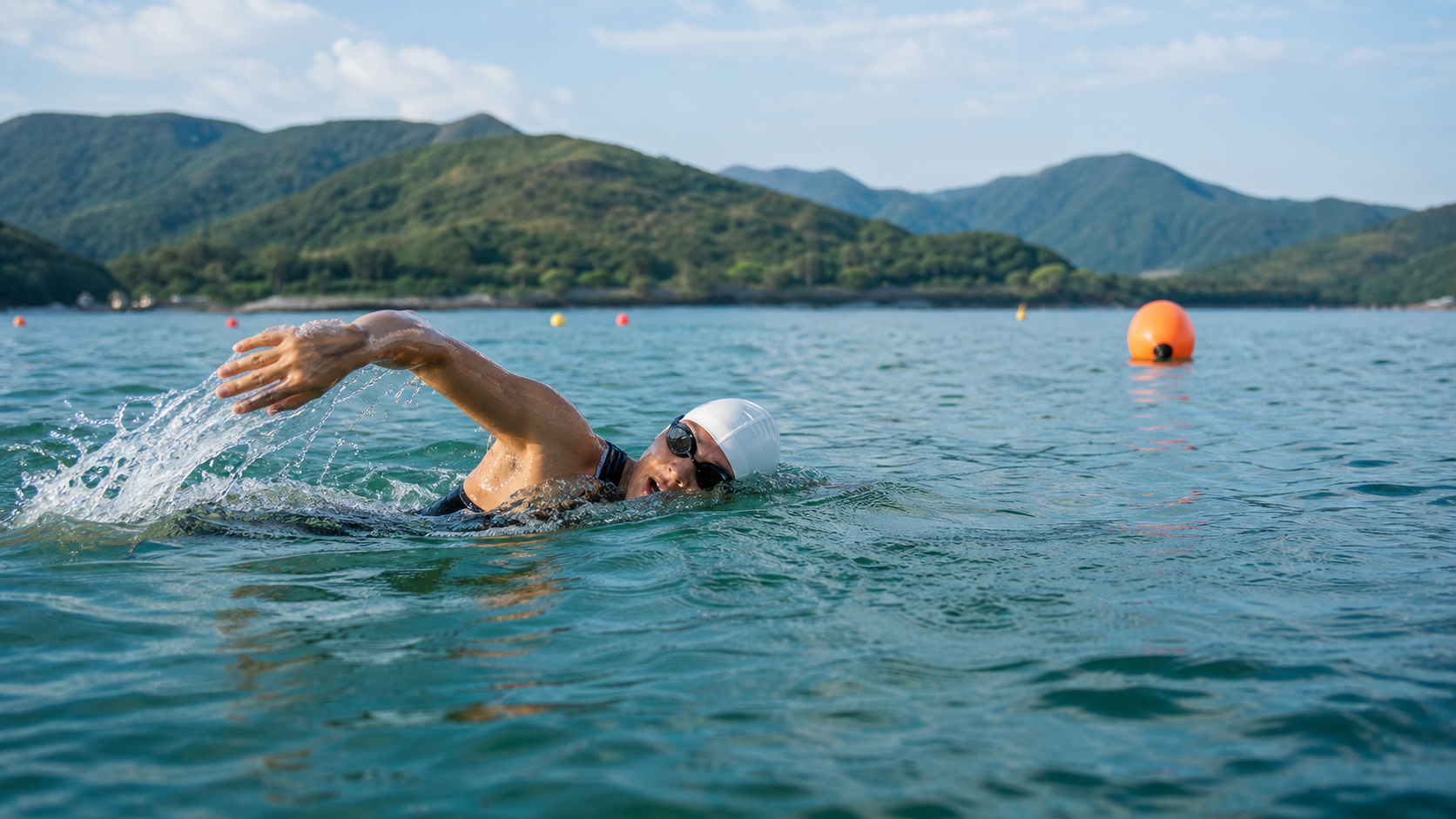
Open Water 5km First Challenge: Adapting from the Pool to Open Water
Introduction
After ten years of swimming in a pool, I thought I understood everything about swimming. It wasn’t until my first 5km open water swim that I realized: the pool gave me fitness, but it couldn’t give me the ability to survive in natural waters. Between the two lies a gap wider than any distance.
This article isn’t about how terrifying open water swimming is, but rather an honest description of what that gap actually looks like, and how I crossed it step by step. If you’re a solid pool swimmer considering your first long-distance open water challenge, I hope this process proves useful to you.
Pool vs. Open Water: Key Differences
Before officially starting my preparation, I spent considerable time organizing the specific differences between the two environments, which helped me more precisely identify what I needed to train:
| Comparison Item | Pool | Open Water (5km Event) |
|---|---|---|
| Navigation | Black line guidance, zero deviation | Relies on buoys + landmarks, requires active sighting |
| Fueling | Usually none (short distances) | Long distances require mid-race fueling |
| Current | Still | Possible side currents, swells |
| Wall turns | Every 50m | None, continuous forward motion |
| Mental environment | Enclosed, high sense of safety | Open, wide field of view, requires adaptation |
| Competitive environment | Separate lanes | Mass start, chaotic initially |
| Swimwear choice | Standard | Wetsuit may be needed |
The most unexpected gap wasn’t technical—it was psychological. In the pool, every 50 meters there’s a wall telling you “you can flip now”; in open water, that wall disappears. Your mind must construct its own “reason to keep going,” and this process requires more practice than I ever imagined.
The Disaster of My First Open Water Attempt
Two months before registering for the 5km race, I went to an open water swimming venue for my first attempt, with the goal of just swimming 1000 meters to “see how it feels.”
After entering the water, the first 200 meters were fine, but then problems started appearing:
- No black line—after swimming about 300 meters, I realized I had drifted nearly 20 meters off course
- Couldn’t see the bottom—although the water was fairly clear, the blue-black of the deep water made my heart race
- No wall-turn rhythm—as I continued past 500 meters, I started “counting strokes” to create mental milestones, but that made me more anxious, not more at ease
- A small wave disrupted my breathing once—I swallowed water, and for the next 20 meters I was in a semi-panic state
In the end, I got out after 850 meters, telling myself “today just isn’t right.” But the problem was actually clear: I hadn’t prepared any basic open water adaptation and simply jumped straight in to try it.
Systematic Adaptation Training
That experience made me redesign my preparation plan, putting “technical adaptation” at the top priority:
Phase 1 (Weeks 1-2): Getting to Know the Water’s Characteristics
- At a lifeguarded open water venue, swim only short distances (300-500 meters)
- No focus on speed; only observe currents, visibility, and breathing difficulty
- Practice “head-up sighting”: lift your head every 10 strokes to check direction
Phase 2 (Weeks 3-4): Extending Distance + Mental Adaptation
- Gradually extend to 1000-2000 meters
- In water with no visible bottom, stop and float for 30 seconds, forcing your brain to accept that “no bottom is also safe”
- Practice adjusting breathing rhythm when encountering swells
Phase 3 (Weeks 5-7): Training Close to Race Conditions
- Swim with other athletes (mass-start environment)
- Under confirmed weather conditions, attempt full 3000-4000 meter training sessions
- Test mid-race fueling products (energy gels, electrolyte drinks)
Week 8: Tapering + Race Preparation
- Reduce intensity, maintain the feel
- Reconfirm equipment, course, and fueling strategy
This phased adaptation process transformed my feeling toward open water from “unfamiliar fear” to “familiar challenge” after 8 weeks.
The 5km on Race Day
The race was designed as a 5km open water loop course, divided into three 2.5km circuits (out-and-back style) or unequal segments, depending on the organizer’s design.
My strategy was:
- First 1km: conservative pace, waiting for the crowd to disperse
- 1-3km: steady pace, focusing on sighting and fueling
- 3-5km: decide whether to pick up the pace based on remaining energy
The biggest challenge came around the 3km mark. Physical fatigue began to set in, and with no finish line in sight ahead and fewer people around me, the psychological pressure of “still so far to go” peaked.
I used one method: I split the remaining 2km into four 500-meter segments, giving myself a small checkpoint for each 500 meters (“swim to that orange buoy”). Breaking a distant goal into short-range tasks effectively maintained my focus and rhythm.
Reflections After Finishing
After finishing, I sat on the shore for about 10 minutes, replaying the entire experience. Several key takeaways:
- The hardest part of open water isn’t physical strength—it’s maintaining mental resilience
- The return on investment for sighting technique is extremely high: one course correction can be more effective than 10 hours of training
- Mid-race fueling must be tested during training; never use it for the first time on race day
- Open water requires accepting the mindset of “imperfect lines”
Practical Advice
- Start with short distances; don’t skip the adaptation phase: Even with excellent swimming technique, open water requires its own dedicated adaptation training
- Join organized open water training groups: An environment with coaches and teammates makes adaptation more systematic
- Learning head-up sighting is the top priority skill
- For a 5km race, it’s recommended to complete at least three open water training sessions of 2km or more before registering
Conclusion
After swimming that 5km, I gained a completely different understanding of my swimming ability. The pool version of me is a technician, executing precisely within grid lines; the open water version of me is an explorer, finding my own route amid uncertainty.
I need both versions of myself, but it was only in open water that I found the kind of swimming that truly makes my heart race.
Related Reading
- Open Water Swimming for Beginners: A Complete Adaptation Guide from Pool to Ocean and Lakes
- Open Water 5K Advanced Challenge: Training Methods to Break Through Distance Plateaus
- Open Water 1km Swim Training Plan: A Transition Program from Pool to Sea Swimming
- Open Water Swimming for Beginners: A Safe Transition Guide from Pool to Ocean
半日 小台灣 極限單車路線挑戰實錄
7 年前
一輪盃環湖挑戰賽 | TIME新車首航 | 一輪帶我飛 | 百萬流量都在場 | 4K畫質 | 公路車 | CT Yeh
3 年前
2019 夏季KOM 5小 完賽心得 準備攻略 東進武嶺 夏季登山王之路 Taiwan KOM Challenge
7 年前
靠單車減肥35公斤 心得分享與整理
7 年前
FTL 與 SYB 車隊專訪 西進武嶺 實用攻略分享! 2小時 如何練?!你不知道的眉角!新手準備武嶺必看 EP1 | 實力派女車友 | 精華版 | 公路車 | CTYeh
4 年前
Zwift 元宇宙單車世界 如何與全世界同步騎車運動
6 年前
西拉雅五庫單車挑戰 / 曾文水庫 & 南168 二寮 / 500元報名費居然這麼超值/ 公路車 / CT Yeh
10 個月前
#PUSHBIKE 原來這麼好玩! 小朋友 滑步車 初體驗 超可愛
6 年前