Overcoming Fear in the Triathlon Swim Leg: Mental Preparation for Your First Mass-Start Swim
Introduction
In triathlon training, there is a phenomenon known as the “swim-leg dropout curse.” Among all triathletes, the vast majority of cases involving quitting the race or panicking and calling for help happen during the swim leg—and usually not because of poor swimming technique, but because of a mental breakdown.
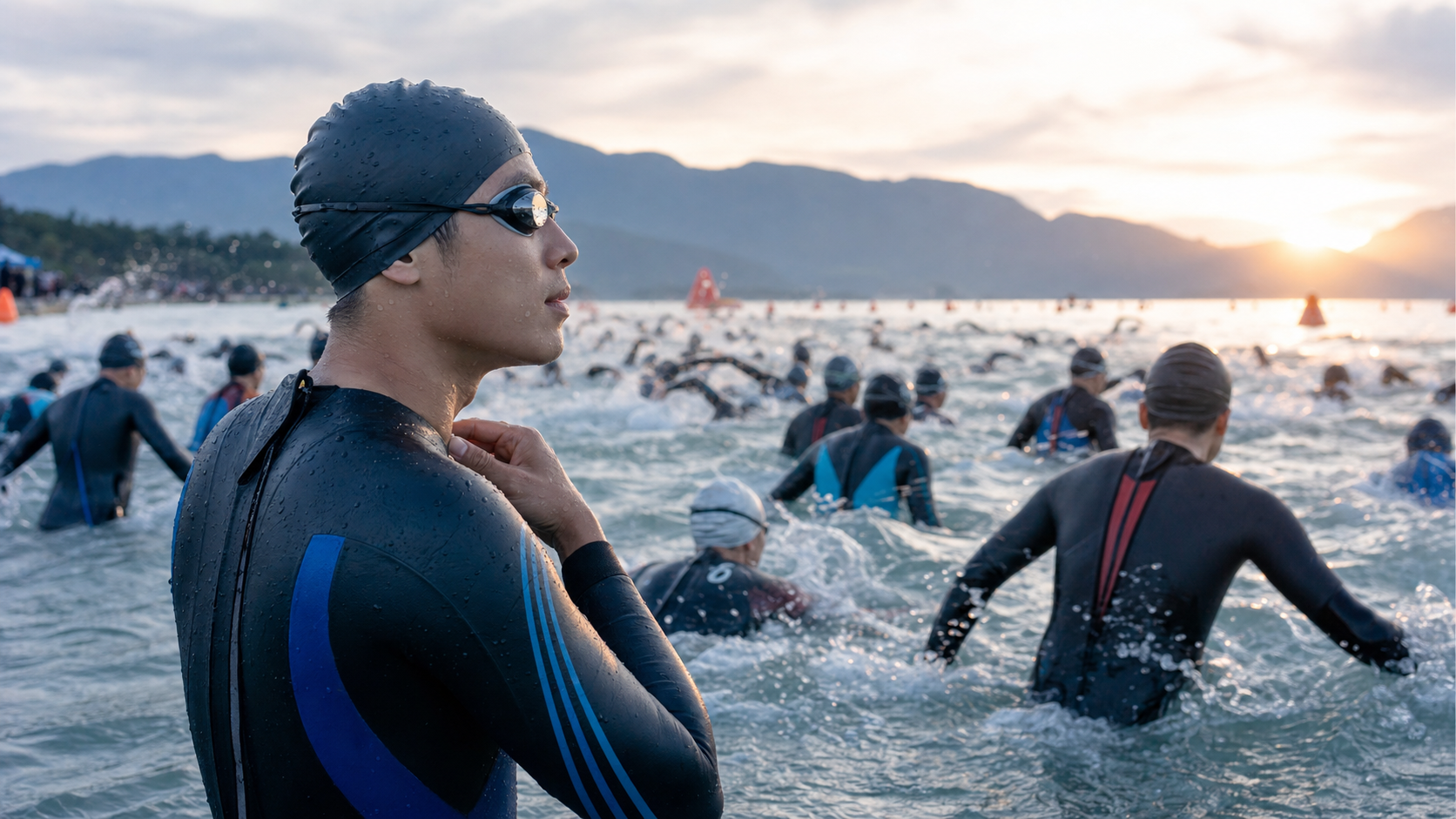
Before my first triathlon, I could swim 1,500 meters in the pool in just 27 minutes. Technically, I had no problem at all. But the moment the starting gun fired and hundreds of athletes entered the water simultaneously, my first thought was: “I want to go back.”
That thought lasted only three seconds, but it made me understand: mass-start swimming is a mental challenge that requires dedicated preparation, and it is a completely different matter from swimming technique.
The Three Sources of Mass-Start Swim Fear
1. The Unpredictability of Physical Contact
In the pool, your personal space is protected by lane lines. In a mass start, that line doesn’t exist. Other athletes’ hands may scrape across your face, and their feet may kick your shoulders. This sudden physical contact is a threat signal to the brain, even if you aren’t injured.
2. Claustrophobia Triggered by Restricted Visibility
When a large number of athletes enter the water at once, waves and foam reduce visibility to nearly zero. A brain accustomed to the clear sightlines of a pool is prone to triggering a panic response when faced with sudden visual restriction.
3. The Perceived Fear of Not Being Able to “Stop”
In the pool, you can stop and stand up or grab the edge at any moment. In open water, there is no wall to hold onto. This sense of “no way out” causes many athletes to lose their anchor of security when anxiety rises.
| Source of Fear | Actual Risk | Perceived Risk | Key Response |
|---|---|---|---|
| Physical contact | Low (occasional bumps) | High (panic trigger) | Expectation training |
| Restricted visibility | Low | High | Environmental adaptation |
| Inability to stop | Low (inflatable buoy) | High | Safety tools + cognitive adjustment |
A Systematic Mental Preparation Strategy
Strategy One: Mass-Start Environment Exposure Training
Before the actual race, deliberately create an environment similar to a mass start:
- Join an open-water swim training group and swim around other people
- In the pool, have swim buddies start simultaneously in the lane next to you to experience a similar sense of proximity
- Enter small open-water practice races to first experience mass-start situations with fewer people
Each exposure lowers the brain’s threat assessment. This is an application of the “systematic desensitization” principle from cognitive behavioral therapy.
Strategy Two: Establishing “Safety Anchor” Cognition
Pre-establish several safety checkpoints in your mind:
- “I have an inflatable buoy, so I can rest at any time”
- “The rescue boats are nearby, and I can raise my hand for help”
- “I have swum this distance dozens of times in the pool”
These are not self-deceptive reassurances but confirmations of facts. When anxiety rises, shifting your attention to facts is a highly effective emotional regulation tool.
Strategy Three: Race Strategy Adjustments (Psychological Protection at the Physical Level)
You don’t need to start from the front row:
-
Position at the edge: Choose the left or right edge of the starting line to minimize the impact of the first wave
-
Start slightly later: If the rules allow, let the main pack enter the water first, then enter in a slightly more open environment
-
Slow down for the first 200 meters: Don’t fight for position in the early stage; let both your body and mind settle into a rhythm
-
Get plenty of rest the night before, and don’t repeatedly replay race details in your head before bed
-
Arrive at the venue early to familiarize yourself with the terrain and water conditions
-
Do a 10-minute acclimatization swim before the start (if the rules allow)
-
Deep breathing: 2 minutes before the start, do 5 rounds of diaphragmatic breathing
Practical Response on Race Day
The moment the gun went off that day, the crowd around me surged toward the water like a tide. Following my plan, I positioned myself at the far right and entered the water at a slightly slower pace after the first wave of athletes had gone in.
The first 100 meters were still chaotic—someone kicked my leg, and someone’s arm brushed across the side of my face. With every touch, I repeated in my mind: “Expected. It’s fine.” That mantra wasn’t magic, but it stopped the first spark of panic from expanding into a second one.
After 200 meters, the pack began to spread out, and I entered a relatively comfortable space. At that point, the race truly became just swimming—only in a different venue, moving stroke by stroke through blue water.
The Mental Shift After Finishing
After getting out of the water, I stood in the T1 transition area putting on my cycling gear and glanced back at the spot where I had exited. The water looked calm and ordinary under the sunlight—hard to imagine that just 20 minutes earlier, it had been my greatest source of fear.
That contrast brought a very special kind of confidence: “I did something I thought I couldn’t do.” This wasn’t about swimming. It was about the ability to face fear.
Practical Advice
- Never skip swim training and go straight to a race: Even a 750-meter sprint-distance triathlon swim requires thorough preparation in open water
- Participate in at least one open-water practice race: Even if it’s just to experience the feeling of a mass start
- An inflatable buoy is not optional—it’s essential: It isn’t a symbol of poor technique; it’s standard equipment for safe swimming
- Feeling psychological impact is completely normal: Almost everyone feels the mental pressure of a mass start. You’re not the exception; you just need more preparation
Conclusion
The fear of the triathlon swim leg was the most honest self-challenge I have faced in my athletic career. It taught me that physical capability and mental permission are two separate thresholds, and both must be crossed at the same time.
If you’re standing at the starting line hesitating right now, that’s okay. The fear is real, but it doesn’t mean you can’t do it. When you’re ready, get in the water.
Related Reading
- Mental Preparation for Triathlon Swimming: Overcoming Anxiety in Black-Water Crowd Navigation
- Triathlon Swim Training: Overcoming Fear and Improving Efficiency in Open Water
- Overcoming Swim Fear and Fear of Water: Common Mental Barriers for Endurance Sports Beginners and Progressive Methods to Overcome Them
- Mass-Start Strategy for the Triathlon Swim Leg: Position Selection and Handling Physical Contact
2026 輪霸西濱200K 挑戰VLOG / 第一集團 / 首次參加..經驗不足、膀胱不足 /死守6H內 / AI戰鬥力顯示系統 / 公路車 / CT Yeh
4 個月前
[防寒衣體驗] 鐵人魂 三鐵 防寒衣試穿會 於松運 深水游泳池 鯨魚池
8 年前
福隆鐵人團練隨拍
8 年前
一日北高常見問題大集合 | 攻略 | 路線 | 訓練 | 補給 | 自行車 單車 | 一日雙城 | 雙塔 | TWB北高360 | 屁股痛
6 年前
FTL 與 SYB 車隊專訪 西進武嶺 實用攻略分享! 2小時 如何練?!你不知道的眉角!新手準備武嶺必看 EP1 | 實力派女車友 | 精華版 | 公路車 | CTYeh
4 年前
一日北高/長距離團騎 常見問題補充篇 / 組團或跟團的眉角 / 壯車友容易被瘦車友慢性拉爆 / 原來屁股痛可能是這個原因...? / 風場配速法 / 公路車 / CT Yeh
2 年前
2019 夏季KOM 5小 完賽心得 準備攻略 東進武嶺 夏季登山王之路 Taiwan KOM Challenge
7 年前
2016 桐花飛舞 單車挑戰 精華片段
10 年前