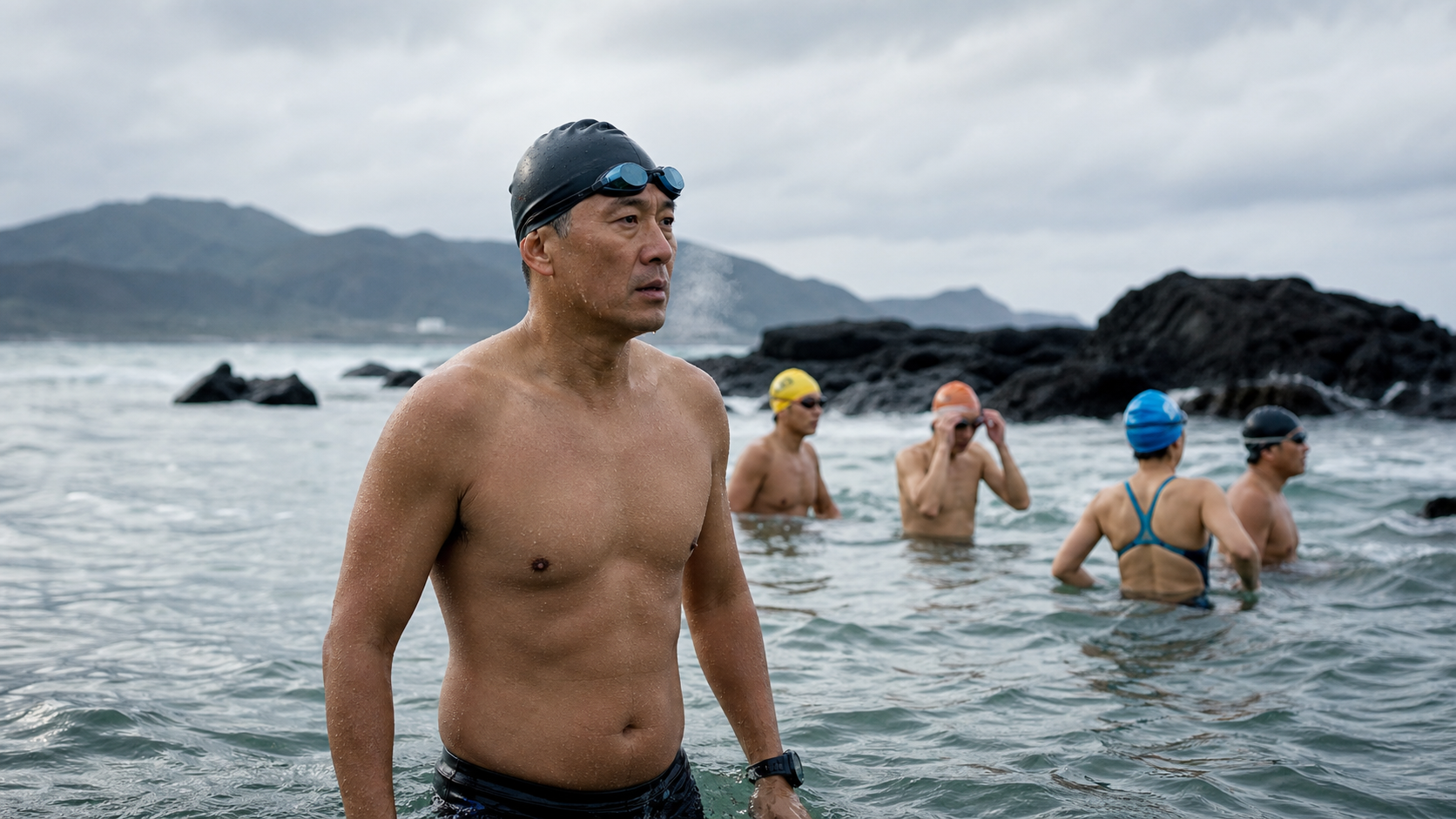
Winter Swimming Challenge: Cold Water Adaptation Training in Taiwan’s Northern 18°C Waters
Introduction
On the northern coast in December, the sea breeze carries a chill, and a few people in swimsuits stand by the rocks, gazing at the gray-green water. Onlookers probably think we’ve lost our minds; we exchange glances with each other, nod, and jump in together.
Cold water swimming has a long cultural tradition in Europe, and in recent years a community of enthusiasts has gradually emerged in Taiwan. My entry into this “winter swimming” circle was somewhat accidental—during pre-race training for a competition, I met a coach who said: “Cold water adaptation is the most overlooked training component in open water swimming.” That remark kicked off my six-month exploration of cold water swimming.
Taiwan’s Winter Water Temperature Overview
Taiwan is surrounded by sea, but water temperatures vary considerably by region:
| Region | Winter (Dec-Feb) Water Temperature Range | Summer Water Temperature Range |
|---|---|---|
| Northern (Keelung, North Coast) | 16-20°C | 27-30°C |
| Eastern (Yilan, Hualien) | 18-22°C | 27-29°C |
| Southern (Kenting, Pingtung) | 22-25°C | 29-31°C |
| Offshore Islands (Penghu, Green Island) | 20-24°C | 28-30°C |
18°C is a temperature with special significance: below this threshold, international swimming rules allow athletes to use wetsuits; most of Taiwan’s winter open water events also permit wetsuits below this temperature. But swimming in this temperature range produces noticeable physiological adaptation responses.
Physiological Responses to Cold Water Swimming
The first time you jump into 18°C water without any preparation, your body’s response is:
Cold Shock Response
In the first 30 seconds after entering the water, your body involuntarily takes deep breaths or even hyperventilates. This is a reflex triggered by the sudden activation of cold receptors in the skin—it’s completely normal, but it can easily cause panic. Learning to anticipate this response, allowing it to happen without panicking, is the first lesson in cold water swimming.
Vasoconstriction
Blood vessels in the extremities constrict rapidly, with blood shunted toward the core to protect vital organs. Fingers and toes quickly lose sensitivity, which affects stroke efficiency.
Heart Rate Rises Then Slows
Heart rate spikes rapidly upon entry, but as the body adapts, it stabilizes after roughly 2-3 minutes.
Cold-Induced Muscle Fatigue
Muscle metabolic efficiency decreases in cold water; the same swimming movements consume about 20-30% more energy in cold water than in warm water.
Systematic Cold Water Adaptation Training
Transitioning from a warm water swimmer to someone who can swim effectively in 18°C water requires a systematic adaptation process:
Week 1: Cold Water Exposure, Building Psychological Acceptance
- End each daily shower with 30-60 seconds of cold water at the lowest temperature
- No need to go into the sea; just let your body begin to recognize that “cold water doesn’t equal danger”
Week 2: Brief Water Entry
- Choose a sunny day with warmer air temperatures, and with someone present for safety, stay in 18-19°C water for 5-10 minutes
- The focus is on observing your cold shock response and practicing slow breathing to control it
Weeks 3-4: Short Distance Swimming
- Swim 100-300 meters in cold water
- Warm up immediately after exiting (have dry towels, a jacket, and warm drinks ready)
- Record your psychological and physiological sensations after each swim
Weeks 5-8: Increasing Distance
- Add roughly 200-300 meters each week
- Note: the maximum distance for cold water swimming varies by individual; don’t force comparisons with others’ performance
Key findings from actual training:
- The biggest improvement in the first month comes from “psychological adaptation,” not physiological adaptation
- The 5 minutes before entering the water and the first 30 seconds of the reaction are the hardest; after that, things get progressively better
- Having a companion is important for both maintaining motivation and safety
Unexpected Benefits of Cold Water Swimming
After six months of systematic cold water swimming practice, I noticed several changes I hadn’t anticipated:
- Lower overall psychological sensitivity to open water: The various discomforts during training made me more immune to difficulties in races
- Improved recovery: Some studies show cold water immersion aids post-exercise muscle recovery, and my personal experience confirms this
- No more fear of the swim leg in winter triathlons: Some triathlons held in Taiwan in winter have water temperatures below 20°C; previously I found them very cold, now I barely notice
- Enhanced focus: Cold water forces you to be completely present in the moment; this forced mindfulness can actually be quite stress-relieving
Safety Precautions
Cold water swimming carries real safety risks. Here are the essential safety guidelines:
- Never swim in cold water alone: Even for experienced swimmers
- Consult a physician first if you have a history of cardiovascular disease: The cold shock response places stress on the heart
- Limit cold water swimming duration: In 18°C water, the safe time for swimming without a wetsuit varies by individual; start with short sessions
- Warm up immediately after exiting: The “after-drop” effect can cause your core temperature to continue falling for up to 10 minutes after leaving the water
- Don’t swim in cold weather with high wind and waves: Cold combined with rough seas is a double risk
Conclusion
Standing by the rocks on the northern coast, gazing at the gray-green winter sea, that moment of deciding to jump in was one of the best decisions of my swimming career. Not because cold water swimming has any magical effects, but because it taught me that the so-called “comfort zone” is actually easier to expand than I thought—one step at a time.
The 18°C sea welcomes you.
Related Reading
- Physical Adaptation for Winter Sea Swimming: Preparing for Cold Water Swimming in Northern Taiwan
- Physiological Adaptation to Cold Water Swimming: Coping with Winter Water Temperatures at Taiwan’s Northeast Cape
- Risk Management in Cold Water (<18°C): Safety Guidelines for Cold Water Swimming
- Cold Water Adaptation for Swimming: The Effects of Water Temperature on Heart Rate, Metabolic Rate, and Oxygen Consumption
[防寒衣體驗] 鐵人魂 三鐵 防寒衣試穿會 於松運 深水游泳池 鯨魚池
8 年前
水金九不厭五分 10度寒流冷到不願停!feat. 卡卡 / 公路車 / CT Yeh
6 個月前
CT暗黑廚房) 車友必備 宇宙無敵鮮蚵湯 幫助訓練恢復 天然食補 好市多 超肥鮮蚵 破PR
7 年前
虎豹潭!日本老師來台一日約騎 台灣車友熱情招待私房路線 / CT Yeh
20 天前
秘境雪場 日本 八甲田 冰樹探險與滑雪體驗 ft. Q老師 & 運動生活
7 年前
備戰 戀戀197 賽前關門點分析 西濱團練 #公路車 4K高畫質
6 年前
滑雪新手們慘摔學習全紀錄(請開字幕),滑雪好好玩 | Snowboard + Ski | 岩原 スキー場 | 滑雪APP使用 | GoPro Max
6 年前
嘉義大埔、阿婆灣挑戰賽,美到以為在日本!ft. 環騎5 Cool 西拉雅188 / 公路車 / CT Yeh
7 個月前