Group Cycling Challenge: The Coordination and Division of Labor for a Five-Person Team Completing 100 Kilometers
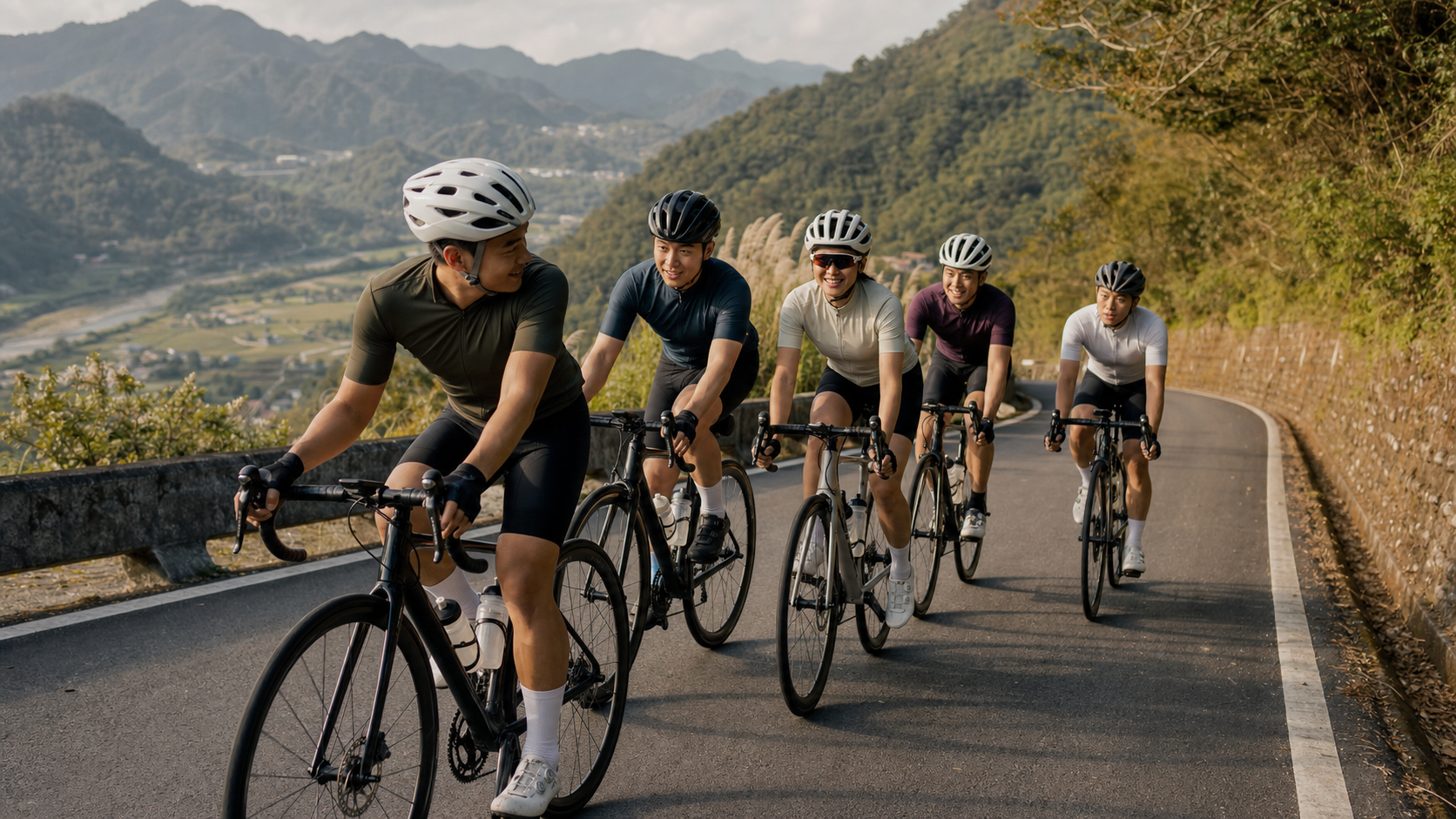
Group Cycling Challenge: Five Riders, One Hundred Kilometers, Built on Coordination and Teamwork
Introduction
I have four cycling friends: Ah-Wei, Xiao-Jie, Jian-Hong, and Ah-Ming. Our riding styles couldn’t be more different—Ah-Wei is the speed-obsessed racer, Xiao-Jie is a leisure rider who enjoys the journey, Jian-Hong is a data junkie (constantly staring at his power meter), Ah-Ming is the cheerful chatterbox who never stops talking no matter how tired he gets, and I’m somewhere in the middle, the coordinator type.
One autumn, we decided to take on a 100-kilometer challenge together. Five different personalities, five bikes of different levels, five different fueling habits—this combination sounded like a recipe for an argument. But by the end of that day, we all agreed it was one of the most special days of our friendship.
The Differences Between the Five of Us
Before setting off, we did an honest assessment:
| Rider | Fitness Level | Longest Ride | Main Strength | Potential Issue |
|---|---|---|---|---|
| Ah-Wei | Strong | 180km | Climbing | Tends to go too fast, doesn’t look back |
| Jian-Hong | Medium-Strong | 120km | Endurance | Overly reliant on data, prone to anxiety |
| Me | Medium | 100km | Steady Pacing | Average, no standout strength |
| Ah-Ming | Medium-Weak | 80km | Mental Toughness | Fitness is the bottleneck |
| Xiao-Jie | Weak | 50km | Strong Willpower | Slow pace, struggles on climbs |
The biggest challenge was obvious: the speed gap. Ah-Wei’s cruising speed is around 30km/h, while Xiao-Jie’s comfortable pace is about 20km/h. Over a long ride, this difference would cause serious fragmentation.
The Agreement Before Departure: Three Core Rules
To avoid the vicious cycle of “the fast wait, the slow chase,” we set three rules before leaving:
- Everyone waits at every rest stop: No one continues until all riders have arrived at each designated stop
- No pushing pace, no complaining: The fast riders don’t urge the slow ones, and the slow riders don’t apologize for themselves
- Prioritize the weakest on difficult sections: On climbs or tough terrain, the slowest member’s pace sets the pace for the whole group
These three rules sound simple, but executing them on the road is far more complicated than saying them.
The Early Section (0–40km): The Pain of Getting in Sync
The route started from Muzha in Taipei, heading toward Shenkeng and Shiding, then looping back. There were a few climbs in the early section.
The problem appeared on the first climb. Ah-Wei’s habit was to sprint before a climb, “powering through the hill,” while Xiao-Jie needed to slow down, shift to a lower gear, and grind up slowly. The result was Ah-Wei waiting at the top for nearly ten minutes.
He said he wasn’t impatient, but the silence while waiting made the atmosphere a bit tense.
The key turning point for building rapport:
Around the 25km mark, Ah-Ming’s rear tire was slightly under-inflated. We all stopped so Jian-Hong could top it up with a pump. That “unplanned” stop actually broke the slightly tense rhythm of the early section. Everyone stood by the roadside, drinking water, chatting. Ah-Wei told a terrible joke that made everyone laugh, and suddenly the mood relaxed.
I realized: “Spontaneous moments” are the best opportunities to build team cohesion.
The Middle Section (40–70km): Finding the Rhythm
The stretch from Shiding to Shenkeng was my favorite part of the entire ride. The road wound through the valley, the sound of the stream mixing with the hum of bike wheels, sunlight filtering through the trees.
On this section, we found an interesting way to divide the roles:
- Ah-Wei as the scout: On flat sections, he rode 200 meters ahead to check for obstacles, then waited for everyone
- Jian-Hong as the fueling clock: Reminded everyone to refuel every 20 minutes, based on his timer rather than how anyone felt
- Ah-Ming as the morale keeper: Started conversations on quiet stretches, or led the complaining (so others felt “I’m tired too, but I’m not the only one”)
- Me as the buffer in the middle: Kept communication flowing between the front and back of the group, making sure no one was left behind
- Xiao-Jie’s role: She set her own pace, and we adjusted to her
This division wasn’t planned—it evolved naturally. Everyone contributed in their area of strength, and the group’s operation became smooth.
The Late Section (70–100km): A Relay of Willpower
In the final 30 kilometers, the fitness gap began to show. Ah-Ming’s cadence visibly slowed, and Xiao-Jie had to walk her bike on a few sections (for her, just finishing was already a victory).
That’s when Ah-Wei did something that left a deep impression on me. He rode up beside Xiao-Jie, slowed to her pace, and started talking to her. Not big words of encouragement, just: “What’s good to eat near your place? What are you having when we get back?”
Xiao-Jie started talking, and that pace held for two kilometers, all the way to the next rest stop.
Words are the lightest form of fuel—sometimes more powerful than any energy bar.
The Moment We Finished
When we got back to the starting point in Muzha, the computer read 101.3 kilometers. All five of us made it. No one quit early, and no one truly regretted it.
We found a coffee shop and sat for three hours, going over every section of the ride. Ah-Wei said the waiting on the climbs taught him patience. Xiao-Jie thanked everyone for not pushing her. Ah-Ming said that without the rule of waiting for everyone, he might have been left behind long ago.
Practical Advice
- For group rides with mixed fitness levels, design the route based on the weakest member’s ability—don’t let anyone start beyond their comfort zone
- Communicating everyone’s needs and concerns in advance is far more effective than solving problems on the fly
- The rule of waiting for everyone at rest stops is a key mechanism for maintaining group cohesion
- Allow stronger riders to contribute while waiting (pumping tires, chatting, checking equipment) instead of just standing around
- The meal after the ride is crucial—it’s the real “climax” of the entire group ride
Conclusion
Riding 100 kilometers alone, you only have to battle yourself. Riding 100 kilometers with four others, you have to coexist with four different speeds, four kinds of fatigue, and four sets of fueling logic—while also making sure everyone feels it was a worthwhile experience.
That difficulty is far greater than riding 100 kilometers alone. And it’s also far more meaningful.
Related Reading
- Building and Managing a Cycling Community: From Individual Rider to Local Riding Group
- Forming a Cycling Group: How to Find Riding Partners That Suit You
- Precious Memories of Riding with Friends: The Bonds Words Can’t Express on Mountain Roads
- Group Riding Skills and Coordination: Hand Signals, Drafting Distance, and Avoiding Chain-Reaction Crashes
2019 夏季KOM 5小 完賽心得 準備攻略 東進武嶺 夏季登山王之路 Taiwan KOM Challenge
7 年前
三鉄共購百人風中劍/ feat. 單車小D、Doris 、城希、Ruby、Ada/ 公路車 / CT Yeh
2 年前
彰化經典百K 多視角衝刺實錄 | 范老師高鐵 NEKO's Fun Eva | 公路車
5 年前
4K 東眼山 x 水蜜桃冰沙 百人單車約騎! 操完再吃冰 多爽快
7 年前
靠單車減肥35公斤 心得分享與整理
7 年前
2024 如來神掌 百人約騎挑戰!feat. 秘境單車社團 / 神人們太可怕 / 全程錄影 x 完整坡度解析 / 公路車 / CT Yeh
2 年前
2023 時代騎輪節挑戰全記錄 / VB小隊 / 差點被收掉... / Remix 第一集團 / 公路車 / CT Yeh
2 年前
Live) 備戰2019彰化經典百K 賽前攻略 (已完賽請看新影片
7 年前