First Bicycle Camping: A Bikepacking Beginner’s First Night in the Wild
Introduction
My first bikepacking trip was a semi-impulsive decision. A friend shared a bikepacking travelogue from a Japanese rider, and those photos of pitching a tent at the edge of a forest and washing feet by a stream suddenly sparked an intense urge in me: “I want to do this too.”
The problem was: I had absolutely no camping experience. I had never spent a night outdoors alone, owned no tent, didn’t know how to build a fire, and had only a vague understanding of wilderness safety. Bikepacking looked incredibly fun, but also incredibly unfamiliar.
This article is about that unfamiliar first time: it was harder than I expected, and more beautiful than I expected.
What is Bikepacking?
Bikepacking is a style of travel where you pack lightweight camping gear onto your bicycle and ride and camp self-sufficiently in the wild. Its differences from traditional bicycle touring are:
| Comparison Item | Bikepacking | Traditional Bicycle Touring |
|---|---|---|
| Load method | Distributed across handlebar bag/saddle bag/frame bag | Front and rear racks + panniers |
| Route preference | Gravel roads/trails/off-road routes | Primarily paved roads |
| Trip pace | Slower, emphasizing experience | Can be fast or slow, depending on the route |
| Gear weight | Lightweight is the core | Comfort takes priority |
| Barrier to entry | Requires basic camping knowledge | No camping knowledge needed |
The core spirit of bikepacking is “light, flexible, self-sufficient,” with gear weight typically kept within 10 kg (excluding water and food).
Gear Preparation: Shopping from Scratch
For this bikepacking trip, I spent about two months researching gear. Here is my first-time equipment list:
Essential Gear:
- Tent: Lightweight one-person tent (approx. 1.2 kg), quick to pitch and strike
- Sleeping bag: Down sleeping bag (comfort rating 10°C), weighing about 500 g
- Sleeping pad: Inflatable lightweight sleeping pad, packs down to fit in the saddle bag
- Cooking gear: Lightweight titanium cookware set + camping stove + fuel canister
- Water filter: Lightweight outdoor water filter (Taiwan’s mountain areas have abundant water sources, so you can filter on-site)
- Tool kit: Spare tubes ×2, puncture repair tools, multi-tool
Bag System:
- Handlebar bag (approx. 10 L capacity): holds the tent and sleeping bag
- Saddle bag (approx. 12 L capacity): holds cooking gear and clothing
- Top tube bag (approx. 1 L capacity): holds phone, energy bars, small tools
- Frame bag (approx. 4 L capacity): holds water bladder and emergency supplies
Total load was about 9.5 kg, plus water and food brought it to roughly 12 kg—lighter than I expected (because I chose lightweight gear), but still clearly noticeable on climbs.
Route Selection: A Beginner’s Caution
For my first bikepacking trip, I chose the mountain route in Jianshi Township, Hsinchu. Starting from Zhudong, I followed Provincial Highway 120 into Jianshi, stayed overnight at a legal campsite near Yufeng Village, and returned the same way the next day—about 80 km round trip with roughly 1,500 meters of climbing.
Reasons for choosing Jianshi:
- Familiar road conditions, with complete paved roads, suitable for a first loaded ride
- Supply points along the way (Guanxi, Jianshi), keeping resupply pressure low
- The campsite had basic facilities (restrooms, water source), reducing the risk of a first-time camping experience
- Not far from Taipei, so problems could be handled relatively quickly if anything went wrong
Departure Day: Harder Than Expected
Setting off from Zhudong at 7 a.m. with 12 kg of gear, the riding felt completely different from my usual rides.
First shock: The weight
On climbs, I could clearly feel the weight behind me with every pedal stroke. My climbing speed dropped by about 25–30%, and a section I estimated at three hours took four. This triggered my first moment of doubt mid-route: “Did I pick a route that’s too hard?”
Second shock: Rethinking pacing
The pacing logic of bikepacking is completely different from regular riding. You’re not “getting to the destination as fast as possible”—you’re “moving with all your survival gear.” This mental shift takes time; it took me about an hour to truly accept: slow is normal, slow is right.
The First Night in the Wild: More Beautiful Than Expected
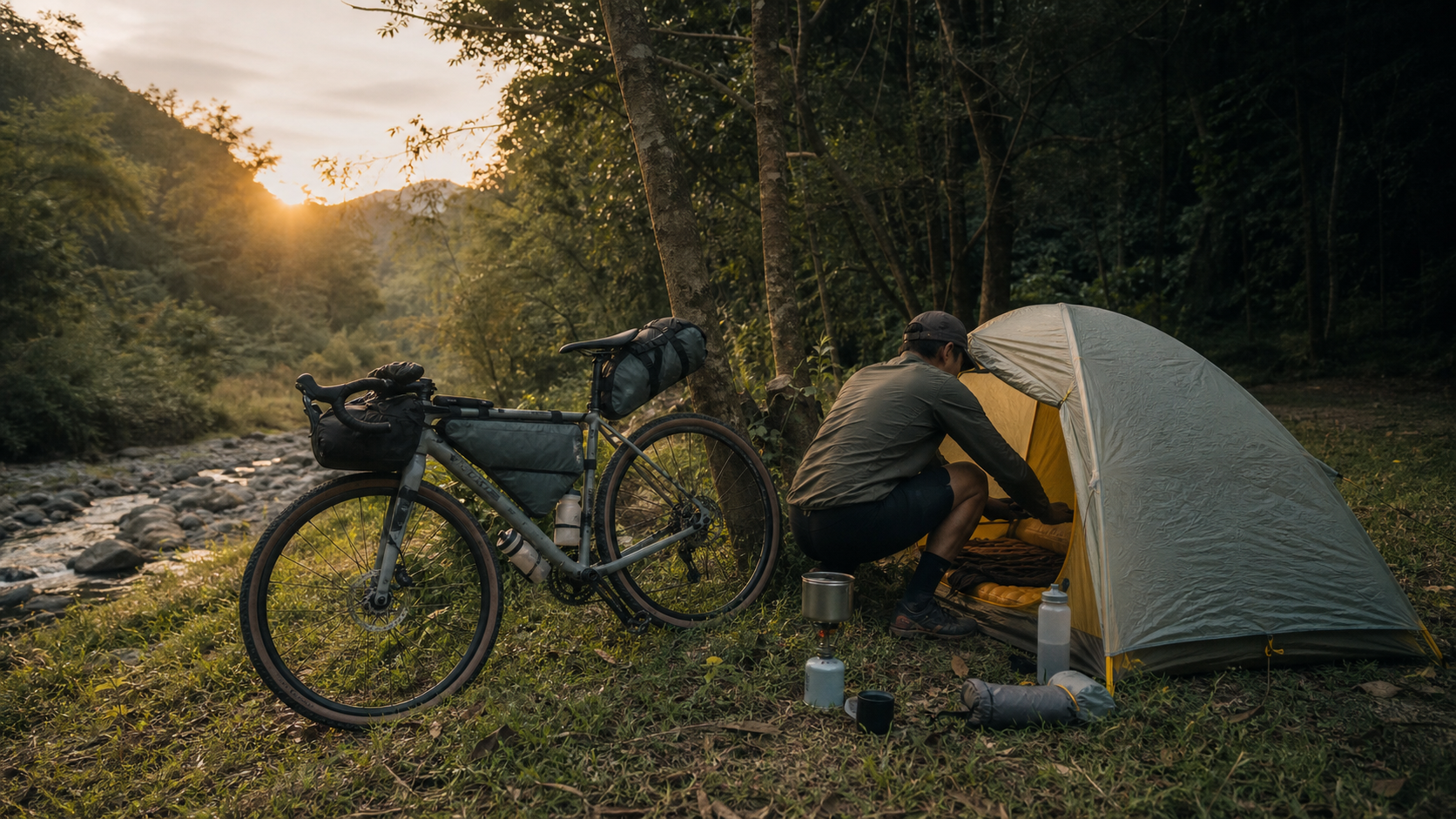
I arrived at the campsite in Yufeng Village at 4:30 p.m. Pitching the tent took about 30 minutes (a flustered first attempt), I cooked a packet of instant dried rice on the stove, and after eating, I sat on the grass outside the tent, watching the dusk settle over the valley.
The light that evening was among the most beautiful I’ve seen in my cycling life. Not because it was particularly spectacular, but because I had earned it with a full day of pedaling—it was mine.
Nighttime scares and getting used to it:
At night, the activity of wild animals in Taiwan’s mountains made me uneasy. Hearing rustling in the grass made my heart race—it turned out to be a squirrel. Lesson learned: hang food high or keep it inside the tent; don’t leave it on the ground where it attracts animals.
At 4:30 a.m., I woke naturally to birdsong. Crawling out of the tent, I saw a sea of clouds in the valley—at that moment, all the effort was worth it.
The Importance of Lightweight Gear
The first lesson of bikepacking: every gram counts. Here are my gear optimization insights:
- The tent offers the biggest weight-saving opportunity; every 100 g saved helps on climbs
- Sleeping bag choice: Taiwan’s summers allow a thin bag; only winter requires a heavier insulated one
- Cooking gear can be simplified: I brought too much the first time; next time I only need one pot and one stove
- Minimize clothing: Two quick-dry shirts are enough; if the forecast is good, you can skip the rain jacket (but it’s advisable to bring one anyway)
Practical Advice
- For your first bikepacking trip, choose a campsite with facilities; don’t challenge wild camping right away
- Practice pitching your tent at home once before you go; setting up in the dark is a common frustration for beginners
- Taiwan’s mountain areas have abundant water sources; bringing a water filter reduces the weight of water you need to carry
- Inform family or friends of your detailed itinerary; cell reception in the mountains can be unreliable
- A backup power bank for your phone is just as important in bikepacking
Conclusion
That first night of bikepacking taught me something: a bicycle isn’t just a commuting tool, isn’t just racing equipment—it can be your way of moving through the world.
Riding a bike carrying everything you need, finding a patch of grass to call home in an unfamiliar place, falling asleep in a night free of phone notifications, waking to birdsong before dawn—this sense of life’s basics is something city living can never give you, no matter how hard it tries.
Next time, I’ll ride farther, and sleep deeper in the mountains.
Related Reading
- Bicycle Camping (Bikepacking) Beginner’s Guide: Lightweight Gear and Recommended Taiwan Routes
- Bicycle Camping Beginner’s Guide: Bikepacking Gear Checklist and Recommended Taiwan Routes
- Bicycle Touring Gear Checklist: The Packing Philosophy of a Week’s Luggage for Bikepacking
- The Minimalism of Bicycle Travel: The Lightweight Travel Philosophy of One Bike and One Bag
單車 一日北高 ( 雙城 ) 肥宅雙人瘋狂行 紀錄片 REACTO
10 年前
北宜騎車⋯好刺激 差點被🐒尻 / 露營單車旅 / 公路車後背攜車架開箱!/ 百人大團露 / YAKIMA 設備開箱儀式感都來了 / 公路車 / CT Yeh
12 個月前
南竿 單車 | 老婆公路車首航 | 偽出國體驗 | 4K 高畫質 | 綠色騎跡低碳輕旅遊 | #公路車
5 年前
單車賞雪 裝備準備及注意事項分享 | 公路車
5 年前
日本自助單車旅,茨城絕景路線/ 新手也可以體驗 / 4K空拍絕景 / 機票省錢大法 / 單車友善旅館 / 國家級霞之浦180K自行車道 / feat. 緯緯 / CT Yeh
1 年前
靠單車減肥35公斤 心得分享與整理
7 年前
荷蘭 Rapha 租公路車 騎 阿姆斯特丹 Amsterdam Rapha Cycling Club Bike Hiring
6 年前
2023自行車展!與環台賽選手一同表演賽 / 全自動AI Fitting?/ TIME新車發表/神秘充電桌等 精華分享 VLOG | CT Yeh | 公路車
3 年前