Night Swimming Challenge Record: A Safe Night Swimming Experience Accompanied by Glow Sticks and Rescue Boats
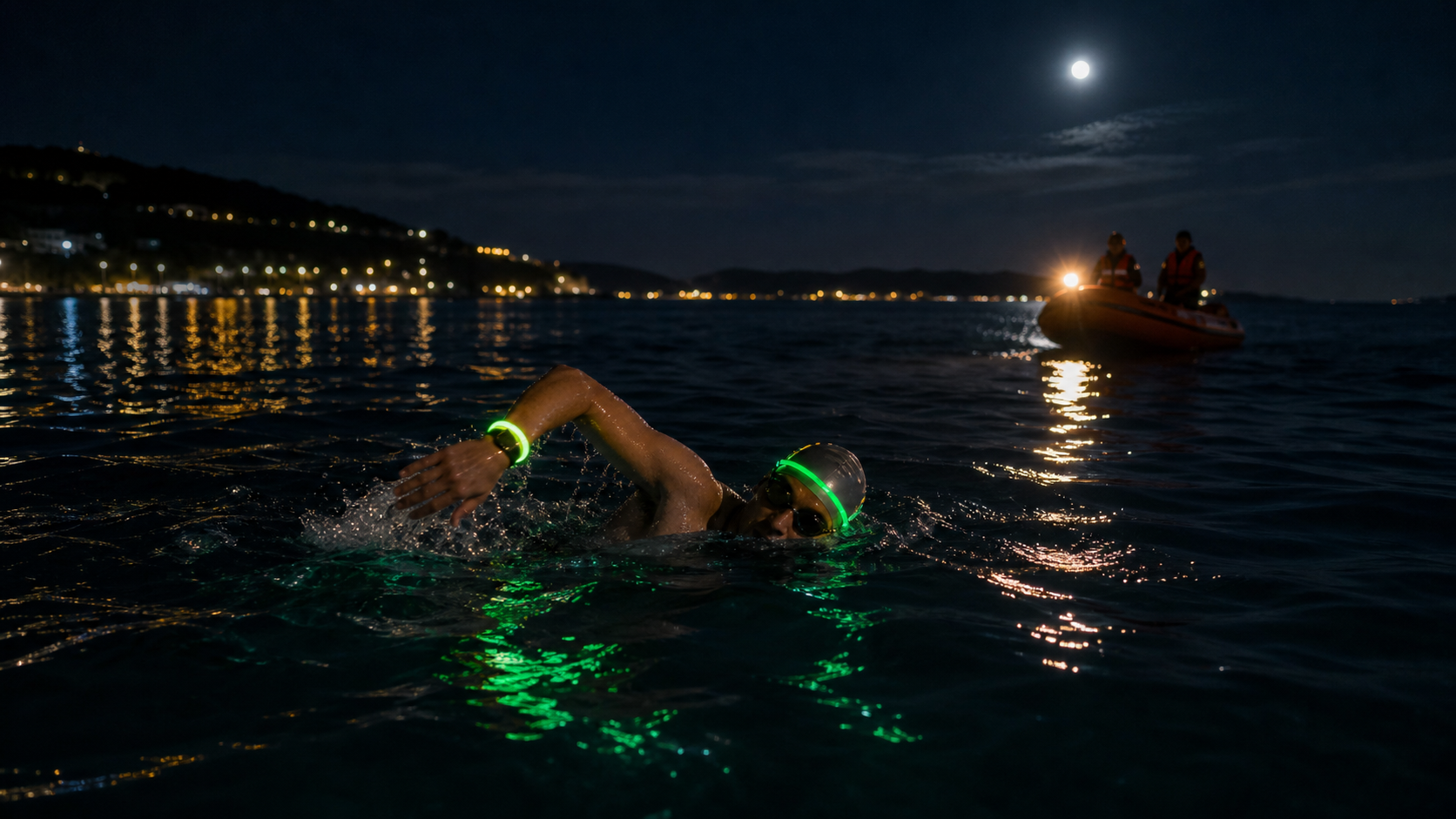
Night Swimming Challenge Report: A Safe Night Swimming Experience Accompanied by Glow Sticks and Rescue Boats
Introduction
The moment I entered the water, my eyes needed a few seconds to adjust. The lights on shore formed several golden beams across the water’s surface, stretching forward before dissolving into the darkness. The glow stick on my left wrist emitted a green light, leaving an arc in the water with every stroke of my arm.
The first sensation of night swimming is a peculiar sense of solitude—not the kind born of fear, but a pure, intimate feeling of “just you and the water.” Swimming during the day, your field of vision includes distant mountains, landmarks, and other swimmers; at night, all of that disappears, leaving only the sound of water, your breathing, and the faint glow of the glow stick in the dark.
Why Do Some People Choose Night Swimming?
Night swimming isn’t a mainstream way to swim, but more and more swimming enthusiasts are adding it to their “must-try” list. Reasons include:
- Sensory recalibration: With the loss of visual dominance, hearing and proprioception are heightened, offering a unique training method for improving technique
- Escaping the heat: In Taiwan’s summer, daytime water temperatures are high and sunlight is intense, making nighttime swimming more comfortable
- A unique aesthetic experience: Bioluminescence on the dark sea surface, reflections of city lights, and star-filled skies are sights you won’t see when swimming during the day
- Challenging psychological boundaries: For those unfamiliar with dark environments, night swimming offers a safe, controlled opportunity for psychological breakthrough
Safety First: Preparation Standards for Night Swimming
The safety standards for night swimming are far higher than those for daytime swimming. Our night swimming event was organized, and here is the complete safety configuration:
| Safety Element | Specification | Description |
|---|---|---|
| Glow sticks | At least 2 per person | Wrist + swim cap, for position identification |
| Waterproof light | Waist-mounted flashing light | Active light source, visible from greater distances in the dark |
| Inflatable float | One per person | For resting + emergency identification |
| Rescue boat | 1 boat per 5 people | Follows throughout, equipped with a searchlight |
| Shore observers | At least 2 people | Maintain visual contact, equipped with two-way radios |
| Communication device | Waterproof whistle | For emergency calls |
| Number of swimmers | Minimum 4 | Solo or duo swimming is prohibited for nighttime activities |
These configurations are not excessive caution but rather the basic threshold for night swimming safety. Risks such as drifting underwater, hypothermia, and disorientation all increase significantly at night; adequate safety gear is the prerequisite for enjoying the night swimming experience.
Technical Challenges of Night Swimming
Orientation becomes significantly harder
During the day, you can use distant landmarks like mountains and lighthouses for orientation; at night, most of these landmarks disappear or become harder to identify. Our solution: the rescue boat stays at key points along the route, using its lights as a forward target.
Psychological adjustment for breathing
When breathing in dark water, you sometimes can’t clearly tell whether “what’s above is air or water.” This lack of visual information can cause slight hesitation at the moment of turning to breathe. The training approach is: trust the timing of your breath rather than waiting until you “see clearly” to breathe.
Changes in speed perception
Without landmarks for reference, your sense of speed nearly disappears. Many people feel they are swimming slowly during night swimming, only to check their GPS records afterward and find the pace was similar to daytime. It’s a fascinating perceptual bias.
- Do adequate adaptation before entering the water: stand on the shore with lights off for 1-2 minutes to let your eyes adjust to the dark
- Don’t rush to start; let your heart rate and breathing stabilize first
- Confirm the direction of the rescue boat’s lights to establish a “forward reference point”
Unexpected Beauty During Night Swimming
On that night swim, at around the 400-meter mark, the swimmer next to me suddenly said, “Quick, look to the left!”
I turned my head and saw a faint blue-green glow in the water. It was the light of bioluminescent algae—in areas with high nighttime plankton density, every stroke activates them, creating a momentary glow effect in the water.
That image is one of the most beautiful sights I’ve seen in my swimming career. With every stroke of your hand, you briefly light up a short arc of blue light in the darkness, which then fades away. It felt like briefly creating something in the dark and letting it freely disappear.
Recommendations for Joining Night Swimming Events
- Don’t organize night swimming yourself: For your first night swim, be sure to join an organized event with rescue provisions
- Inform your family of your plans: Include the location, estimated end time, and emergency contact
- Don’t night swim in unfamiliar waters: Only consider nighttime activities in venues you already know well during the day
- Avoid alcohol or excessive fatigue before night swimming: Judgment and reaction time matter even more at night
- Be stricter with weather condition assessments: Weather changes at night are harder to detect in real time than during the day
Conclusion
After getting back on shore, everyone gathered on the beach, and no one spoke yet. That black expanse of sea was still there, calmly reflecting the starlight, completely indifferent to the fact that a few humans had just swum across its surface for half an hour.
Night swimming taught me this: swimming is not just a sport that moves the body; it’s also a way of perceiving the world. The darkness removes all the visual information that usually distracts you, leaving only the most essential things: water, breathing, moving forward.
On that night, that was enough.
Related Reading
- Night Swimming Techniques in Open Water: Glow Sticks, Light Signals, and Safety Guidelines
- The Joy of Swimming Alone: Meditation and Self-Dialogue for Solo Swimmers
- The Allure and Cost of Night Riding: Safety Guidelines and Real Experiences on Dark Highways
- Open Water Swimming vs. Pool Swimming: Key Differences in Feel, Technique, and Training Strategies
2026 輪霸西濱200K 挑戰VLOG / 第一集團 / 首次參加..經驗不足、膀胱不足 /死守6H內 / AI戰鬥力顯示系統 / 公路車 / CT Yeh
4 個月前
一輪盃環湖挑戰賽 | TIME新車首航 | 一輪帶我飛 | 百萬流量都在場 | 4K畫質 | 公路車 | CT Yeh
3 年前
單車 一日北高 ( 雙城 ) 肥宅雙人瘋狂行 紀錄片 REACTO
10 年前
備戰 戀戀197 賽前關門點分析 西濱團練 #公路車 4K高畫質
6 年前
[防寒衣體驗] 鐵人魂 三鐵 防寒衣試穿會 於松運 深水游泳池 鯨魚池
8 年前
2023自行車展!與環台賽選手一同表演賽 / 全自動AI Fitting?/ TIME新車發表/神秘充電桌等 精華分享 VLOG | CT Yeh | 公路車
3 年前
CT暗黑廚房) 車友必備 宇宙無敵鮮蚵湯 幫助訓練恢復 天然食補 好市多 超肥鮮蚵 破PR
7 年前
水金九不厭五分 10度寒流冷到不願停!feat. 卡卡 / 公路車 / CT Yeh
6 個月前