Overseas Swimming Events: Cultural Experience and Technical Observations from Participating in the Okinawa Swimming Race in Japan
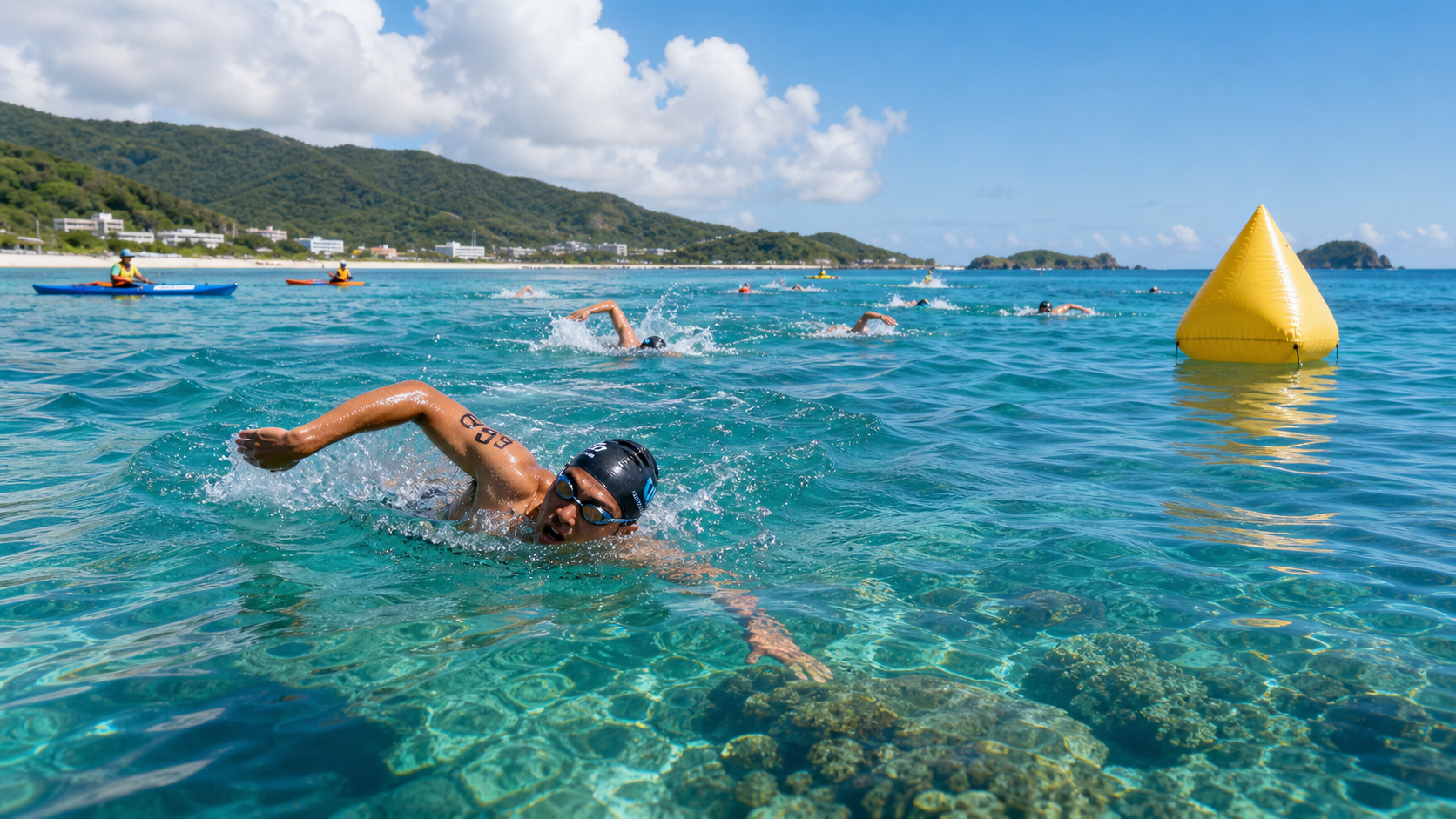
Overseas Swimming Event: Cultural Experience and Technical Observations from the Okinawa Open-Water Swim in Japan
Introduction
There is a kind of swimming called “swimming in someone else’s sea.”
The waters of Okinawa and the waters of Taiwan are both blue, but when you swim in that water, the experience is completely different. The language is different, the culture is different, the organization is different, and even the pre-swim warm-up music for athletes is J-pop—these differences together form a unique “swimming abroad” experience.
My initial motivation for joining this open-water swim in Okinawa was simply “wanting to try swimming in a different sea,” but what I brought back was far richer than I expected.
Registration and Administration: The Meticulousness and Complexity of Japanese Events
The registration process for Japanese swimming events is the most meticulous I have ever encountered. The form requires you to fill in: emergency contact phone number (requiring a domestic Japanese number or an attached “international emergency contact method” explanation), self-assessment of swimming ability, insurance options, and food allergy declarations.
This level of detail was somewhat unfamiliar to me as someone from Taiwan, but at the same time, I could feel how much the organizers prioritize athlete safety. Behind every detail lies a corresponding safety consideration.
| Comparison Item | Taiwan Events | Okinawa Events |
|---|---|---|
| Registration Process | Online form, 3-5 minutes | Detailed application, 15-20 minutes |
| Check-in | Usually 1-2 days prior | Morning of the race, very punctual |
| Safety Measures | Adequate but slightly loose | Very intensive, one rescue boat every 50 meters |
| Announcement Language | Chinese | Japanese (with English interpreter) |
| Aid Stations | Simple drinks | Japanese bento boxes, hot tea, local sweets |
The Sea of Okinawa: Technical Observations
Okinawa is located at the southwesternmost tip of Japan, with water temperatures reaching 29-30°C in summer. The clarity of the water is astonishing—while swimming, I could clearly see coral reefs 8-10 meters below the surface. The psychological effect of that visibility is very positive: when you can see the bottom, you don’t fear the depth.
In terms of currents, the sea currents in Okinawa are more regular than those in Taiwan’s Penghu area. Unlike the unpredictable lateral currents of the Taiwan Strait, they are easier to predict and compensate for.
Technically, the biggest lesson from the Okinawa event was observing the swimming style of Japanese athletes:
- Slower but more complete stroke cadence: Japanese open-water swimmers generally have a lower stroke rate than Taiwanese swimmers, but each stroke covers a longer pull distance, resulting in greater overall efficiency
- Fewer breathing exchanges: Many athletes breathe only every three to four strokes, with extremely efficient breathing technique
- More precise turning technique: The radius around the buoy is very small, almost “hugging the buoy” through the turn, far more efficient than the wide arcs I commonly see Taiwanese swimmers take
Cultural Experience: Japanese Details in a Swimming Competition
The details of the Japanese event left a deep impression on me:
The Ultimate Expression of Punctuality Culture
The event schedule was precise to the minute, with every wave’s start time executed exactly as planned. Fifteen minutes before the start, the announcement said “All athletes in this group, please take your positions”; at 10 minutes, “Starting soon”; at 5 minutes, “Check your equipment”; at 1 minute, “Get ready.” This level of precision is quite rare in Taiwanese events (including the many I have participated in).
The Thoughtfulness of Aid Stations
The aid stations weren’t just a few bottles of sports drink on a table. There were staff members handing out supplies, a designated order for taking items (to prevent athletes from crowding together), and backup supplies for athletes at the back of the pack. The food after getting out of the water included Okinawan specialty purple sweet potato candy, hot tea, and a traditional mochi whose name I couldn’t even pronounce.
The Culture of Respect Among Athletes
In the water, when Japanese athletes bumped into you, many would nod in acknowledgment during lulls (such as when resting against the buoy line). That atmosphere of “maintaining courtesy even during competition” is something I have rarely experienced at Taiwanese events.
The Fun and Challenge of Language
Not speaking Japanese was more troublesome than expected during the race, but also more interesting:
- At check-in, I managed with Google Translate and hand gestures, and the staff were extremely patient
- I couldn’t understand the announcements, so I could only watch the Japanese athletes around me and follow their actions (which worked surprisingly well)
- I “conversed” with a Japanese athlete next to me at the aid station, relying entirely on facial expressions and thumbs-up, and somehow we conveyed complete encouragement
The language barrier made me more observant of my surroundings and others than usual, which actually created a peculiar state of focus.
Observations and Changes I Brought Back to Taiwan
This trip to Okinawa brought back several concrete changes:
- Adjusting stroke cadence: I began practicing the completeness of each stroke rather than high-frequency, rapid stroking
- Breathing interval practice: Deliberately practicing breathing every four strokes in training to extend breathing intervals
- Turning technique drills: Making the radius around the buoy a key focus of training
The biggest change was psychological: Taiwanese events are familiar, and familiarity can sometimes be an obstacle to improvement. In Okinawa, everything was new, forcing my observation and learning abilities to operate at maximum capacity. That state carried back to Taiwan and sustained my training motivation for several months.
Practical Advice: Planning an Overseas Swimming Event
- Registration deadlines are usually much earlier than in Taiwan—act promptly once confirmed
- Prepare swimming ability documentation in English and Japanese (required by some events)
- Attach destination insurance certificates; Japanese events typically have strict requirements
- Choose travel insurance with “participation in sports competitions” as an additional coverage
- Arrive early to acclimate to the local waters; don’t wait until race day for your first swim
Conclusion
Swimming in the waters of Okinawa—that blue so clear you could see the coral reefs, and the Japanese athletes you didn’t know but who cheered you on with thumbs-up—formed a memory that is hard to fully replicate in words.
Swimming is not just a sport; it is a language. In any country, in any sea, when you dive in and swim, you begin a shared dialogue with that place. Okinawa’s sea, thank you for your hospitality.
Related Reading
嘉義大埔、阿婆灣挑戰賽,美到以為在日本!ft. 環騎5 Cool 西拉雅188 / 公路車 / CT Yeh
7 個月前
日本島波海道 EP2 / 自行車神社拜什麼?/ 整天都大景 太離譜啦!/大三島 to 尾道/公路車 / CT Yeh
2 年前
第二屆 海鷗繞圈賽 / 桃園團體城市繞圈賽!多視角實況精華版 | | 訪問才是最好笑的 | 公路車 | CT Yeh
3 年前
小野田真的存在!日本赤城山爬坡公路賽 台灣首發團完全實錄 | 頭文字D真實賽道! | 看完東奧自行車賽後好想再去騎一次啊! | 公路車 | CT Yeh
4 年前
2023桃園團體繞圈賽 / 海鷗繞圈賽 | 全程空拍數據版 | 公路車 | CT Yeh
2 年前
[海外單車] 日本 茨城 霞之浦單車 銀杏 慢遊體驗
7 年前
秘境雪場 日本 八甲田 冰樹探險與滑雪體驗 ft. Q老師 & 運動生活
7 年前
日本自助單車旅,茨城絕景路線/ 新手也可以體驗 / 4K空拍絕景 / 機票省錢大法 / 單車友善旅館 / 國家級霞之浦180K自行車道 / feat. 緯緯 / CT Yeh
1 年前