The Psychological Challenges of the Taroko Gorge Marathon: Balancing the Gorge's Oppressive Feel with Scenic Inspiration
Introduction
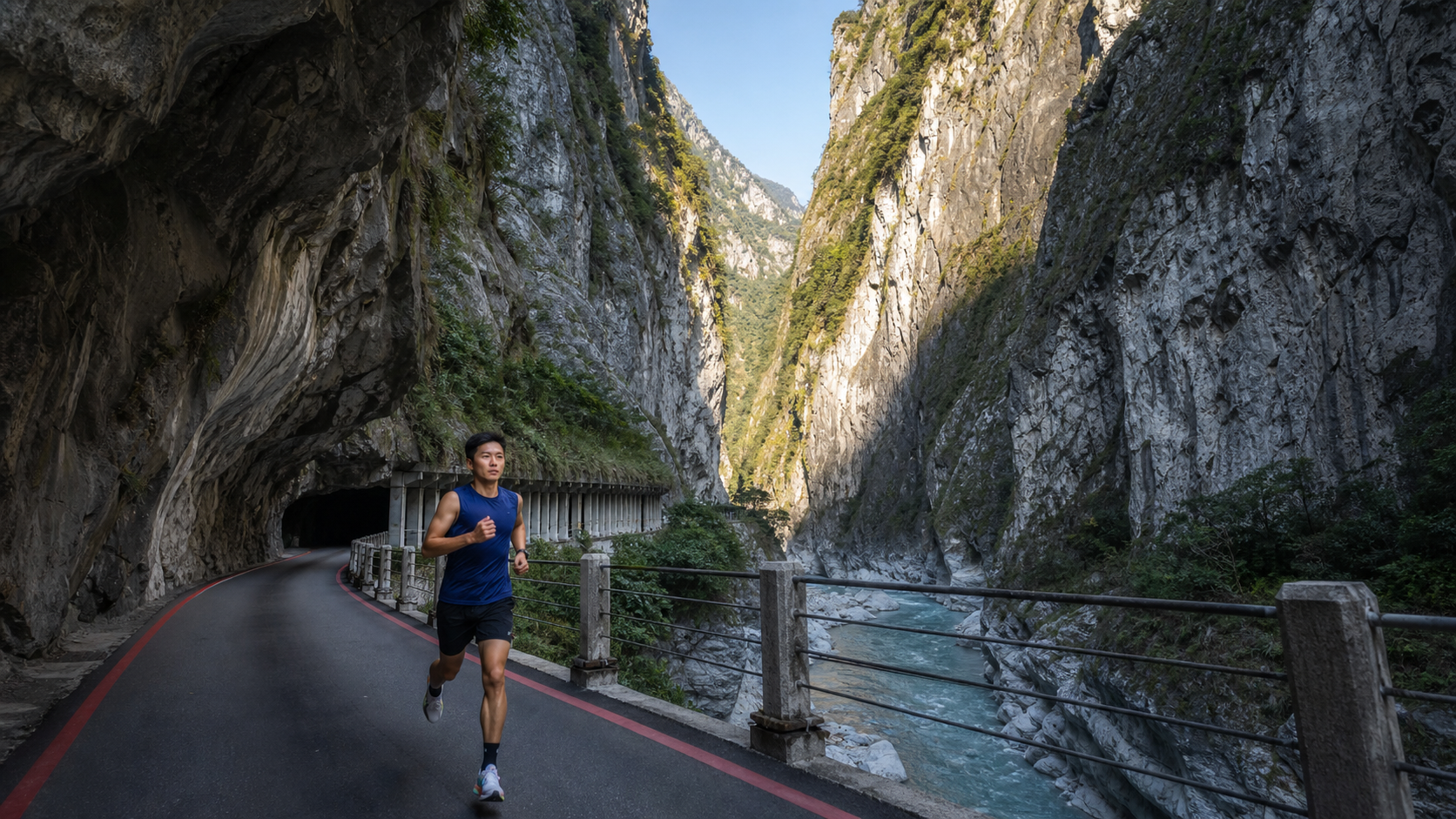
Every October, the Taroko Gorge Marathon takes place in Taroko National Park in eastern Taiwan. It is a world-class mountain marathon—runners traverse the Central Cross-Island Highway, flanked by vertical marble cliffs, with the rushing Liwu River below and a sliver of sky overhead. This course is arguably the most beautiful in Taiwan and all of Asia, but “the most beautiful” also means “the most psychologically challenging.”
Unlike flat city marathons, the psychological challenge of the Taroko Marathon stems from three unique aspects: the physical oppressiveness of the gorge, the physical impact of elevation changes, and the emotional swings triggered by the magnificent scenery. Finding a balance among these three is the core task for finishing the race.
The Psychogeography of the Gorge
Taroko’s cliffs reach up to 300 meters high. When entering the gorge, many runners feel an indescribable sense of pressure—the sky narrows, the field of vision is restricted, and sounds are amplified (the sound of rushing water, the escort vehicles’ signals, the footsteps of other runners).
This feeling originates from human evolutionary instincts: narrow terrain with limited visibility triggers a mild alert response. Its effects on runners include:
- Unconsciously increasing muscle tension, raising energy expenditure
- Attention being drawn to the terrain, affecting pacing focus
- Feeling claustrophobic discomfort in tunnel sections (the Central Cross-Island Highway has multiple tunnels)
| Special Course Environment | Psychological Effect | Coping Strategy |
|---|---|---|
| Vertical cliffs (0–10K) | A mix of pressure and awe | Actively appreciate the “spectacle” rather than feeling “oppressed” |
| Tunnel sections | Claustrophobia, amplified sound, loss of vision | Adjust breathing beforehand, consciously relax the shoulders |
| High-point sections (best views) | Excitement may lead to loss of pace control | Set “scenery moments” for photos only, no speeding up |
| Downhill sections | Excitement may lead to overestimating ability | Conservative pacing, save energy for the later climbs |
| Headwind on the return | Increased mental fatigue | Accept the headwind in advance, use cadence instead of speed |
The Double-Edged Sword of Scenic Inspiration
Taroko’s scenery is a double-edged sword:
Positive Effects
The grandeur of the landscape can trigger “awe,” a psychological state that has been well studied. It can:
- Temporarily suppress self-centered thinking (making you forget how tired you are)
- Enhance feelings of gratitude and well-being
- Increase immersion in the present moment
- Provide a strong sense of “it’s worth it” during fatigue
Many runners report that on certain sections of the Taroko Marathon (especially when a panoramic view of the gorge suddenly appears around a bend), they experience a joy that transcends physical exhaustion, feeling “very small, yet very lucky to be running here.”
Negative Effects
However, the scenery also has its psychological pitfalls:
- Excessive distraction: Constantly turning your head to look at the scenery disrupts your stride rhythm and compromises foot safety
- Energy rhythm disruption from “photo stops”: Frequently stopping to take pictures breaks the running cadence
- The false intuition of “it’s so beautiful, I should run faster to etch it into memory”: Excitement leads to overly fast pacing in the early stages
- Psychological monotony from similar scenery in the latter half: After 20 kilometers of cliffs, the “novelty” fades, ironically making runners feel more fatigued
Special Psychological Preparation for Mountain Marathons
Psychological Strategies for Climbing
The Taroko Marathon features significant elevation changes, and the climbing sections are prime zones for mental breakdowns. Effective psychological strategies for climbing:
- Change the goal: Switch from “maintaining pace” to “maintaining heart rate” or “maintaining breathing rhythm” during climbs
- Accept “power hiking”: Beyond a certain gradient, walking is more energy-efficient than running. Accept that walking is not failure, but a strategy
- Visual anchors for proximal goals: Find a target within 50–100 meters on the road (a rock, a turn), run only to that point, then find the next one
Psychological Coping for Tunnels
The tunnel sections of the Central Cross-Island Highway pose a special challenge for runners prone to claustrophobia:
- Take deep breaths before entering the tunnel, telling yourself “I’ll be out of here in about X minutes”
- Increase your pace inside the tunnel (usually there are other runners to follow), shortening the time spent inside
- Treat the light at the tunnel’s exit as a “target” and run toward it
The Psychological Impact of Weather
The weather at the Taroko Marathon is highly variable. The gorge’s microclimate can present drastically different temperatures and wind conditions within just a few kilometers. Mental preparation:
- Research recent years’ weather records before the race to build a psychological foundation of “I’m prepared for any weather”
- View adverse weather as “an element that adds to the story,” rather than “an increase in the challenge”
The Psychological Advantage of Taiwanese Mountain Marathon Runners
Taiwan’s unique terrain gives Taiwanese runners a natural psychological advantage in mountain marathons—most Taiwanese runners have grown up in mountain forests and possess an instinctive affinity for mountainous terrain. Fully utilize this familiarity during preparation: do multiple training runs in Taroko or similar gorge terrain, allowing both body and mind to “get to know” the environment.
Practical Advice
The “Scenery Savings” Strategy: During training, deliberately choose beautiful routes to run on, but “moderate” the frequency of stopping to admire the view. Practice “appreciating while running, but not stopping,” making the enjoyment of scenery a part of running, rather than an interruption to it.
Pre-race Reconnaissance: If possible, one or two months before the race, do a “preview run” or hike in Taroko, so that the gorge’s oppressive feeling is normalized before the actual race, no longer an unknown psychological factor.
Conclusion
The Taroko Gorge Marathon is one of the most precious experiences in Taiwan’s running culture. Those cliffs, that Liwu River, that sliver of sky—they are not just a backdrop; they are the soul of this race. When you learn to dance with the gorge—neither oppressed by it nor lost in its scenery—you will be running not just a marathon, but engaging in the most profound dialogue with the land of Taiwan.
Related Reading
- Taroko Gorge Marathon: An Ultimate Challenge in a Majestic Gorge
- Taroko Gorge Marathon: Climbing Strategies and Altitude Adaptation for a Mountain Race
- Taroko Gorge Marathon Guide: Climbing Strategies and Breathtaking Scenery on a Mountain Course
- Taroko Gorge Marathon In-Depth Review: A Dreamlike Run Through a World-Class Gorge
台灣登山王之路 KOM 全程參賽4K臨空錄影 PART1 穿越峽谷地形! #東進武嶺 太魯閣 / 燕子口 / 天祥 / 西寶 PART1 (公路車 / CT Yeh)
3 年前
2023 夏季KOM 參賽實況 / 穿越空拍視角 / 整車都凸台 / 太魯閣峽谷x合歡山絕美大景 / 東進武嶺 / Taiwan KOM Challenge / 公路車 / CT Yeh
3 年前
新竹羅平 x 天湖部落 大禹嶺級變態陡坡! 4K超高畫質 空拍 | 公路車
5 年前
大武山後門26%歡樂陡坡!JJSC南台灣單車行Day2 / 被颱風追著跑 / 公路車 / CT Yeh
2 年前
台北闊瀨陡坡 騎旅 / 日本單車雜誌編輯車友臨時加入!/ 髮香才是最強的 / feat. 北迴歸線小隊 / 公路車 CT Yeh
6 個月前
觀霧 變好騎了! | 北高車友爆笑大會師 | 公路車 | 單車旅遊 Taiwan Cycling Route GuanWu
6 年前
#北橫 + #北進武嶺 最硬的員工旅遊 EP1 | #公路車 #拉拉山 | 明池 | 武嶺 | 武陵農場 | 雲海 | Taiwan Cycling Route Wulin
6 年前
萬年峽谷! 30% 超激陡坡 里佳部落DAY2 還是很硬! | 公路車 | CT Yeh
3 年前