Introduction
Two days before the 2019 Taipei Marathon, the weather forecast showed that race-day temperatures could exceed 27°C—unusually warm for Taipei in December. Many runners had trained in 10–15°C conditions, and this news triggered widespread psychological turmoil: Was all the preparation wasted? Did their goals need adjustment?
Weather has significant physiological effects on marathon performance: in high heat, heart rate rises, sweating increases, and energy expenditure is greater; rain makes clothing heavier, the ground slippery, and temperature regulation more difficult; strong winds not only add physical resistance but also create constant psychological drain. However, research shows that the psychological impact of weather on performance is often greater than the physiological impact—runners who are “well mentally prepared for the weather” finish at significantly higher rates and with better times under the same adverse conditions than runners who are “intimidated by the weather.”
The Psychological Impact Mechanisms of Weather on Runners
| Weather Condition | Physiological Impact | Psychological Impact | Common Erroneous Reaction |
|---|---|---|---|
| High Heat (>22°C) | Elevated heart rate, accelerated dehydration | Anxiety, pace loss, premature giving up | Trying to maintain “normal pace” early on, then collapsing later |
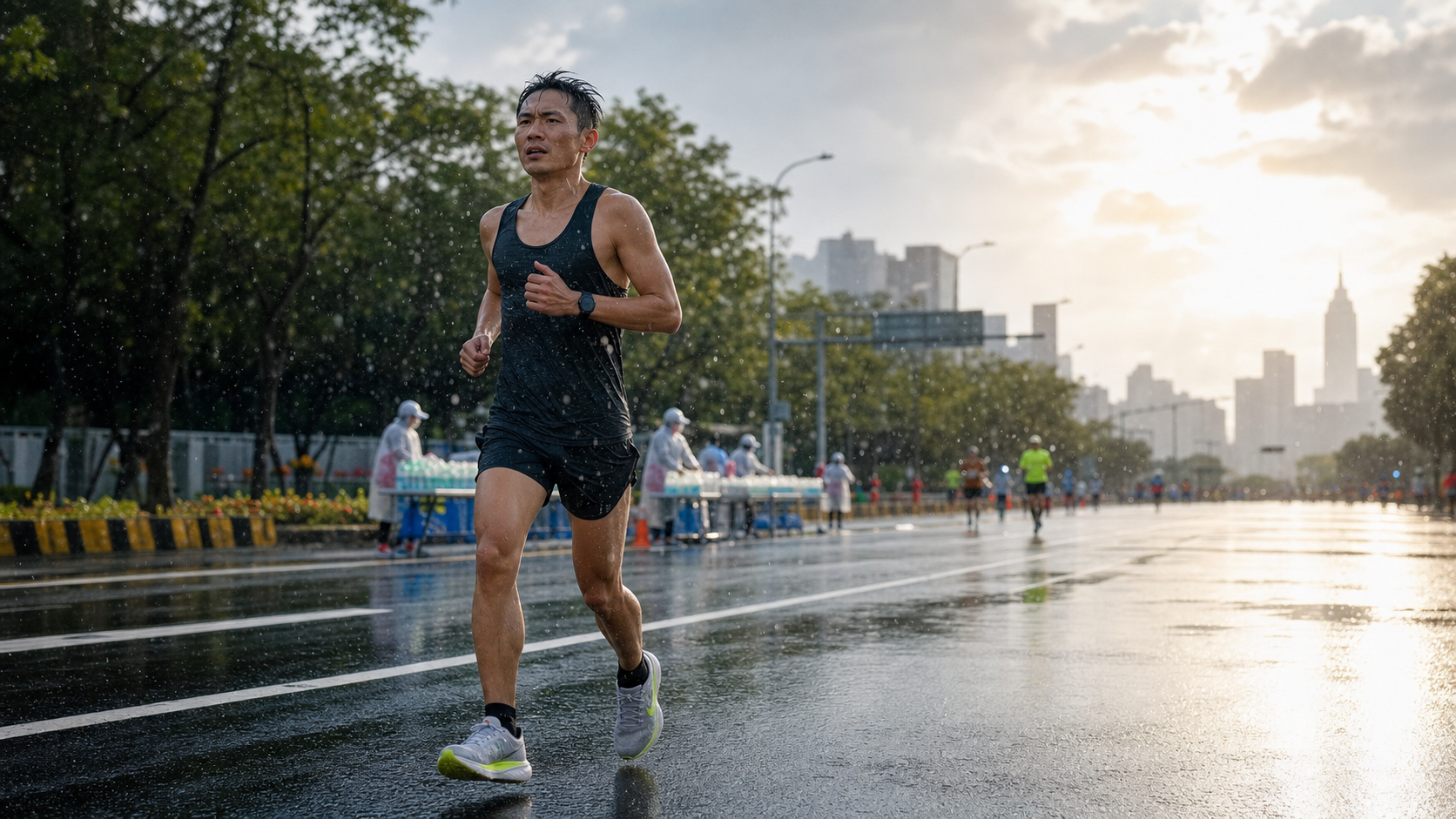
| Rain | Increased clothing weight, body heat loss | Discouragement, loss of motivation, distracted attention | Focusing energy on “not liking the rain” rather than “how to run well” |
| Strong Wind (headwind) | 10–15% increase in energy expenditure | Frustration, feeling like you’re running slowly | Growing increasingly impatient, trying to fight the wind resistance |
| Low Temperature (<8°C) | Insufficient warm-up, stiff muscles | Worry, discomfort | Wearing too much, overheating later on |
| Overcast, No Wind | Optimal running conditions | Occasionally lacking a “fighting spirit” | Relaxing too much, neglecting pace management |
Psychological Strategies for High-Heat Adaptation
Reset Goals, Eliminate Anxiety
The core psychological principle for hot-weather racing: Accept that a slower finish time is a scientific fact, not your failure.
For every 1°C increase (within the 15–25°C range), marathon times drop by an average of about 1–2 minutes. If race-day temperatures are 10 degrees higher than during your training period, your target time needs to be adjusted accordingly by 10–20 minutes. Do this calculation in advance so you can accept before the race that “today is not a day for a PB; today is a day for testing strategy execution.”
The “Small Joys” Strategy at Every Kilometer
In hot-weather races, grab water at every aid station and pour it over your head—the physiological cooling effect of this simple action is brief, but the psychological “satisfaction” can significantly boost your motivation to keep going. Treat pouring water over yourself at each aid station as a “reward” rather than an “emergency measure.” A different mental framework leads to a completely different physical experience.
Cadence Over Speed
In high heat, don’t look at your pace—look at your cadence or heart rate instead. Aim to “maintain cadence” or “stay below 140 bpm,” allowing your body to sustain rhythm at a lower intensity. This is smarter than trying to maintain your original speed.
Psychological Strategies for Rainy-Day Adaptation
Reframing: “Rain Is My Friend”
Rain offers runners one genuine benefit: it helps lower body temperature, and in hot, humid conditions it can even be better for running than a sunny day. Change the rain story from “today I’m unlucky” to “today the weather gods are helping me stay cool.”
Physical Habituation Before Mental Habituation
The discomfort of running in the rain comes mainly from being “unaccustomed.” During your preparation period, proactively schedule a few rainy training runs (don’t switch to indoor training just because it’s raining), allowing your body to get used to the feeling of wet clothes and wet shoes before race day. The psychological “rain resistance” will drop significantly once familiarity is established.
The First Three Kilometers Rule
Almost all runners report that the discomfort of running in the rain is strongest in the first three kilometers; after that, the body adapts and it no longer feels bothersome. Tell yourself: “If I can just get through the first three kilometers, I’ll be used to it after that.” This knowledge gives you psychological support during the most uncomfortable starting phase.
Psychological Strategies for Headwind Adaptation
Headwinds are among the most psychologically draining weather conditions because they make you “feel like you’re running slowly,” even when your heart rate and effort level are within normal range.
Core psychological principle: In headwinds, measure performance by perceived effort rather than speed.
- Headwind sections: Accept the slower pace, maintain heart rate or breathing sensation
- Tailwind sections: Proactively speed up to make up for time lost to the headwind
- Treat the headwind as “resistance training”: “Every step I take right now is more powerful and more valuable than a step in a tailwind.”
Weather Mental Preparation: A One-Week Pre-Race Approach
- Set A/B/C goals: Set one goal each for sunny, overcast, and severe weather conditions, giving yourself a prepared response framework
- Research weather history: Look up weather records for the race location over the same period in the past five years to understand the possible range
- Practice “weather acceptance meditation”: Imagine the scenario of learning about bad weather before the race, and practice the mental process of accepting and adjusting your goals
- Discuss weather strategy with running partners: Verbalize your response plan so it becomes a committed plan rather than vague mental preparation
Practical Advice
Emergency psychological script for encountering severe weather on race day: “Today’s weather is today’s condition, not today’s result. I can’t control the weather, but I can control my strategy. Reset my goals and run according to today’s conditions—that is the true wisdom of running.”
Conclusion
Taiwan’s marathon runners are very fortunate, and also very challenged—this island’s weather is unpredictable, and every race can be an adventure in weather. But it is precisely this uncontrollability that has cultivated a resilient climate adaptability in Taiwanese runners through long-term training. The next time you open the window on race morning and see pouring rain, try saying to yourself: “Today is a special race. Good—let me see how well I’ve prepared.”
Related Reading
- Weather Response for Road Races: Strategy Adjustments for Rain, High Heat, and Strong Winds
- Marathon Weather Strategy: Optimal Temperature and Pace Adjustments for Hot Races
- Full Marathon Special Weather Response: Adjustments for Taiwan’s Plum Rain Season and Post-Typhoon Races
- The Complete Guide to Weather Adaptation in Cycling Events: On-the-Spot Strategies from Scorching Sun to Downpour
下雨天就是要改車 #ceramicspeed #bike
1 年前
5 ℃ 櫻花之旅 / 75萬單車直接雨中洗車.../ 平菁街 / 北迴歸小隊 / 公路車 / CT Yeh
5 個月前
單車賞雪 裝備準備及注意事項分享 | 公路車
5 年前
微雨戰! 2022桃園市長盃錦標賽 無敵交管 沒來玩太可惜了! 羅馬公路太可怕 差點成佛! 公路車 | CT Yeh
4 年前
TBA 北高360 逆風爆熱再送空汙 苦行挑戰賽全記錄 4K沈浸式臨空畫質| 公路車 | CT Yeh
3 年前
一日北高/長距離團騎 常見問題補充篇 / 組團或跟團的眉角 / 壯車友容易被瘦車友慢性拉爆 / 原來屁股痛可能是這個原因...? / 風場配速法 / 公路車 / CT Yeh
2 年前
一日北高前的西濱集訓 | 跟著11小時軍團 | 300W踩不動的大逆風 | 輪車破風差幾瓦?
6 年前
雨戰! 西進武嶺員工旅遊 加料 各路段大數據分析 | 同事端出5公斤的公路車來挑戰!? EP1
4 年前