The Positive Psychology of Running Communities: How Running Companions Boost Race Completion Rates
Introduction
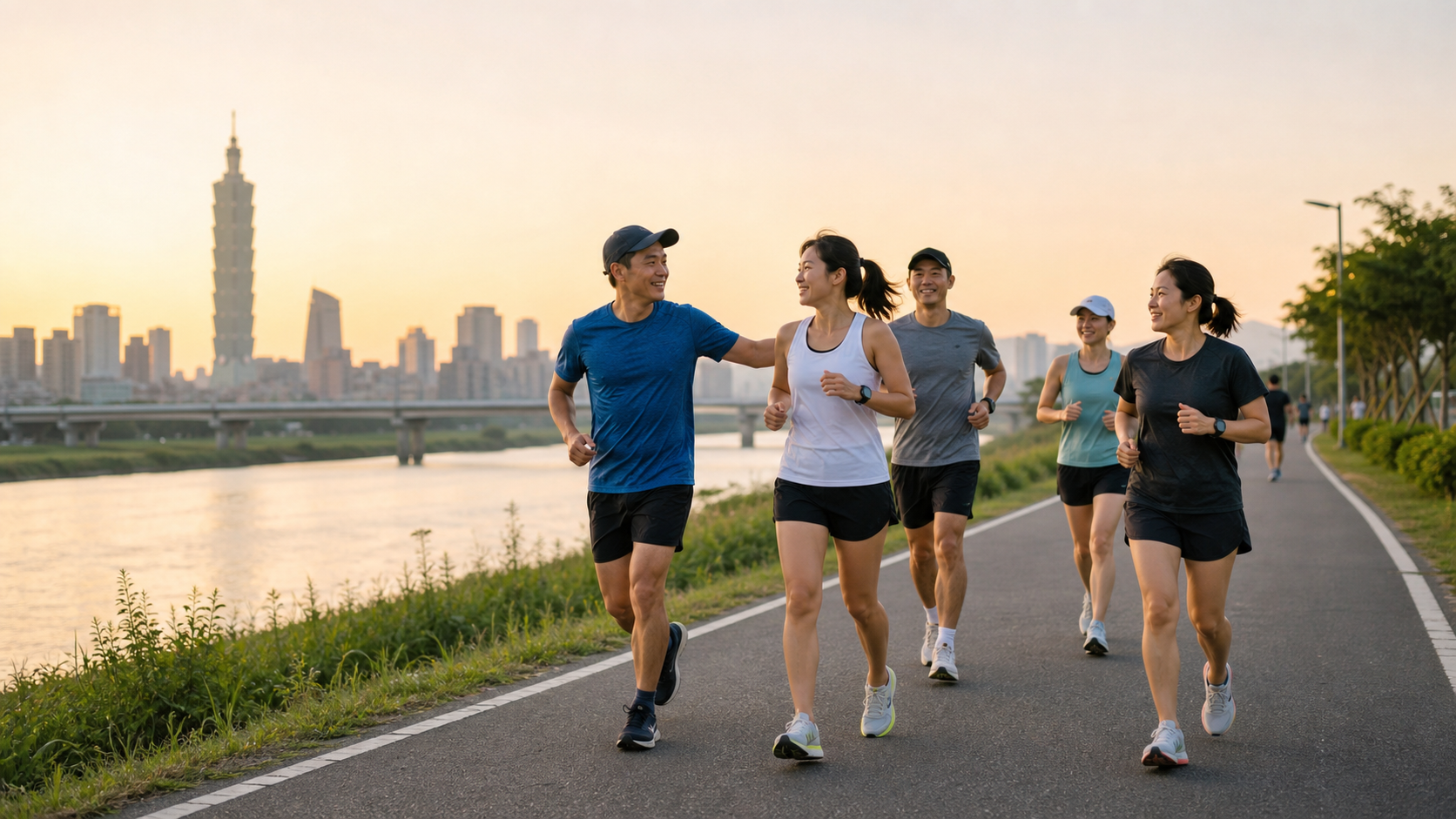
Every Saturday morning, along Taipei’s riverside parks, Daan Forest Park, and park trails across the island, groups of runners gather into a distinctive scene. They may be coworkers, strangers from a LINE group, or members of a Facebook running club, but at that moment they share the same rhythm. Taiwan’s road-running community has grown rapidly over the past decade—according to sports statistics, annual participation in Taiwan’s road races has surpassed one million, and one of the core driving forces behind this is the powerful psychological support network of the running community.
Sports psychology researchers have found that runners with community support show 40% higher training adherence than solo runners, and their finish rates in marathons are also significantly higher. This is not just because the community provides the practical help of “having someone to run with,” but also because the community brings a series of complex psychological mechanisms.
Six Psychological Mechanisms by Which Community Improves Finish Rates
| Psychological Mechanism | Description | Concrete Manifestation |
|---|---|---|
| Social Responsibility | The psychology of not wanting to let running buddies down | “They expect me to run together this weekend—I can’t be absent” |
| Social Comparison Effect | Seeing others improve motivates you | A running buddy signs up for a marathon, so you want to too |
| Emotional Support | Having someone who understands when you struggle | A running buddy’s “I get it” after a breakdown is more powerful than any words |
| Information Sharing | Collective wisdom | “There’s a steep hill at kilometer 25 on that course—prepare in advance” |
| Collective Identity | Self-definition as “I’m a member of XX running club” | Makes running a core identity rather than an occasional activity |
| Shared Rituals | Group rituals before and after races | “Pre-race dinner” and “post-race celebration” strengthen memories and bonds |
The Unique Culture of Taiwan’s Road-Running Community
Taiwan’s running community has several distinctive cultural phenomena that provide unique psychological motivation for participants:
1. The “Early Morning Check-in” Culture
Taiwan’s summer heat has accustomed runners to running at 4–5 AM, giving rise to a unique early-morning community culture—checking in on social media after a run and seeing friends who are also running at that hour creates a sense of “companionship in the dark.”
2. The “Finisher Medal Sharing” Ritual
Almost all Taiwanese runners have the habit of photographing their finisher medals after a race and sharing them. This ritual serves an important psychological function: it turns finishing a race into a “public event,” earning recognition and congratulations from the community, reinforcing the sense of accomplishment, and encouraging more people to want to experience that achievement.
3. The “Run-cation” Culture
More and more Taiwanese runners are combining races with travel—signing up for the Wan Jin Shi Marathon and touring the Northeast Coast, or registering for the Sun Moon Lake cycling event and staying for two extra days. This “run-cation” culture elevates the race itself beyond competition, making it part of a lifestyle.
How to Maximize the Positive Psychological Benefits of Community
Find Running Buddies “Slightly Better Than Your Level”
Research on the social comparison effect shows that the motivational boost is strongest when our comparison target is slightly stronger than us (rather than much stronger). Look for running buddies who are 5–10% faster—their presence will keep pushing you to improve without making you feel discouraged.
Establish an “Accountability Partner” Relationship
Find a running buddy and establish a mutual accountability agreement: you report your training progress to each other, and if you miss a session, you need to explain why. Research shows that exercisers with an accountability partner have a 65% higher training adherence rate than those who train alone.
Be a Giver, Not Just a Taker, in the Community
A powerful psychological strategy: shift from “I need the community” to “the community needs me.” Proactively share your running insights, help beginners, and cheer for others during races. This giving behavior significantly enhances your sense of commitment and meaning in running.
Choose a Healthy Community Culture
Not all running communities have positive psychological effects. Watch out for these signs:
- Overemphasis on numerical competition (pace, distance comparisons) while ignoring personal growth
- Lack of empathy for members who are injured or underperforming
- Formation of cliques that are unfriendly to new members
A healthy community should make you feel accepted and supported, not pressured and self-doubting.
Community Psychological Support During Races
During a race, the community’s psychological power manifests in several ways:
- The energy of “seeing someone you know”: Spotting a friend cheering for you along the Taipei Marathon course gives an instant energy boost that is real and measurable (studies show it can improve speed by 5–7%)
- The motivation of “a running buddy might be waiting at the finish”: Knowing someone is waiting at the finish line sustains the sense of meaning in the later stages of a race
- The positive pressure of “not wanting to look bad in front of running buddies”: Moderate social pressure can help you push through when you want to give up
Practical Advice
If you are currently a solo runner and want to gain the psychological support of a community, you can start with these steps:
- Join a local running group (Facebook group, LINE group, or an in-person running club)
- Sign up for a local 5K or 10K race as your ticket into the community
- Regularly attend weekend group training runs, even if it’s just to grab a coffee together afterward
- Share your running logs (even if you think your results aren’t worth sharing) so others can see you exist
Conclusion
The beauty of the running community unfolds every morning in Taipei, Taichung, and Tainan. Those running buddies who persist together in the rain, the strangers who take photos for each other after races, the online friends who cheer each other on in group chats—they form the warmest undertone of Taiwan’s running culture. You don’t need to be the fastest runner to feel this warmth; you only need to show up, step out your door, and join that flowing line woven by all runners together, stretching all the way to the finish.
Related Reading
- The Psychology of Running Communities: How Support and Competition from Running Buddies Affect Training Motivation
- Psychological Support in Running Communities: Why Running Alone and Running with a Group Are Completely Different
- The Psychological Dynamics of Team Racing: The Mechanisms Behind Improved Performance When Running with Companions
- The Psychological Benefits of Group Running: How Running Buddy Companionship Improves Performance
一日北高/長距離團騎 常見問題補充篇 / 組團或跟團的眉角 / 壯車友容易被瘦車友慢性拉爆 / 原來屁股痛可能是這個原因...? / 風場配速法 / 公路車 / CT Yeh
2 年前
Live) 備戰2019彰化經典百K 賽前攻略 (已完賽請看新影片
7 年前
#雙崎部落 單車挑戰賽 心跳破200 #公路車 Neko's Fun
6 年前
2019 柯P 超越北高 第一集團實錄 (11小時實錄請參考另一部影片) 一日雙城 一日北高 NeverStop Taiwan Long Distance Cycling Challenge
7 年前
新屋團體繞圈賽 | 眾多菁英好手賽道奔馳 | 千瓦女子軍團 | 無敵交管狂獲好評 明年你一定不能錯過 | #公路車
5 年前
2025 海鷗團體繞圈賽 網路直播 超激烈裁判長視角 / EIPC 李廷威、Waypoint 等眾多高手競爭 / feat. 卡密兒主持 / 海鷗繞圈賽
9 個月前
2026 輪霸西濱200K 挑戰VLOG / 第一集團 / 首次參加..經驗不足、膀胱不足 /死守6H內 / AI戰鬥力顯示系統 / 公路車 / CT Yeh
4 個月前
2021 96聯賽 桃園市長盃 4K多視角實況 當天選手瓦數/推力比/均速/時間 即時數據分析 | 公路車 | CT Yeh
5 年前