Introduction
Ask Taiwanese runners: “Do you do strength training?” The usual answer is “Sometimes, but running is the main focus.” This mindset needs to be corrected.
A 2018 systematic review published in the British Journal of Sports Medicine analyzed 25 studies and reached a clear conclusion: incorporating strength training reduces running injury rates by 34%, while simply increasing weekly mileage only raises injury risk—it doesn’t lower it. More importantly, the research identified the key muscle groups that most runners overlook—the glutes and the deep core.
Why Are the Glutes and Core So Important for Runners?
The Glutes’ Role in Running
The gluteal muscles (gluteus maximus, gluteus medius, gluteus minimus) perform three critical tasks during running:
- Propulsion in push-off: The gluteus maximus is the primary propulsive muscle in running; a weak gluteus maximus creates a feeling of “no power” while running.
- Pelvic stability: The gluteus medius stabilizes the pelvis during single-leg support; when weak, the pelvis drops to the opposite side (Trendelenburg gait).
- Knee protection: Weak glutes cause the knees to cave inward, a common root cause of ITBS, anterior knee pain, and patellar tendinopathy.
The Core’s Role in Running
The “core” isn’t just the rectus abdominis (six-pack); the deep core is even more important:
- Transversus abdominis: The main player in the trunk’s pressure-stabilization system.
- Multifidus: Stabilizes between spinal segments.
- Pelvic floor muscles: Support the pelvic organs and protect the spine during running impact.
Runners with a weak core often develop trunk lean and excessive lumbar rotation in the later stages of long runs. These compensatory movements shift the load to the knees and ankles.
The Numbers Backed by Science
| Training Intervention | Reduction in Injury Risk |
|---|---|
| Simply increasing mileage | Risk increases |
| Adding core training | 20–35% reduction |
| Adding glute training | 25–40% reduction |
| Glute + core combined | 34–50% reduction |
| Twice weekly vs. once weekly | Twice is clearly more effective than once |
The Twice-Weekly Runner Strength Training Plan
This plan is designed as:
- Time: 25–35 minutes per session
- Equipment: No gym required (resistance band + bodyweight)
- Location: At home, an open space near the office, or a park
Workout A (Glute-Focused)
Warm-up (5 minutes):
- Glute bridge × 15 reps (feel the glutes activate)
- Clamshell × 15 reps (side-lying, affected side on top)
Main workout (20 minutes):
-
Bulgarian Split Squat:
- Rear foot on a chair, front foot in a lunge stance
- 3 sets × 10 reps (each side), focusing on gluteus maximus engagement
- Progression: hold water bottles for added weight
-
Lateral Band Walk:
- Band around the knees (available at Taiwanese sporting goods stores for about NT$100–200)
- Half-squat position, walk sideways 15 steps × 3 sets
- Strengthens the gluteus medius to prevent knee valgus
-
Single-Leg Romanian Deadlift (Single-Leg RDL):
- Stand on one leg, hinge the torso forward, extend the rear leg backward
- 3 sets × 8 reps (each side), training the gluteus maximus and posterior chain
-
Hip Bridge + Ankle Dorsiflexion:
- Supine, feet flat on the floor, squeeze the glutes and lift the pelvis
- Hold the top position for 5 seconds, 3 sets × 12 reps
Cool-down (5 minutes):
- Lunge stretch × 45 seconds (each side)
- Pigeon pose (seated version) × 60 seconds (each side)
Workout B (Core-Focused)
Warm-up (5 minutes):
- Cat-Cow × 10 reps
- Bird Dog × 8 reps (each side)
Main workout (20 minutes):
-
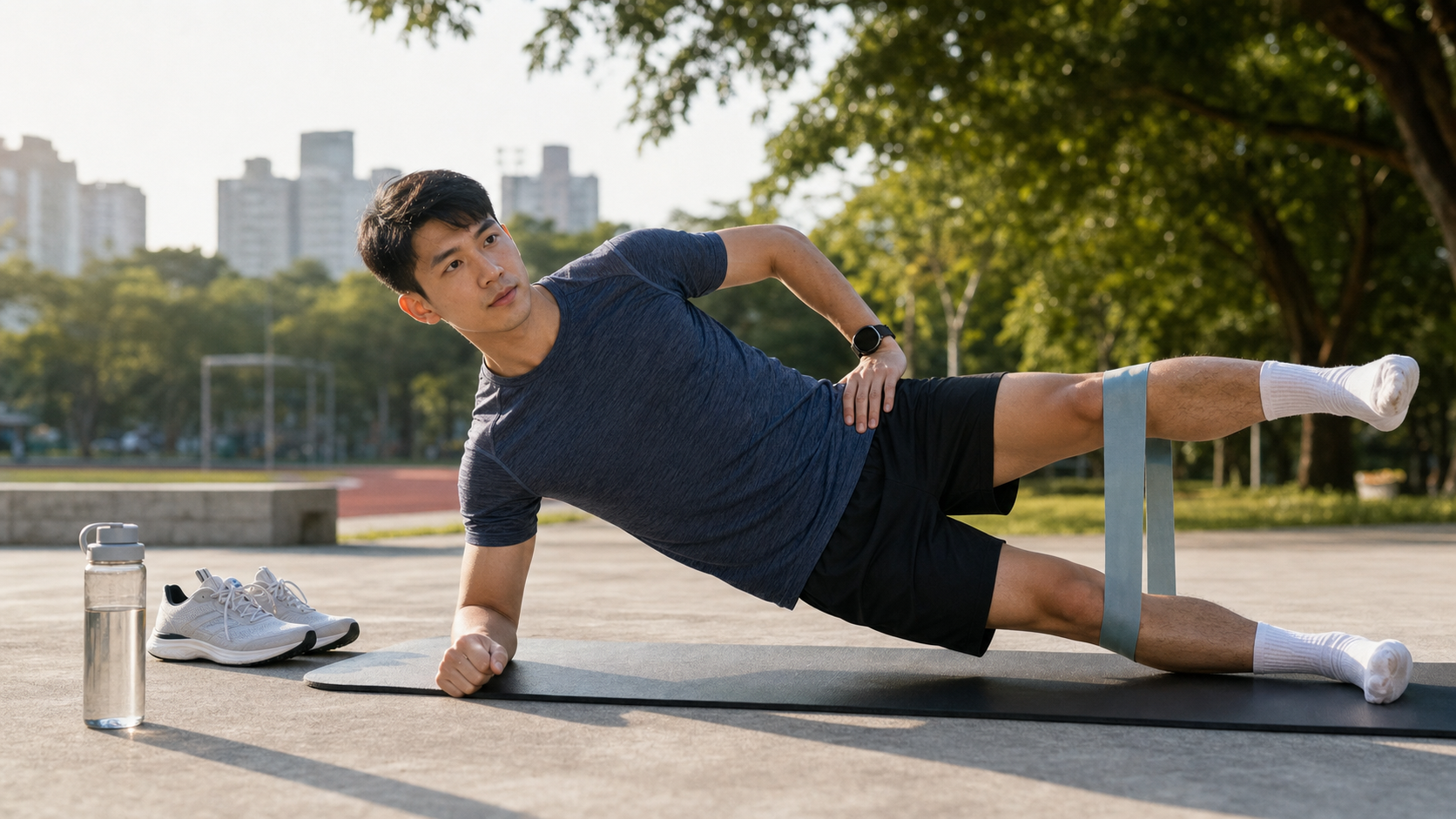
Plank Variations:
- Standard plank: 30–60 seconds × 3 sets
- Side plank: 30 seconds × 3 sets (each side)
- Progression: plank with leg lift (keep the pelvis from rotating)
-
Dead Bug:
- Supine, arms and legs extended upward, slowly lower opposite arm and leg simultaneously
- 3 sets × 10 reps (each side), the best deep-core exercise
-
Walking Lunge + Trunk Rotation:
- Standard walking lunge; after the front foot lands, rotate the torso toward the front-leg side
- 3 sets × 10 steps, integrating core rotational stability
-
Single-Leg Squat (Pistol Squat Beginner Version):
- Hold onto a wall, slowly lower onto a chair on one leg, then stand back up
- 3 sets × 8 reps (each side), integrating glute and core control
Cool-down (5 minutes):
- Hip flexor stretch (lunge) × 45 seconds (each side)
- Child’s pose × 60 seconds
How to Fit This Into Your Running Plan?
| Training Day | Recommended Activity |
|---|---|
| Monday | Easy run |
| Tuesday | Workout A (glutes) |
| Wednesday | Speed work or intervals |
| Thursday | Easy run or rest |
| Friday | Workout B (core) |
| Saturday | Long run |
| Sunday | Active recovery |
Principle: Schedule strength training on the same day after your run (not before), so it doesn’t compromise your running quality.
Additional Resources in Taiwan
- Resistance bands: Available on Momo and Shopee; a set (light/medium/heavy, three bands) costs about NT$300–500
- Online courses: Several Taiwanese fitness YouTubers design content specifically for runners, offering free runner strength-training videos
- Gyms: Monthly gym fees in Taiwan run about NT$1,000–2,000, but this plan requires no gym at all
Conclusion
Twice a week, 30 minutes per session of glute and core training is the lowest-cost investment with the greatest injury-prevention payoff for Taiwanese runners. You don’t need expensive equipment or more running mileage—just the open space in front of your couch and the discipline to show up twice a week. Doing your first glute bridge today is the first step toward lowering your injury risk.
Related Reading
- Strength Training for Half-Marathon Runners: Twice-Weekly Lower-Body and Core Reinforcement
- Integrating Core Training for Road Runners: How to Embed a 20-Minute Twice-Weekly Core Routine
- Glute Strengthening for Runners: The Stabilizing Function of the Gluteus Medius and Maximus
- Strength Training for Runners: Sport-Specific Strength Moves for the Core, Glutes, and Legs
一日北高/長距離團騎 常見問題補充篇 / 組團或跟團的眉角 / 壯車友容易被瘦車友慢性拉爆 / 原來屁股痛可能是這個原因...? / 風場配速法 / 公路車 / CT Yeh
2 年前
西進武嶺 免費訓練分析服務 Intervals | 練不夠還是練過頭?你哪一種類型選手?AI模型告訴你! | 備戰神器 | 公路車 訓練 | CT Yeh
4 年前
實景訓練台) 彰化經典百K 高強度喵團 90分鐘 跟著一起練功 2019 Indoor workout Changhua Classic 100 Taiwan
7 年前
一日北高常見問題大集合 | 攻略 | 路線 | 訓練 | 補給 | 自行車 單車 | 一日雙城 | 雙塔 | TWB北高360 | 屁股痛
6 年前
2019 柯P 超越北高 第一集團實錄 (11小時實錄請參考另一部影片) 一日雙城 一日北高 NeverStop Taiwan Long Distance Cycling Challenge
7 年前
Live) 備戰2019彰化經典百K 賽前攻略 (已完賽請看新影片
7 年前
CT趣訪 西進武嶺 2小時組 EP2 全村的希望 蔣緯緯! 訓練菜單&技巧公開 |公路車 |CT Yeh
4 年前
Never Stop 西進武嶺 前後雙機 完整全程錄影 訓練台 實境
8 年前