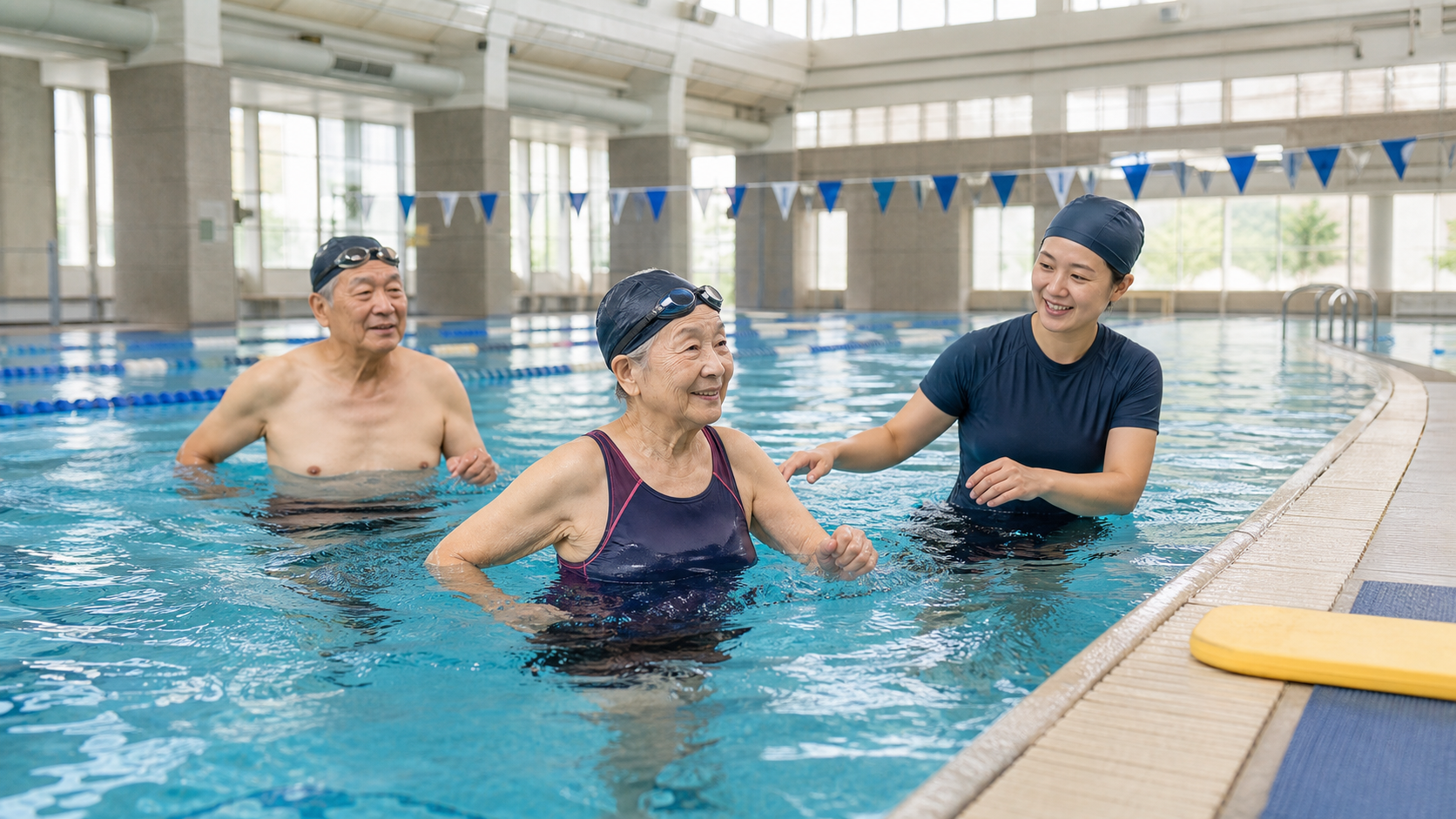
Introduction
Taiwan officially entered a “super-aged society” in 2025, with people aged 65 and over accounting for more than 20% of the population. As age increases, physiological changes such as muscle atrophy, bone loss, and declining balance make falls the leading cause of accidental injury among the elderly. Swimming and water aerobics (aquatic exercise) combine cardiorespiratory training, muscle maintenance, and joint protection, and are recommended by the Taiwan Geriatric Society as one of the preferred exercise modalities for seniors.
Multiple Benefits of Swimming for Seniors
Seniors who engage in regular swimming training can experience improvements in the following areas:
- Cardiorespiratory endurance: Increased maximal oxygen uptake (VO₂max), making daily activities (such as climbing stairs, shopping) less likely to cause breathlessness
- Muscle mass maintenance: Water resistance provides full-body light resistance training, slowing the progression of sarcopenia
- Bone density: Although aquatic exercise does not improve bone density as much as weight-bearing exercise on land, it is still better than being completely sedentary
- Balance and coordination: The viscosity of water provides positive stimulation for balance training
- Chronic pain relief: Buoyancy reduces joint load, significantly improving pain in patients with degenerative arthritis
- Cognitive function: Aerobic exercise promotes hippocampal neurogenesis, helping to delay the progression of dementia
Safe Beginner’s Plan for Ages 65 and Over (12 Weeks)
| Phase | Weeks | Duration per Session | Main Content | Target Heart Rate |
|---|---|---|---|---|
| Adaptation Phase | 1–3 | 20–25 min | Water walking, wall-supported leg kicks, breaststroke arm drills | 40–50% of max heart rate |
| Foundation Phase | 4–7 | 30–35 min | Full-lap breaststroke or backstroke, 4–6 laps (25m) per session | 50–60% of max heart rate |
| Strengthening Phase | 8–12 | 40–45 min | Increase laps to 8–12, introduce light-resistance water dumbbells | 55–65% of max heart rate |
Max heart rate estimation: 220 − age (e.g., a 70-year-old has a max heart rate of approximately 150 bpm, with a target heart rate of 60–90 bpm)
Recommended session structure:
- Warm-up 5 minutes: water walking along the pool edge
- Main workout 25–35 minutes: swimming lap drills
- Cool-down 5 minutes: slow treading water, deep breathing
- Rest for 2–3 minutes before exiting the water to avoid orthostatic hypotension
Safety Precautions
Pre-entry assessment:
- Check blood pressure: do not swim on days when systolic pressure exceeds 180 mmHg
- Confirm there are no symptoms such as dizziness or chest tightness
- Certain medications (diuretics, antihypertensives) may affect fluid regulation; consult a physician first
Pool selection recommendations:
- Choose pools equipped with lift platforms or gradual ramp entries (most municipal pools in Taipei already have these)
- Water depth of waist to chest level (approximately 110–130cm) is ideal for standing up easily in an emergency
- Choose sessions with lifeguards on duty at all times
Special warnings:
- Do not stand up quickly right after exiting the water to prevent dizziness and falls
- Avoid eating a large meal within 1 hour before and after swimming
- Water entering the ear canal can easily trigger vertigo; wear earplugs along with goggles
Resources in Taiwan
- Senior swimming classes in various cities and counties: Taipei City, New Taipei City, Taichung City, and other local governments offer classes regularly at low cost (some are free)
- Aqua Fitness courses: Most public pools offer these courses, suitable for seniors who cannot swim
- Long-Term Care 2.0 resources: Some community day care centers offer aquatic rehabilitation programs; inquiries can be made via the Long-Term Care hotline 1966
Practical Tips
- First-time entry into the water must be accompanied by an instructor or lifeguard to confirm your stability in the water.
- Bring non-slip slippers; wet pool deck floors are a common place for seniors to fall.
- Swim with a partner or join a community swimming club, which improves consistency and increases social connections, helping to prevent depression.
- Patients with chronic diseases should first complete the “Physical Activity Readiness Questionnaire (PAR-Q)” and have it confirmed by a physician.
- Set small goals, such as completing 2 laps of 25 meters in the first week, then adding 1–2 laps every two weeks.
Conclusion
For seniors, swimming is not just exercise—it is a lifestyle that maintains health and delays aging. Taiwan has a public pool system that is friendly to the elderly, along with an increasingly rich selection of water aerobics classes, allowing people to enjoy the pleasures of aquatic exercise well past age 65. As long as you progress gradually and pay attention to safety, three pool sessions per week will become the most precious health investment in your senior years.
Related Reading
- Senior Swimming Safety Guidelines: A Complete Training Plan for Beginners Aged 65 and Over
- Senior Swimming Guide: Safe Water Entry and Training Recommendations After Age 50
- Senior Swimming: An Aerobic Exercise Guide You Can Do at 75
- Health Benefits of Swimming for Older Adults: Joint-Friendly Aerobic Training
西進武嶺 免費訓練分析服務 Intervals | 練不夠還是練過頭?你哪一種類型選手?AI模型告訴你! | 備戰神器 | 公路車 訓練 | CT Yeh
4 年前
實景訓練台) 彰化經典百K 高強度喵團 90分鐘 跟著一起練功 2019 Indoor workout Changhua Classic 100 Taiwan
7 年前
滑雪新手們慘摔學習全紀錄(請開字幕),滑雪好好玩 | Snowboard + Ski | 岩原 スキー場 | 滑雪APP使用 | GoPro Max
6 年前
白沙屯媽祖進香在家走!UREVO 坡度自調走步機 / 可連接訓練遊戲APP MyWhoosh / 邊看直播邊走起來 / CT Yeh
11 個月前
一起升級!海鷗盃LSD團練...JJSC Zone2招待 騎到手抖 / 公路車 / CT Yeh
2 天前
一日北高/長距離團騎 常見問題補充篇 / 組團或跟團的眉角 / 壯車友容易被瘦車友慢性拉爆 / 原來屁股痛可能是這個原因...? / 風場配速法 / 公路車 / CT Yeh
2 年前
[教學] Premiere 影片 手震 修正 教學 防抖 單眼 影像 GoPro 穩定 Video Stabilization
8 年前
[防寒衣體驗] 鐵人魂 三鐵 防寒衣試穿會 於松運 深水游泳池 鯨魚池
8 年前