Positioning Strategy in Criterium Racing: Calculating the Energy Cost of Fighting for Position Before Corners
Introduction
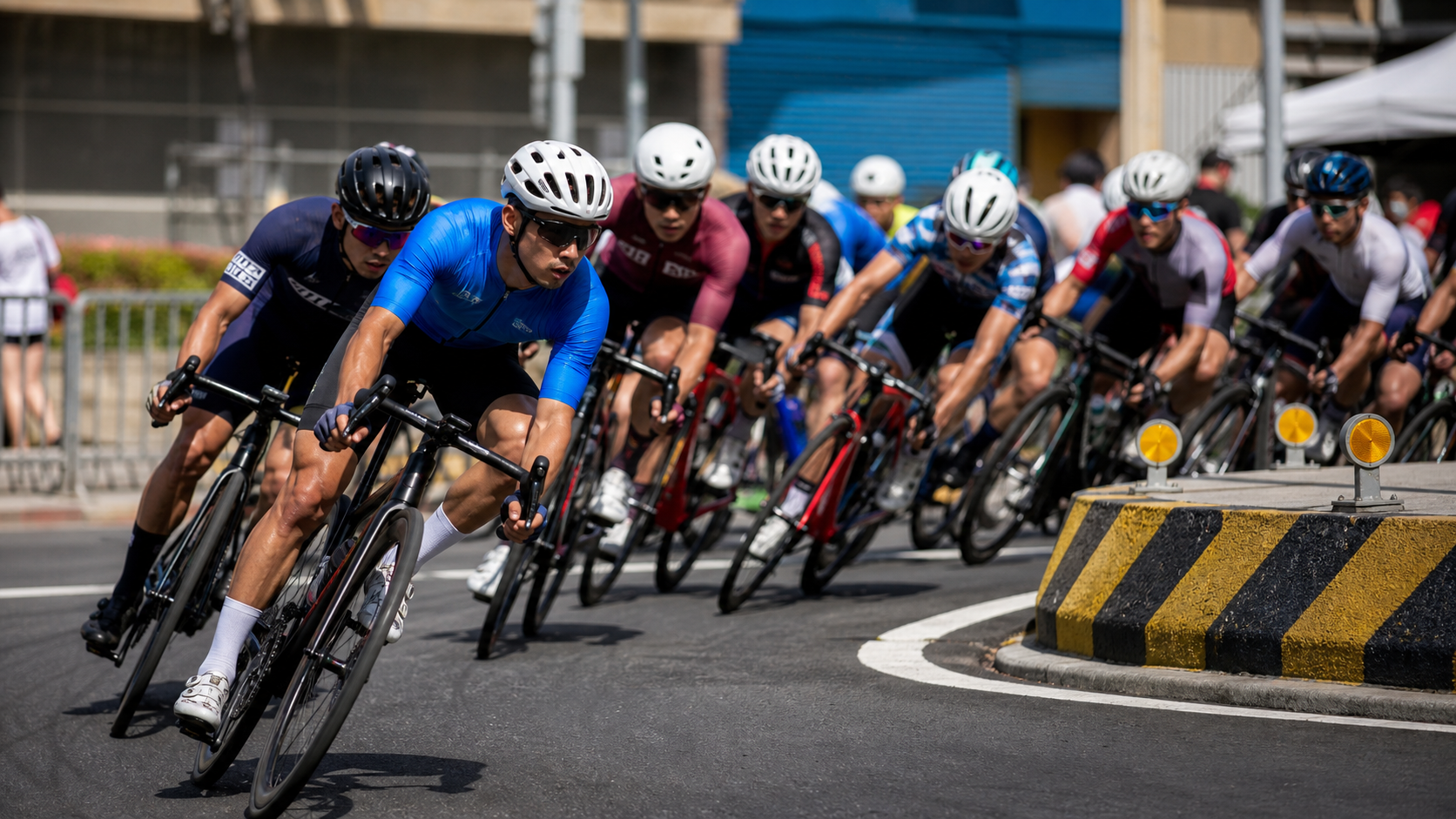
The criterium (commonly known as “Crit”) is the primary format for street and urban races in Taiwan. Compared to the long-distance endurance demands of road racing, criteriums are characterized by: high-frequency acceleration and deceleration, dense corners, and intense position battles—with a 180-degree hairpin turn every 1–3 minutes. In this format, calculating the energy cost of position management becomes the core skill that determines results.
The Energy Expenditure Model of Criterium Racing
Unlike road racing, where you can rely on the peloton to save energy, a criterium’s energy expenditure model is closer to high-intensity interval training (HIIT):
Per-Lap Power Analysis
| Segment | Duration | Power Output | Cumulative Energy Cost |
|---|---|---|---|
| Fighting for position before corner | 10–20 sec | 130–160% FTP | High |
| Cornering | 5–10 sec | 80–100% FTP | Low–Medium |
| Acceleration after corner | 15–25 sec | 120–150% FTP | High |
| Drafting on the straight | 30–60 sec | 85–100% FTP | Medium |
Key Finding: In a 40-minute criterium, a rider’s energy spent on “position-fighting acceleration” can account for 35–45% of total energy expenditure—far higher than in a road race of equal duration.
The Cost of Losing Position
When you drop from 5th to 15th place before a corner, the speed deficit you need to make up after exiting the corner is roughly 3–5 km/h, requiring 8–15 seconds of high-power output to return to the front. If you lose position once every lap, the accumulated energy cost can completely rob you of your explosive power in the latter part of the race.
Timing and Methods for Fighting for Position
Effective Positioning vs. Wasted Effort
- Effective positioning: In the final 100 meters of the straight before a corner, use the natural surge of the peloton to move up without needing a full sprint
- Wasted effort: Starting a full acceleration 300 meters before the corner not only burns more energy by the time you reach it, but also allows other riders to fill the gap you leave behind
Three Key Positioning Strategies for Criteriums
Strategy One: The Outside Cut-In
Position yourself on the outside of the group (when width permits), taking advantage of better visibility and less shelter on the outside. Cut in at a slightly higher speed before the corner to hold your position without needing a full burst.
Strategy Two: The Standing Acceleration
The moment the rider ahead brakes, stand up and pedal (out of the saddle), using the high torque of the first 3–5 pedal strokes to quickly fill the space ahead. This is more energy-efficient than a seated full-power acceleration.
Strategy Three: Anticipating Braking Rhythm
Observe the braking habits of the riders ahead: some habitually brake too early. You can brake 0.5 seconds later than them and naturally slot into a bike length ahead. Note that this requires very precise brake control.
Characteristics of Taiwanese Criterium Courses
Criteriums in Taiwan are often held in urban areas or on race tracks, with several special considerations:
- Road markings: Taiwanese roads often feature white lane markings and reflective markers; brake earlier in wet conditions
- Sharp corner angles: Some courses feature 90-degree or even tighter corners, requiring a longer braking zone
- Close spectators: Urban courses have barriers along the roadside; drifting off course carries severe consequences
- Road potholes: Urban road quality is inconsistent; mark hazardous sections during pre-race reconnaissance
Long-Term Energy Allocation Calculation
A typical 60-minute criterium (1.5 km/lap) has about 30–40 laps. Recommended energy allocation:
- First 10 laps: Invest 70–80% effort into positioning to secure a stable top 10–15 position
- Middle 20 laps: Maintain position with minimal expenditure, using the group’s shelter to save energy
- Final 10 laps: Gradually increase effort in preparation for the final sprint
- Final 3 laps: Enter full position-fighting mode to ensure a top-5 spot for the sprint
Practical Advice
- Train explosive power: Do at least 2 interval sessions per week with 10–20 second full sprints to simulate criterium energy demands
- Pre-race course reconnaissance: Ride at least 3–5 laps, marking the ideal turn-in point and braking zone for each corner
- Practice standing acceleration: Deliberately include standing starts and accelerations in flat-road training to get used to the feel of high-torque pedaling
- Learn group braking feel: Practice following the braking rhythm of a 10–15 rider group during club rides
- Record your position each lap: If you have teammates spectating, have them record your position at a specific point each lap, then analyze position trends after the race
Conclusion
The criterium is a comprehensive test of road cycling technique and fitness. The art of fighting for position lies in “using the least energy to secure the best position.” When you move up effortlessly on the straights, quickly fill gaps after corners, and intelligently conserve energy in the middle of the group, you have the capital to make a decisive move at the finish line. The criterium is not won by the strongest rider, but by the one who spends their energy where it matters most.
Related Reading
- Criterium Nutrition Strategy: Precision Fueling for Short, High-Intensity Races
- The Final-Lap Sprint in Criteriums: Position and Timing in the Last 500 Meters
- Criterium Race Strategy: How to Win in Short-Distance Explosions
- Criterium Fitness and Tactical Training: How to Handle Constant Acceleration and Attacks
Live) 備戰2019彰化經典百K 賽前攻略 (已完賽請看新影片
7 年前
2023桃園團體繞圈賽 / 海鷗繞圈賽 | 全程空拍數據版 | 公路車 | CT Yeh
2 年前
CT 喇低賽) 武嶺牽車 才是王道 西進牽車四小時內秘訣 攝手位置 如何判斷 防抽筋小秘訣
7 年前
單車實況) 車測中心高速賽道 96 彰化讚 挑戰組一圈實錄 | ARTC
6 年前
2019 夏季KOM 5小 完賽心得 準備攻略 東進武嶺 夏季登山王之路 Taiwan KOM Challenge
7 年前
西進武嶺 免費訓練分析服務 Intervals | 練不夠還是練過頭?你哪一種類型選手?AI模型告訴你! | 備戰神器 | 公路車 訓練 | CT Yeh
4 年前
2025 海鷗團體繞圈賽 / 前八強賽事精華!/ 環台賽等級拍攝 / 國手菁英隊伍較勁 / CT Yeh #公路車
8 個月前
第二屆 桃園團體繞圈賽!賽前指南 | 公路車 | CT Yeh
3 年前