Introduction
No matter how skilled a rider you are, the risk of crashing always exists. Taiwan’s road environment has its own specific hazards: dense manhole covers (especially in Taipei City), numerous road patches, shared space between motorcycles and bicycles, plus standing water and gravel on roads after typhoons or rain. When an accident happens, staying calm and providing correct first aid often determines the speed of recovery and whether there will be lasting aftereffects.
The First Step After a Fall: Ensure Scene Safety
Before performing any first aid, first ensure the safety of yourself and the injured person:
- Move away from the danger zone: If in the middle of the roadway, move to the side immediately (if able to move)
- Ask bystanders to help with traffic control: Prevent vehicles from hitting you from behind
- Stay calm, do not move the neck: If a cervical spine injury is suspected (e.g., direct impact to the head, or a helmet with severe impact), wait for the ambulance and do not move the person on your own
Taiwan emergency numbers: 119 (ambulance), 110 (police)
Wound Classification and Treatment
1. Abrasion (Road Rash)
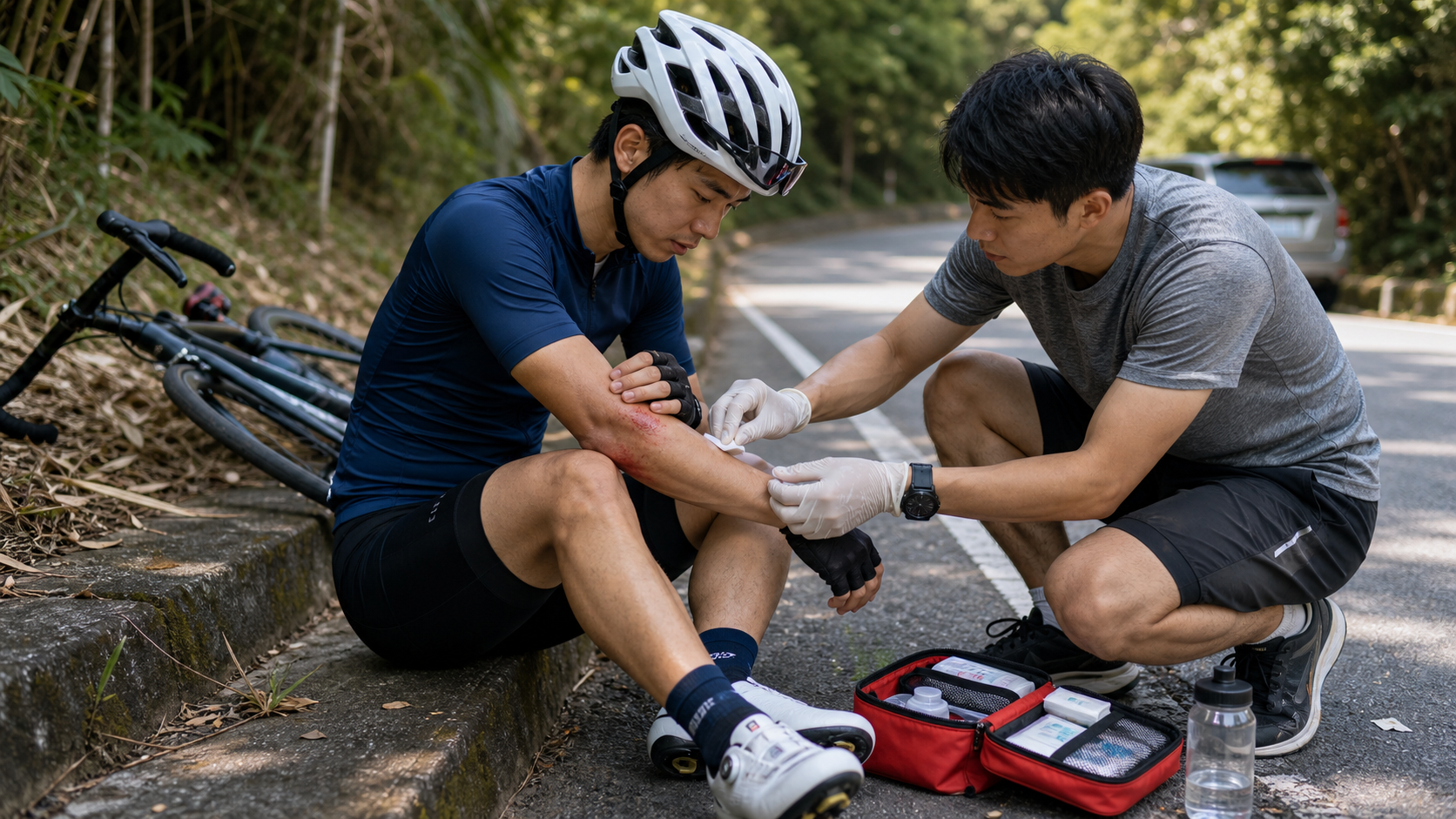
Road rash (commonly called “road burn”) is the most common cycling injury, caused by high-speed friction between the skin and the road surface, with damage ranging from the epidermis to the dermis at varying depths.
First aid procedure:
| Step | Action | Notes |
|---|---|---|
| 1. Clean | Irrigate with copious sterile saline or clean water | Flush for 5–10 minutes to remove gravel particles |
| 2. Remove debris | Use sterile tweezers to carefully remove visible embedded stones | Do not dig or scrape forcefully |
| 3. Disinfect | Clean with povidone-iodine or sterile saline | Alcohol is highly irritating and can be skipped |
| 4. Cover | Apply a moist wound dressing (e.g., Mepitel, Meptex) or petrolatum gauze | Do not let the wound dry out and form a scab |
| 5. Secure | Use breathable paper tape or self-adhesive elastic bandage | Do not wrap too tightly |
Key to modern wound care: Moist Wound Healing
The traditional belief that wounds should be left to “air dry” is incorrect. Keeping the wound in a moist environment (using moist wound dressings) can:
- Accelerate cell migration and tissue repair
- Reduce scar formation
- Decrease pain
Moist wound dressings (such as Tegaderm, Mepitel) are widely available at pharmacies in Taiwan. It is recommended that every cyclist keep them in their first aid kit when riding.
2. Laceration
Deep cuts with irregular wound edges:
- Minor bleeding: Apply pressure for 5–10 minutes to stop bleeding, using a clean dressing with pressure
- Continuous bleeding, deep wound, or longer than 1 cm: Requires emergency department suturing
- Located on the face or over joints: Suturing is recommended to reduce scarring and functional impairment
When to seek medical attention: If the wound is dirty (deeply embedded road gravel or soil) → a tetanus booster is needed (if the last injection was more than 5 years ago)
3. Contusion
Subcutaneous tissue impacted by a blow, with no open wound:
- Within 24 hours of injury: Ice (Ice), 15–20 minutes per session, every 2–3 hours
- After 24 hours: May switch to heat application to promote blood circulation
- If swelling is severe or function is impaired (unable to move normally), seek medical attention to rule out fracture
Warning Signs Requiring Immediate Medical Attention
The following situations must go to the emergency department immediately:
Head injury:
- Loss of consciousness (even for just a few seconds)
- Headache that continues to worsen or is severe
- Vomiting
- Blurred vision, tinnitus
- Behavioral changes, confusion
Neck and back:
- Neck or back pain after the fall
- Numbness or weakness in the limbs
- Inability to move limbs
Suspected fracture:
- Obvious local deformity
- Crepitus (grinding sensation) felt when touching the bone
- Unable to bear weight on the injured area (leg) or unable to lift it (arm)
- Severe localized pain, especially in the collarbone, wrist, or ankle joint
Chest and abdominal trauma:
- Difficulty breathing or chest pain when breathing (rib fracture or pneumothorax)
- Persistent abdominal pain (abdominal organ injury)
First Aid Points for Common Accident Scenarios in Taiwan
| Accident Scenario | Common Injuries | Special Considerations |
|---|---|---|
| Slipping on manhole covers | Hip contusion, wrist fracture | Elderly riders should watch for femoral neck fractures |
| Cornering too fast and running wide | Large lateral abrasions | Watch for shoulder dislocation |
| Loss of control on descents | Head injury, collarbone fracture | Always inspect the helmet; replace it after any impact |
| Rear-ended by a motorcycle | Multiple injuries | Call 119 immediately, do not move the person on your own |
Essential Contents of a First Aid Kit
Recommended to carry for long rides:
- Sterile saline (100 ml small bottle)
- Sterile gauze (several pieces)
- Moist wound dressings (e.g., 2–3 pieces of Tegaderm)
- Elastic bandage (1–2 rolls)
- Sterile tweezers
- Disposable gloves (2 pairs)
- Emergency contact card (including blood type, emergency contact, and medication allergy record)
Helmet Replacement After Impact
The EPS foam cushioning layer of a helmet loses its protective effectiveness once impacted, even if it looks intact on the outside, it should be replaced. Common CPSC and CE EN 1078 certified helmets available in Taiwan are all designed for single-impact use and must be replaced after a crash.
Practical Advice
- Check your first aid kit is complete before riding: Just as important as your tire repair tools
- Share your emergency contact information with riding companions: When riding alone, at least leave your route and expected return time with family
- Follow up on wound healing: If an abrasion shows increasing redness, swelling, heat, pain, or pus, these are signs of infection and you should seek medical attention for antibiotics
Conclusion
Accidents cannot be completely avoided, but correct first aid knowledge can minimize harm to the greatest extent. Fire departments in cities and counties across Taiwan regularly offer free first aid training courses. Cyclists are encouraged to sign up, making first aid skills the most important “piece of equipment” on your gear list. Remember: ensure safety first, then treat the wound, and make timely judgments about seeking medical care—these three principles will protect you and your riding partners.
Related Reading
- Cycling Road Accident Management: On-Scene First Aid for Abrasions, Impacts, and Fractures
- Emergency Response After a Cycling Accident: On-Scene Management of Abrasions, Fractures, and Head Impacts
- On-Scene Management of Cycling Accidents: First Aid Basics and Reporting Procedures
- First Aid for Road Bike Accident Injuries: On-Scene Response to Head Trauma, Fractures, and Abrasions
摔車後補裝備: 好市多新款單車安全帽& Specialized Romin 北高整路屁股都不痛的坐墊 | 一千元居然有MIPS | CT Yeh | 公路車
4 年前
單車 一日北高 ( 雙城 ) 肥宅雙人瘋狂行 紀錄片 REACTO
10 年前
#公路車 #Fitting 靠人工智慧APP 幫你調整單車
6 年前
碟煞公路車 銑面器 !? 原來銑完差這麼多! 降低蹭碟機率! | TIME 公路車 保養小記錄 | CT Yeh
3 年前
公路車 爬坡 破PR 紀錄 小技巧 分享
6 年前
自助洗車場 洗單車 50元有找 清鍊條大法 居然還有小小兵
7 年前
風櫃嘴 | 全台最多大砲的單車路線 | 尋寶網攝影師告訴你怎麼擺拍起來才好看 | 熱門攝影地點巡禮
6 年前
爬陡坡被爆胎的車友跑步超車 #cycling #里佳部落
9 個月前