Pre-Race Anxiety Management: Psychological Stabilization Techniques for the 10 Minutes Before the Start
Introduction
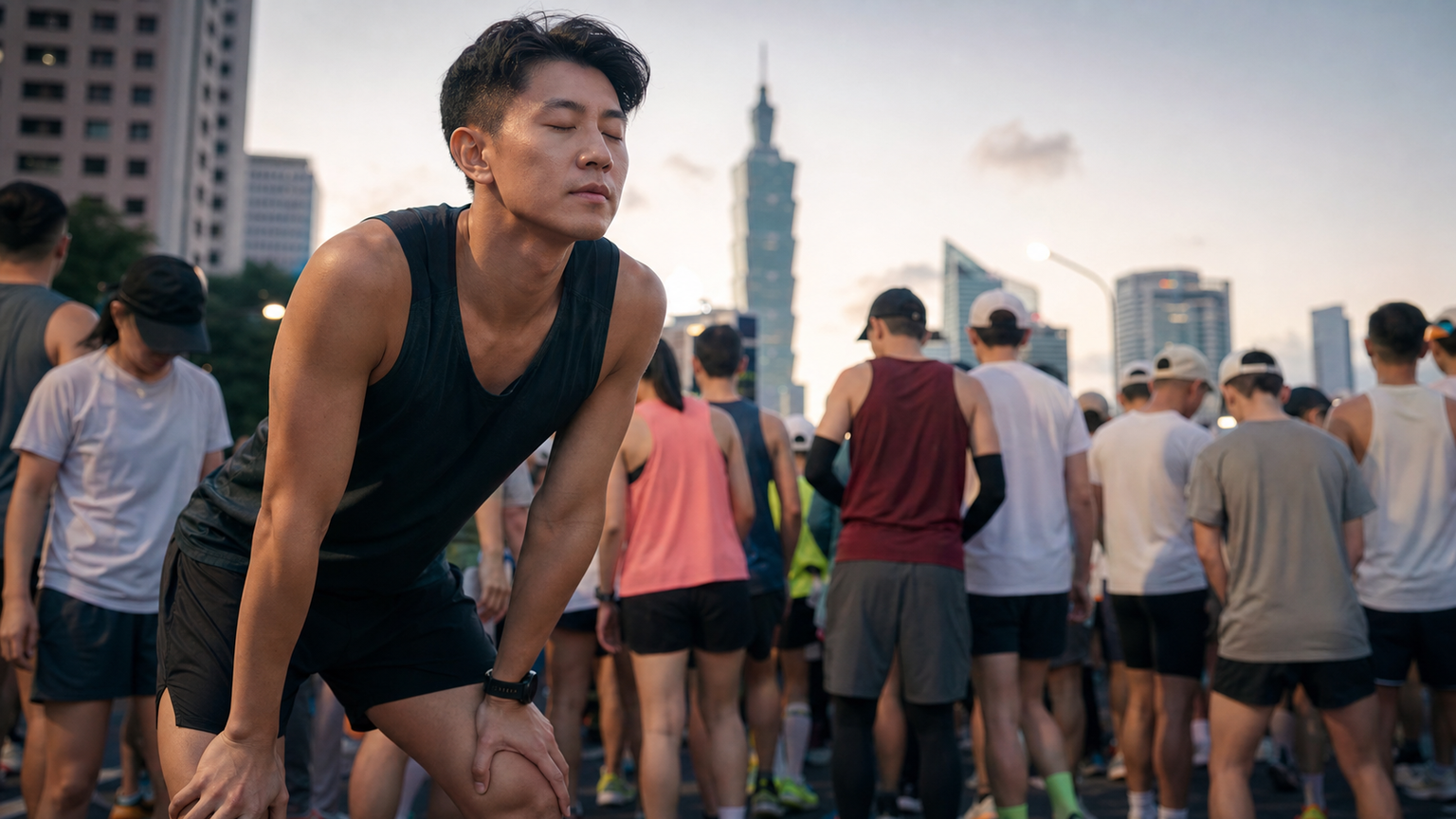
At 5:30 in the morning, outside Taipei City Hall Plaza, thousands of runners are packed into the starting corral. An uneasy stomach, a heart rate ticking noticeably faster than usual, and your gaze unconsciously drifting toward your competitors’ gear—this feeling is certainly familiar to you. Pre-race anxiety is a nearly universal physiological and psychological phenomenon, and even elite runners are not entirely immune to it.
The question is not “how to eliminate anxiety,” but rather “how to make anxiety work for you.” Sports psychology research indicates that a moderate level of physiological arousal can enhance performance, but excessive anxiety can lead to muscle tension, impaired judgment, and loss of pace control. This article provides a psychological stabilization routine that can be completed within 10 minutes before the start.
The Physiological Mechanisms of Anxiety and Common Runner Reactions
The root of pre-race anxiety lies in the brain interpreting the race as a “threat,” triggering the sympathetic nervous system’s “fight-or-flight” response. This leads to an elevated heart rate, accelerated gastrointestinal motility, sweaty palms, and other symptoms.
| Symptom | Physiological Cause | Impact |
|---|---|---|
| Elevated heart rate | Adrenaline secretion | Beneficial for output when moderate; causes panic when excessive |
| Gastrointestinal discomfort | Blood flow redistribution | Reduced blood supply to the digestive system |
| Muscle tension | Stress hormones | Shortened stride, reduced efficiency |
| Scattered attention | Prefrontal cortex inhibition | Impaired pace judgment |
| Negative self-talk | Cognitive distortion | Collapse of confidence |
The most common mistake among Taiwanese runners is doing extensive dynamic warm-ups in the starting corral, trying to “burn off” anxiety with muscle fatigue—only to deplete their energy prematurely.
Psychological Stabilization Routine for the 10 Minutes Before the Start
Step 1: Body Scan (10–8 minutes before the start)
Find a relatively quiet corner and close your eyes. Starting from the soles of your feet, consciously relax each muscle group:
- Ankles and calves: Gently rotate your ankles and feel the elasticity of the tendons
- Thighs and glutes: Deliberately release the tension in your quadriceps as you take deep breaths
- Shoulders and neck: This is where anxiety accumulates most; do three shoulder shrugs followed by releases
- Jaw: Many runners clench their teeth when nervous; let your jaw hang naturally
The purpose of the body scan is not complete relaxation, but rather to build bodily awareness and avoid starting the race unknowingly carrying tension.
Step 2: Box Breathing (8–6 minutes before the start)
Box Breathing is a regulation technique used by U.S. Navy SEALs before high-pressure missions, and it is very simple to perform:
- Inhale for 4 seconds
- Hold for 4 seconds
- Exhale for 4 seconds
- Hold for 4 seconds
Repeat for 4–6 cycles. This pattern effectively stimulates the parasympathetic nervous system, bringing your heart rate back from “panic mode” into the “moderate arousal” zone. At outdoor races with sea breeze interference, such as the Wan Jin Shi Marathon, you can perform this in a standing position with equally significant results.
Step 3: Anchoring Ritual (6–4 minutes before the start)
Anchoring is a concept from Neuro-Linguistic Programming (NLP) that builds a conditioned reflex between a specific action and a positive psychological state. Many elite runners have fixed pre-race rituals:
- Japanese runner Suguru Osako performs a specific hand-slapping motion before races
- Taiwanese ultramarathon standout Tommy Chen follows a fixed prayer routine
You can design your own anchoring ritual: tap your thigh three times + take a deep breath + silently repeat a core keyword (such as “steady,” “rhythm,” or “enjoy”). The key is to use the same ritual during every training session so that it can effectively evoke your training state when triggered on race day.
Step 4: Reappraisal (4–2 minutes before the start)
Research by psychologist Jeremy Jamieson shows that simply reappraising “I feel anxious” as “I feel excited” can significantly improve athletic performance. The physiological states of the two are nearly identical (high arousal), but the cognitive appraisal is completely different.
Before the start, try telling yourself:
“My heart is racing because my body is ready. This feeling means I care about this race. I choose to treat it as excitement, not fear.”
This is not self-deception; it is the practical application of cognitive reappraisal.
Practical Tips
- Plan ahead: Confirm the starting corral location and restroom queue times the day before the race to reduce uncertainty on race day
- Avoid information overload: Do not check weather forecasts, competitor results, or social media before the start
- Bring earphones: Prepare an “activation playlist” and use familiar music to reinforce your state after completing the routine
- Find familiar running buddies: Standing with familiar people can reduce social anxiety, but avoid excessive discussion of pace strategy
- Accept an imperfect start: Set a “tolerance range,” such as accepting that the first kilometer may be 10 seconds slower than planned
Conclusion
Pre-race anxiety is not a sign of weakness; it is a signal that you care about this race. The difference between top athletes and amateur runners is not whether they feel anxious before the start, but whether they have a reliable set of tools to manage that anxiety.
Practice this 10-minute routine, and it is recommended to test it first in lower-pressure races such as a half marathon or 10K, allowing your body and brain to become familiar with the rhythm. By the day you stand on the starting line of the Taipei Marathon or the Standard Chartered Marathon, your body will remember: this feeling is the feeling of being ready.
Related Reading
- Pre-Race Anxiety Management: How to Turn Starting Line Nerves into Motivation
- Race Anxiety Management: Breathing and Relaxation Techniques Before the Start
- The Science of Pre-Race Anxiety: How to Manage Marathon Nervousness
- The Complete Guide to Race Anxiety: Practical Methods for Physiological Reactions, Pre-Race Rituals, Breathing, and Attention Regulation
[教學] Premiere 影片 手震 修正 教學 防抖 單眼 影像 GoPro 穩定 Video Stabilization
8 年前
西進武嶺 免費訓練分析服務 Intervals | 練不夠還是練過頭?你哪一種類型選手?AI模型告訴你! | 備戰神器 | 公路車 訓練 | CT Yeh
4 年前
西進武嶺 自製新版AI配速表產生器 x 賽前攻略 抱佛腳! 沒有功率計也可以產生配速表嗎?有什麼其他眉角賽前要注意的呢? | 西進武嶺 / 東進武嶺 KOM 攻略 | 公路車 | CT Yeh
4 年前
Live) 備戰2019彰化經典百K 賽前攻略 (已完賽請看新影片
7 年前
FTL 與 SYB 車隊專訪 西進武嶺 實用攻略分享! 2小時 如何練?!你不知道的眉角!新手準備武嶺必看 EP1 | 實力派女車友 | 精華版 | 公路車 | CTYeh
4 年前
一日北高/長距離團騎 常見問題補充篇 / 組團或跟團的眉角 / 壯車友容易被瘦車友慢性拉爆 / 原來屁股痛可能是這個原因...? / 風場配速法 / 公路車 / CT Yeh
2 年前
一日北高前的高裝檢 | 北高 360 | 挑戰11小時的裝備 | 一日雙塔 | 補給
6 年前
CT 喇低賽) 武嶺牽車 才是王道 西進牽車四小時內秘訣 攝手位置 如何判斷 防抽筋小秘訣
7 年前