Introduction
Climbing on a bike is a full-body effort, but most training only targets the cardiovascular system and leg pushing power. When the gradient exceeds 8%, many riders start to stand and rock the bike for leverage—often a sign of weak glutes or an unstable core. After riding 100 km to attack the western slope of Wuling, if your gluteus maximus has already failed prematurely, no amount of FTP will translate into speed.
This article focuses on off-bike strength training, providing a climbing-specific supplementary program of 2 sessions per week, 45 minutes each.
Muscle Demand Analysis During Climbing
Primary Working Muscle Groups
| Muscle Group | Role | Common Weakness Symptoms |
|---|---|---|
| Gluteus Maximus | Primary hip extensor, provides climbing push power | Pedaling relies only on quadriceps, premature soreness and fatigue |
| Gluteus Medius | Stabilizes lateral pelvic sway | Lower back compensates with pain when rocking the bike |
| Deep Core (Transversus Abdominis, Multifidus) | Maintains upper body stability, reduces energy leakage | Back soreness and stiff arms after long climbs |
| Hip Flexors (Iliopsoas) | Upstroke pull, maintains pedaling smoothness | Obvious dead spots in the pedal stroke |
Why Is Riding Alone Not Enough?
- The seated riding position keeps the glutes in a shortened position for extended periods, making it difficult to achieve sufficient neural activation training
- Peak single-leg pedaling force during climbs can reach 1.2–1.5 times body weight, requiring off-bike loaded training to strengthen
- Core anti-rotation capacity is crucial when rocking the bike, and general riding cannot effectively train this aspect
Glute Activation and Strengthening Training
Activation Exercises (First 10 Minutes of Each Session)
-
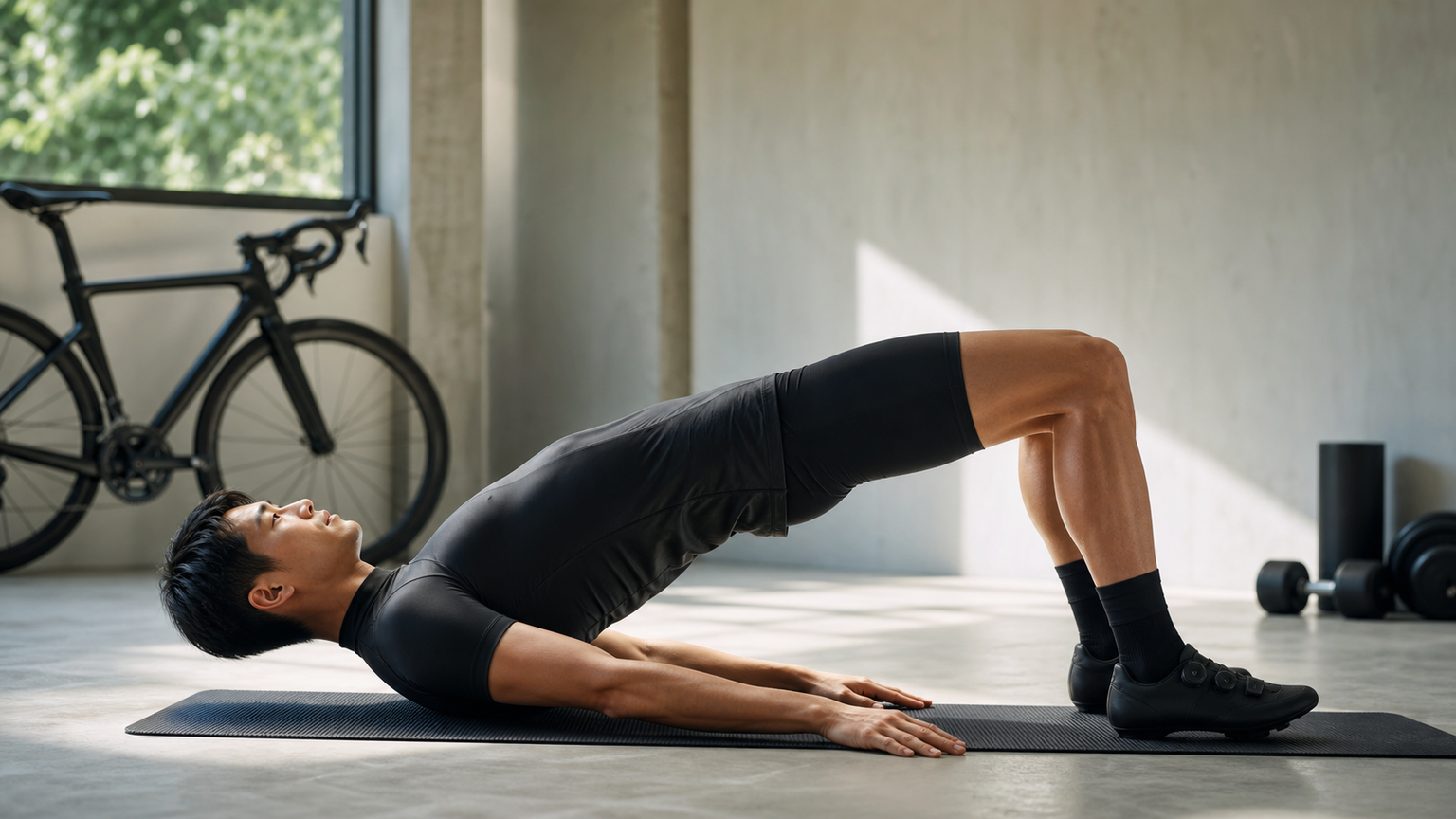
Banded Glute Bridge
- Sets: 3 sets × 15 reps, 30 seconds rest between sets
- Focus: Hold for 2 seconds at the top, feel the glute contraction
- Band placed above the knees to prevent knees caving inward
-
Side-Lying Clamshell
- Sets: 3 sets × 20 reps (each side)
- Focus: Keep heels in contact, rotate only at the hip joint, do not let the pelvis tilt backward
-
Fire Hydrant
- Sets: 3 sets × 15 reps (each side)
- Focus: On all fours, lift the leg out to the side and back, gluteus medius as the prime mover
Strengthening Exercises (Main Program 25 Minutes)
- Romanian Deadlift (RDL): 4 sets × 8 reps, start with 40% of body weight
- Stance width equal to saddle width, simulating the standing riding position
- Bulgarian Split Squat: 3 sets × 10 reps (each side)
- Rear foot on a bench, front knee aligned with the second toe
- Walking Lunge with Rotation: 3 sets × 12 steps
- After each lunge step, rotate the torso toward the front leg while holding a kettlebell, training anti-rotation stability
Core Training: Anti-Rotation and Anti-Extension
The focus of climbing core training is stiffness, not crunches and flexion.
Core Program (10 Minutes)
| Exercise | Sets/Time | Training Focus |
|---|---|---|
| Dead Bug | 3 sets × 10 reps (each side) | Anti-extension, lumbar spine stays neutral |
| Plank Shoulder Tap | 3 sets × 20 reps (each side) | Anti-rotation, pelvis does not sway |
| Farmer’s Carry | 3 sets × 20 meters | Unilateral loading, anti-lateral flexion |
| Russian Twist | 3 sets × 15 reps (each side) | Active rotation, torso rotation control when rocking the bike |
Weekly Program Integration Recommendations
- Tuesday: 2 hours after a high-intensity riding day, light glute activation + core (no heavy deadlifts)
- Thursday: Main strength day, full glute strengthening program
- Sunday: After a long ride, do 10 minutes of glute activation and stretching to prevent tightness
4-Week Progressive Plan
- Weeks 1–2: Focus on control and feel, light loads, proper form
- Weeks 3–4: Increase load by 10–15%, reduce rest between sets to 45 seconds
- 1 week before race: Reduce volume (halve the sets), maintain neural system activation
Practical Advice
- Many road cyclists in Taiwan do not go to the gym; the entire program can be completed at home with resistance bands and dumbbells
- The glute bridge looks simple, but most riders compensate with their hamstrings—feel your glutes to confirm they are contracting before continuing
- Core training is not about building a “six-pack”; it is about keeping your upper body steady on the bike so power transfers fully to the pedals
- Strength training will not make you “bulky and heavier”; as long as you do not consume excess calories, your weight will remain essentially unchanged
Conclusion
The ceiling of climbing ability is sometimes not the cardiovascular system, but the glutes and core. Two 45-minute off-bike strength sessions per week are a core component of many pro riders’ winter training. Add this program to your training plan, and the next time you face the 3,275-meter ascent of Wuling, you will find your legs are no longer fighting alone.
Related Reading
- Climbing-Specific Strength Training: Single-Leg Squat and Hip Flexor Strengthening Program
- Core Strengthening for Climbing Training: The Impact of Stability on Power Output
- Climbing-Specific Strength: How to Build Legs That Don’t Fade on Long Climbs in the Gym
- Key Climbing Muscle Training for Westbound Wuling: A Complete Guide to Gym Supplementary Exercises
一日北高/長距離團騎 常見問題補充篇 / 組團或跟團的眉角 / 壯車友容易被瘦車友慢性拉爆 / 原來屁股痛可能是這個原因...? / 風場配速法 / 公路車 / CT Yeh
2 年前
Never Stop 西進武嶺 前後雙機 完整全程錄影 訓練台 實境
8 年前
一日北高常見問題大集合 | 攻略 | 路線 | 訓練 | 補給 | 自行車 單車 | 一日雙城 | 雙塔 | TWB北高360 | 屁股痛
6 年前
單車 梅山36灣 坡度介紹 路段介紹 空拍 (相關遊記影片,請參考說明或我的頻道喔,歡迎訂閱)
6 年前
單車 一日北高 ( 雙城 ) 肥宅雙人瘋狂行 紀錄片 REACTO
10 年前
西進武嶺 免費訓練分析服務 Intervals | 練不夠還是練過頭?你哪一種類型選手?AI模型告訴你! | 備戰神器 | 公路車 訓練 | CT Yeh
4 年前
大禹嶺 到 武嶺牌樓 全程前後實況錄影 | 北進武嶺 | 東進武嶺 | KOM | 訓練台 | 坡度分析 | Taiwan KOM Last 10 km HARD | 公路車
6 年前
#公路車 #Fitting 靠人工智慧APP 幫你調整單車
6 年前