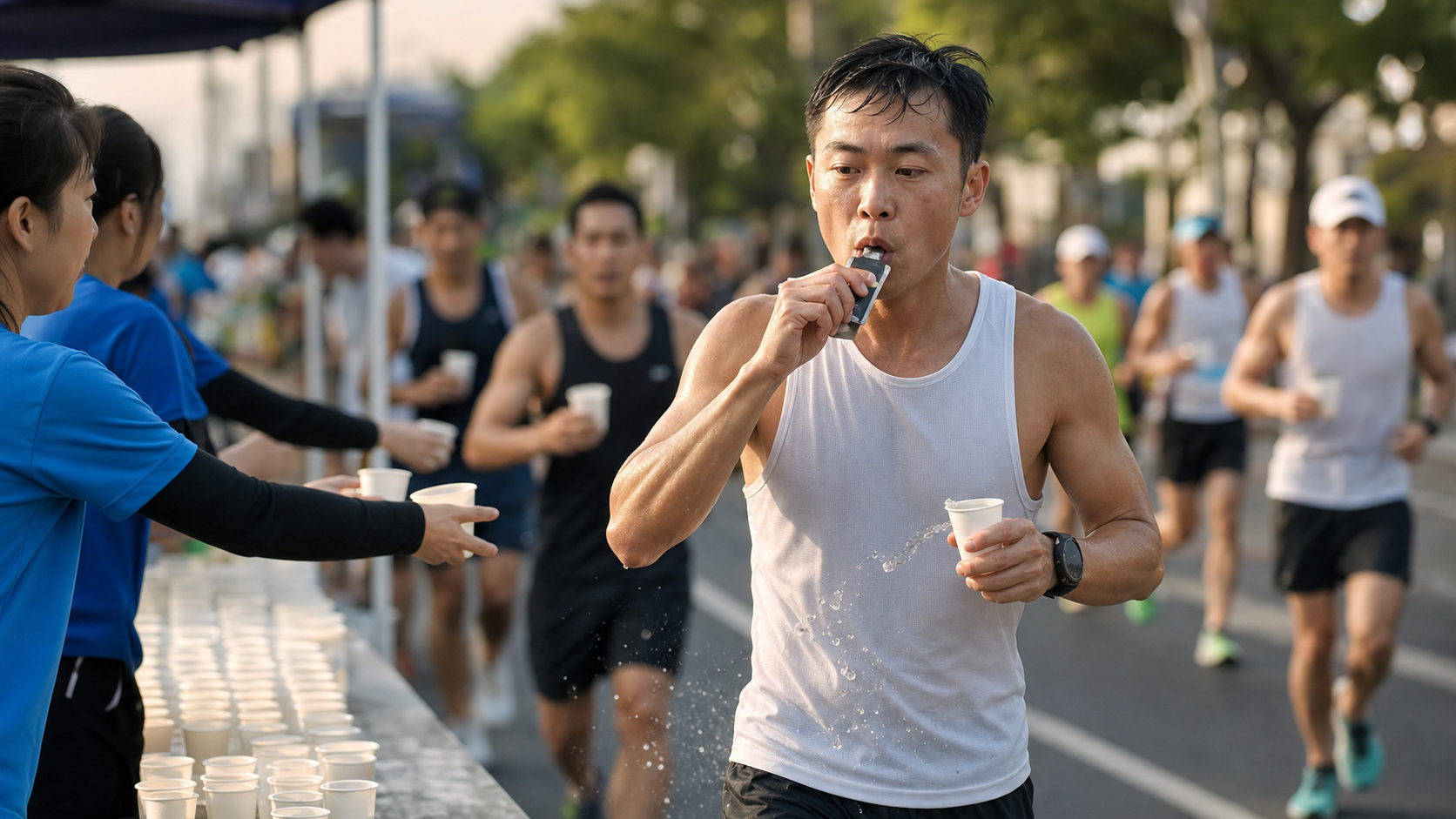
Introduction
“Is a gel really necessary for a half marathon, which is only 21 km?” This is one of the most common questions from runners preparing for their first half marathon. The answer is: it depends. Compared with a full marathon (42 km), the energy expenditure of a half marathon is relatively manageable. However, if your finish time exceeds 90 minutes, timely carbohydrate intake can help sustain your power output in the latter stages, preventing a “slowdown” or even a “bonk.” This article provides customized half-marathon fueling strategies for runners targeting different finish times.
Calculating Half-Marathon Energy Needs
Running energy expenditure is roughly 1 kcal per kilogram of body weight per kilometer. For a 60 kg runner completing a half marathon:
- Total expenditure is approximately 60 × 21 = 1260 kcal
- The body’s muscle glycogen stores are about 400–500g (1600–2000 kcal)
- In theory, muscle glycogen should not be completely depleted during a half marathon
But this calculation has a caveat: muscle glycogen must be fully loaded before the race, and the intensity cannot be too high (higher intensity relies more on glycogen). If you’re running a near-all-out half marathon, muscle glycogen may indeed run low in the second half.
Fueling Strategy by Finish Time
| Target Finish Time | Running Duration | Gel Needed? | Recommended Fueling Timing |
|---|---|---|---|
| < 1:30 | ~90 minutes | Optional (but 1 gel is recommended) | 10–12 km |
| 1:30–1:45 | 90–105 minutes | 1–2 gels recommended | 10 km, 15 km |
| 1:45–2:00 | 105–120 minutes | 1–2 gels recommended | 8–10 km, 15–16 km |
| > 2:00 | > 120 minutes | 2 gels strongly recommended | 8 km, 14–15 km |
Key principle: After 75–90 minutes of exercise, blood glucose begins to drop. Even if muscle glycogen isn’t depleted, exogenous carbohydrates can still help maintain your pace.
How to Use Gels Correctly
Many runners fuel incorrectly, which leads to gastrointestinal discomfort:
- Take gels with water: Gels must be consumed with water (100–150 ml); otherwise, the high sugar concentration can irritate the stomach
- Don’t wait until you’re tired: Gels take 10–15 minutes to absorb, so take them early while you “still feel fine”
- Use brands you’ve tested before race day: Don’t try unfamiliar gel brands on race day to avoid stomach issues
- Caffeinated versions work better: Caffeine can reduce perceived fatigue; consider using a gel with 50 mg of caffeine after the 15 km mark
Aid Station Layout at Taiwan Half Marathons
Taking common large-scale half marathons in Taiwan as an example, aid stations are typically set up as follows:
- 5 km: Water (some races offer sports drinks)
- 10 km: Water + sports drink + food (bananas, salt candies)
- 15 km: Water + sports drink
- 18 km: Water (final aid station)
Since the food options provided at aid stations are limited, if you need gels, it’s recommended to carry your own, tucked into your shorts waistband or using a hydration belt.
Pre-Race Carbohydrate Loading (The Most Important Fueling Strategy)
Rather than relying on gels on race day, it’s better to fully fuel up beforehand:
- 3 days before the race: Consume 8–10g of carbs per kg of body weight daily (rice, noodles, sweet potatoes, bananas)
- Dinner the night before: High-carb, low-fiber (white rice or pasta; avoid beans and high-fiber vegetables)
- Breakfast on race day (2–3 hours before the start): 200–400g of carbs (toast with peanut butter + banana + sports drink)
- 15–30 minutes before the start: A small gel or 100 ml of sports drink to top off blood glucose
Hydration Strategy
Sweat loss during a half marathon varies with temperature:
- Taiwan autumn/winter (15–20°C): Sweat rate is about 0.5–1L/hr; drink 100–150 ml at each aid station
- Taiwan spring (25–30°C): Sweat loss increases significantly; drink 150–200 ml at each station and consider electrolyte replacement
- Don’t stop at aid stations for more than 10 seconds to drink; practice “drinking while walking” or “drinking while jogging”
Practical Tips
- Do a “gel practice” the week before the race: Simulate fueling during a 15–18 km long run to confirm your stomach’s tolerance
- Carry 2 gels (1 as backup); they’re lightweight (about 30g each) and won’t affect your running
- For Taiwan summer half marathons (e.g., March–April), heavy sweating due to high heat means hydration takes priority over gels
- If you have a sensitive stomach, switch to “energy chews,” which are easier to consume in portions
Conclusion
There’s no one-size-fits-all fueling strategy for a half marathon, but there is a consensus: for runs exceeding 90 minutes, proactively consuming carbohydrates helps sustain power output. Rather than guessing on race day, test repeatedly during training to find a fueling plan that suits your stomach and taste, and on race day you’ll only need to execute it.
Related Reading
CT暗黑廚房) 車友必備 宇宙無敵鮮蚵湯 幫助訓練恢復 天然食補 好市多 超肥鮮蚵 破PR
7 年前
一日北高前的高裝檢 | 北高 360 | 挑戰11小時的裝備 | 一日雙塔 | 補給
6 年前
Live) 備戰2019彰化經典百K 賽前攻略 (已完賽請看新影片
7 年前
半日 小台灣 極限單車路線挑戰實錄
7 年前
一日北高/長距離團騎 常見問題補充篇 / 組團或跟團的眉角 / 壯車友容易被瘦車友慢性拉爆 / 原來屁股痛可能是這個原因...? / 風場配速法 / 公路車 / CT Yeh
2 年前
2016/4/20 - 中社路 夜騎 半年甩肉14KG 後測
10 年前
2019 夏季KOM 5小 完賽心得 準備攻略 東進武嶺 夏季登山王之路 Taiwan KOM Challenge
7 年前
#公路車 #Fitting 靠人工智慧APP 幫你調整單車
6 年前