Triathlon Transition (T1/T2) Speed Tips and Flow Planning: A Painless Guide to Finishing (Series 126)
文章導覽
- The Art of a Smooth Transition: Breaking Down T1 and T2
- Brick Workouts: Overcoming Heavy Legs
- Triathlon (Olympic Distance 51.5K) Transition Flow Checklist
- Core Gear and Nutrition Checklist
- Frequently Asked Questions
- Q: Do I need to wear socks during T1?
- Q: How can I make my wetsuit easier to remove?
- Conclusion and Outlook
Triathlon Transition (T1/T2) Speed Tips and Flow Planning: A Painless Guide to Finishing (Series 126)
This article was written in collaboration with our sports science editorial team and professional coaches, bringing you the most professional triathlon knowledge and training advice.
Whether it’s the depths of winter or the heat of summer, consistent training is a shared memory for all triathlon enthusiasts. However, training blindly often comes with injury and stagnation. How can you use modern sports science to optimize physical adaptation, gear pairing, and fueling strategy? Let’s take a look at the analysis from professional coaches and scientists.
The Art of a Smooth Transition: Breaking Down T1 and T2
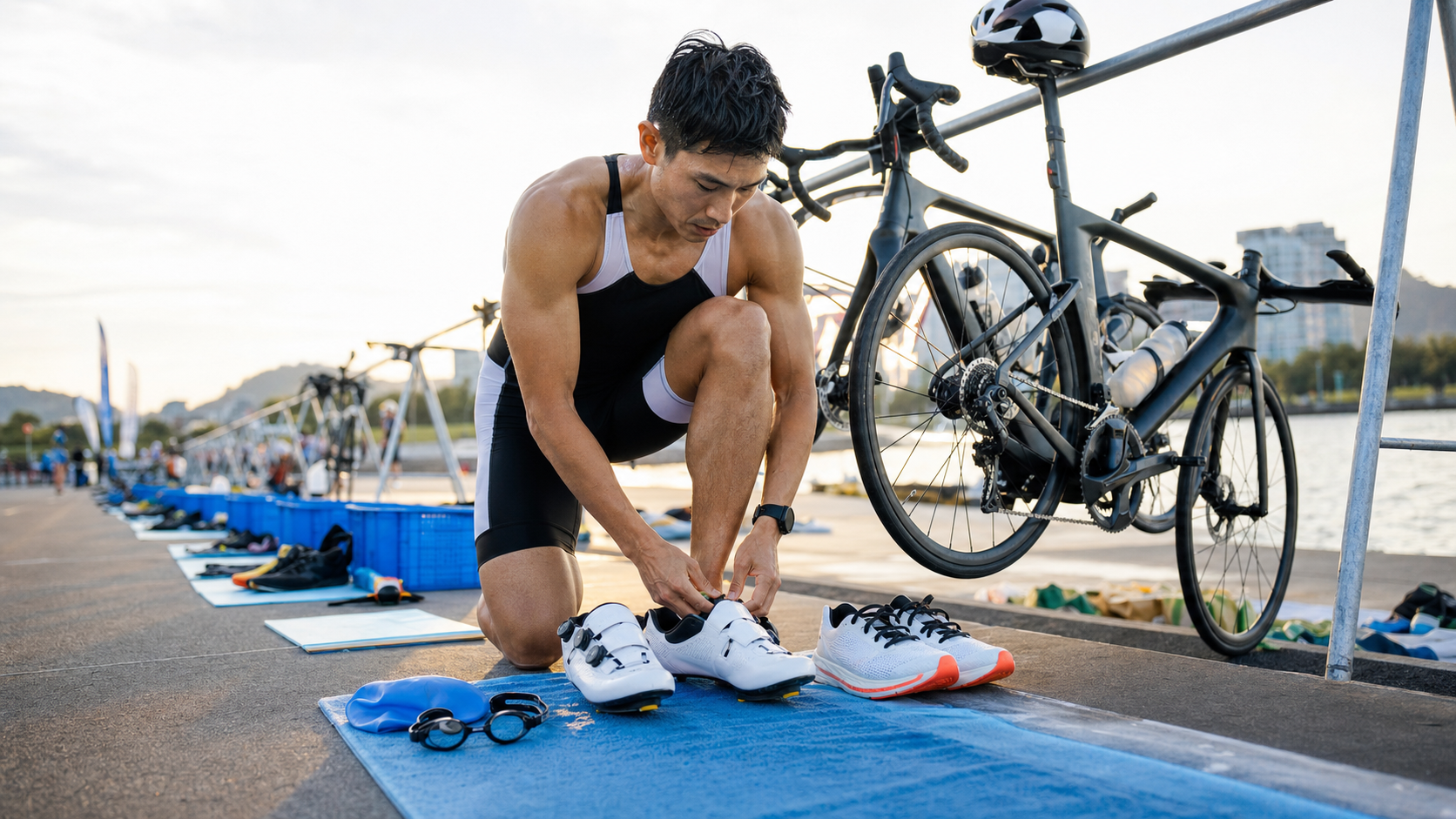
In triathlon, the transition area is often called “the fourth discipline.” A skilled athlete can complete T1 (swim to bike) and T2 (bike to run) in as little as 1-2 minutes, while a beginner may take more than 5 minutes. The key to speeding up lies in simplifying the process: unzip your wetsuit before exiting the water, pre-clip your cleats on the bike, and lay out your gear in order on your transition towel. Every unnecessary movement quietly eats into precious race time.
Brick Workouts: Overcoming Heavy Legs
After riding dozens of kilometers on the bike, the first 1-2 kilometers of running can leave your legs feeling incredibly heavy, as if filled with lead. This happens because blood is concentrated in the cycling muscles, and running and cycling use completely different muscle fibers and neural pathways. Through “brick workouts” (running 15-30 minutes immediately after finishing a bike ride), you can train your brain and muscles to redistribute blood within minutes, helping your body adapt to this rapid neuromuscular transition.
Triathlon (Olympic Distance 51.5K) Transition Flow Checklist
Here is a practical data-driven checklist for you:
| Transition Phase | Athlete Action Steps | Gear Check | Tactical Focus | Time-Saving Tips |
|---|---|---|---|---|
| Swim Exit (T1 Start) | Unzip wetsuit down to the waist | Hold swim cap and goggles in hand | Maintain running rhythm, avoid dizziness | Remove upper wetsuit while running from the water exit |
| Bike Preparation (T1) | Put on helmet (must buckle first) -> Remove wetsuit -> Put on cycling shoes | Helmet, race bib (turned to back) | Confirm bib and helmet are securely fastened | Use elastic no-tie laces, pre-clip shoes onto the bike |
| Bike Return (T2 Start) | Remove feet from cleats and rest on top of shoes about 500m before the line | Prepare to dismount | Watch the dismount line, do not dismount early | Dynamic dismount, run into the transition area pushing the bike |
| Run Start (T2) | Rack bike -> Remove helmet -> Put on running shoes -> Grab nutrition | Running shoes, cap, energy gel | Turn race bib to the front | Use talc powder in shoes for easy entry, slow pace for the first 1K |
Core Gear and Nutrition Checklist
For this training or race, it’s recommended to prepare the following:
- Post-race golden recovery drink: A carbohydrate-to-protein ratio of 3-4:1, consumed within 30 minutes after finishing/training.
- Electrolyte/salt tablet supplementation: Prevents electrolyte imbalance and muscle cramps caused by heavy sweating in high temperatures.
- Heart rate monitoring gear: A chest strap heart rate monitor or high-precision sports watch for real-time heart rate zone tracking.
Frequently Asked Questions
Q: Do I need to wear socks during T1?
A: For shorter distance races (such as half or Olympic distance), many elite athletes skip socks to save time, applying petroleum jelly inside their cycling shoes to prevent chafing. However, for longer distances like 70.3 or full-distance (Ironman), it’s recommended to take the time to put on socks to avoid blisters.
Q: How can I make my wetsuit easier to remove?
A: Apply anti-chafing balm (such as Body Glide) to your wrists, ankles, and neck. When removing the wetsuit, roll it down and outward, then step on the cuff and pull it firmly to take it off.
Conclusion and Outlook
Whether your goal is to stand on the podium or simply finish within the time limit, every drop of sweat has value. Remember, systematic pacing and scientific fueling are your secret weapons. Wishes for a successful finish to all triathletes and runners!
Related Reading
- Triathlon Transition (T1/T2) Speed Tips and Flow Planning: A Painless Guide to Finishing (Series 321)
- Triathlon Transition (T1/T2) Speed Tips and Flow Planning: A Painless Guide to Finishing (Series 69)
- Triathlon Transition (T1/T2) Speed Tips and Flow Planning: An Annual Training Guide (Series 486)
- Triathlon Transition (T1/T2) Speed Tips and Flow Planning: An Annual Training Guide (Series 447)