Do Compression Garments Really Work? A Comprehensive Sports Science Analysis of Compression Gear
文章導覽
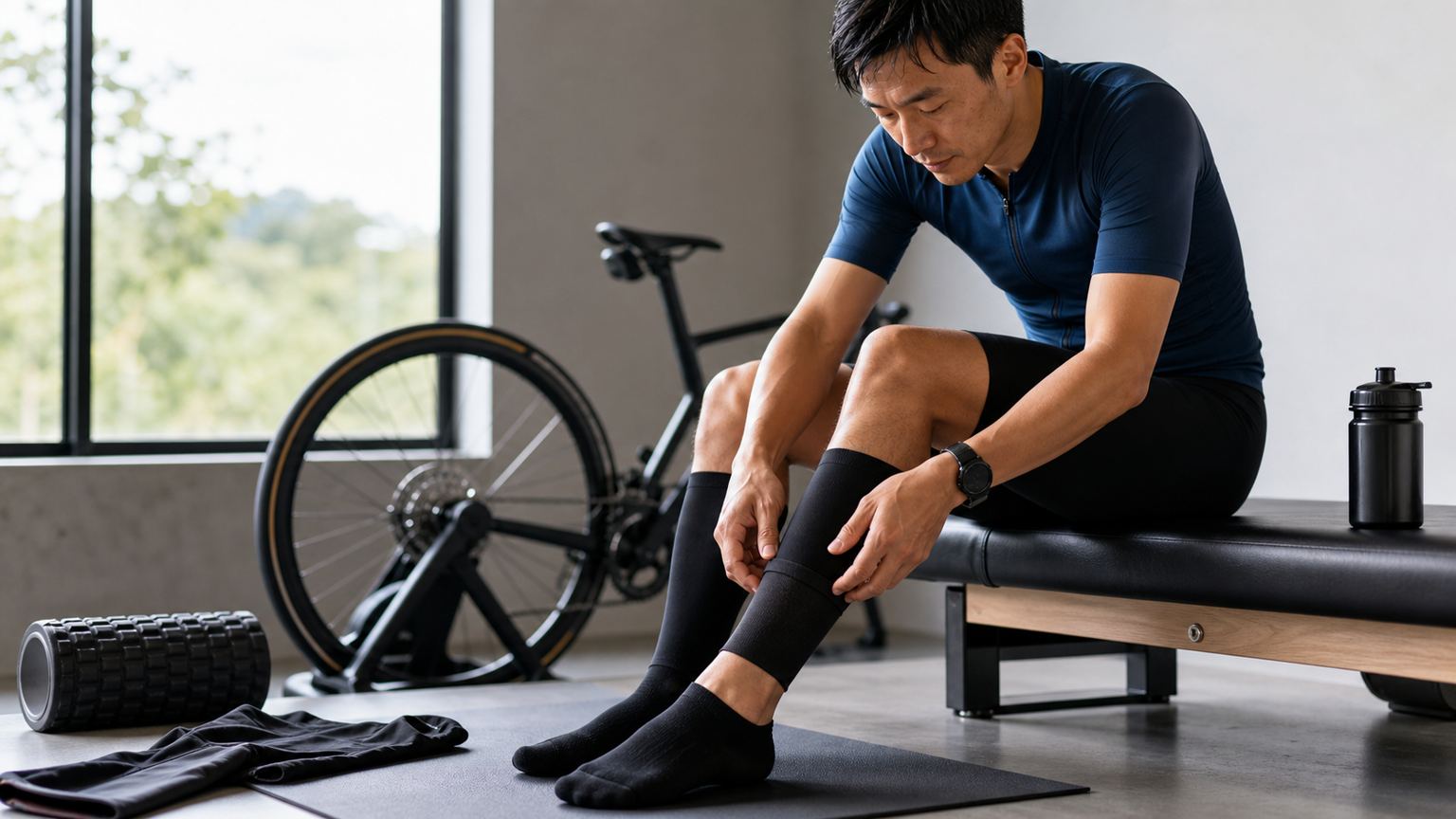
Are Compression Garments Really Effective? A Comprehensive Sports Science Analysis of Compression Gear
Walk into any sporting goods store, and compression garments always occupy a prominent position. From compression tights, compression socks, to compression arm sleeves, prices often exceed a thousand NT dollars. Marketing copy claims they can “enhance performance,” “accelerate recovery,” and “reduce muscle oscillation.” But how much scientific basis do these claims have? This article will comprehensively examine the empirical research on compression garments to help cyclists make rational choices.
Basic Principles of Compression Garments
Graduated Compression
Medical-grade compression socks were originally designed to treat varicose veins and deep vein thrombosis (DVT). Their core principle is graduated compression—maximum pressure at the ankle, gradually decreasing upward. This creates a pressure gradient that helps venous blood return to the heart against gravity.
The unit of pressure is mmHg (millimeters of mercury), with different levels of compression:
| Level | Pressure Range | Purpose |
|---|---|---|
| Mild | 10-15 mmHg | Daily wear, mild fatigue |
| Moderate | 15-20 mmHg | Sports recovery, people who stand for long periods |
| High | 20-30 mmHg | Medical use, severe venous issues |
| Therapeutic | 30-40 mmHg | Prescribed by physicians |
Most sports brands’ compression garments fall within the 15-25 mmHg range.
Theoretical Physiological Benefits
The mechanisms claimed for compression garments include:
- Improved venous return: The pressure gradient accelerates blood flow back to the heart
- Reduced muscle oscillation: Decreases muscle vibration amplitude during exercise
- Enhanced proprioception: Pressure provides additional sensory feedback
- Reduced swelling: Limits tissue fluid accumulation
- Maintained muscle temperature: Thermal insulation may improve muscle function
Examining the Scientific Evidence
Effects on Athletic Performance
Endurance sports (cycling, running):
A 2021 systematic review (Engel et al.) analyzed 38 studies, with surprising conclusions:
- The effects of compression garments on VO2max, lactate threshold, and running economy were statistically insignificant
- Improvement in time trial performance was approximately 0.5-1.5%, but most studies did not reach statistical significance
- Some studies showed slight reductions in heart rate and ratings of perceived exertion (RPE)
Practical significance: If compression garments do enhance performance, the effect is extremely small, and for amateur cyclists it would be nearly impossible to perceive the difference during actual riding.
But there is one important exception—for prolonged exercise (>2 hours), compression tights may delay the subjective feeling of fatigue by reducing muscle oscillation. This may be more noticeable on rough-road road cycling or gravel riding.
Effects on Recovery
This is the most compelling area for compression garments:
Key findings from the 2022 Meta-analysis (Brown et al.):
- DOMS relief: Moderate effect (SMD = -0.47), especially when worn 24-72 hours after training
- CK (creatine kinase) clearance: The group wearing compression garments had significantly lower CK values after 48 hours
- Strength recovery: Slight acceleration (on average 5-8% faster return to baseline values)
- Perceived recovery: Strong positive effect—athletes consistently reported “feeling better recovered”
Key observation: The benefits of compression garments for recovery far exceed their benefits for performance. This means their greatest value lies in “wearing after training” rather than “wearing during training.”
Psychological and Placebo Effects
The significant placebo effect of compression garments cannot be overlooked. An interesting study (Brophy-Williams et al., 2017) used “sham compression tights” (identical in appearance but with extremely low pressure) and found:
- Both groups showed nearly identical improvements in subjective recovery perception
- On objective recovery metrics, the true compression group was slightly better, but the difference was small
This tells us: “Believing it works” is itself an effective recovery mechanism. Psychological factors play a more important role in sports recovery than we think.
A Cyclist’s Buying Guide for Compression Gear
Compression Socks
The most recommended category, with the strongest scientific evidence.
- Wearing during exercise: Knee-high compression socks, 15-20 mmHg
- For recovery: Knee-high or thigh-high, 20-25 mmHg
- Material: Choose blends containing 15-20% elastane (Lycra/Spandex)
- Note: Ensure ankle pressure is higher than mid-calf pressure to create a proper pressure gradient
Compression Tights
- Primarily for recovery: Wear for 2-4 hours or overnight after long rides
- Sizing is critical: Too loose means no compression effect; too tight may restrict blood flow
- Recommendation: Choose brands that specify mmHg values rather than merely labeling “compression”
Arm Sleeves
- Less practical for cyclists (arms are not the primary working muscle groups)
- Mainly used for warmth and sun protection
- If you have forearm fatigue issues (e.g., from prolonged handlebar gripping), you may try them
Pneumatic Compression Devices
Inflatable leg sleeves such as NormaTec, RecoveryPump, etc.:
- Pressure far exceeds wearable compression garments (up to 80-100 mmHg)
- Use sequential pulse compression, simulating the squeezing effect of muscle contractions
- Studies show significant effects on lymphatic return and subjective recovery
- Disadvantages: expensive (NT$15,000-60,000), bulky, and require a power source
- Best suited for: professional athletes, high-volume amateur cyclists, and stage race participants
Wearing Strategy Recommendations
Training Days
Before riding: No special compression garments needed
During riding: Personal preference (effect not significant but harmless)
After riding: Immediately put on recovery compression tights/socks
Duration of wear: 2-4 hours, or until bedtime
Race Days
Pre-race: Compression socks can be worn during warm-up
During race: Compression socks (if race kit allows)
Post-race: Full compression tights + socks, worn for at least 3-4 hours
Sleep: Wear compression socks overnight (if comfortable)
Multi-Day Races
After each day's race: Put on compression garments immediately
During dinner/rest periods: Keep wearing them
Sleep: Compression socks are recommended
Next morning: Remove after waking up, prepare as normal
Frequently Asked Questions
Q: How long must compression socks be worn to be effective?
Studies show they need to be worn for at least 1-2 hours to observe effects, with optimal benefits at 3-4 hours. Studies on overnight wear also show it is safe and beneficial.
Q: Can compression garments prevent cramps?
There is currently no direct evidence supporting this. Cramps are primarily related to neuromuscular fatigue and electrolyte imbalance, which compression garments cannot directly address.
Q: Are compression socks useful during flights?
Yes. Wearing 15-20 mmHg compression socks during long-haul flights can reduce the risk of deep vein thrombosis, which is particularly helpful for cyclists traveling to race destinations.
Q: Who should not wear compression garments?
Patients with peripheral arterial disease, severe skin infections, or heart failure should use them under a physician’s guidance. Healthy athletes using sports-grade compression garments generally face no risk.
A Rational Look at Compression Gear
Compression gear is neither magic equipment nor a marketing scam—it is a recovery aid with moderate scientific support. The most important things to understand are:
- It helps with recovery more than it helps with performance
- Its effects are a bonus, not a substitute for sleep, nutrition, and a well-planned training schedule
- The positive psychological effects should not be overlooked
- The option with the best value for money is a good pair of compression socks
Put compression gear in its proper place—it is one tool in the recovery toolbox, not the only tool.
Related Reading
- The Real Effects of Compression Technology in Cycling: From Medical Principles to Practical Application
- Road Running Compression Tights Buying Guide: The Practical Benefits of Gradient Pressure Design for Muscle Support
- The Application of Compression Garments in Cycling Recovery: A Study on Wearing Timing and Benefits
- The Scientific Basis of Compression Gear: The Benefits of Compression Tights and Compression Calf Sleeves for Post-Exercise Recovery