文章導覽
2025 Complete Power Meter Buying Guide: Best Choices from Beginner to Advanced
The power meter is arguably one of the most revolutionary inventions in cycling training. It directly measures the wattage you generate while pedaling, unaffected by external factors such as wind speed, gradient, or temperature, giving you the most objective training and racing data. If you take your training seriously, a power meter is an almost indispensable investment.
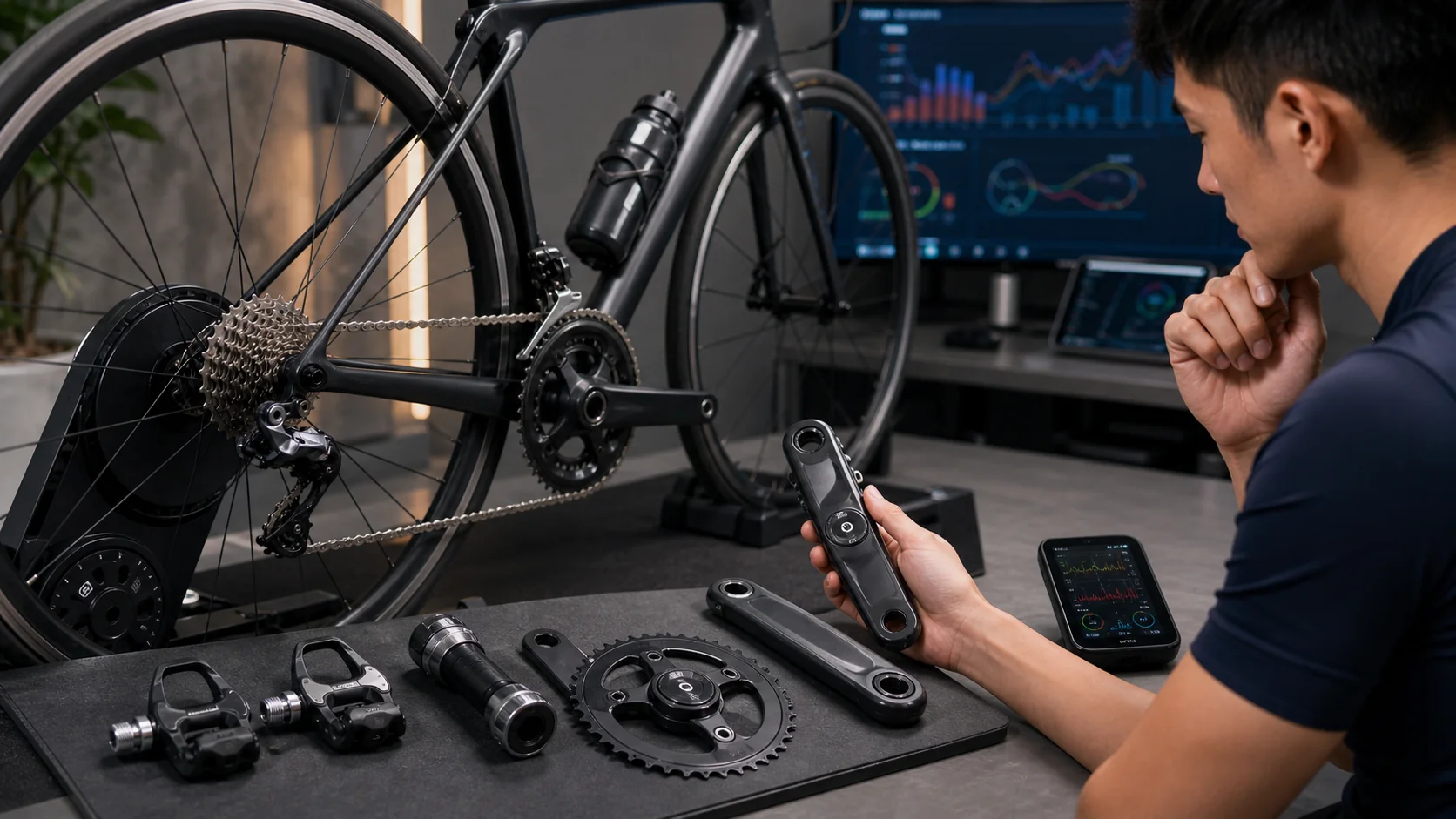
Why Do You Need a Power Meter?
Heart Rate vs. Power: A Fundamental Difference
Many riders rely on heart rate to gauge exercise intensity, but heart rate is a “lagging indicator” — when you accelerate into a sprint, it takes tens of seconds for your heart rate to reflect the actual load. Heart rate is also affected by caffeine intake, sleep quality, ambient temperature, hydration level, and many other factors, so the same heart rate can represent completely different physical states on different days.
A power meter, on the other hand, is a “real-time indicator.” Every pedal stroke you make is reflected instantly in the power data. 200 watts is 200 watts, regardless of your mood or the weather that day. This makes setting training zones far more precise and tracking progress far more reliable.
Core Concepts of Power-Based Training
- FTP (Functional Threshold Power): The maximum average power you can sustain for one hour, the foundation for all training zones
- TSS (Training Stress Score): Quantifies the stress load of each training session
- IF (Intensity Factor): The ratio of normalized power to FTP, reflecting training intensity
- W/kg (watts per kilogram): Power-to-weight ratio, a key indicator of climbing ability
- NP (Normalized Power): The equivalent average power that accounts for variability in effort
A Complete Breakdown of Power Meter Types
1. Crank-Based Power Meters
Representative brands: Stages, 4iiii, Pioneer
Crank-based power meters mount a strain gauge on the crank arm, measuring the tiny deformation of the crank during pedaling to calculate power.
Pros:
- Relatively affordable, single-sided entry models cost around NT$8,000-12,000
- Simple installation, suitable for sharing across multiple bikes (if the crank specs match)
- Easy battery replacement, low maintenance cost
Cons:
- Single-sided measurement only reads the left leg, assuming a 50/50 left-right balance (actual deviation can be 3-8%)
- Dual-sided versions cost roughly double
- Compatibility with the frame and chainset needs to be checked
Recommended picks:
- Best for beginners: Stages Gen 4 single-sided (~NT$9,500), with greatly improved stability
- Best value for money: 4iiii Precision 3+ single-sided (~NT$8,500), lightweight and accurate
- Dual-sided recommendation: Stages LR dual-sided kit (~NT$22,000)
2. Pedal-Based Power Meters
Representative brands: Garmin Rally, Favero Assioma, SRM X-Power
Pedal-based power meters integrate the sensors directly into the pedals and have become the most popular type in recent years.
Pros:
- Easiest to install — switching bikes only requires swapping the pedals
- Naturally supports left-right power balance analysis
- Great for riders who own multiple bikes
Cons:
- Higher price, dual-sided versions cost around NT$20,000-35,000
- Limited to specific cleat systems (Look, SPD-SL, SPD)
- Heavier pedals, adding about 50-100g per side
- Prone to impact damage
Recommended picks:
- Best value for money: Favero Assioma Duo-Shi (SPD dual-sided, ~NT$22,000), the new SPD version released in 2024 has been extremely well received
- Best ecosystem integration: Garmin Rally XC200 (SPD dual-sided, ~NT$28,000), seamless connection with Garmin bike computers
- Best for road bikes: Favero Assioma Duo (Look system, ~NT$20,000), the best reputation in the market
3. Spider-Based Power Meters
Representative brands: Quarq, Power2Max, SRM
Spider-based power meters are mounted on the spider arms between the crank and chainring, measuring drive force directly.
Pros:
- Highest accuracy (within ±1%)
- Naturally measures total power from both legs
- Not affected by pedal or crank choice
Cons:
- Most expensive, around NT$25,000-60,000
- Installation requires professional tools
- Switching bikes is more troublesome, requires a compatible crank system
Recommended picks:
- Best for professionals: SRM Origin (~NT$55,000), the industry benchmark for accuracy
- Best value pick: Power2Max NG Eco (~NT$18,000), a great choice for entry-level spider power meters
- Best for SRAM users: Quarq DZero DUB (~NT$30,000), a perfect match with SRAM groupsets
4. Hub-Based Power Meters
Representative brands: PowerTap (discontinued), Revere (new brand)
Hub-based power meters are installed in the rear wheel hub, measuring power at the very end of the drivetrain.
Pros:
- Measurement point closest to the actual drive force
- Not affected by drivetrain efficiency losses at the front
Cons:
- Requires a dedicated wheelset, expensive to replace
- Limited options on the market
- Adds weight to the rear wheel
The hub-based power meter market has shrunk significantly and is not recommended for new purchases.
2025 Recommendations by Price Range
Under NT$10,000 (Entry-Level)
| Product | Type | Accuracy | Price |
|---|---|---|---|
| 4iiii Precision 3+ single-sided | Crank | ±1.0% | ~NT$8,500 |
| Stages Gen 4 single-sided | Crank | ±1.5% | ~NT$9,500 |
| Magene P325CS single-sided | Crank | ±2.0% | ~NT$5,500 |
NT$15,000-25,000 (Mid-Range)
| Product | Type | Accuracy | Price |
|---|---|---|---|
| Favero Assioma Duo | Pedal | ±1.0% | ~NT$20,000 |
| Favero Assioma Duo-Shi | Pedal | ±1.0% | ~NT$22,000 |
| Power2Max NG Eco | Spider | ±1.5% | ~NT$18,000 |
| Stages LR dual-sided | Crank | ±1.5% | ~NT$22,000 |
Above NT$25,000 (Advanced)
| Product | Type | Accuracy | Price |
|---|---|---|---|
| Garmin Rally RS/XC 200 | Pedal | ±1.0% | ~NT$28,000 |
| Quarq DZero DUB | Spider | ±1.5% | ~NT$30,000 |
| SRM Origin | Spider | ±1.0% | ~NT$55,000 |
Buying Decision Process
- Confirm your budget: For beginners, budget at least NT$8,000-10,000
- Confirm number of bikes: Riders with multiple bikes should prioritize pedal-based options
- Confirm your cleat system: SPD or Look/SPD-SL determines which pedal-based options are available
- Confirm crank specifications: Before buying a crank-based power meter, check the BCD and spindle specs
- Consider future upgrades: Whether a single-sided unit can be upgraded to dual-sided later
Frequently Asked Questions
Q: Is a single-sided power meter good enough?
For entry-level training and general riding, a single-sided power meter is sufficient. It provides trend tracking and basic training zone setup. However, if you need precise left-right balance analysis or plan to compete in serious time trials, an upgrade to dual-sided is recommended.
Q: How often does a power meter need to be calibrated?
It’s recommended to perform a zero-offset calibration before every ride. Most power meters can do this through your bike computer in just 10 seconds.
Q: Can data from different power meter brands be compared directly?
There can be a systematic deviation of 2-5% between different brands. It’s best to stick with one brand once chosen and track your own trends — that matters more than absolute values.
Conclusion
2025 is the richest year yet for power meter choices. No matter your budget, you can find a product that suits you. Remember, the best power meter is the one you’ll actually keep using. The wisest strategy is to start with an entry-level model to build the habit of data-driven training, then upgrade gradually as your needs grow.
Further Reading
- 2024 Power Meter Buying Guide: Which Power Meter Best Fits Your Budget and Needs
- Introduction to Power-Based Cycling Training: From Buying a Power Meter to Designing Your First Training Plan
- The Ultimate 2025 Power Meter Buying Guide: Pedal, Crank, or Hub — Which to Choose?
- Choosing and Calibrating a Power Meter: How Accuracy Errors Affect Your Training Data