文章導覽
One-Day Twin Towers Attempt Failed: The Collapse and Rebirth of a 200 km Single-Day Ride
Let me start with the conclusion: I did not complete the One-Day Twin Towers. The plan was to ride 520 km from Fugui Cape Lighthouse to Eluanbi, but I completely collapsed in Xiangshan, Hsinchu, at around the 160 km mark. But this article isn’t about failure—it’s about recording what happened that day, and why I think it was the most important day of my cycling career.
But before I get to the Twin Towers, let me first go back to the ride that truly taught me what “200 km” means.
The Spark: Why 200 km?
For road cyclists, 200 km is a psychological threshold. Unlike a century ride, which can be completed with enough physical fitness, 200 km tests your nutrition strategy, pacing discipline, and—most importantly—whether your mind can hold up after your body starts protesting.
At that point, I had about two years of cycling experience, and my longest single-day ride was 130 km (one loop around the North Coast). After 130 km, I felt “tired but okay,” so I naively thought: “Adding another 70 km shouldn’t be that different, right?”
It was only later that I learned fatigue in long-distance riding doesn’t increase linearly—it’s exponential.
First 200K Attempt: The West Coast Highway
I chose the West Coast Highway (Provincial Highway 61), starting from Bali in Taipei, riding south along the coastline to Lukang in Changhua, then taking the train back to Taipei. I chose the West Coast because it’s essentially all flat with no climbs, so in theory I could maintain a steady pace.
I set off at 5 a.m. The sky was still gray, and the streetlights at Bali Ferry Terminal were still on. The temperature was around 20 degrees, with a light breeze—nearly perfect cycling weather.
0-80K: A Wonderful Start
The first 80 km went so smoothly it was almost unreal. My speed held steady between 28 and 30 km/h, heart rate controlled in Zone 2, eating every 40 minutes (energy bars or bananas), drinking water every 20 minutes. The sun happened to rise as I passed Zhunan, golden light spilling across the sea. I thought to myself as I pedaled: “This is way too comfortable. 200 km is nothing.”
Looking back now, that kind of thinking was the precursor to disaster.
80-120K: Starting to Feel It
After passing Hsinchu, the tailwind turned into a crosswind. This stretch of the West Coast Highway has no shelter on either side, and the wind blew straight off the sea, making the perceived temperature drop. My pace slipped a bit, but it was still within an acceptable range.
Things really started feeling wrong around the 100 km mark. My butt began to hurt—not a sharp pain, but a persistent, dull pressure. No matter how I adjusted my position on the saddle, nothing felt right. My hands also started going numb. Even with gloves on, the prolonged pressure on the handlebars made my ulnar nerve start complaining.
I stopped at a convenience store, bought a Coke and an onigiri. While stretching by the entrance, an older man passing by asked me: “Young man, where did you ride from?” I said Bali. His eyes widened: “What? Isn’t that over 100 km? Are you crazy?”
I smiled and thought to myself: I still have 100 km to go.
120-160K: Prelude to Collapse
After passing Tongxiao in Miaoli, my condition deteriorated rapidly.
First, my digestive system went on strike. After eating energy gels and bars all morning, my stomach started churning—every bite made me want to throw up. But I couldn’t not eat, because my body’s energy was depleting fast. It was a vicious cycle—the hungrier I got, the weaker I became; the weaker I became, the slower I rode; the slower I rode, the longer it took; the longer it took, the hungrier I got.
Then came my knee. A sharp, intermittent pain started on the outside of my left knee. I knew this was likely an IT band issue, a common injury in long-distance riding. Every pedal stroke brought a jolt of pain, like someone poking me with a needle.
Finally, the mental side. After passing 140 km, every 10 km felt like an eternity. I kept staring at the distance on my cycling computer—141, 142, 143—each number ticking up with agonizing slowness. The voice in my head shifted from “You can do this, keep going” to “Why are you putting yourself through this?”
160K: The Epiphany at 7-Eleven
At the 160 km mark, near Dajia, I stopped at a 7-Eleven. Not a planned nutrition stop—I stopped because I was completely broken.
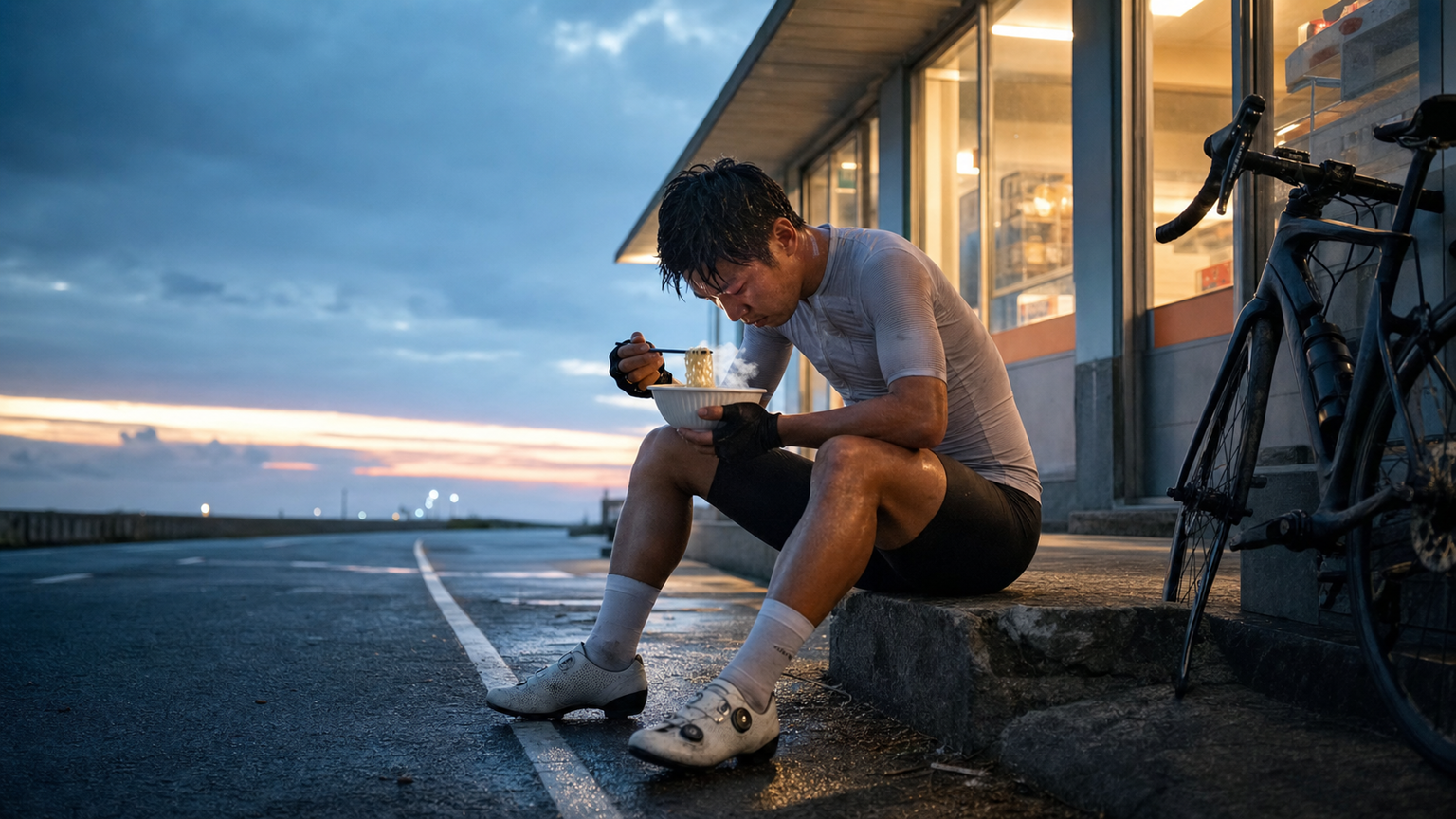
I leaned my bike against the wall, walked inside, and got a cup of instant noodles. I found a table, sat down, and ate the hot noodle soup while watching cars pass by on the road outside. My legs were shaking, my hands were shaking, and my nose inexplicably started to sting.
That bowl of instant noodles was probably the best thing I’ve ever eaten in my life. Not because of the taste, but because it was hot, it was salty, and it was exactly what my cold, depleted body desperately needed. After finishing, I sat for another fifteen minutes, thinking about nothing, just sitting.
Then I stood up, and got back on the bike.
160-200K: Riding the Rest with a Different Mindset
After setting off again, everything was different. I stopped looking at the distance on my cycling computer and switched to watching the time instead. I told myself: “Just ride one more hour. After that hour, decide whether to continue.”
My knee still hurt, my butt still hurt, but the calories and psychological comfort from that bowl of noodles carried me through the lowest point. My pace dropped to around 22 km/h, but I didn’t care anymore. I started noticing the scenery along the road—the sunset filtering through the windbreak forests, egrets flying up from the rice paddies, the golden light reflecting off the roof of a Mazu temple in the distance.
At 6:30 p.m., the sky was getting dark. My cycling computer showed 203 km. I was in a small town in Changhua, found a train station, and decided this was where I’d stop.
What 200 km Taught Me
One: Nutrition Is Not Optional—It’s Mandatory
In long-distance riding, “eating” is a skill. You have to start eating before you’re hungry, and you have to eat the right things. Relying purely on energy gels to get through 200 km is unrealistic—your body needs solid food and diverse nutrition. The rule of thumb I later learned: consume 60-80 grams of carbohydrates per hour, and eat “real food” (rice balls, bread, bananas) every two hours.
Two: Pacing Discipline Determines Everything
Go too fast in the first half, and you’ll collapse in the second. The first 100 km of a 200 km ride should feel “easy to the point of being boring”—that’s what’s correct. I held 30 km/h for the first 80 km, and it felt great, but the price I paid was a total breakdown in the second half. If I had held 26 or 27 km/h in the first half, my condition in the second half would have been far better.
Three: Mental Resilience Can Be Trained
When I collapsed at 160 km, I almost called a taxi to go home. But that bowl of noodles, those fifteen minutes of zoning out, helped me find a reason to continue. In the second half of a long-distance ride, 70 percent is a mental battle. Your body can actually keep moving, but your brain is screaming “stop.” Learning to coexist with that voice, rather than being controlled by it, is the most essential skill in long-distance riding.
Four: A Failed Plan Is Still a Plan
Later, in that One-Day Twin Towers attempt, I retreated in Hsinchu. But that wasn’t because I couldn’t do it—it was because I had learned that “quitting is also a strategy.” The wind conditions and my physical state that day told me the risk of continuing outweighed the reward. Knowing when to stop is just as important as knowing when to push through.
Afterword
After that 200 km ride, I went on to complete several more rides over 200 km. The longest was a 260 km loop around northern Taiwan. Each time was more composed and more enjoyable than the last. But before every departure, I think back to that version of myself eating instant noodles at the 7-Eleven in Dajia, with red-rimmed eyes.
It’s an important reminder: what you think is your limit is often just a checkpoint. Past that checkpoint, there’s still a very, very long road ahead.
Practical tips for rides over 200 km: definitely install a rear light (you might be riding into the dark), bring a lightweight windbreaker (temperature differences can be huge), and keep a phone charging cable and power bank in your saddle bag (for navigation and emergencies). Also, research the locations of convenience stores and restaurants along your route in advance, and set a supply point every 40-50 km.
Related Reading
- One-Day Twin Towers 520 km Ride Report: The Ultimate Challenge from Fugui Cape Lighthouse to Eluanbi
- Ultra-Long Distance Riding Training Methods: Endurance Building Strategies for 200 km and Beyond
- Road Bike Long-Distance Challenge Preparation: Training Methods for a 200 km Round Trip in One Day
- The Mental Challenges of Long-Distance Cycling: Psychological Preparation Strategies for a 200 km One-Day Ride