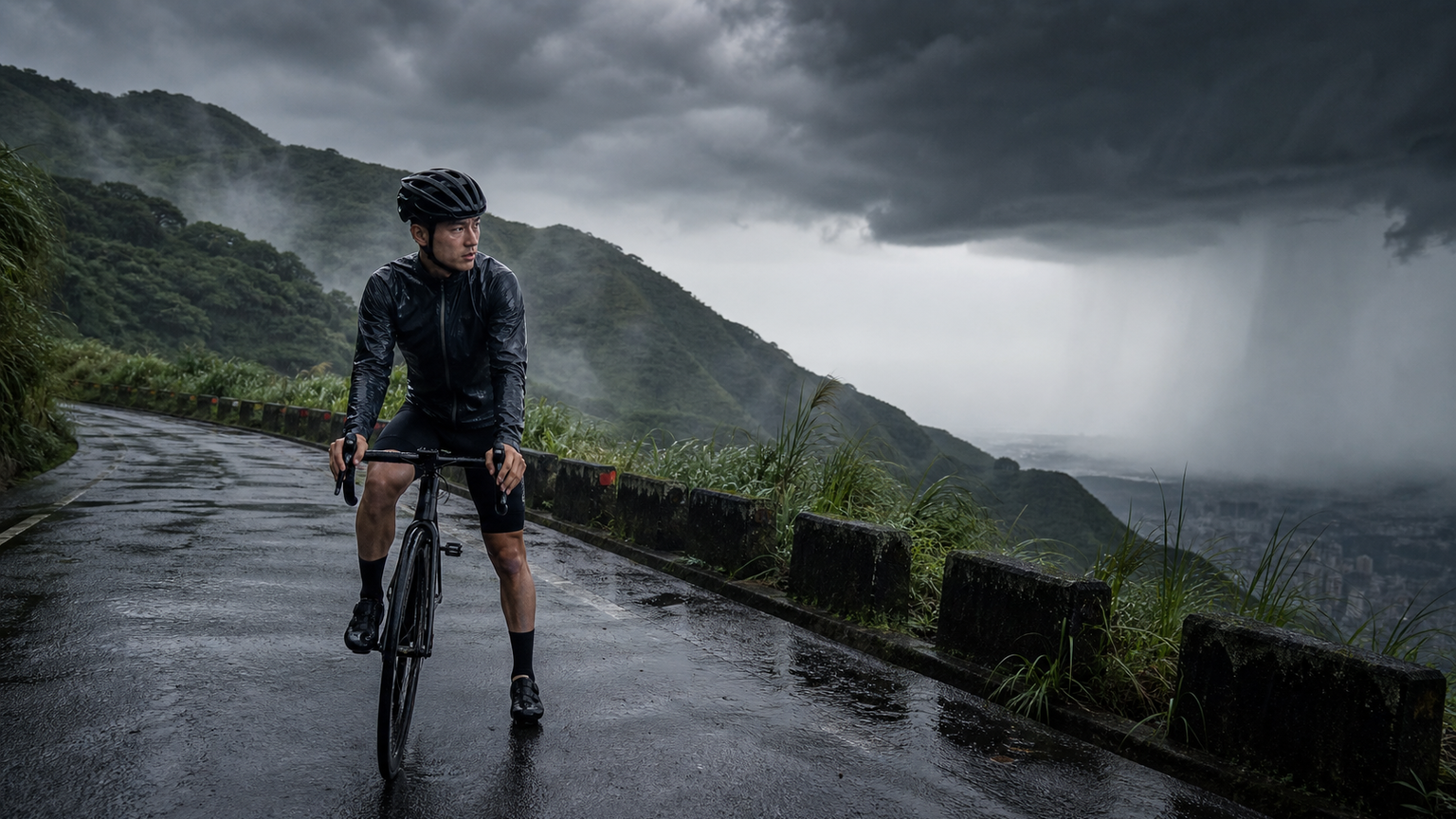
Lessons Learned from Riding in Typhoon Season: What the Wind and Rain Taught Me
Summer in Taiwan is a season of contradictions for cyclists. On one hand, the long daylight hours and lush greenery make it a great time to ride; on the other, from June to October, typhoon season means the weather can turn on you at any moment. Over my years of riding in Taiwan, I’ve accumulated plenty of experience battling wind and rain—some of it valuable lessons, some of it harrowing memories that nearly cost me my life.
Incident One: The Afternoon I Was Trapped on Yangmingshan
It was a Saturday afternoon in July. When I left in the morning, the weather forecast said “scattered afternoon thundershowers,” and I figured “scattered” meant it might not hit me. So I rode up Yangmingshan as usual.
Everything was fine on the climb—blazing sun, sweat pouring down. Near Xiaoyoukeng, I noticed heavy clouds piling up in the northwestern sky, but I was only two kilometers from the summit, so I thought I’d ride up, take a photo, and head down.
That decision nearly killed me.
Less than five minutes after reaching the top, the clouds rolled in like someone had tipped over a bucket of black paint. After a few muffled thunderclaps, the rain came down like someone had turned on a faucet. Not your average heavy rain—the kind that stings when it hits your skin and makes it impossible to open your eyes. It was accompanied by relentless lightning—the gap between flash and thunder was less than two seconds, meaning the strikes were nearby.
I absolutely did not dare descend. Riding downhill in that downpour was suicide—visibility was nearly zero, braking power was halved, and standing water on the road could cause a slide at any moment. I took shelter in a pavilion by the roadside, shivering in the mountain wind in my soaked jersey. My phone signal came and went, and I barely managed to make one call to my family to let them know I was safe.
That rain lasted nearly an hour. Only when it eased slightly did I slowly, carefully ride back down. I kept my hands on the brake levers the entire way, never exceeding fifteen kilometers per hour, every corner feeling like walking a tightrope. By the time I got home, it was dark, and there wasn’t a dry spot on my body.
Lesson One: Afternoon thundershowers are no joke. In Taiwan’s mountain areas, you need to be off the mountain before 3 PM.
Incident Two: The Surprise Attack of a Typhoon’s Outer Bands
Another experience was even scarier. It was September, and a moderate typhoon was moving northward in the waters east of Taiwan. It wasn’t expected to make landfall directly, but it would bring the effects of its outer bands. The Central Weather Bureau had issued a land typhoon warning, but the weather in my area in the west looked fine—windy, but the sun was still out.
I thought a short ride before the typhoon arrived would be no problem. What a foolish idea.
About thirty minutes after I left, the wind suddenly picked up. Not ordinary wind—the kind of gusts that push you off your line. I was on an open riverside bike path with zero shelter. When the crosswind was at its strongest, I had to lean my body nearly twenty degrees just to ride in a straight line, my front wheel wobbling in the gusts.
Then the rain came. Not rain falling vertically—rain blown nearly horizontal by the wind. It felt like sandpaper against my face. I was wearing sunglasses, but the rain completely fogged up the lenses, and when I took them off, the rain was so intense I couldn’t keep my eyes open.
It took me forty minutes to cover a route that normally takes fifteen. When I walked through the door, my hands were shaking. Not from cold—from fear. In those forty minutes, there were several gusts so strong I nearly lost control of the bike. If a car had been passing by, the consequences would have been unthinkable.
Lesson Two: During a typhoon warning, no matter how good the weather looks, do not go out riding. The gusts from outer bands can go from a breeze to a gale in minutes.
Incident Three: The Terrifying Rainy Descent
Another experience that taught me a permanent lesson happened on the Beiyi Highway.
That day, I was riding back to Taipei from Pinglin when it started raining on the descent. Once the road got wet, the braking power of my carbon wheel rims with rim brakes dropped by at least fifty percent instantly. I squeezed the brake levers, but the bike barely slowed down. That feeling of not being able to stop nearly stopped my heart.
Next came a hairpin turn. I knew that at my current speed and braking power, I would drift wide in the middle of the corner. My only option was to slow down as much as possible before entering the turn. I pulled both brakes simultaneously, shifted my weight as low and far back as I could, and the rear wheel slid slightly on the wet surface—that one second was probably the most terrifying second of my cycling career.
I managed to make it through the corner safely, but my heart rate must have hit two hundred.
Lesson Three: Carbon rims lose significant braking performance in the rain (unless you have disc brakes). If you’re riding rim-brake carbon wheels, brake much earlier in wet conditions—at least double your braking distance before corners. Or seriously consider switching to a disc-brake bike.
Typhoon Season Survival Rules Earned from Years of Experience
One: Learn to Read Weather Charts
Don’t just rely on the weather forecast on your phone app. Learn to read the Central Weather Administration’s radar reflectivity maps and satellite cloud imagery. Radar maps show the real-time location and movement direction of precipitation; satellite imagery shows the development of convective cloud systems. Spending five minutes checking before you head out can save you a lot of trouble.
A few practical rules of thumb:
- Radar reflectivity above 40 dBZ: Heavy rain—don’t go out
- Reflectivity above 50 dBZ: Torrential rain with lightning—absolutely do not go out
- Bright white clusters on satellite imagery moving toward you: Weather may turn within one to two hours
- Central Weather Administration issues a heavy rain or torrential rain advisory: Cancel your ride plan
Two: Gear Upgrades
Essential gear checklist for typhoon season:
| Gear | Function | Recommendation |
|---|---|---|
| Lightweight rain jacket | Windproof and waterproof | Choose a breathable model; stuff it in a jersey pocket |
| Water-resistant shoe covers | Protect cycling shoes | Silicone material is most durable |
| Clear or light-tinted lenses | Visibility in rain | Swap out for sunglasses |
| Front and rear lights | Visibility in rain | Set rear light to flashing mode |
| Fenders | Reduce spray | Quick-release type won’t hurt the looks |
Three: Route Selection
Route selection principles for typhoon season:
- Avoid mountain routes: Afternoon thundershowers are most likely in the mountains, and once bad weather hits, escape options are limited
- Choose routes with shelter: Riverside bike paths are convenient but completely exposed to wind and rain. City streets at least have buildings for temporary cover
- Avoid coastal routes: Winds are strongest along the coast during typhoons, and there may be storm surges
- Have an indoor backup plan: Buy a trainer and ride Zwift at home on typhoon days—safe and effective
Four: Time Management
Between June and September, I’ve shifted almost all my riding to early morning. Leaving at 5 AM and getting home before 9 AM avoids most afternoon thundershowers. If I’m only free in the afternoon, I ride the trainer or do strength training instead.
Five: Wet-Riding Techniques
Sometimes getting caught in the rain while out on the road is unavoidable. A few key techniques for riding in the wet:
- Lower tire pressure: If your normal pressure is 90 PSI, drop it to 80 PSI in the rain to increase the tire’s contact patch and improve grip
- Avoid road markings and manhole covers: These are as slippery as an ice rink in the rain
- Slow down in corners: On dry roads you can lean to thirty degrees; in the rain, don’t exceed twenty
- Increase following distance: Spray kicked up by the rider ahead severely impairs visibility
- Brake earlier: Wet brake surfaces need to “wipe” the water first before generating stopping power, so start braking three to five seconds earlier than on dry roads
Reflection: Why Do We Still Ride?
After writing all these experiences with wind and rain, some might ask: “Then why bother riding during typhoon season at all?”
The answer is simple—if you don’t ride during typhoon season, you lose four to five months of riding time a year. And honestly, the weather after a typhoon is often the best of all. That calm after the storm, the rain-washed sky and mountains, the smell of earth and grass in the air—that’s scenery you can only experience during typhoon season.
The point isn’t to stop riding; it’s to learn how to ride safely. Respect the weather, be prepared, stay humble. Nature will always be stronger than us, but as long as we’re smart, we can find room to ride safely within its moods.
Final reminder: Be extra careful when riding after a typhoon passes. There may be rockslides, fallen trees, mud, and standing water on the roads. If your route crosses streams or river valleys, make sure the water has fully receded before crossing. Safety is always the top priority.
Related Reading
- Rainy Season Training Strategies: Maintaining Training Quality and Safety in Monsoon Conditions
- The Complete Guide to Riding in the Rain: Gear, Techniques, and Safety Tips
- Riding Safety During Taiwan’s Typhoon and Plum Rain Season: When Not to Ride
- The Complete Rainy Season Riding Guide: Safe Training Tips for Taiwan’s Plum Rain and Typhoon Seasons
下雨天就是要改車 #ceramicspeed #bike
1 年前
大武山後門26%歡樂陡坡!JJSC南台灣單車行Day2 / 被颱風追著跑 / 公路車 / CT Yeh
2 年前
一日北高前的西濱集訓 | 跟著11小時軍團 | 300W踩不動的大逆風 | 輪車破風差幾瓦?
6 年前
JJSC南台灣單車走春三日行 DAY 1 / 強度 x 美食 x 節慶體驗 / 公路車 CT Yeh
5 個月前
4K單車實境) 舊陽金P字道 第1P 仰德大道至小油坑 誤跟武嶺神人們 被拉爆爽飛天 Taiwan Cycling Climb Route Recommend
7 年前
鯉魚潭水庫 歡笑單車騎旅,季節限定大景 | 大湖/鯉魚潭水庫/龍騰斷橋/薑麻園 | 公路車 | CT Yeh
3 年前
單車 一日北高 ( 雙城 ) 肥宅雙人瘋狂行 紀錄片 REACTO
10 年前
微雨戰! 2022桃園市長盃錦標賽 無敵交管 沒來玩太可惜了! 羅馬公路太可怕 差點成佛! 公路車 | CT Yeh
4 年前