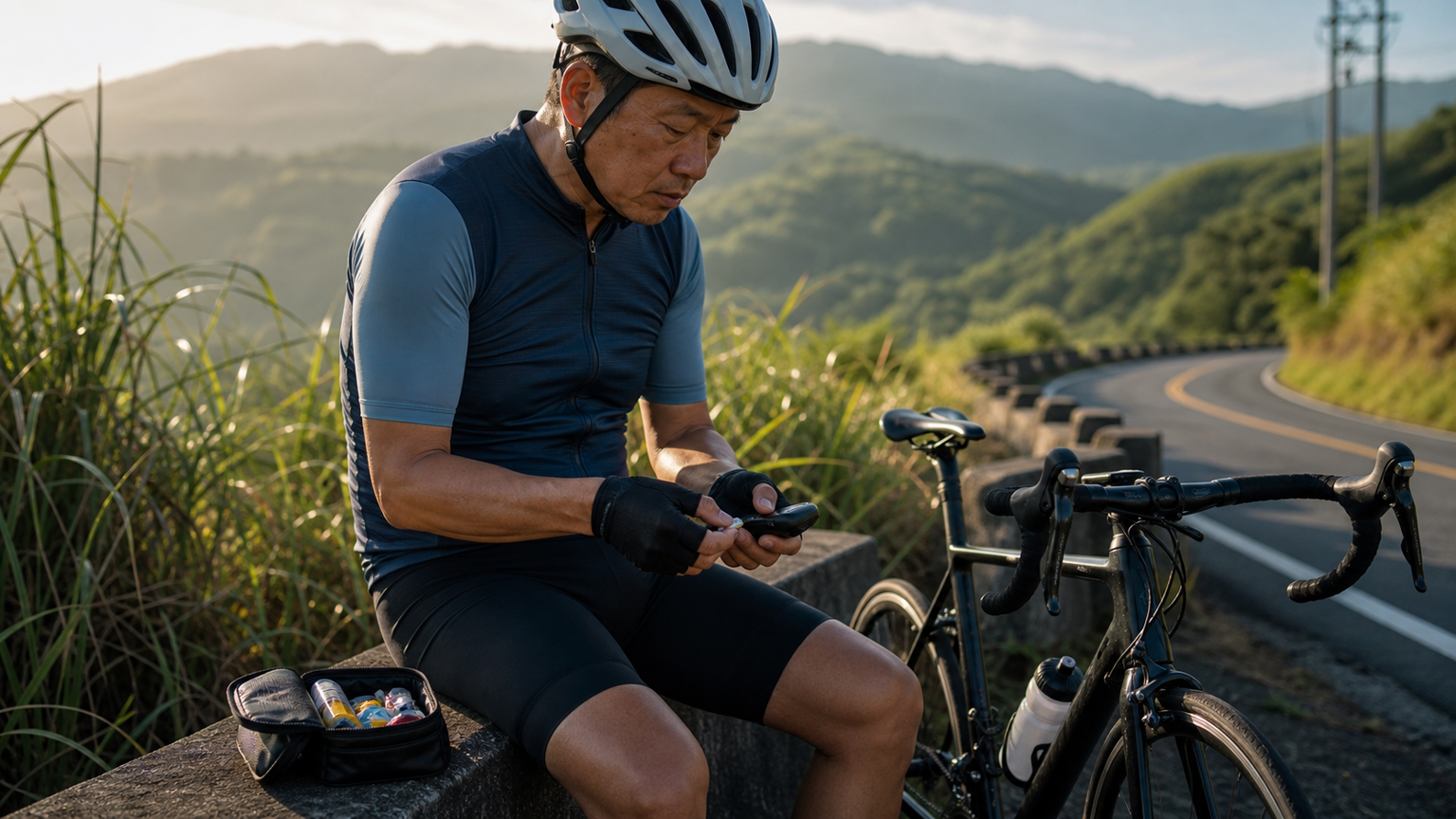
Riding with a Glucose Meter: A Diabetic Cyclist’s Challenge Diary
Three years ago, my health check report showed an HbA1c level of 8.2%. The upper limit of normal is 5.7%, and anything above 6.5% means diabetes. The doctor looked at the report, then at me sitting across from him—thirty-eight years old, weighing 92 kilograms, having spent years sitting in an office—and said in a flat tone: “You have type 2 diabetes, and you need to start medication.”
On the way home that day, I thought seriously about death for the first time. Not immediate death, but the kind of future where the disease slowly consumes you—losing feeling in your hands and feet, your eyesight deteriorating, and finally kidney failure requiring dialysis. My father had diabetes too. He started dialysis at sixty-two and passed away at sixty-seven.
I didn’t want that.
Getting Started with Exercise: From Walking to Cycling
Besides prescribing medication, the doctor gave me two pieces of advice: lose weight and exercise.
I started with walking. Every day after work, I’d walk around the neighborhood for thirty minutes. But after a month, I’d only lost one kilogram, and my blood sugar had improved only marginally. The doctor said walking’s exercise intensity was limited in its benefit for blood sugar control and suggested I try aerobic exercise at a higher intensity.
My neighbor is a road cyclist. One day he saw me walking around the neighborhood and asked if I wanted to try cycling. He had an old road bike he could lend me. I’d never ridden a road bike before, but I figured I had nothing to lose, so I agreed.
The first time I swung my leg over a road bike felt incredible. Bending down to grip the drop bars, clipping my feet into the pedals, pushing down on that first revolution—the wind rushed into my face, and the world suddenly accelerated. That sense of speed and freedom was something walking could never offer.
I was gasping for air after less than five kilometers, but a thought took root in my mind: “I want to ride farther.”
Learning to Ride with a Glucose Meter
Once I started riding regularly, the first issue I faced was blood sugar management.
Exercise lowers blood sugar, which is a good thing for diabetics, but if not managed properly, it can also cause hypoglycemia. The symptoms of hypoglycemia include shaking hands, cold sweats, dizziness, and an inability to concentrate—experiencing these symptoms while riding is extremely dangerous.
My endocrinologist gave me a protocol for monitoring blood sugar before and after exercise:
Before Exercise
| Blood Sugar Level | Recommendation |
|---|---|
| Below 100 mg/dL | Eat 15-20g of carbohydrates first, wait 15 minutes, then test again |
| 100-180 mg/dL | Safe range, can begin exercise |
| 180-250 mg/dL | Can exercise, but avoid high intensity |
| Above 250 mg/dL | Don’t exercise yet; medication may need adjustment |
During Exercise
- Test blood sugar every 30-45 minutes (I use a continuous glucose monitor, CGM, so I can see the numbers in real time)
- Carry fast-acting candy (glucose tablets) and carbohydrate snacks at all times
- If blood sugar drops below 70 mg/dL, stop immediately and consume 15g of fast-acting carbohydrates
After Exercise
- Test blood sugar within 30 minutes after exercise
- The blood sugar-lowering effect of exercise can last 24-48 hours, so watch for hypoglycemia that evening and the next day
In the beginning, every ride felt like walking a tightrope. Blood sugar too high was uncomfortable, too low was dangerous, and I constantly had to find a balance between the two. My jersey pockets always held a glucose meter (later replaced by a CGM, which was much more convenient), glucose tablets, and energy bars. The back pockets looked noticeably bulkier than other riders’, but they were my lifeline.
The First Turning Point: A Follow-Up Visit Three Months Later
Three months after I started cycling, I went back to see my endocrinologist.
My weight had dropped from 92 kilograms to 85. My HbA1c had dropped from 8.2% to 6.8%. My fasting blood sugar had dropped from 180 to 130. Every number was moving in the right direction.
The doctor flipped through the report and, unusually, cracked a smile. “What have you been doing?” he asked.
“Riding a bicycle.”
He reduced my medication dosage, then said: “Keep riding.”
As I walked out of the clinic that day, the air itself felt different. The improvement in those numbers wasn’t just a health milestone—it was proof. Proof that I could change the course of my disease through my own actions, rather than being passively controlled by it.
The Century Ride Challenge: The First Big Goal Achieved with a Chronic Condition
Six months into cycling, my fitness and blood sugar control had stabilized considerably. I was riding three to four days a week, and my per-ride distance had progressed from the initial five kilometers to forty or fifty. An idea began to take shape: I wanted to ride one hundred kilometers.
For a healthy cyclist, a century ride might not seem like much. But for a diabetic who, six months earlier, weighed 92 kilograms with an HbA1c of 8.2%, it was a monumental goal.
I spent two months preparing, and the biggest challenge wasn’t physical fitness—it was my fueling strategy. A century ride takes roughly four to five hours, during which I needed to continuously consume carbohydrates to maintain energy—but carbohydrates raise blood sugar. I had to find a balance between “taking in enough energy” and “not letting my blood sugar spike too high.”
After many experiments and discussions with my doctor, I found a fueling strategy that worked for me:
- Two hours before departure: Eat a low-GI breakfast (whole wheat toast with eggs and avocado) to let blood sugar rise steadily
- Every 45 minutes during the ride: Eat half a banana or half a pack of energy gel (about 15g of carbs), along with water
- Every 30 minutes during the ride: Glance at the CGM to check the blood sugar trend. If blood sugar is dropping, take in carbs early; if it’s rising, delay the next fueling
- Key principle: Eat small amounts frequently, never all at once, keeping blood sugar as steady as an ECG reading rather than roller-coastering up and down
On the day of the century challenge, I chose a flat route from Taipei along the riverside to Taoyuan and back. The whole ride took four hours and fifty-two minutes. My blood sugar stayed between 100-180 mg/dL throughout, with no hypoglycemia and no spikes to an uncomfortable level.
When I finished, I sat on the riverbank and cried. Not from exhaustion, but because I had actually done it. The person who had been diagnosed with diabetes six months earlier had completed a hundred-kilometer ride. The disease didn’t define me—I used my own legs to redefine the place this disease holds in my life.
Life Now
Three years have passed. My weight is stable at 78 kilograms, and my HbA1c stays between 6.0-6.3%—my doctor says that’s nearly at the edge of prediabetes, and if I keep it up, there’s a chance to further reduce or even stop medication.
Cycling has become fully integrated into my daily life. I ride three to four days a week, with one longer ride (60-80 kilometers) on the weekend. My jersey pockets still carry glucose tablets and a CGM, but I no longer see them as a burden—they’re just part of my cycling gear, like a helmet and cycling shoes.
I’ve also started joining group rides with a local cycling club. At first, I was a bit embarrassed to tell people I had diabetes, afraid of being treated differently. But I soon discovered that my fellow riders didn’t mind at all—in fact, they were curious about how I managed my blood sugar. Several riders even told me their family members had diabetes and asked if I could recommend some exercise advice.
A Message for Those in the Same Boat
If you’re reading this and you have diabetes, or someone close to you does—there are a few things I want to tell you:
First, exercise really works. This isn’t just feel-good inspiration; it’s a fact supported by extensive scientific research. Regular aerobic exercise improves insulin sensitivity, lowers HbA1c, and reduces the risk of cardiovascular complications. Cycling is especially well-suited for diabetics because it’s a low-impact aerobic activity that puts far less stress on the joints than running.
Second, see your doctor before you start. Everyone’s condition is different, their medications are different, and their response to exercise is different. Before beginning any exercise program, please discuss it with your endocrinologist or diabetes educator. They can help adjust your medication dosage, set your blood sugar monitoring frequency, and design a safe exercise plan.
Third, don’t rush. It took me three months to comfortably ride twenty kilometers and six months to take on a century ride. Everyone starts from a different point and progresses at a different pace. The only thing that matters is that you rode a little more today than you did yesterday.
Fourth, a glucose meter isn’t a shackle—it’s wings. When I first started riding with a glucose meter, I saw it as a symbol of my disease, a marker that set me apart from “normal” people. But now I see it as the tool that lets me ride safely—it’s my wings, allowing me to fly farther.
Diabetes is a chronic condition. It won’t disappear. But it doesn’t have to be the protagonist of your life. Let exercise be your script, and let the bicycle be your vehicle—not just a vehicle from point A to point B, but a vehicle from illness to health, from passivity to agency, from fear to confidence.
To the despairing version of myself in that clinic three years ago: thank you for not giving up.
Important disclaimer: This article shares personal experience and does not constitute medical advice. Every diabetic patient’s condition is different, and exercise plans should be developed under a physician’s guidance. If you experience symptoms of hypoglycemia during exercise (shaking hands, cold sweats, dizziness, palpitations), stop exercising immediately and consume sugar.
Related Reading
- Cycling Strategies for Diabetic Patients: Stabilizing Your Blood Sugar Curve with Every Pedal Stroke
- Nutrition Management for Diabetes and Exercise: A Coach’s Field Notes on Blood Sugar, Carbohydrate Adjustments, and Hypoglycemia Prevention
- Diabetes Management for Cyclists: Blood Sugar Monitoring and Insulin Adjustment Strategies
- Cycling and Diabetes Management: A Cycling Prescription for Blood Sugar Control
靠單車減肥35公斤 心得分享與整理
7 年前
2016/4/20 - 中社路 夜騎 半年甩肉14KG 後測
10 年前
#公路車 #Fitting 靠人工智慧APP 幫你調整單車
6 年前
車友來我家測FTP...好硬啊🤣 #cycling #公路車
2 年前
下次拍照前要查清楚啦🤣 #cycling
7 個月前
一日北高常見問題大集合 | 攻略 | 路線 | 訓練 | 補給 | 自行車 單車 | 一日雙城 | 雙塔 | TWB北高360 | 屁股痛
6 年前
單車 一日北高 ( 雙城 ) 肥宅雙人瘋狂行 紀錄片 REACTO
10 年前
碟煞公路車 銑面器 !? 原來銑完差這麼多! 降低蹭碟機率! | TIME 公路車 保養小記錄 | CT Yeh
3 年前