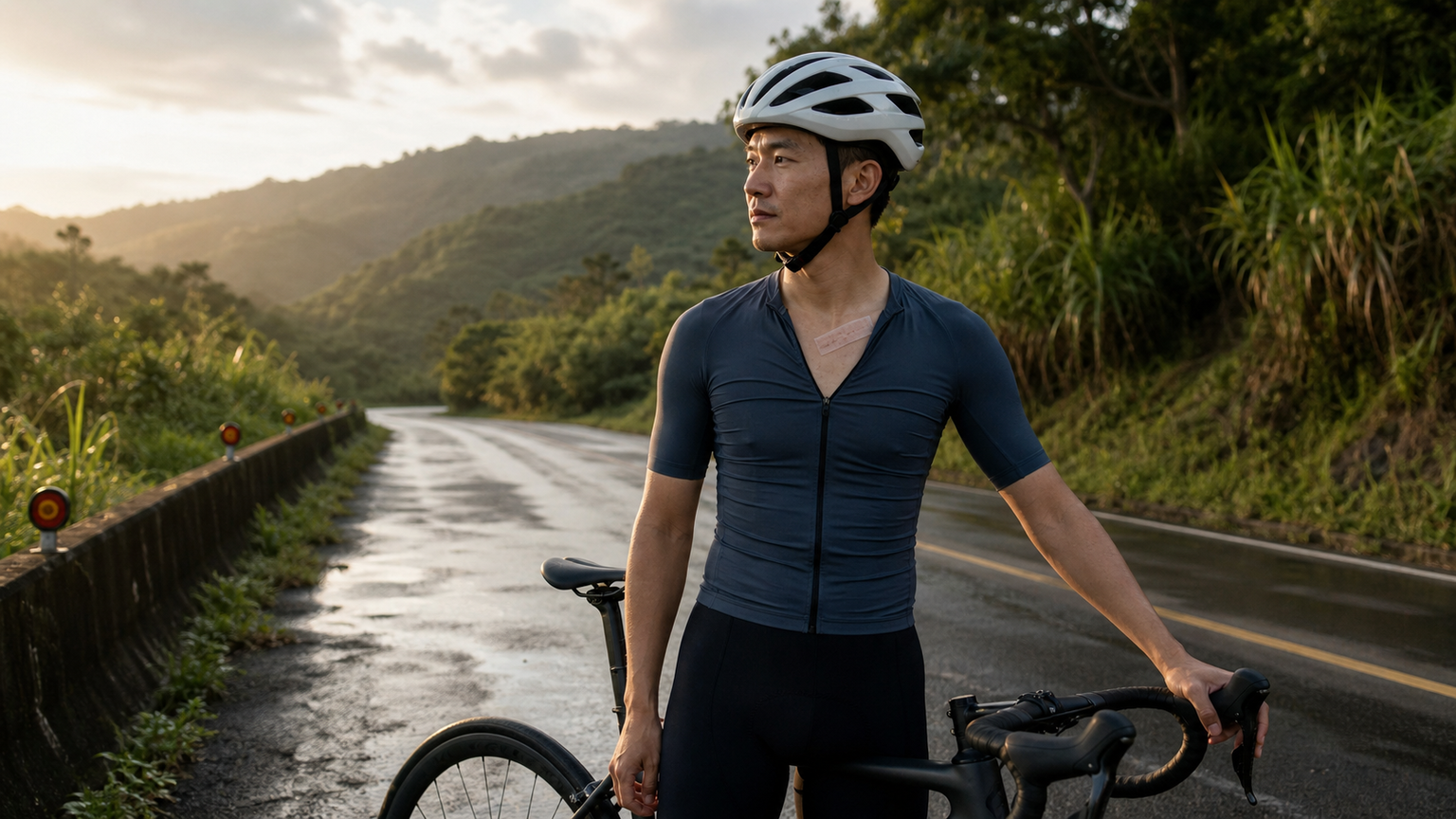
Broken and Reconnected: The Long Road Back to Cycling After Injury
My memory of that second is fractured.
I remember taking a corner on a descent when the door of a car parked on the side of the road suddenly swung open. I remember instinctively swerving my handlebars. Then everything went blank. When I came to, I was lying on the asphalt, and a sharp, completely unfamiliar pain shot through my left shoulder.
Someone nearby was calling 119. Someone picked up my helmet—it had a long crack running through it. Someone was asking me my name and whether I could move. I tried to move my left arm, and a jolt of electric pain made me curl up.
The emergency room X-ray showed a clean fracture in the middle of my left collarbone, with the bone displaced by about one centimeter. The doctor said surgery was needed.
That day was October 17th. From that day on, I didn’t ride a bike for six months.
Surgery and Aftermath: The Hardest Six Weeks
Surgery took place three days after the injury. The doctor used a titanium plate and seven screws to fix the broken collarbone. The surgery itself went smoothly, but the pain and inconvenience afterward were the real test.
For the first two weeks, I could barely do anything. My left arm hung in a sling—I couldn’t raise it, couldn’t put weight on it, couldn’t rotate it. I had to shower one-handed with my right arm, get dressed by putting the injured side in first, and eat using only my right hand. Sleeping was the worst—I could only lie on my back, and the slightest turn would pull at the wound and wake me up in pain.
During those first two weeks, I thought about cycling almost every day. Staring at the sky outside the window, I thought about how, if I hadn’t been injured, this would have been the most comfortable time of autumn for riding. That sense of loss was more agonizing than the physical pain.
Starting in the third week, the pain gradually eased, but it was replaced by a deeper anxiety: “Will I ever get back to my previous level?” “What if I don’t recover well?” “Will I dare to descend again?”
These questions looped through my mind like a marquee sign during that period.
Rehabilitation: Requires More Patience Than the Injury Itself
Six weeks after surgery, the doctor said the bone was healing well and I could begin rehabilitation.
I went to a rehab clinic, where the physical therapist first assessed my shoulder joint range of motion. The results were grim—my left shoulder’s forward flexion was only 60 percent of normal, and abduction was even worse, at about 40 percent. The price of six weeks of immobility was severe muscle atrophy and joint adhesions.
The rehabilitation process was extremely slow and extremely painful.
Each session lasted about an hour and included: heat therapy, ultrasound, manual mobilization, and active range-of-motion exercises. The most painful part was the manual mobilization—the therapist used their hands to gradually break apart the adhered joint tissue. After every session, my shoulder felt like it had been punched, but the range of motion did improve a little the next day.
The therapist told me something I still remember to this day: “Rehab isn’t treating the injury—it’s retraining your body. You have to treat it like a new sport that requires discipline and patience.”
Every day at home, I did the exercises the therapist taught me—wall climbing (facing the wall, slowly walking my fingers up the surface), towel stretches (holding one end of a towel with my left hand while my right hand pulled the other end from behind my back), and resistance band external rotations. Each exercise was three sets of fifteen reps, twice a day, morning and evening.
Two months later, my shoulder range of motion had recovered to 90 percent. But my strength was still very weak—my left hand couldn’t even grip a water bottle cap tightly.
Returning to the Trainer: The First Pedal Strokes
Three months after surgery, the doctor allowed me to start light exercise. He specifically warned: no riding on the road outside, because if I crashed again, the plate could break.
I mounted my road bike on the indoor trainer.
The feeling of that first pedal stroke… was strange. After three months without riding, my leg strength had dropped significantly, and my cardiovascular fitness was a disaster. A Zone 2 wattage that used to be easy now had my heart rate straight into Zone 4. I got off after just twenty minutes, gasping for air, with my left shoulder aching faintly from the handlebar vibration.
But those twenty minutes were the happiest twenty minutes in three months.
Over the next month, I rode thirty to forty-five minutes on the trainer every day. The intensity was very low—purely recovery-oriented aerobic work. But every day, I could feel my body finding its memory again—the rhythm of the pedal stroke, the cadence of breathing, the stability of my hips and core. It was like a machine that hadn’t been used in a long time starting back up, with each part clicking back into place one by one.
Returning Outdoors: Overcoming the Mental Barrier
Five months after surgery, the doctor said I could ride outdoors again. He looked at the latest X-ray—the bone had healed completely, and the plate was firmly in place.
I chose a weekday morning and rode to the riverside bike path near my home. Completely flat, no traffic, as safe as it could possibly be.
But when I rode out of my driveway and hit the road for the first time, an inexplicable fear surged up from my chest.
Every passing car made me tense. Every intersection made me slow down. When I saw cars parked on the side of the road, I would reflexively veer at least two meters away—because it was a roadside door opening that had caused my crash.
It got a little better once I reached the riverside bike path, but on descents, I still found myself death-gripping the brake levers. Corners I used to take with ease, I now had to slow down to nearly a stop before daring to go through.
After getting home that day, I called a fellow rider who had also been injured in a crash. After listening to my description, he said: “That’s normal. After I broke my ribs, it took me three months before I dared to go over 40 km/h. Don’t rush it. Your body is ready, but your brain still needs time.”
He suggested I start with the safest, most familiar routes and gradually add elements of “discomfort”—first speeding up on flat roads, then small downhill sections, then bigger descents, and finally roads with traffic.
I did exactly that. For an entire month, every time I went out, I deliberately pushed myself to do a little more of what scared me. Not forcing it, but gently nudging myself. By the fifth week, I could finally release the brakes on descents and let my speed naturally climb to 45 km/h without my heart rate spiking from fear.
The First Group Ride After Coming Back
Six months after surgery, I joined the team’s weekend group ride. It was the first time riding with others since the injury.
Before we set off, the riders came over to greet me. Someone patted my shoulder (the right one) and said welcome back. Someone asked how I was doing. Someone said: “Take it easy, don’t push yourself. If you can’t keep up, just ride on your own.”
The route was Lengshuikeng in Yangmingshan, a road I used to ride often. But after six months without proper training, the gap in fitness was obvious. On the climbs, I was quickly dropped to the back, watching the silhouettes of the riders ahead growing smaller and smaller.
But—I didn’t mind.
The old me would have been anxious, embarrassed at being dropped, and would have chased desperately. The current me just pedaled steadily at my own pace, taking in the scenery along the road, enjoying the feeling of being back on a mountain road.
Before the injury, cycling for me was about pursuit—pursuing faster speeds, longer distances, better results. After the injury, cycling became about gratitude—grateful that I could still ride, still pedal, still feel the cool wind against my face.
When I reached the observation deck at the summit, the riders were already there waiting for me. When they saw me come up, they all applauded together. In that moment, my eyes welled up again.
For Those of You Recovering from Injury
If you’ve temporarily stepped away from cycling because of an injury, I want to share a few things with you:
The injury will heal, but it takes time. Bone healing follows its own physiological cycle, and rushing won’t help. All you can do is follow your doctor’s instructions, take rehab seriously, and eat and sleep well.
Fitness can be rebuilt, but the psychological wound needs even more care. Many people underestimate the mental impact of a crash. If you find yourself feeling fear or anxiety about cycling, don’t be ashamed—it’s a completely normal reaction. Give yourself time and rebuild your confidence gradually, starting from the safest environment.
An injury will change your attitude toward cycling—and it’s a change for the better. Before the injury, I took cycling for granted. After the injury, I realized that being healthy enough to get on a bike and pedal is itself a form of luck.
Safety gear isn’t optional—it’s life-saving. My helmet cracked in that crash. If I hadn’t been wearing it, it would have been my skull that cracked. Every time you ride, a helmet is a non-negotiable essential.
The plate in my collarbone is still there—in about a year or two, the doctor will schedule surgery to remove it. Sometimes, when the weather changes, that spot aches a little. But I’ve come to think of it as a memento—it reminds me that I once fell, and it reminds me that I got back up.
The post-surgery recovery timeline is for reference only. Everyone’s injury and recovery speed are different; always follow your attending physician’s assessment. If you experience unusual pain, swelling, or a significant decline in range of motion during rehabilitation, return to your doctor immediately.
Related Reading
- How to Come Back from Injury: A Cyclist’s Progressive Return-to-Training Plan
- Cycling Return-to-Training Plan: A Progressive Schedule for Returning to Riding After Injury
- Rehabilitation Plan After a Cycling Fracture: Return-to-Training Timeline for Collarbone and Wrist Fractures
- Cycling Fracture First Aid: On-Site Management of a Collarbone Fracture and When to Return to Riding
摔車後補裝備: 好市多新款單車安全帽& Specialized Romin 北高整路屁股都不痛的坐墊 | 一千元居然有MIPS | CT Yeh | 公路車
4 年前
高雄綠園道鐵路自行車道 / 外地人能輕鬆駕馭 還是整路崩潰? / 2025 全線開通 春節實地探索一次!(附GPS連結)/ 公路車 / CT Yeh
1 年前
Canyon 公路車斷把手 五年老車特規還能修嗎? 維修保養全記錄 feat. 501單車監理站 | 公路車 | CT Yeh
4 年前
公路車 | 塔塔加驚險員工旅遊 | 還好手腳快沒被抓交替!
5 年前
Never Stop 西進武嶺 前後雙機 完整全程錄影 訓練台 實境
8 年前
中秋團練!GoPro Hero 9 拍攝絲般順滑,ft. 新竹某校隊 公路車
5 年前
把帶被我推爛,換新的防推爛款💪 #cycling #公路車 #曜越單車
2 年前
iPhone內建一秒變長腿🤣 車友必備#cycling
2 年前