Nutrition Strategies for Multi-Day and Ultra-Endurance Races: When the Race Is So Long Your Stomach Quits Before Your Legs Do
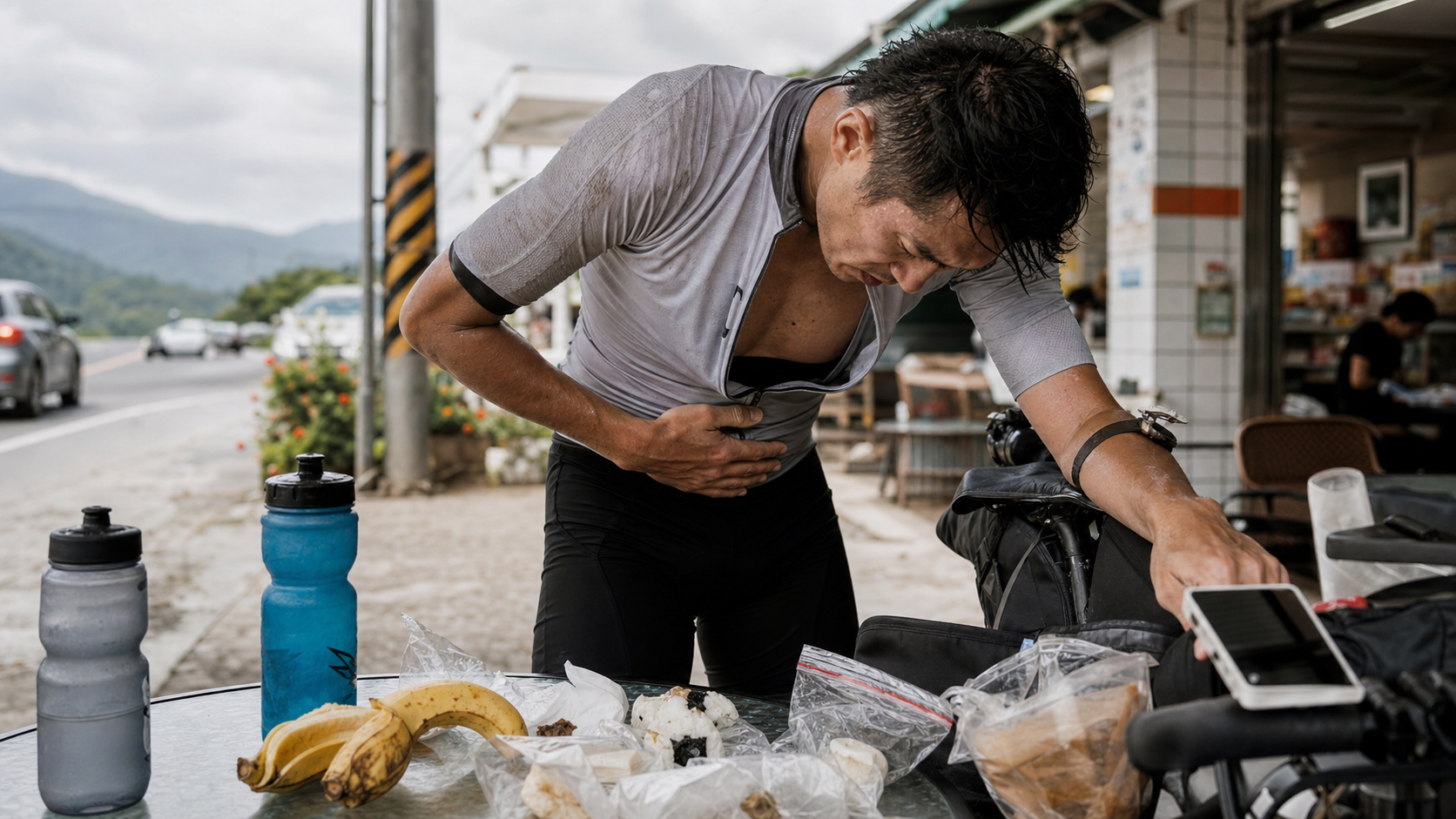
When Your Stomach Quits Before Your Legs Do
Of all the athletes I’ve coached, the one who left the deepest impression was a middle-aged cyclist preparing to tackle the Wuling KOM, then add a “One-Day Double Cape” (Tainan to Kenting to Eluanbi) and a full island lap on top. His legs were genuinely strong—his FTP translated to roughly 4.2 W/kg, and he could hold his target power zone steadily on flat cruising. But his first two long-distance attempts both “blew up” in the seventh or eighth hour—not from cramping, not from hitting the wall, but from what he described as “can’t eat a single bite, want to throw up at the smell of an energy gel, and end up stuck in a convenience store bathroom unable to come out.”
During the post-race review that time, I told him something he still jokes about to this day: “Your legs were ready a long time ago. It’s your stomach that hasn’t graduated yet.”
This is precisely the fundamental difference between multi-day and ultra-endurance events versus a typical three- or four-hour activity. When exercise stretches to six hours, ten hours, or even several consecutive days, what determines whether you finish is often not your VO₂ max, not your power-to-weight ratio, but something that sounds far less sexy: Can your gastrointestinal tract—while you’re exhausted, overheated, and jostling around—keep grinding, emptying, and absorbing food, turning it into energy your legs can actually use?
In this article, I want to break this down properly from a coach’s perspective. From the underlying logic of energy metabolism, to when solid food should actually come into play, to gut management—the hardest thing that few people seriously train. I’ll try to give you ranges, tables, and actionable steps you can follow, rather than a pile of intimidating jargon.
1. First, Understand: What the Energy Ledger of an Ultra-Endurance Race Looks Like
Your Fuel Tank Is Actually Quite Small
Let’s start with a harsh fact. The body’s stored glycogen (the form in which carbohydrates are stored in the body) is actually very limited in total amount. A well-trained endurance athlete has roughly 1,600 to 2,000 kcal available from muscle and liver glycogen combined. Sounds like a lot? But if you’re moving at a serious race intensity, burning 600 to 900 kcal per hour, that tank runs dry in about two to three hours.
In contrast, even a lean-looking athlete with very low body fat has fat reserves that can easily provide 30,000 to 100,000 kcal. Fat is a nearly inexhaustible reserve tank, but the problem is it “flows out slowly,” and at high intensities it can barely keep up—carbohydrates have to fill the gap.
So the energy strategy for ultra-endurance racing is essentially one sentence:
On one hand, get the body to burn more fat (saving precious glycogen); on the other, keep taking in carbohydrates through the mouth so that small tank never runs dry.
“What You Eat” and “What You Can Use” Are Two Different Things
Here’s a key point where many people get stuck. The carbohydrates you eat don’t directly become energy. They first have to be emptied from the stomach, delivered to the small intestine, carried across the intestinal wall by specific “transport proteins,” enter the bloodstream, and reach the muscles—if any segment of this entire production line gets congested, what you’ve consumed becomes a burden in your gut, not fuel for your legs.
The body’s rate of absorbing exogenous carbohydrates has a ceiling. If you only consume a single type of glucose-based carbohydrate, the transport protein (the SGLT1 pathway) saturates at roughly 60 grams per hour. Anything more won’t be absorbed; instead, it piles up in the gut, fermenting, causing bloating and diarrhea.
But sports science later discovered a highly practical trick: consuming both “glucose-type” and “fructose-type” carbohydrates simultaneously, because fructose uses a different transport pathway (GLUT5). This effectively opens two production lines at once, pushing the total absorption rate higher. Research shows that combining glucose and fructose at roughly a 2:1 ratio increases carbohydrate oxidation rates by about 50% compared to glucose alone, reaching 90 grams per hour or even higher (Gatorade Sports Science Institute).
That’s why good energy gels and drink mixes on the market today list “maltodextrin + fructose 2:1” or similar on their labels. It’s not a marketing gimmick; it has a physiological basis.
How Much Carbohydrate Per Hour, Exactly?
This is the question athletes ask most often. I’ve compiled the mainstream recommendations into a table. The following are general guidelines; the actual numbers must be fine-tuned based on the individual, the intensity, and the conditions of the day.
| Exercise Duration | Recommended Carbs Per Hour | Recommended Carb Type | Notes |
|---|---|---|---|
| Under 45 minutes | Barely needed | Plain water is fine | Existing glycogen is sufficient |
| 45–75 minutes | Small amounts, mouth rinse is enough | Single glucose | Carb mouth rinse can be used at high intensity |
| 1–2.5 hours | About 30–60 grams | Single or mixed, either works | Exogenous fueling becomes necessary |
| Over 2.5 hours | Can push to 60–90 grams | Must use glucose + fructose mix | This is the core zone for ultra-endurance |
| Multi-day / extremely long | Target 60–90 grams, interspersed with solids | Mixed carbs + solid food | The key is “consistency,” not volume |
The American College of Sports Medicine (ACSM) generally points toward: about 60 grams per hour for efforts under 2.5 hours, and up to 90 grams per hour for efforts exceeding 2.5 hours. This number doesn’t scale much with body weight, because the oxidation ceiling for exogenous carbs is primarily determined by intestinal absorption capacity, not how heavy you are (The Feed、Precision Hydration).
I want to specifically warn: 90 grams is a “ceiling target,” not a “starting standard.” I’ve seen too many people hear “90” and force it, only to have their gut completely untrained, leading directly to nausea and diarrhea. For most amateur ultra-endurance athletes, steadily maintaining 60 grams per hour without interruption for the entire event is far better than hitting 90 for a few hours and then collapsing entirely.
2. Solid Food: The Underrated Star of Ultra-Endurance Races
Why You Can’t Just Live on Gels the Whole Way
For short races, you can get through the entire event on energy gels and sports drinks. But if you try that in an ultra-endurance race, you usually won’t last half a day. There are three reasons:
First, palatability fatigue. Sweet overload is a real physiological response. After several consecutive hours of only pouring in sweet, cloying gels, you’ll develop a physical aversion to them—the mere thought makes you nauseous. My One-Day Double Cape athlete was a textbook case of “sweet poisoning”—from the sixth hour on, just the sound of tearing open a gel wrapper made him dry-heave.
Second, the stomach needs “something to grind.” When only liquids and gels enter the stomach for a long time, gastric emptying and intestinal rhythm can easily get disrupted. Many people experience a strange sensation of “empty stomach yet nauseous.” A moderate amount of solid food, a little fat and protein, and some salty flavor and texture can actually soothe the gut, slow emptying, and make energy release more steady.
Third, caloric density and the psychological support of satiety. In a race lasting over ten hours, you need more than just sugar—you need a bit of salt, a bit of fat, a bit of protein, and even just the psychological comfort of the act of chewing. Many people who’ve finished ultramarathons or ultra-cycling events will tell you: that rice ball or that bowl of hot noodle soup mid-race was what pulled them back from the brink of collapse.
When to Bring in Solid Food
Here’s a principle: the higher the intensity, the more you should rely on liquids and gels; the lower and steadier the intensity, the more you can eat solid food.
Because when intensity rises, blood is shunted away from the gastrointestinal tract to supply working muscles, and the gut’s “production line” slows down. Stuffing solids in at that point easily leads to poor digestion. Conversely, during flat cruising, low-intensity sections of long climbs, or brief stops at aid stations—those are the golden windows for eating solids.
When designing fueling plans for my athletes, I often use a “three-tier strategy”:
| Tier | When to Use | Food Form | Examples (Easily Found in Taiwan) |
|---|---|---|---|
| Tier 1: Liquid sugar | Continuously throughout, high-intensity sections | Sports drinks, drink mixes, gels | Sports drinks, maltodextrin + fructose powder, energy gels |
| Tier 2: Semi-solid | Moderate intensity, when you need a flavor change | Fruit puree, bananas, soft energy foods | Bananas, sweet potatoes, applesauce, yokan (sweet red bean jelly), rice balls |
| Tier 3: True solids and savory food | Low intensity, aid stations, nighttime sections | Savory food, hot food, items with fat and protein | Onigiri (rice balls), savory congee, noodle soup, salty crackers, boiled eggs |
Taiwan’s ultra-endurance athletes are actually very fortunate—I have to say this. Our convenience store density is among the highest in the world. On island laps or long-distance challenges, rice balls, sweet potatoes, tea eggs, oden, and savory breads are practically within arm’s reach. I often tell my athletes that Taiwan’s 7-Eleven and FamilyMart are the ultimate mobile aid stations—leveraging local food is far more practical and cost-effective than hauling a bunch of imported energy products. A tuna rice ball gives you carbs, a bit of protein, and salt all at once—an incredibly high value-for-money fuel source in ultra-endurance racing.
Practical Principles for Choosing Solid Foods
When choosing solid foods, I ask my athletes to follow three criteria:
- Easy to chew, easy to swallow: Trying to chew something too hard while panting is dangerous and miserable—choose softer options.
- Low fiber, low fat as the priority: Race day is not the time for a high-fiber health meal. Excess fiber and fat slow gastric emptying and increase gut burden. Save whole grains, heavy vegetables, and fried foods for after the race.
- Test before you use: This is the most important one, and I’ll cover it in detail below. Never eat anything on race day that you haven’t tried during training.
3. Gut Management: The True Hidden Boss of Ultra-Endurance Races
This Isn’t a Willpower Issue—It’s a Trainable Skill
I want to defend a lot of people here. Exercise-induced gastrointestinal distress—nausea, bloating, cramping, diarrhea, feeling like vomiting—is extremely common. Research indicates that at high intensity or prolonged duration, up to roughly 70% of endurance athletes experience some degree of GI symptoms (Springer / Sports Medicine systematic review). So if you’ve been affected, you’re far from alone, and it doesn’t mean you’re not tough enough.
More importantly: this is an ability that can be improved through training.
What “Training Your Gut” Actually Trains
In recent years, sports nutrition has developed an increasingly solid concept called “gut training.” The core logic is: the gastrointestinal tract, like muscle, has plasticity. If you repeatedly practice fueling during exercise, it adapts—gastric emptying speeds up, intestinal absorption capacity rises, and symptoms decrease.
A systematic review found that roughly two weeks of gut training with regular intake of 30 to 90 grams of carbs per hour during exercise can reduce GI discomfort by up to about 47% and significantly improve carbohydrate malabsorption (Sports Medicine systematic review). These are very encouraging numbers—they tell us that nausea and diarrhea are often a matter of “not having trained,” not “fate.”
When I set up gut training for my athletes, I typically do it like this:
- Start at an amount you can comfortably tolerate, such as 40 grams per hour.
- During long-distance training, deliberately practice fueling, treating the session as a fueling rehearsal, not just a leg workout.
- Every one to two weeks, gradually increase by 5 to 10 grams, letting the gut slowly adapt to higher intake.
- Log your reactions: write down which product, which food, and at what intensity causes discomfort.
- A few weeks before the race, do a “simulation race” to run through the final fueling plan end to end.
On-the-Spot Management When the Gut Acts Up
Even with the best training, the gut can still throw a tantrum in an ultra-endurance race. Here’s a reference table for on-the-spot self-rescue. Please note these are general self-adjustment directions, not medical treatment:
| Symptom | Possible Cause | On-the-Spot Adjustments to Try |
|---|---|---|
| Nausea, feeling like vomiting | Concentration too high, fueling too fast, too sweet | Slow down fueling, dilute drinks, switch to savory food, temporarily just water and mouth rinse |
| Upper abdominal bloating, slow gastric emptying | Intensity too high, eating too much at once | Lower intensity for a few minutes, switch to small frequent sips/bites, walk for a bit |
| Lower abdominal cramping, urge to defecate | Malabsorption, too much fiber, too concentrated | Dilute concentration, pause solids, add some electrolytes |
| Getting weaker the more you fuel | Actually not fueling enough or not absorbing | Check if you’re drinking too much plain water, add electrolytes and sugar |
A mantra I often give: “If it’s too concentrated, add water; if it’s too sweet and nauseating, switch to salty; if intensity is too high, back off first.” Many gut collapses are simply a mismatch between “fuel concentration” and “current intensity”—a small adjustment can save the day.
4. Fluids and Electrolytes: Another Place That’s Just as Easy to Capsize as the Gut
When discussing nutrition for ultra-endurance races, you can’t only talk about sugar. Water and sodium (salt) are equally critical to success, and mishandling them can mean more than just losing speed—it can be life-threatening.
Don’t Treat “Drink More Water” as Gospel
Many people have a deeply ingrained belief: when exercising, you must aggressively hydrate, the more the better. In ultra-endurance racing, this is a dangerous myth. Drinking excessive plain water or low-sodium beverages dilutes the sodium concentration in your blood, leading to “exercise-associated hyponatremia” (EAH). Research indicates that among ultramarathon runners who develop hyponatremia, their fluid intake is sometimes about twice that of those who don’t; severe hyponatremia is primarily “dilutional”—caused by drinking too much water without enough sodium (NCBI / hyponatremia narrative review).
Severe hyponatremia can cause headache, nausea, confusion, and even cerebral edema and seizures—it’s one of the conditions that can genuinely be fatal in ultra-endurance events. So please remember: in very prolonged exercise, water and sodium must be taken together, not by chugging plain water.
How Much Sodium to Take
A general guideline: for prolonged, higher-intensity efforts, take in roughly 1 to 1.5 grams of salt per hour through electrolyte drinks, isotonic drinks, or savory foods (Pyrène Performance summary). Note this is “salt,” not pure sodium—about 1 gram of table salt contains roughly 400 mg of sodium. Actual needs vary greatly depending on your sweat rate and how salty your sweat is (some people sweat particularly salty, leaving white salt crystals on their clothes). The range is for reference; you need to figure out the details through your own training.
Taiwan’s summers are humid and hot, which makes this especially important for us. In the same race, under Taiwan’s July mugginess, sweat rate and sodium loss are often far higher than in dry, cool conditions. I constantly remind athletes training for ultra-endurance in Taiwan: your hydration and sodium plan for summer can’t just copy numbers from dry, cool foreign environments—you have to aim higher and monitor more closely.
A Simple Self-Monitoring Method
You can make basic judgments without a lab. I teach my athletes two low-tech but useful indicators:
- Thirst sensation: The current mainstream recommendation is “drink to thirst”—don’t force water, but don’t wait until you’re desperately thirsty either.
- Urine color: Pale yellow is roughly normal; clear and colorless may mean you’re drinking too much and should watch your sodium; dark yellow and concentrated suggests dehydration.
Combined, these two indicators can help you get a general direction without precision instruments.
5. The Unique Challenges of Multi-Day Events: More Than Just “Longer”
Single-day ultra-endurance is already hard; multi-day events (riding or running for several consecutive days) are another level entirely. The core contradiction is: you can’t replenish all your losses during exercise itself, so each day’s “post-race recovery” is just as important as—if not more important than—“in-race fueling.”
Managing Daily Energy Deficit
In a multi-day event, you’ll almost certainly be in an energy deficit—burning more each day than you can eat back. The strategy isn’t to eliminate the deficit (impossible), but to keep the deficit within a range your body can handle, and do your best to replenish glycogen, fluids, and electrolytes during each day’s rest period.
Here’s a highly practical key point: the 0 to 2 hours after the race is the golden recovery window. During this time, the body is especially efficient at absorbing carbohydrates and resynthesizing glycogen. Multi-day athletes should consume a large amount of carbs as soon as possible after finishing each day, paired with some protein to aid muscle repair.
I’ve organized the daily rhythm of a multi-day event into this table for my athletes:
| Time Period | Nutritional Focus | Practical Approach |
|---|---|---|
| Pre-race (after waking) | Top off glycogen, easy to digest | High-carb breakfast, avoid high fiber and high fat, leave 1.5–2 hours for digestion |
| During race | Continuous carbs + electrolytes | 60–90 grams of carbs per hour, interspersed with solids and savory food |
| 0–2 hours after finishing | Golden recovery window | Large amount of carbs + moderate protein, rehydrate and replenish sodium |
| Evening | Replenish next day’s energy, repair | Eat a full meal, quality carbs and protein, moderate salt |
| Before bed | Aid recovery and sleep | Easy-to-digest carbs or a little protein, avoid being too full to sleep |
Cumulative Gut Fatigue
Multi-day events also have a problem rarely seen in single-day races: gut fatigue accumulates. On day one, your stomach is cooperative; by days three or four, many athletes hit a state of “no appetite no matter what, annoyed at the sight of food.” At this point, the strategy needs to be more flexible:
- Allow yourself to switch flavors and forms—use salty, hot, and soupy options; don’t stubbornly stick to one product.
- Eat small, frequent meals—rather than forcing down one large portion, break it into smaller pieces spread over time.
- Use liquid calories—when appetite is very poor, a cup of high-calorie liquid (like a drink with maltodextrin added, or a thick soup) can sometimes be easier to get down than a plate of solids.
6. Common Mistakes and Fixes: The Landmines I Catch Most Often with My Athletes
In this section, I’ll lay out the most common mistakes I’ve seen in years of coaching ultra-endurance athletes, along with the fixes, all at once.
Mistake 1: Trying Something New on Race Day
This is the number one mistake, no exceptions. Hearing that someone’s new gel is amazing, or grabbing an unfamiliar food at an aid station—this is one of the most common reasons for blowing up in ultra-endurance races. Your gut’s reaction to each product is highly individual.
Fix: Establish an iron rule: “Race day uses only training-verified fuel.” Every gel, powder, and solid food you plan to use in the race must be tested during long training rides/runs, at an intensity close to race pace, and confirmed to be acceptable to your gut.
Mistake 2: Only Focusing on Sugar, Forgetting the Sodium-Water Balance
Many people put all their attention on “grams of carbs per hour” and completely ignore sodium. The result: they fuel diligently with carbs, but dilute their blood sodium by chugging plain water, or lose too much sodium through sweat without replacing it—leading to the same slowdown or even danger.
Fix: Treat carbs, water, and sodium as a “three-legged stool”—if one leg is missing, it collapses. Plan all three together when designing your fueling plan.
Mistake 3: Too Eager at the Start, Over-Fueling Early
Some people get nervous and cram in a huge amount of fuel in the first two hours of the race, trying to “store it up.” But absorption rate has a ceiling. Over-fueling just piles up in the gut, setting the stage for nausea later.
Fix: Fuel steadily and regularly from the start. Put “never stopping” ahead of “huge volumes.” Set a watch reminder to take a small sip every 15 to 20 minutes—far better than slamming a large amount once per hour.
Mistake 4: Fueling Disconnected from Intensity
Forcing solids during high-intensity sections like steep climbs or sprints, or maintaining the same fueling rate at high intensity as at low intensity, both easily cause problems.
Fix: Liquids at high intensity, solids at low intensity. Plan your fueling rhythm tied to the intensity profile of the course.
Mistake 5: Not Training the Gut at All, Only Training the Legs
Many people, to “take it easy” during training, only drink water on long rides and skip fueling entirely. The result: on race day, the gut is a “raw recruit on its first deployment”—of course it collapses.
Fix: Treat long training sessions as fueling rehearsals and seriously train your gut. The gut is trainable—I’ve already given you the methods above.
7. Actionable Advice for Readers at Different Levels
Everyone starts from a different point. I’ve divided the advice into three groups by level. Find where you currently are and start from there.
Beginner: First Time Attempting an Event Over Six Hours
- Aim for finishing, not efficiency. Set your goal as “never stop fueling, gut doesn’t collapse.” Target 40 to 60 grams of carbs per hour, and fuel steadily.
- Make heavy use of Taiwan’s convenience stores. For island laps or long-distance challenges, treat convenience stores as aid stations—rotate rice balls, bananas, sweet potatoes, and sports drinks.
- Take a small sip every 15–20 minutes, use a watch reminder; don’t wait until you’re hungry or thirsty.
- Never try anything new—test all fuel in several long training sessions first.
Intermediate: Want to Finish Consistently, Starting to Chase Performance
- Begin gut training, gradually pushing carbs per hour toward 60 to 90 grams, adapting over two to three weeks.
- Learn to use mixed carbs (glucose + fructose), choosing products labeled with a 2:1 ratio.
- Build a personalized sodium plan, observing your sweat rate and saltiness to figure out roughly how much salt you need per hour.
- Do one full simulation race before the event, running the final fueling plan from start to finish.
Advanced: Multi-Day Events, Extreme Distances, Chasing Results
- Precisely calculate daily energy balance, maintain 60–90 grams per hour during the race, and aggressively use the golden recovery window afterward.
- Prepare a “flavor change” backup plan, anticipating cumulative gut fatigue, and have multiple food forms and liquid calories ready.
- Build a complete fueling timeline, writing down what to take each hour, which sections to eat solids, and which sections to drink only—carry the plan with you.
- Work with professionals: to optimize further, find an experienced sports dietitian to tailor a plan for you—far more efficient than DIY trial and error.
8. Frequently Asked Questions from Athletes (FAQ)
Q: Can I reduce fueling by going “low-carb, training fat metabolism”?
A: Fat adaptation is an interesting direction—it can genuinely help the body use more fat at low intensity and spare glycogen. But for most ultra-endurance athletes aiming to finish or perform, the carbs you need to fuel with on race day can’t be skipped, especially in moderate-to-high intensity sections. My advice: train fat metabolism as your “foundation,” but don’t abandon race fueling because of it. Individual variation is large here; if you want to explore it deeply, I recommend consulting a professional for assessment.
Q: Does caffeine help in ultra-endurance events?
A: Caffeine can often help reduce perceived fatigue and improve focus, and many ultra-endurance athletes use it in the later stages for a “pick-me-up.” But dosage and timing vary by individual—some people are sensitive to caffeine and get heart palpitations, GI discomfort, or disrupted sleep (especially important in multi-day events—avoid too much at night). Same principle: test it in training first, don’t use it for the first time on race day.
Q: I have a chronic condition (e.g., diabetes, hypertension, heart disease). Do these fueling recommendations apply to me?
A: This is something I must answer carefully. All the carbohydrate, sodium, and fluid recommendations in this article are general guidelines for a healthy athletic population. If you have diabetes, hypertension, heart disease, kidney disease, or other chronic conditions, your glucose and sodium intake may require strict individualized management, and there may be additional risks. Please discuss with your primary care physician and a sports-nutrition-qualified dietitian first to assess whether you can participate and how you should fuel—do not directly apply the numbers in this article. In Taiwan, making good use of the National Health Insurance system to get a full medical evaluation and exercise risk consultation first is a very worthwhile step.
Q: What if I really can’t eat anymore during the race?
A: Don’t panic first. Try lowering intensity, diluting your fuel, switching to something salty or hot, and switching to small, frequent sips/bites. Often “can’t eat” is a temporary reaction to concentration being too high or intensity being too high, and a small adjustment can restore it. But if it’s accompanied by severe headache, confusion, persistent vomiting, or chest tightness, that’s beyond the scope of fueling adjustments—stop the race immediately and seek medical help. Most large events in Taiwan have medical stations. Don’t push through it.
9. Conclusion: Turn “Eating” into a True Race Skill
Back to that One-Day Double Cape athlete from the beginning. Afterward, we spent about two months seriously building gut training into his long-distance schedule—starting at 40 grams per hour and gradually increasing, learning to combine mixed carbs with savory food, and re-planning his sodium and water balance. On his third attempt, he never once ended up in a bathroom, and at the moment he crossed the finish line, he messaged me: “Coach, this time my legs were tired, not my stomach surrendering. That feeling is amazing.”
That’s the core message I want to convey through this article: in ultra-endurance and multi-day events, “eating” is not a supporting role—it’s a race skill that requires serious training and can continuously improve. You can train your legs, you can train your cardio, and you can train your gut just the same.
Please remember these key takeaways you can carry with you: the small tank needs continuous fueling to stay supported; use mixed carbs to raise the absorption ceiling; solid food and savory items are the hidden stars of ultra-endurance; water and sodium must be taken together—don’t chug plain water; the gut is trainable; and race day uses only what you’ve tested. Make these part of your training, and you’ll find that what carries you to the finish line is often the stomach you’ve taken good care of.
Wishing you, on your next long journey, tired legs—but a stomach that doesn’t surrender.
This article is educational content and cannot replace individual diagnosis and treatment advice from a physician, physical therapist, or dietitian. If you have any chronic conditions or health concerns, please seek professional medical and nutritional evaluation before participating in ultra-endurance events.
References
- Gatorade Sports Science Institute — Multiple Transportable Carbohydrates And Their Benefits: https://www.gssiweb.org/sports-science-exchange/article/sse-108-multiple-transportable-carbohydrates-and-their-benefits
- The Feed — 90g Carbs Per Hour: The Endurance Fuel Strategy: https://thefeed.com/insider/90g-carbs-per-hour-the-endurance-fuel-strategy-that-changes-everything
- Precision Hydration — How much carbohydrate do athletes need per hour: https://www.precisionhydration.com/performance-advice/nutrition/how-much-carbohydrate-carbs-athletes-per-hour/
- Sports Medicine (Springer) — The Effect of Gut-Training and Feeding-Challenge on Markers of Gastrointestinal Status: https://link.springer.com/article/10.1007/s40279-023-01841-0
- NCBI PMC — Gut-Training systematic review (full text): https://pmc.ncbi.nlm.nih.gov/articles/PMC10185635/
- NCBI PMC — Exercise-Associated Hyponatremia narrative review: https://www.ncbi.nlm.nih.gov/pmc/articles/PMC6780610/
- Pyrène Performance — Exercise-induced hyponatremia: A silent risk in ultra-endurance sports: https://www.pyreneperformance.com/en/blogs/ultra-endurance-lab/hyponatremie-a-l-effort-un-risque-silencieux-en-ultra-endurance
Related Reading
- Gut Training: Treating the Gut as a Trainable Organ So You Can Still Eat in the Second Half
- Race Week Nutrition Plans for Athletes: Glycogen, Gut, and Daily Plate Strategies for the Week Before
- Ultramarathon Gut Training: How to Train Your Gut to Accept Solid Food During Training
- Practicing Fueling in Training: Why Race Fueling Should Be Rehearsed on Long Training Days
FTL 與 SYB 車隊專訪 西進武嶺 實用攻略分享! 2小時 如何練?!你不知道的眉角!新手準備武嶺必看 EP1 | 實力派女車友 | 精華版 | 公路車 | CTYeh
4 年前
CT 喇低賽) 武嶺牽車 才是王道 西進牽車四小時內秘訣 攝手位置 如何判斷 防抽筋小秘訣
7 年前
西進武嶺 自製新版AI配速表產生器 x 賽前攻略 抱佛腳! 沒有功率計也可以產生配速表嗎?有什麼其他眉角賽前要注意的呢? | 西進武嶺 / 東進武嶺 KOM 攻略 | 公路車 | CT Yeh
4 年前
#KOM 夏季登山王之路 比賽實況 #東進武嶺
7 年前
CT趣訪 西進武嶺 2小時組 EP2 全村的希望 蔣緯緯! 訓練菜單&技巧公開 |公路車 |CT Yeh
4 年前
一日北高/長距離團騎 常見問題補充篇 / 組團或跟團的眉角 / 壯車友容易被瘦車友慢性拉爆 / 原來屁股痛可能是這個原因...? / 風場配速法 / 公路車 / CT Yeh
2 年前
西進武嶺 免費訓練分析服務 Intervals | 練不夠還是練過頭?你哪一種類型選手?AI模型告訴你! | 備戰神器 | 公路車 訓練 | CT Yeh
4 年前
2019 夏季KOM 5小 完賽心得 準備攻略 東進武嶺 夏季登山王之路 Taiwan KOM Challenge
7 年前