Meeting the Sky Above the Peaks: The UFO Line's Flying Saucer Legend, the Ishizuchi Mountain Range, and a Once-in-a-Lifetime Ride Through Stunning Scenery
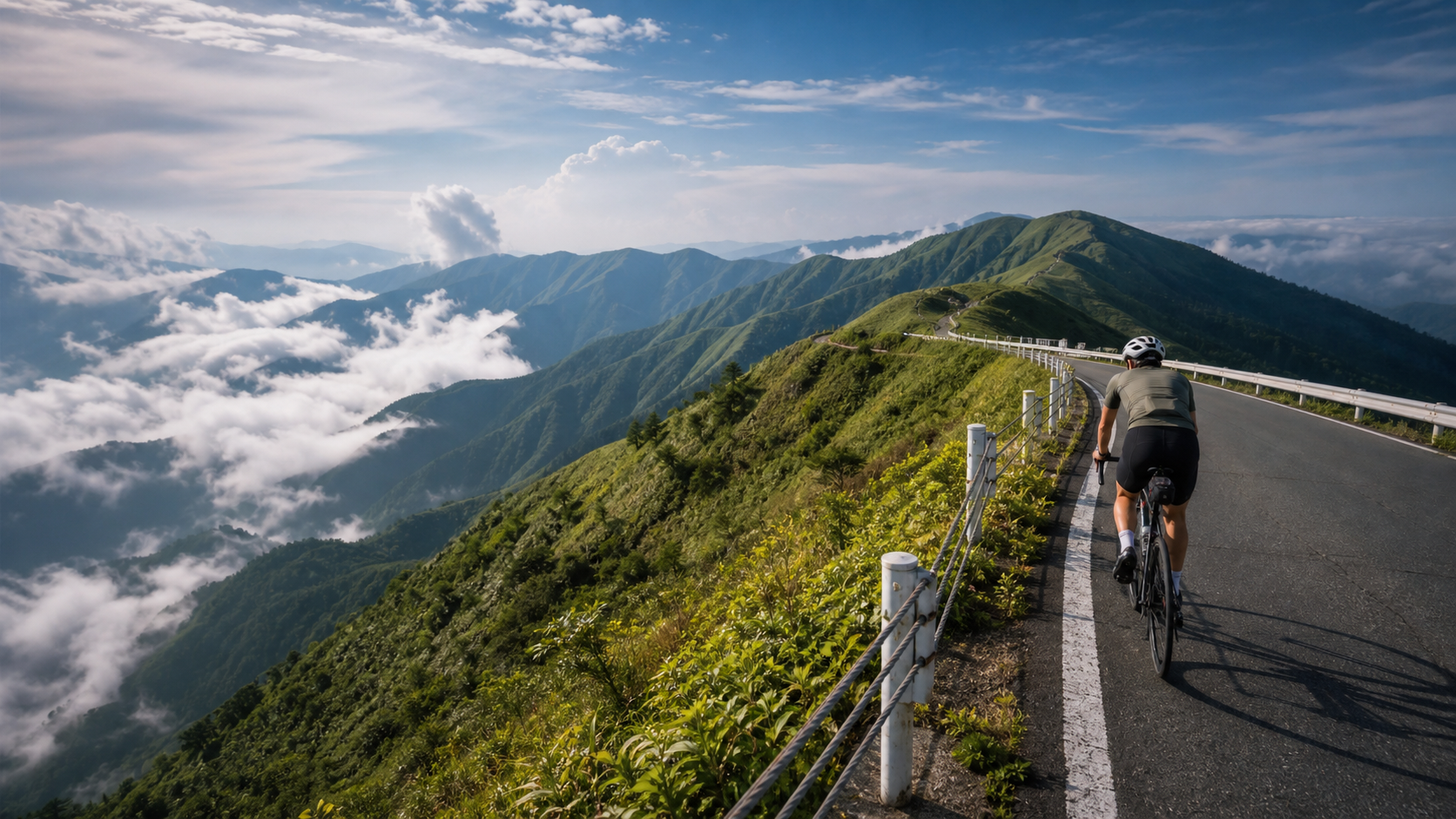
Some roads, you measure by how hard they are; others, you can only describe by how beautiful they are. Shikoku’s UFO Line belongs to the latter—it’s a road that, just when you’re on the verge of tears from climbing, suddenly hits you with a vista so stunning it takes your breath away. The locals call it the “Road to the Sky,” and the moment I first rode it, I fully understood the weight of that name.
A Romantic Misunderstanding About a UFO
The road’s official name is actually quite plain: “Chōdō Kamegamori Line,” or “Kamegamori Forest Road.” Its original name was “Yūhō Line”—because it strings together one majestic peak after another across the Shikoku Mountains, and the characters for “Yūhō” are the most direct tribute to this sweeping mountain terrain.
So where does the sci-fi-sounding name “UFO Line” come from? The story carries a touch of romantic serendipity: it’s said that in 1962, a hiker captured a photo of a suspected “unidentified flying object (UFO)” near this road. The mysterious rumor spread like wildfire, and since the Japanese pronunciation of “Yūhō” bears a striking resemblance to “UFO,” over time people began calling the road the “UFO Line”—half in jest, half in earnest.
A coincidence of pronunciation, an old photo of dubious authenticity—and just like that, a ridge road was draped in an eternal veil of mystery. Yet local riders and residents prefer another name for it: the “Road to the Sky.”
When you actually ride this ridgeline, you’ll find both names perfectly fitting. It hangs high above the clouds, as if it truly leads to some world beyond Earth; and the way it stretches along the mountaintops indeed resembles a road suspended in the sky.
Standing on the Roof of Western Japan
To grasp the geographical weight of this road, you first need to know the stage it occupies—the Ishizuchi Mountain Range.
Mount Ishizuchi is the highest peak in western Japan and the geographic and spiritual apex of Shikoku, revered since ancient times as a sacred site of mountain worship. The UFO Line’s ridgeline, nestled within this highest mountain system in western Japan, links together notable peaks such as Mount Kanzō (approx. 1,176 m), Iyo Fuji (approx. 1,756 m), and Kamegamori (approx. 1,897 m).
In other words, when you ride this road, you’re not gazing up at the mountains from a valley—you’re riding on the backs of the peaks, eye to eye with these famous summits. This is a truly unique perspective. Most climbing routes “deliver” you to the flank or summit of a single mountain; the UFO Line lets you “walk” along the skyline of an entire mountain range, with a sea of peaks on one side and another on the other. This feeling of being embraced by the summits, as if strolling above the clouds, is its irreplaceable soul.
On clear days, you can distinctly see the majestic ridgeline of the Ishizuchi range in the distance, and when the weather is exceptional, your view can stretch all the way to the faintly glimmering Pacific Ocean far away. In that moment, you forget how sore your legs are and remember only that you’re standing somewhere impossibly close to the sky.
A Ridgeline Spanning Two Prefectures
This road also has an easily overlooked yet romantic geographic trait: it’s located in Saijō City, Ehime Prefecture, but the ridgeline happens to straddle the prefectural border between Ehime and Kōchi.
What does that mean? It means that during your ride, you’ll unknowingly “cross” from one prefecture into another, and perhaps cross back again. This sense of “one foot in two prefectures” adds an intriguing layer of geographic ritual to the ride. The ridgeline itself is a natural watershed and administrative boundary, and you—along this great divide of the earth—are measuring Shikoku’s spine inch by inch with your two wheels.
A First-Person Ride Narrative: That Day on the Road to the Sky
I want to honestly record that day and the range of emotions I experienced on this road.
The approach section climbing toward the ridgeline was long and quiet. I deliberately held back my effort, reminding myself that “the best is yet to come.” The forest was dense, cicadas sang without pause, and sweat dripped onto the frame one drop at a time. As I climbed, I mentally calculated my food supply and energy allocation—this is a road that requires “management,” not just a burst of adrenaline.
Then, after a certain turn, the forest suddenly fell away, and the sky opened up before me without any warning.
I’ll never forget that moment. The pavement stretched endlessly along the mountain’s spine, flanked by deep valleys and surging clouds, with layer upon layer of blue-gray peaks in the distance. Almost instinctively, I squeezed the brakes, stopped at the roadside, and stared blankly at everything before me. It wasn’t something you could describe as “the scenery is beautiful”—it was an almost sacred awe that tightened my throat. I finally understood why people call it the “Road to the Sky.”
The ridgeline section that followed was a tug-of-war between beauty and pain. This road is anything but gentle—it climbs, descends, and climbs again without pause, each undulation draining strength from my legs. The wind on the ridge was fierce, the road narrow, and I had to carefully watch for oncoming traffic around every bend. But every time I lowered my head to catch my breath from the climb, on the verge of giving up, all I had to do was look up—and that magnificent, almost unreal vista would hit me again, refilling me with strength.
That day, I cycled the entire ridgeline in a recurring loop of “painfully pedaling with my head down” and “stunned, looking up in awe.” When I finally finished and looked back at the road winding away across the mountaintops, I knew this would be a day I’d never forget for the rest of my life.
What This Road Means to Riders
If Mount Fuji is a pure interrogation of your “aerobic engine,” then the UFO Line is a romantic summons to the “rider’s soul.”
It’s not the kind of road that makes you want to brag about “shaving off a few minutes and seconds” when you get home. It’s the kind of road that makes you flip through photos again and again, stare blankly at your screen, and tell every friend, “You have to ride it once.” Its value lies not in data but in experience; not in conquest but in encounter.
For many riders, the UFO Line represents the ultimate longing for “scenic riding”—the kind where you’re willing to pay the price of long distances, repeated climbs, and careful preparation for a single view, a single stretch of landscape. It reminds us that the most primal joy of cycling may not be about becoming faster or stronger, but about using our own power to reach places—closest to the sky—that cars and crowds can never reach.
Seasonal Scenery
The UFO Line reveals completely different faces across the seasons, and its seasonal restrictions are especially strict.
- Winter (roughly late November to early April): Closed due to snow accumulation; the road is inaccessible and cannot be ridden. This is a hard constraint you must remember.
- Late spring to early summer: In the early period after the road reopens, the mountains are lush with fresh greenery and the air is crisp—a great time to experience the ridgeline awakening.
- Summer: It’s scorching down below, but the high-altitude ridgeline is relatively cool, making it an excellent choice for a summer escape ride. However, fog and changing weather are common in the afternoon, so pay close attention to the forecast.
- Autumn: If weather and road conditions allow, the Shikoku Mountains in autumn don a coat of brilliant fall colors, with the ridgeline stretching through interwoven reds and yellows—for many, this is the road’s most beautiful season.
Please always remember: regardless of the season, you must confirm whether the road is open and check the day’s weather and visibility before setting out. This route is far more sensitive to weather than typical roads.
Side Trip Suggestions: Ride Deeper into Your Shikoku Journey
Since you’ve come to Shikoku, a land embraced by mountains and sea, it would be a shame to ride just one ridgeline and leave. The following directions are worth incorporating to make your itinerary more complete (please research the latest information on attractions, opening hours, and transportation conditions yourself before departure):
Around Mount Ishizuchi—Getting Close to Western Japan’s Sacred Mountain
Since the UFO Line encircles the Ishizuchi range, why not take time to get close to this highest peak in western Japan? Mount Ishizuchi has been a sacred site of mountain worship since ancient times, surrounded by abundant hiking trails, a ropeway, and natural scenery—a superb place to experience Shikoku’s mountain culture. For riders who love the mountains, being able to ride the ridgeline on two wheels and then approach the sacred peak on foot makes for a truly complete mountain journey.
Saijō City—Famous Waters and Local Character
As the home of this route, Saijō City in Ehime Prefecture is itself a city worth exploring. The area is renowned for its abundant underground springs and famous waters, and its local customs, cuisine, and culture each have their own distinct character. After finishing the ridgeline, finding a spot in the city to properly refuel and rest, soaking in the leisurely pace of a small Shikoku town, is a gentle way to close out the journey.
Shikoku’s Local Cuisine — Reward Yourself with a Meal
Every region of Shikoku has local delicacies and traditional dishes worth trying. After just completing a long ridge-line ride, your body is desperately craving energy. Why not take the time during your journey to seek out a hearty local meal and replenish, bite by bite, the strength you’ve worked so hard to expend. There are many renowned eateries in this area, each with its own character—be sure to check their business hours before dining so you don’t miss out.
Conclusion: Some Roads Are Meant to Be Encountered
On the evening after riding the UFO Line, I sat at the foot of the mountains, reflecting on that road suspended above the peaks. What it gave me wasn’t an impressive statistic, but a scene and a feeling that will never fade—for a whole day, for a lifetime.
I think that’s the most enchanting thing about this road. In an era where everything demands data, efficiency, and rankings, the UFO Line gently reminds every rider: some roads aren’t meant to be “conquered,” but to be “encountered.” You encounter the sea of clouds, the mountain peaks, the glimmer of the Pacific Ocean, and also that version of yourself willing to spend an entire day’s effort for the sake of a single view.
If one day you also have the chance to ride a bicycle to Shikoku, to this road in the sky, please remember—at some bend where the forest recedes and the sky suddenly opens up, stop. Not for photos, not for check-ins, but simply to take in, deeply and fully, this breathtaking vista belonging to the sky, and store it in your heart. Because such an encounter may come only once in a lifetime.
Mountain Worship: The Thousand-Year Soul Carried by These Peaks
To truly understand the UFO Line, you can’t just treat it as a beautiful ridge road—you need to grasp the profound mountain worship heritage of the land beneath it.
Mount Ishizuchi, as the highest peak in western Japan, has been an important sacred site for “Shugendō” since ancient times. Shugendō is a uniquely Japanese faith that blends mountain worship, Buddhism, and Shinto. Practitioners believe that by climbing, trekking, and undergoing ascetic training in rugged mountains, they can temper body and mind, commune with nature’s spirits, and gain spiritual power. For centuries, countless ascetics have trodden the rugged mountain paths, treating these peaks as their training ground.
When you ride along this ridge, you are in fact traversing land steeped in faith for a thousand years. This backdrop adds a layer of profound, sacred texture to an already magnificent landscape. You’ll suddenly understand why the Japanese hold an almost religious reverence for “mountains”—mountains have never been merely geographical high points, but places where souls dwell and hearts make pilgrimage.
Riding in mountains like these, if you’re willing to slow down a little and feel a little, you’ll discover that every pedal stroke resonates across time and space with the souls who have practiced asceticism in these mountains for centuries.
Light, Shadow, and Mist: The Ever-Changing Theater on the Ridge
Anyone who has ridden the UFO Line will tell you that the sky above this road is a theater that never closes its curtains.
Because you’re on a high-altitude ridge, your proximity to the clouds is almost unbelievable. Sometimes, mist rises slowly from the valleys, like a slow-motion tide, gradually spilling over the road and wrapping the entire ridge in a hazy, milky white—at that moment, the “Road in the Sky” truly becomes a “Road Through the Clouds.” You feel as if you’re riding along the edge of heaven, with nothing around you but your own breathing and the road appearing and disappearing.
And when the mist clears and sunlight pours down, the entire mountain range suddenly becomes crystal clear, vividly three-dimensional. Light plays across the ridges and ravines, light and shadow interweaving in distinct layers, with the distant Ishizuchi mountain range seemingly within reach. This ever-shifting drama of “clouds coming and going, light brightening and dimming” makes every ride a unique, unrepeatable experience. You never know what performance this sky theater will stage for you around the next bend.
That’s why I often say the UFO Line is worth riding more than once. Because even on the same road, the same ridge, in different seasons, different weather, different hours, it shows you a completely different face.
Why It’s Worth Traveling All This Way
Some might ask: Taiwan itself has Wuling, the Hehuan Mountain range, and countless magnificent high-mountain routes—why fly all the way to Shikoku just to ride this UFO Line?
My answer is: because every mountain range has its own unique soul. Wuling has its grandeur, Hehuan Mountain its vastness, and the UFO Line possesses that distinctive quality of “walking along the skyline of peaks, standing shoulder to shoulder with famous mountains, surrounded by faith and legend.” It’s not meant to replace any road you’re familiar with, but to open a window in your cycling life to different landscapes, different cultures, different emotions.
When you pack your bike into a travel bag, cross the ocean, arrive on a completely unfamiliar land, and use the most primitive human power to measure a foreign ridge line—that act itself is filled with the weight of romance and adventure. What you bring back isn’t just photos and statistics, but memories that have expanded the boundaries of your life. And that is precisely the most enchanting and most precious value of “cycling travel.”
To Every Rider Who Dreams of Breathtaking Views
Finally, I want to dedicate this article to every one of you who harbors a “dream of riding to breathtaking views.”
Perhaps you’re still huffing and puffing up the small hill near your home. Perhaps Shikoku, the Road in the Sky, still feels far away. But trust me, all great rides begin with a small longing. Every drop of sweat you shed on the slopes near your home, every bit of endurance you train today, is quietly saving up for that one day, that one road of your dreams.
The UFO Line will be waiting for you there. It doesn’t rush you, doesn’t judge you—it simply hovers silently above Shikoku’s peaks, waiting for every rider willing to put in the effort, to hold reverence, and to yearn for an encounter with the sky. When you’re finally ready, when you finally stand on that ridge, you’ll be deeply grateful to the version of yourself that never gave up and kept pedaling.
The Road in the Sky—until we meet again. May we all, on some clear morning when the clouds part, deeply encounter the most beautiful scenery at the summit of the peaks.
Three Famous Peaks, Three Personalities
As mentioned earlier, this ridge connects famous peaks like Mount Kanzan, Iyo Fuji, and Mount Kamegamori. I’d like to spend a bit more time introducing you to these three mountains, each with its own character, because when you know you’re riding in their embrace, the journey becomes more vivid and more storied.
Mount Kanzan (approximately 1,176 meters above sea level)—just hearing the name carries a biting chill. It’s the relatively “entry-level” peak on this ridge, yet because of that evocative name, it becomes many riders’ first impression of this mountain area. When the ridge wind howls past, you’ll sincerely feel that the name “Cold Wind Mountain” is truly well-deserved.
Iyo Fuji (approximately 1,756 meters above sea level) is one of the few mountains in the area bearing the name “Fuji.” In Japan, beautiful peaks resembling Mount Fuji across various regions are given nicknames combining the local name with “Fuji,” called “local Fuji” or “regional Fuji.” Iyo is the ancient name of Ehime; “Iyo Fuji” is the proud peak that the people of Ehime regard as beautiful as Fuji. Its towering form makes it a highly recognizable landmark on the ridge.
Mount Kamegamori (approximately 1,897 meters above sea level) is the highest of the three peaks and the namesake of this forest road (Kamegamori Forest Road). It is majestic and serene, with the expansive grassland scenery near its summit being especially famous—a hidden gem in the minds of many hikers. When you ride along the ridge at its base and look up at that imposing figure, it’s hard not to feel awe at nature’s masterful craftsmanship.
Riding the UFO Line, in a sense, is a sequential encounter with these three famous peaks. Getting to know them means every time you look up, you’ll feel a little more of that “so this is what it means to ride alongside them” emotion.
Turning Your Ride into a Deep Shikoku Journey
I often encourage riders not to treat an expedition simply as “going to ride a road,” but to weave it into a more complete journey. Shikoku is a land truly worth savoring slowly.
This fourth-largest island of Japan is known for its simple character, its profound faith culture (the famous Shikoku Pilgrimage route lies here), its abundant produce, and its warm hospitality. Since you’re coming for the UFO Line, why not stay a few extra days and transform yourself from a “cyclist” back into a “traveler”?
You could spend a day approaching Mount Ishizuchi on foot, feeling the solemnity of this Shugendō sacred site; you could savor local flavors brewed with pure spring water in a town of famous waters like Saijō; you could take a leisurely flat ride along the coastline, experiencing the different hues of the Seto Inland Sea and the Pacific Ocean; or you could do nothing at all—just sit in a small shop in some mountain village, watching cloud shadows drift slowly across distant peaks, letting the emotions from your ridge ride settle gradually in your heart.
When cycling and travel interweave, the UFO Line ceases to be just a segment in your riding log, and instead becomes a rich, complete life memory—of Shikoku, of the mountains, of yourself.
Finally, on “Slowing Down”
In this era of chasing KOM (King of the Mountain), chasing PRs (Personal Records), uploading, comparing, and ranking every single ride, the deepest lesson the UFO Line taught me is, in fact, “slowing down.”
With its breathtaking scenery so vast it leaves you speechless, it gently yet firmly tells every rider: some beauty, you must slow down to see; some emotions, you must stop to receive. If you only focus on charging ahead, head down, chasing a good finishing time, then even if you complete the entire route, you’ve merely “passed through” it, without truly “experiencing” it.
So, when you finally set foot on this Sky Road, please allow yourself to slow down. Allow yourself to pause before a stunning view, allow yourself to be struck speechless by the sea of clouds and the mountain peaks, allow yourself to simply, greedily, store this sky before your eyes into your memory. Because years later, when you look back on this road, what makes you smile won’t be the number on your bike computer, but a moment when you stopped, held your breath, and gazed deeply into the vast sky.
That moment is the true gift the Sky Road wants to give you.
One Road, Two Mindsets: The Longing of the Outbound Journey and the Fulfillment of the Return
Riding the UFO Line is, in essence, a journey of the mind. On the way out and on the way back, you will be two completely different versions of yourself.
On the outbound leg, your heart is full of longing and apprehension. You repeatedly check your supplies, calculate your energy, worry about the weather, while simultaneously unable to suppress your yearning for the legendary scenery ahead. Every pedal stroke is a mix of anticipation and a hint of unease. You don’t know what face the mountain will show you today, or whether you’ll make it through. This uncertainty fills the entire outbound journey with a sense of adventurous tension.
And when you’ve completed the entire ridge and begin your descent, everything changes. Your taut nerves relax, replaced by a deep, tranquil sense of fulfillment. You no longer worry, no longer calculate; you simply let those images just burned into your retina—the sea of clouds, the peaks, the play of light and shadow, the faint glimmer of the Pacific—replay in your mind over and over. Your legs may be sore, but your heart is profoundly grounded. You’ll find yourself turning back again and again, gazing at the ridge growing ever more distant, as if trying to etch every detail of it firmly into your memory.
This stark contrast between the “longing of the outbound journey” and the “fulfillment of the return” is precisely the most captivating psychological rhythm of long-distance challenge riding. It allows you, within a single day, to experience the complete emotional arc of yearning, effort, struggle, breakthrough, and fulfillment. And this arc itself is an incredibly precious life experience.
A Final Note: May You Also Have Your Own Sky Road
Deep in every rider’s heart, there may lie their own “Sky Road”—that dream route that makes your eyes light up at the mere thought, for which you’re willing to invest long preparation and arduous travel, just to meet that breathtaking scenery.
For me, the UFO Line is exactly such a road. With the grandeur of the Shikoku mountains, the ever-changing sea of clouds and light, the romance of the flying saucer legend, and the depth of mountain worship, it has carved an indelible mark on my cycling life.
And I think what this article truly wants to tell you isn’t just that “Shikoku has a beautiful road,” but rather—please, go find and realize that Sky Road of your own. Perhaps it lies atop distant mountains in a foreign land, or perhaps it’s on a familiar island, on some high peak you haven’t yet conquered. Wherever it is, don’t let it remain merely a dream-list item. Because the deepest emotions in life are often hidden in those places you thought were out of reach, yet eventually reached on your own two legs.
May we all, in our lifetimes, ride that Sky Road that haunts our dreams, and then, atop the peaks, meet the most beautiful scenery and the best version of ourselves—deeply, deeply.
Related Reading
- UFO Line Sky Road Practical Guide: Don’t Be Fooled by the 3.9% Average—The Endurance Truth of 42km of Ridge Undulations
- Riding the Line Between Heaven and Earth: The Scenery, Wind Turbines, and Serene Moments of the Shikoku Karst Sky Road
- The Sky Road to the Sacred Mountain: Mount Ishizuchi Skyline, Shugendo Faith, and the Blue of Menagawa on the Roof of Shikoku
- Mount Ishizuchi Skyline Guide: The 12km Sky Climb Straight to Tsuchigoya, Gateway to Western Japan’s Highest Peak
台北闊瀨陡坡 騎旅 / 日本單車雜誌編輯車友臨時加入!/ 髮香才是最強的 / feat. 北迴歸線小隊 / 公路車 CT Yeh
6 個月前
日本島波海道 EP1 / 五大絕景路線之一! / 私房溫泉 x 豪華單車客棧 / 今治 to 大三島 / 公路車 / CT Yeh
2 年前
台灣登山王之路 KOM 全程參賽4K臨空錄影 PART1 穿越峽谷地形! #東進武嶺 太魯閣 / 燕子口 / 天祥 / 西寶 PART1 (公路車 / CT Yeh)
3 年前
4K單車實境) 舊陽金P字道 第1P 仰德大道至小油坑 誤跟武嶺神人們 被拉爆爽飛天 Taiwan Cycling Climb Route Recommend
7 年前
宇老大滿貫(改)/ UBike神人 / 太離譜了!出大景 差點被擊落 / feat. 神秘密境單車團 / 公路車 / CT Yeh
2 年前
台北大雁西飛 約騎挑戰 feat. Doris | 公路車 | CT Yeh
3 年前
2025 乘鞍 KOM 登山賽挑戰實錄 / 日本公路最高 ! 賽前探路篇 / 比富士山厲害,無敵絕景!/ 40週年 / 中文YT首發 / 公路車 / CT Yeh #乘鞍ヒルクライム
10 個月前
在 飛機 上網? WIFI 各種應用大測試! LINE YOUTUBE 遠端 FTP
8 年前