Riding into a Thousand-Year Legend: The Heike Elegy, the Lost Ark, and the Sky-high Sasa Fields of Mount Tsurugi Hill Climb
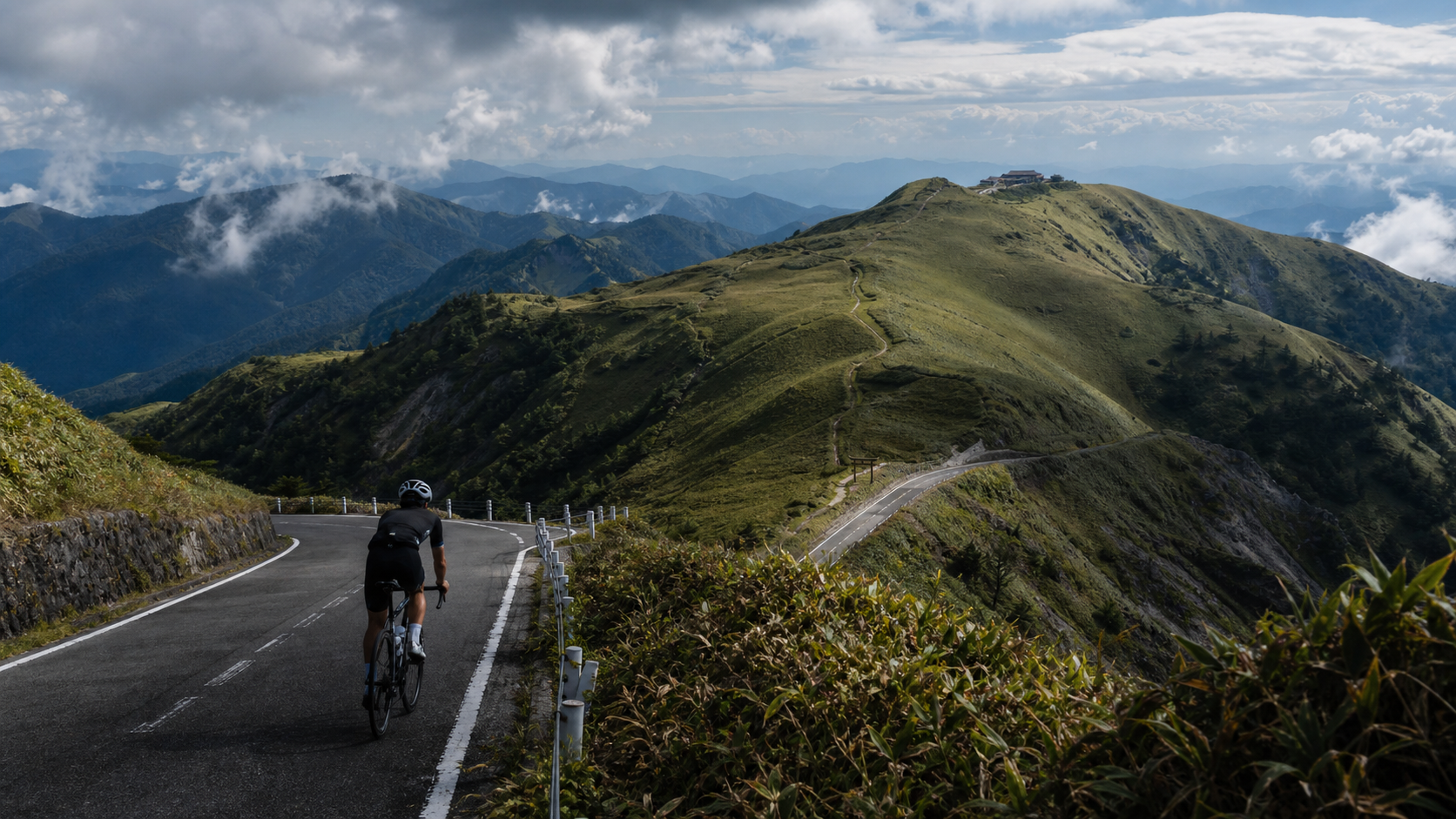
Some mountains you conquer for the sake of performance; others you approach for the sake of their stories. Mount Tsurugi (つるぎさん) undoubtedly belongs to the latter. Standing at 1,955 meters, it is the highest peak in Tokushima Prefecture and is listed among Japan’s 100 Famous Mountains. The trailhead at Minokoshi (見ノ越) on its flank, at an elevation of about 1,400 meters, is the farthest point reachable by bicycle. But what truly sets Mount Tsurugi apart is not just the staggering nearly 2,000-meter climb, but the legends and faith that have been woven around this mountain for over a thousand years.
As you pedal, slowly ascending through the hairpin turns of National Route 438, you are not merely climbing a mountain—you are riding into one ancient story after another. The tragic tale of the fallen Heike clan, the mystery of the lost Ark of the Covenant, the legend of a fountain of youth, and the footsteps of Shugendo ascetics—all of it is sedimented beneath this high-altitude sasa plain. This article aims to help you see Mount Tsurugi through a different lens: not as a string of gradient data, but as a living, storytelling sacred mountain.
What makes Mount Tsurugi so captivating is that it simultaneously offers the “physical challenge of a hard-core climb” and the “spiritual depth of a thousand-year-old legend.” As you measure its height with your legs, you also touch its depth with your soul.
Geography and Historical Background: A Sacred Peak on the Roof of Shikoku
Mount Tsurugi is located in the Mima District of Tokushima Prefecture on Shikoku, and is one of the core peaks of the Shikoku Mountains, as well as the highest point in Tokushima Prefecture. It connects with neighboring peaks such as Jirogyū to form the rugged backbone of the Shikoku mountain range. Topographically, Mount Tsurugi exhibits typical alpine features—yet the summit area is not a jagged rock face, but rather an open, gently undulating high-altitude sasa plain (dwarf bamboo grassland). This kind of terrain is strikingly distinctive among Japan’s high mountains, adding to its air of mystery and vastness.
As one of the “100 Famous Japanese Mountains,” Mount Tsurugi holds an exalted status in Japan’s mountaineering world. This list was compiled by the literary figure Fukada Kyūya, selecting renowned mountains across Japan that combine beauty of form, depth of history, and the joy of climbing. To be included on it is an acknowledgment in itself. And what Mount Tsurugi is most celebrated for is its religious standing as a “sacred mountain of Shugendo.”
Shugendo is a unique Japanese ascetic tradition that blends mountain worship, Buddhism, and Shinto. Its practitioners (yamabushi) use the mountains as their training ground, subjecting themselves to rigorous austerities in rugged terrain to discipline body and mind and seek enlightenment. Mount Tsurugi has been regarded as a sacred site by Shugendo ascetics since ancient times, and the very character “剣” (sword) in its name carries a solemn, awe-inspiring aura. When you ride along this road leading to a sacred mountain, in a sense, you too are treading a path of spiritual practice walked by countless ascetics over the centuries.
The Mystery of the Mountain’s Name and the Imagery of the “Sword”
Where does the name “Mount Tsurugi” come from? Theories abound. One suggests it relates to the summit’s topography and rock formations; another points directly to the most captivating legend of all—that a “treasured sword” is hidden within the mountain. Whatever the truth may be, the imagery of the “sword” has become deeply etched into the soul of this mountain, endowing it with a character that is at once majestic and mysterious.
The Heike Legend: An Elegy on the High Sasa Plain
Among the many legends of Mount Tsurugi, the most widely told and most moving is the story connected to the Heike clan.
The expansive high-altitude sasa plain at the summit bears a name that is both poetic and tinged with sorrow—“Heike no Babā” (The Heike Horse Grounds). According to legend, during the late Heian period, the once-mighty Heike clan suffered successive defeats in the Genpei War. One remnant of their forces, after enduring countless hardships, wandered into this remote mountain highland, cut off from the world.
Even more intriguing is the claim that this Heike remnant did not arrive empty-handed. Legend has it that after their defeat at the famous Battle of Yashima, they escorted the young Emperor Antoku and secretly concealed one of the Three Sacred Treasures of the Japanese imperial regalia—the “Sacred Sword”—within Mount Tsurugi. This, in fact, is one of the romantic explanations for the origin of the mountain’s name.
Imagine it: a group of aristocrats who once knew glory and wealth, now with their clan shattered and their homeland lost, escorting a child emperor and carrying the very symbol of imperial legitimacy, fleeing into this remote, uninhabited highland. They grazed their horses on this sasa plain, lived in seclusion, and guarded their final dignity and their secret. This legend drapes a subtle veil of melancholy and a thousand years of weight over what appears to be a serene and boundless grassland.
When you ride to Minokoshi and gaze out over that high sasa plain, take a moment to imagine the figures of that Heike remnant a thousand years ago. The same grassland, the same sky—only time has flowed on for a millennium. This is the most moving spiritual moment of riding Mount Tsurugi.
King Solomon’s Treasure: The Eastern Mystery of the Lost Ark
If the Heike legend is already remarkable, then the next one catapults Mount Tsurugi onto the stage of world-class mysticism.
A breathtaking legend circulates about Mount Tsurugi—the “Treasure of King Solomon,” namely the lost “Ark of the Covenant” described in the Bible, which is said to be hidden within the mountain. This tale, spanning East and West and seemingly straight out of fantasy, is not merely idle dinner-table chatter. In the early Shōwa era, a researcher named Takane Masanori genuinely believed in this theory and actually conducted excavations and surveys on Mount Tsurugi.
That a peak deep in the mountains of Shikoku, Japan, could be linked to the distant ancient Kingdom of Israel and to a lost sacred relic—this kind of imagination that transcends common sense is the ultimate expression of Mount Tsurugi’s mysterious allure. Whether or not this legend holds up academically, it has become part of the mountain’s cultural fabric, drawing generation after generation of the curious to come and search.
Of course, as rational cyclists, we can easily treat this legend as an “easter egg” that adds flavor to the journey. But there is no denying that when you are riding alone on the quiet mountain road toward Mount Tsurugi, and the thought crosses your mind that “this mountain might hold the lost Ark,” that subtle, imaginative brush with the unknown makes the entire ride taste all the more rich.
The Water of Rejuvenation: Another Gift of the Sacred Mountain
Beyond the legends of the sword and the Ark, Mount Tsurugi holds another, gentler legend more attuned to the human longing for life—the “Wakagaeri no Mizu,” or the “Water of Rejuvenation.”
It is said that a spring gushing from somewhere within Mount Tsurugi yields water that, when drunk, restores youth and reverses aging. This legend reflects the simple, age-old human desire for health, longevity, and eternal youth, and once again confirms the sacred and beautiful image that Mount Tsurugi, as a sacred mountain, carries in people’s hearts. A clear spring emerging from a high peak naturally evokes purity and naturalness, so it seems entirely fitting and moving that it should be endowed with the spiritual power of “rejuvenation.”
For cyclists, this legend resonates in a special way: when you have struggled up Mount Tsurugi through tremendous effort, and you breathe deeply of the crisp high-altitude air and drink freely from the cool spring, that feeling of being thoroughly cleansed in body and mind, as if reborn, may well be the most authentic modern interpretation of the “Water of Rejuvenation.” You don’t need to truly believe the water has magical powers—the experience of being “washed clean by the mountains and recharged” is itself a form of rejuvenation.
Scenery Along the Way and the Narrative of the Ride: A Journey in the Company of Legends
Let me take you, in the first person, through the sensory and spiritual flow of this ride.
In the early morning, I set out from the Sadamitsu area, pushing along National Route 438 toward the mountains. The road is still relatively gentle at first; morning light filters through the treetops, and the air carries that distinctive coolness and dampness of mountain regions. After passing Tsurugi Bridge, the gradient begins to get serious. I shift down, letting my breathing and pedaling find a rhythm that can be sustained over the long haul.
As altitude increases, the views gradually open up. Looking back at the road behind, valleys spread out layer upon layer below, and distant ridges appear and disappear through the thin mist. That feeling of “lifting yourself step by step into the clouds” is the unique romance of climbing. Mountain weather proves as changeable as expected—one moment bathed in sunshine, the next, a mountain mist rolls in around a bend, shrouding the entire forest in haze, as if the Heike remnant from a thousand years ago might emerge from the fog at any moment.
The higher I go, the fewer signs of human presence remain. There is only my own breathing, the faint whir of the drivetrain, and the sound of wind rustling through the treetops. This near-total seclusion and stillness is precisely the most captivating quality of Mount Tsurugi as a sacred mountain. Unconsciously, you slow your thoughts, letting those ancient legends swirl through your mind, allowing physical fatigue and spiritual stillness to blend in a strange and wonderful way.
When I finally reach the Minokoshi trailhead and gaze out at the legendary “Heike no Babā” high sasa plain, an indescribable emotion wells up inside me. At this moment, the numbers on the cycling computer no longer matter. What matters is that I have used my own legs to physically arrive at this sacred mountain bearing a thousand years of legend, standing on the very stage where countless ascetics and countless stories have played out.
The most precious reward of riding Mount Tsurugi has never been the numbers on the cycling computer, but the irreplaceable emotion—woven from physical exhaustion and spiritual awe—that arises the moment you stand at Minokoshi and gaze out over Heike no Babā.
Local Culture and Suggested Side Trips
The mountainous western region of Tokushima Prefecture, where Mount Tsurugi is located, offers a wealth of natural and cultural resources beyond the mountain itself, making it well worth arranging side trips to round out your cycling journey.
In terms of natural scenery, the valleys, clear streams, and forests of the Shikoku Mountains are themselves superb places to soothe the mind and body. The crisp mountain air, the chorus of cicadas and birds, and the babbling of streams are luxuries rarely found in urban life. If time permits, slowing down and lingering in small mountain villages to experience the unhurried pace of the deep Shikoku mountains would be a wonderful experience.
For cultural experiences, the Minokoshi trailhead on Mount Tsurugi is equipped with a ropeway, allowing travelers with limited time or who wish to conserve energy to easily reach higher elevations and enjoy the main peak of Mount Tsurugi and its famous high sasa plain. If you have the energy to spare, I strongly recommend securing your bike and then taking the ropeway or hiking to the summit to see the legendary “Heike no Babā” with your own eyes—climbing to 1,400 meters by bike, then covering that final stretch closest to the heart of the legend on foot. This experience of “approaching the legend through physical effort” is something no mode of transportation can replace.
As for food, the mountain regions of Shikoku each have their own local rustic dishes and specialties. I would encourage you to explore with an open and respectful attitude. I will refrain from singling out any particular restaurant or dish here to avoid providing inaccurate information, but one thing is certain: after a hard-core climb, any warm local meal will taste exceptionally good. The body’s craving for energy and salt after exercise transforms even the simplest fare into a feast.
Seasonal Scenery and the Meaning of the Ride
The beauty of Mount Tsurugi shifts with the turning of the four seasons. In spring, the mountains awaken from the lingering cold, and fresh greenery gradually climbs the slopes; in summer, the high sasa plain is a sea of green, making it the best season for a challenge—though you should be wary of changeable afternoon weather; in autumn, the mountains may be painted in layers of color, and the clear skies make the outlines of distant peaks especially crisp, offering excellent visibility; in winter, the mountains may be blanketed in snow, presenting a starkly different, austere beauty—but due to snow and ice, it is not suitable for ordinary cyclists to attempt recklessly.
No matter which season you visit, Mount Tsurugi will respond to you in its own unique way. And this, perhaps, is the deepest meaning of riding this sacred mountain—it makes you realize that cycling has never been merely a sport, but a way of conversing with nature, with history, and even with your own inner self.
When you conquer nearly 2,000 meters of climbing with your legs, when you stand before the high sasa plain and imagine legends a thousand years old, when you cleanse your body and mind amid mountain mist and clear springs—you will discover that Mount Tsurugi has long transcended the definition of a “route.” It is a story in which you personally participate, co-written with sweat and emotion. And this story will quietly accompany you on every ride you take thereafter.
Some mountains you ride over and forget; others take up residence in your heart for a lifetime. Mount Tsurugi belongs to the latter. May you find your own sense of wonder and tranquility between its legends and its heights.
Minokoshi: The Gateway Where Legend and Reality Meet
Minokoshi, at an elevation of about 1,400 meters, is the endpoint of the cycling journey and the primary starting point for hiking to the summit of Mount Tsurugi. The name itself is steeped in poetry—“Minokoshi,” as if to say that once you cross this point, you will be able to see a different landscape. And indeed, that is the case: reaching Minokoshi means you have lifted yourself from the mundane world below to the mist-shrouded gateway of a sacred mountain.
Here, reality and legend intersect in a wonderful way. On one hand, there is a parking lot, restrooms, and a ropeway station—practical, modern facilities that serve travelers well. On the other hand, when you look up toward that high sasa plain, your thoughts involuntarily drift back to the Heike legend of a thousand years ago, to those mysterious tales of the sword and the Ark. This strange sensation of “one foot in reality, one foot in legend” is precisely what makes Minokoshi so enchanting.
The presence of the ropeway means that the beauty of Mount Tsurugi is no longer the exclusive preserve of the physically strong. Even travelers who cannot ride or who have limited stamina can easily ascend via the ropeway and behold the grandeur of the main peak and the high sasa plain. For cyclists, the ropeway is an “extra reward”—after completing the hardest climb with your legs, the remaining stretch to the summit can be conquered on foot if you choose, or you can take the ropeway and leisurely enjoy the high-mountain scenery you have just earned with your sweat.
Why “Sacred Mountain”? The Deeper Meaning of Mountain Worship
Earlier, we mentioned that Mount Tsurugi is a sacred mountain of Shugendo. But the term “sacred mountain” may seem somewhat abstract to modern urban dwellers. Let us try to understand it more deeply.
In Japan’s traditional mountain worship, mountains are not merely geographical high points; they are dwelling places of the gods, passages connecting heaven and earth, and sacred spaces capable of purifying the heart and bringing rebirth. The ancients harbored a complex mix of awe and longing toward towering, weather-defying peaks. They believed that only through ascetic practice and discipline in the mountains could one transcend the ordinary self and touch a higher spiritual realm.
The expansive high sasa plain of Mount Tsurugi, the spiritual vein from which clear springs emerge, and the ever-shifting clouds that shroud the summit—all of these combine to create a superb “spiritual field.” When Shugendo ascetics practiced austerities here, when travelers hold their breath and gaze in wonder, what people feel is a shock of connection with heaven and earth that transcends the everyday.
And cyclists, in a sense, are the modern-day “yamabushi.” We use our bodies, through the ascetic discipline of pedaling, to approach the summit step by step. The pain of climbing, the shortness of breath, the drenching sweat—are these not a modern form of spiritual practice? When you grit your teeth and persevere on the steep slopes of Mount Tsurugi, when you experience that pure sense of accomplishment upon reaching the top, what you are experiencing is, in essence, the same thing those ascetics sought a thousand years ago: “the elevation of the spirit through the discipline of the body.”
Riding a bike up a mountain is the most accessible form of “spiritual practice” for modern people. And Mount Tsurugi is a sacred mountain tailor-made for precisely that kind of practice. Every drop of sweat you shed is the most sincere act of worship you can offer this mountain.
A Legend, a State of Mind: How to Ride with Stories
Now that you know the various legends of Mount Tsurugi, how can you make these stories truly “come alive” during an actual ride and enrich your journey? Here are a few small suggestions.
First, read through these legends carefully before you set out. When your mind is filled with the Heike elegy, the mystery of the Ark, and the legend of the sacred spring, every stretch of road and every piece of scenery will take on an added layer of meaning. The same grassland—knowing it is called “Heike no Babā” and knowing it bears a thousand-year-old elegy—will feel like far more than “just grass.”
Second, allow yourself to “be distracted” by imagination during the ride. Climbing is certainly hard, but when you occasionally shift your attention from your aching legs to the ancient stories swirling around this mountain, you will find that time passes a little faster and the pain seems diluted. Imagine the ascetics of a thousand years ago treading the same mountain paths, imagine the Heike remnant leading their horses through the mist—these images will become a gentle strength that carries you onward as you pedal.
Finally, give yourself a quiet moment after reaching the top. Don’t rush to take photos, check in on social media, or hurry back down. Find a place to sit, gaze out over the high sasa plain, let the mountain wind blow over you, and let the legends settle in your heart. This moment of stillness and emotion is the most precious souvenir of a Mount Tsurugi journey—it will not appear in your cycling computer’s data, but it will be etched deeply into your memory.
To Every Cyclist Who Longs for Mount Tsurugi
Mount Tsurugi is a mountain you must conquer with your body and approach with your soul. It has hard-core climbing data that will honestly test your fitness and willpower; and it has a thousand years of legends that will gently nourish your spirit and imagination.
When you decide to take on the challenge, bring two things with you: first, adequate physical preparation and safety gear, so that your body can complete the journey safely; second, an open and humble heart, so that you can truly receive the stories this sacred mountain wishes to tell.
You will shed painful sweat on the steep slopes, and you will experience pure joy after reaching the summit; you will feel small in the mountain mist, and you will touch eternity within the legends. This is Mount Tsurugi—a sacred peak where body and soul are both baptized.
May you ride out a story of your own, irreplaceable, between the heights and legends of Mount Tsurugi. Years from now, when you look back on this journey, what surfaces in your mind may not be the gradient numbers or the finish time, but that high sasa plain shrouded in mountain mist, and the image of yourself, breathless yet with shining eyes. That is the most beautiful meaning of riding Mount Tsurugi.
Starting from a Place Name: A Thousand Years of Memory in Language
Sometimes, the soul of a mountain is hidden in its place names. The area around Mount Tsurugi is dotted with names full of stories, each one like a seal of time stamped upon the memory of this land.
“Heike no Babā” is the best example. A single place name condenses the entire tragic history of the Heike’s fall and their life of grazing horses on the highland. The local people have passed this story down orally from generation to generation, so that it has not dissipated with the passage of time but has been firmly preserved through the place name itself. This is the most moving way legends are transmitted—they need not be written in expensive history books; as long as they live in people’s speech and in the names of the land, they can endure for a thousand years.
As you ride Mount Tsurugi, take note of the place names along the way. Behind every seemingly ordinary name, there may lie a forgotten story. This pleasure of “deciphering place names and imagining history” will elevate your ride from a mere physical challenge to a cultural exploration across time and space.
The High Sasa Plain: A Breathing Grassland
Finally, let us turn our gaze once more to Mount Tsurugi’s most iconic landscape—that expansive high-altitude sasa plain.
A sasa plain is a grassland composed of dwarf bamboo (sasa). Around the summit of Mount Tsurugi, this dwarf bamboo grassland undulates with the contours of the mountain, stretching endlessly and swaying like waves in the wind. It lacks the depth of a forest and the ruggedness of a cliff face, instead spreading across the mountaintop in a soft, open, and far-reaching manner. This kind of terrain is dreamlike when shrouded in mist and brilliantly green under full sunlight—it is the very essence of Mount Tsurugi’s beauty.
When you stand before this sasa plain, a gentle breeze passes, and the dwarf bamboo rustles softly, as if the entire mountain is breathing quietly. At this moment, all the legends—the Heike elegy, the mystery of the Ark, the gift of the sacred spring—seem to find their concrete stage. You will understand why, for a thousand years, people have held such profound reverence and imagination for this mountain. Because standing here, anyone would feel a wordless, awe-inspiring sense of the vastness of heaven and earth.
This breathing grassland is the gentlest and most magnificent gift Mount Tsurugi offers to every traveler who arrives after great hardship. And the cyclist who has climbed step by step to this legendary place on their own legs is undoubtedly the one most worthy of receiving this gift.
May we all have the chance to stand before that high sasa plain, let the mountain wind blow away our weariness, let a thousand years of legends surge into our hearts, and then say to this sacred mountain, from the bottom of our hearts: thank you, for letting me come.
As the setting sun gilds that sasa plain in gold, as the first star appears in the clear high-altitude night sky, you will feel genuine gratitude for your decision to take on Mount Tsurugi. For upon this sacred mountain, what you gain is far more than the completion of a ride—it is a beautiful memory of body and soul that will warm you for years to come. This is the eternal charm of Mount Tsurugi.
Related Reading
- Mount Tsurugi Hill Climb Practical Guide: 15 km, Nearly 2,000 Meters of Climbing, a Complete Analysis of Shikoku’s Hard-Core Sacred Mountain
- The Sky Road to the Sacred Mountain: Ishizuchi Skyline, Shugendo Faith, and the Blue of Menagawa on a Journey Across the Roof of Shikoku
- Riding to the Land Where the Heavenly Grandson Descended: The Cycling Story of Takachiho-gawara, a Journey from a National Treasure Shrine to a Mythic Sacred Mountain
- The Coming-of-Age Ritual for Kanto Cyclists: Yabitsu Pass, a Sacred Site That Measures Your Fighting Spirit
台北闊瀨陡坡 騎旅 / 日本單車雜誌編輯車友臨時加入!/ 髮香才是最強的 / feat. 北迴歸線小隊 / 公路車 CT Yeh
6 個月前
2025 乘鞍 KOM 登山賽挑戰實錄 / 日本公路最高 ! 賽前探路篇 / 比富士山厲害,無敵絕景!/ 40週年 / 中文YT首發 / 公路車 / CT Yeh #乘鞍ヒルクライム
11 個月前
2025 乘鞍岳登山賽 比賽全紀錄篇 / 完整路線攻略介紹 / 日本版武嶺 公路最高點 / 高山空拍絕景 / 明年會開團! / 公路車 / CT Yeh
10 個月前
大武山後門26%歡樂陡坡!JJSC南台灣單車行Day2 / 被颱風追著跑 / 公路車 / CT Yeh
2 年前
秘境雪場 日本 八甲田 冰樹探險與滑雪體驗 ft. Q老師 & 運動生活
7 年前
小野田真的存在!日本赤城山爬坡公路賽 台灣首發團完全實錄 | 頭文字D真實賽道! | 看完東奧自行車賽後好想再去騎一次啊! | 公路車 | CT Yeh
4 年前
騎單車去大屯山賞雪! 助航台滑冰 全記錄 | 台北R友大集合 | 下雪打雪仗囉 | 4K超高畫質
5 年前
京都!99%人不知道的秘境玩法!租 E-Bike 騎進探訪宇治抹茶原鄉 刺激好玩絕美的山林古道 鬼滅之刃的場景探訪 / CT Yeh
14 天前