Riding on the Line Between Sky and Earth: The Scenic Beauty, Windmills, and Serene Moments of the Shikoku Karst Sky Road
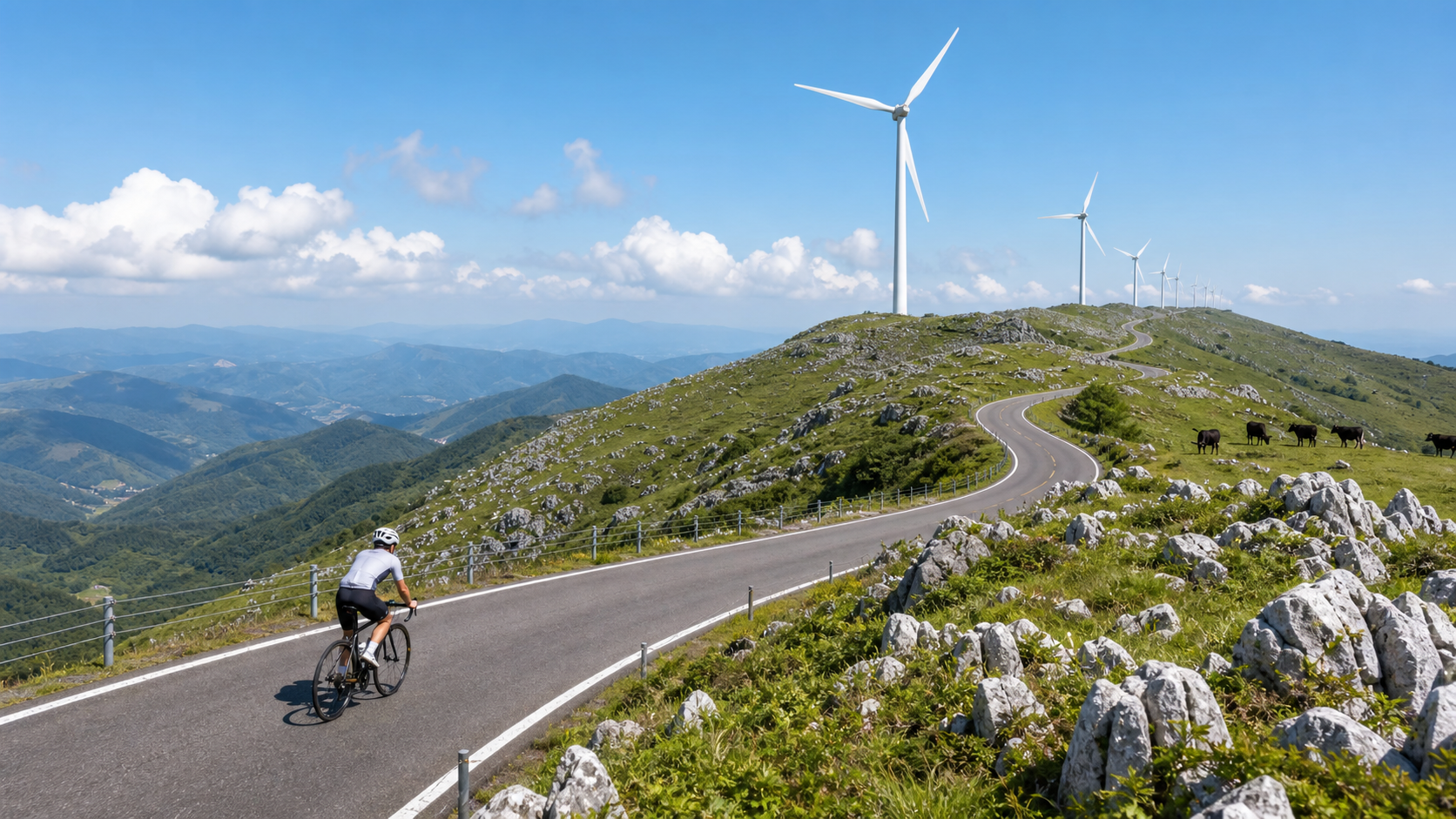
There are landscapes that make you forget to breathe the moment you see them; there are roads that, once ridden, you will miss for a lifetime. The Shikoku Karst (四国カルスト) — that highland scenic road known as the “Sky Road” — is exactly such a place.
It is located in Kumakōgen Town, Ehime Prefecture, straddling the border between Ehime and Kōchi Prefectures, at an elevation of roughly 1,000 to 1,400 meters. It is one of Japan’s three major karst landforms and is affectionately called the “Roof of Shikoku.” White limestone rocks are scattered sparsely across the boundless emerald grasslands, giant windmills turn slowly along the ridgeline, cattle graze leisurely on the meadows, and the road winds like a ribbon between heaven and earth — all of this forms a surreal scene that seems less like Earth and more like a dreamlike otherworld.
This article will not discuss gradients, gear ratios, or pacing. It simply wants to take you on a heartfelt journey to discover the geographic story hidden within this Sky Road, the scenery along the way, and why it leaves such a deep and gentle mark on the hearts of countless riders.
Some routes make you stronger; some routes make you whole. The Shikoku Karst belongs to the latter. It offers not the thrill of conquest, but an indescribable happiness of being gently embraced by nature and utterly awestruck by magnificent vistas.
Geographic Background: A Sky City Sculpted Over Millennia
To understand the beauty of the Shikoku Karst, one must first understand how it came to be. This highland owes its unique topography to a geological process known as “karst” formation.
Karst topography is a distinctive landform shaped by the prolonged dissolution of soluble limestone by rainwater and groundwater. Imagine this: over millions of years, drop after drop of rain slowly dissolved the limestone on this highland, day after day, year after year, eventually leaving behind those exposed, boulder-like white rock formations scattered across the grassland. Every white limestone rock you see today is a masterpiece carved by time and nature over millions of years.
The Shikoku Karst is a premier example of this landform, standing alongside Akiyoshidai in Yamaguchi Prefecture and Hiraodai in Fukuoka Prefecture as one of Japan’s three major karst regions. Among the three, the Shikoku Karst stands out because it sits atop a high-elevation ridgeline, possessing that vast and lofty “sky city” quality that makes it uniquely special. When you stand on this highland, you are not merely standing on a grassland — you are standing within a natural artistic sanctuary meticulously sculpted by time over millions of years.
Scenery and Landmarks Along the Way: A Flowing Panorama
The beauty of the Shikoku Karst is not concentrated at a single spot but unfolds continuously along the “Sky Road,” forming a flowing panorama. Among its many features, three names stand out as core landmarks that no visitor will miss.
Mezuru-daira: The Starting Point of the Panorama
Mezuru-daira (めづるだいら) is one of the most popular core areas of the Shikoku Karst. With its open terrain and expansive grasslands, it serves as an excellent base for appreciating the karst scenery. Notably, the Mezuru-daira area has a bicycle rental station, operating roughly from early April to early November, giving more people the opportunity to explore this highland by bike — the most intimate way to connect with the land.
Standing at Mezuru-daira, the three colors of white rock, green grassland, and blue sky interweave before your eyes. That purity and vastness will instantly wash away all the fatigue and anxiety of urban life.
Tengu Highlands: The Best of the Best
The roughly 4-kilometer stretch from Mezuru-daira to Tengu Highlands (てんぐこうげん) is widely recognized as the highlight section of the Shikoku Karst and the segment most deserving of the “Sky Road” title. This section features gentle gradients and supremely open views, with the road seemingly extending toward the horizon, flanked by endless grasslands and scattered white rocks. Riding here, you will experience the strange sensation of “advancing along the boundary between heaven and earth.”
Tengu Highlands is one of the highest areas of the Shikoku Karst. Standing here and looking out, the mountains of Shikoku unfold layer upon layer beneath your feet. On clear days, that sense of “seeing all lesser mountains at a glance” is enough to awe every visitor.
Ōno-ga-hara: An Unbroken Extension of Scenery
The beauty of the Shikoku Karst does not stop at Tengu Highlands. Continuing toward Ōno-ga-hara (おおのがはら), the scenic wonders remain unbroken. Tengu Highlands, Mezuru-daira, and Ōno-ga-hara — this chain of highland spots forms a complete and rich gallery of karst scenery. For travelers with ample time who wish to fully explore this highland, extending the route to Ōno-ga-hara will yield an even more fulfilling experience.
A First-Person Riding Narrative: On the Sky Road
Let me take you, in the first person, through the emotional flow of this ride.
The climb was arduous, but the moment I finally burst out of the forest and the view opened up before me — seeing that legendary karst highland spread out under the sunlight — all my fatigue vanished in an instant. Almost involuntarily, I slowed my pedaling and even stopped altogether, simply gazing silently at the surreal scene before me, unable to speak for a long time.
White rocks were scattered sparsely across the boundless emerald grassland; in the distance, giant windmills along the ridgeline turned slowly; a few cattle grazed leisurely with their heads lowered; and the road beneath my wheels stretched like a silver ribbon, winding toward the point where sky met grassland. The wind was strong, sweeping the grassland into waves of green and sending a chill through me, but my heart burned hot.
I pushed down on the pedals again and rode slowly along this Sky Road. This time, I didn’t glance at my cycling computer, didn’t care about speed. I simply and greedily absorbed this magnificent scenery with my eyes, my skin, my entire being. The wind rushed past my ears, the scent of grass filled my nostrils, the sunlight was warm, and the sky was an impossibly deep blue. In that moment, I suddenly understood: after all these years of riding, through all the pain and sweat, perhaps what I had been seeking was exactly this — a pure, indescribable happiness of becoming one with heaven and earth.
On the Sky Road, I felt for the first time, with such clarity: the ultimate meaning of cycling is not reaching a destination, but achieving a profound and peaceful reconciliation with the world — and with oneself — in some moment along the journey.
What the Shikoku Karst Means to Riders
What are we truly seeking when we ride? Faster speeds? Longer distances? Higher climbs? The Shikoku Karst offers a different answer.
On this route, you will discover that there is a kind of riding that requires no all-out effort; there is a kind of scenery worth setting aside your results and slowing down to savor. What the Shikoku Karst teaches riders is the wisdom of “knowing when to slow down.” It reminds us that on the path toward becoming stronger and faster, we should not forget to occasionally stop, look up at the scenery before us, and feel the most essential joy of this sport.
For many riders, the Shikoku Karst is a “soul-recharging journey.” It carries you away from the clamor of the city and brings you to a vast, tranquil, and pristine highland, allowing you to rediscover inner peace and a love for life with every pedal stroke. When you ride through this Sky Road, what you take away is not just a few beautiful photos, but a memory of beauty and vastness warm enough to sustain you for years to come.
Seasonal Scenery
The beauty of the Shikoku Karst transforms with the turning seasons, and each one is worth a dedicated visit.
In late spring, the highland awakens from its slumber, and the grasslands gradually take on fresh green hues, with the vitality of renewal quietly unfolding across this elevated land. By summer, the grasslands are a lush, verdant green — the most classic and photogenic season of the Shikoku Karst. Blue skies, white clouds, green grass, white rocks, and windmills compose the most saturated and moving palette of colors. In autumn, the highland sky becomes exceptionally clear and lofty, with superb visibility and crisp outlines of distant mountains — the best time for panoramic mountain views, and the grasslands may don their golden autumn attire. In winter, the highland may be blanketed in snow, presenting a stark, silvery beauty; however, due to snow and ice accumulation and the closure of some facilities, it is not suitable for ordinary riders to venture out.
Whichever season you choose to visit, the Shikoku Karst will respond to your arrival in its own unique way.
Suggested Side Trips and the Right Mindset
The area around Kumakōgen in Ehime and Kōchi, where the Shikoku Karst is located, is rich in mountain natural resources, making it ideal for side trips that round out the journey. The surrounding valleys, forests, and rustic mountain villages are wonderful places to escape the hustle and bustle and heal the body and mind. I recommend slowing down and savoring the unhurried, warm rhythm of the deep mountains of Shikoku.
As for local cuisine, each region of Shikoku has its own unique local dishes and products, and I encourage you to explore with an open and curious mind. I will not single out any particular restaurant or dish here, to avoid misleading travelers with potentially inaccurate information. But one thing is certain: after feasting your eyes on stunning scenery and enjoying a full ride, a warm local meal will be the most comforting way to end the journey.
Finally, I want to remind every rider who visits the Shikoku Karst: come with a heart of reverence and respect. This highland is a masterpiece of nature carved over millions of years, a home for grazing cattle, and a sacred place in the hearts of countless travelers. Please cherish this land — leave no trash behind, do not disturb the cattle or the ecosystem, and coexist with this magnificent scenery in the gentlest way possible.
To Everyone Who Yearns for the Sky Road
The Shikoku Karst is a route that will leave a permanent mark on your heart. With its karst scenery sculpted over millions of years, its vast and lofty Sky Road, its leisurely cattle, and its slowly turning windmills, it offers you a feast for both the eyes and the soul.
When you decide to visit, do not think only of conquest or results. Bring a heart willing to slow down and be moved. For the most precious gift of the Shikoku Karst is that pure and profound awe and tranquility that wells up within you when you stand on the Sky Road and gaze upon the boundless scenery before you.
May you one day personally push down on the pedals, ascend to the roof of Shikoku, and ride along the boundary between heaven and earth. May that scenery of white rocks and emerald grasslands, those slowly turning windmills and leisurely cattle, wash away your fatigue and heal your soul, becoming the gentlest, most expansive, and most unforgettable memory of your cycling life.
There are countless roads in this world worth riding, but the ones that, years later, you can still close your eyes and clearly recall — that sky and that grassland — are few and far between. The Shikoku Karst is precisely such a Sky Road, one that will live in your heart for a lifetime.
The Whisper of White Rocks: The Aesthetic Philosophy of Karst
On the emerald grasslands of the Shikoku Karst, nothing captivates the heart more than those scattered white limestone rocks. They are not as orderly as artificial sculptures, nor as ostentatious as sheer cliffs, but rather adorn the boundless green in a nearly spontaneous yet perfectly natural manner. This striking contrast of “white and green” forms the most recognizable visual signature of the Shikoku Karst.
If you are willing to slow down and examine these white rocks closely, you will discover a curious aesthetic philosophy. They are “imperfect perfection” — each rock is irregular in shape and utterly unique, the random result of rain and time sculpting over millions of years. This beauty, born of nature and untouched by human hands, echoes the spirit of “wabi-sabi” in Eastern aesthetics: finding the deepest, most moving beauty within imperfection and impermanence.
Riding through such scenery, your state of mind will unknowingly settle into calmness. These white rocks, standing in silence for millions of years, seem to whisper to every passing traveler: slow down, just a little more. The beauty of life is often hidden in those moments when you are willing to stop and gaze with full attention. The Shikoku Karst is moving not only because of its grand scenery, but because it can guide the most restless heart back to tranquility amid that expanse of white and green.
A Journey of Wind: A Way of Conversing with This Highland
Riding the Shikoku Karst, you will constantly encounter “wind.” The wind here is sometimes gentle, sweeping across the grassland and raising layers of green waves; sometimes fierce, forcing you to grip your handlebars firmly as you ride. Those giant windmills standing along the ridgeline are the most direct proof of this highland’s “windy” character.
But from another perspective, the wind is how the Shikoku Karst converses with you. When you ride against the wind, you feel the raw, powerful force of this highland; when you glide with the wind, you experience the exhilaration of being gently pushed along by nature. The howl of wind rushing past your ears, the rustle of wind-blown grass, and the bursts of grass fragrance and cool air all form the unique auditory and olfactory memories of this ride.
Many riders recall the Shikoku Karst not only for the scenery their eyes beheld, but for the highland wind their skin felt. That wind carries the scent of grass, the warmth of sunlight, the crispness of the highlands, and an indescribable breath of “freedom.” When you stand on the Sky Road and let the strong wind blow through you, you feel an incomparable sense of release, as if you might merge with heaven and earth. This is the love letter the Shikoku Karst writes to every rider through its wind.
A Theater of Clouds: The Ever-Changing Highland Sky
The Shikoku Karst’s high elevation and open terrain give it an unparalleled “theater of clouds.” On this highland, the sky’s expressions change in an instant, offering a free performance that never ends.
Sometimes, fluffy white cumulus clouds dot the azure sky, and cloud shadows drift slowly across the green grassland, light and shadow flowing over the land like a living oil painting. Sometimes, thick fog surges onto the highland without warning, shrouding the entire grassland in a hazy milky white, with white rocks appearing and disappearing in the mist like a fairyland. And when the clouds and fog disperse and sunlight pours down once more, that sudden clarity and the reappearance of the magnificent scenery is breathtaking.
Precisely because the highland weather is so changeable, every visit to the Shikoku Karst presents a sky that is unique and unrepeatable. This is part of the route’s charm: it never gives you “the same scenery” — every visit is a brand-new encounter. It is for this reason that many riders return to this highland again and again, just to once more chance upon that ever-changing sky.
A Highland for One, Memories for Many
The Shikoku Karst is suited both for a quiet solo ride and for riding alongside a few good friends.
Riding alone on the Sky Road, you can attain a deep, meditative solitude of self-dialogue. With no words to interrupt, only the sound of wind, the scent of grass, and your own breathing, you can let your thoughts drift across the grassland like cloud shadows, sorting out your mind and settling your soul. This solitude is not loneliness, but a rare luxury of being alone with yourself.
Riding with companions, the Shikoku Karst becomes a shared, shining memory. Imagine a group bursting out of the forest together and seeing that magnificent scenery unfold before their eyes, exclamations rising one after another; imagine everyone riding side by side on the Sky Road, taking photos together against the stunning backdrop, sharing that awe and joy. Years later, when friends gather and someone says, “Remember that time we rode the Shikoku Karst together?” — that shared beautiful memory becomes the warmest bond sustaining friendship.
Whether it is the quiet reflection of riding solo or the exuberance of riding with companions, the Shikoku Karst can hold your emotions and reward you with an irreplaceable, wonderful time.
In Closing: On Beauty, on Slowness, on Love
The Shikoku Karst — this highland scenic road known as the “Sky Road” — ultimately seeks to teach us three simple yet profound things.
On beauty — it shows us that there exists in this world a grandeur so breathtaking it makes you forget to breathe, and that such beauty often lies in the distant places we are willing to travel far and strive hard to reach. White rocks, emerald grasslands, slowly turning windmills, leisurely cattle, an ever-changing sky — these images will tell you that the pursuit of beauty is always worthwhile.
On slowness — it teaches us that riding need not always be all-out effort, and life need not always be a hurried rush. Sometimes, slowing down to truly look at the scenery before you and savor every present moment is the deepest wisdom. The gentle gradient of the Shikoku Karst’s highlight section is nature’s tender reminder: slowness is also a form of strength.
On love — it makes us fall in love with cycling all over again, and it makes us cherish the nature that sustains all life even more. When you stand on the Sky Road, utterly awestruck by the scenery, you will remember why you fell in love with cycling in the first place: not for results, not for showing off, but to use your own legs to reach such beautiful faraway places and witness such magnificent landscapes.
May every rider who reads this have the opportunity to personally push down on the pedals, ascend to the roof of Shikoku, and ride along that road leading to the sky. May that magnificent scenery wash away your fatigue, heal your soul, and leave the gentlest, most expansive, and most unforgettable memory in your cycling career. The Sky Road awaits you quietly in the distance.
From the City to the Highlands: A Distance Toward the Inner Self
For many riders living in bustling cities, the Shikoku Karst is precious precisely because of its stark contrast to daily life. The roads we ride on weekdays are often squeezed between traffic, traffic lights, and concrete. The Shikoku Karst, by contrast, carries you to a highland almost completely cut off from the world — vast heavens and earth, utter stillness, with only the wind, the grass, the clouds, and yourself.
This contrast is itself a powerful form of healing. When you pedal from a crowded, noisy, stressful city all the way up to this lofty, tranquil, pristine Sky Road, you feel something inside you being quietly released and purified. Those accumulated burdens of fatigue, anxiety, and irritability seem to be blown away, bit by bit, by the strong highland wind.
The physical distance from city to highland is also a spiritual distance toward the inner self. The farther you ride and the higher you climb, the farther you get from daily worries and the closer you come to your truest, calmest self. This, perhaps, is the deepest meaning of long-distance cycling — it is not merely a movement of the body, but a journey of the soul.
So, if you are feeling weary, lost, or crushed by the weight of life, perhaps what you need is precisely a journey to the Shikoku Karst. Let your legs carry you away from the clamor, up to the roof of Shikoku, and on that Sky Road, rediscover the vastness and peace within your heart.
May this Sky Road become a gentle corner in your life’s journey that you can always look back to and draw strength from. When you think of it — that expanse of white rocks and green grass, that strong highland wind, that slowly turning windmill — your heart will once again become soft and expansive.
Related Reading
- Shikoku Karst Sky Road Practical Guide: 13.6 km of Scenic Highland, Top-Tier Views for Moderate Effort
- Meeting the Sky Above the Peaks: The UFO Line’s Flying Saucer Legend, the Ishizuchi Mountain Range, and a Once-in-a-Lifetime Scenic Ride
- UFO Line Sky Road Practical Guide: Don’t Be Fooled by the 3.9% Average — The Endurance Truth of 42 km of Ridgeline Undulations
- Riding into a Land of Myth and Volcanoes: A Riding Chronicle of Ebino Highlands, a Highland Pilgrimage Through the Kirishima Mountain Range
台北闊瀨陡坡 騎旅 / 日本單車雜誌編輯車友臨時加入!/ 髮香才是最強的 / feat. 北迴歸線小隊 / 公路車 CT Yeh
6 個月前
台灣登山王之路 KOM 全程參賽4K臨空錄影 PART1 穿越峽谷地形! #東進武嶺 太魯閣 / 燕子口 / 天祥 / 西寶 PART1 (公路車 / CT Yeh)
3 年前
新竹羅平 x 天湖部落 大禹嶺級變態陡坡! 4K超高畫質 空拍 | 公路車
5 年前
嘉義大埔、阿婆灣挑戰賽,美到以為在日本!ft. 環騎5 Cool 西拉雅188 / 公路車 / CT Yeh
7 個月前
日本島波海道 EP1 / 五大絕景路線之一! / 私房溫泉 x 豪華單車客棧 / 今治 to 大三島 / 公路車 / CT Yeh
2 年前
大禹嶺 到 武嶺牌樓 全程前後實況錄影 | 北進武嶺 | 東進武嶺 | KOM | 訓練台 | 坡度分析 | Taiwan KOM Last 10 km HARD | 公路車
6 年前
帶「咩」一起騎玩日本熊本 上天草市 / 單車旅行、賞海豚、釣魚、高空滑索通通有!/ 公路車 / CT Yeh /
1 年前
2023 夏季KOM 參賽實況 / 穿越空拍視角 / 整車都凸台 / 太魯閣峽谷x合歡山絕美大景 / 東進武嶺 / Taiwan KOM Challenge / 公路車 / CT Yeh
3 年前