Riding Toward the Sky on a Shield Volcano: The Grand Sky Corridor, Dragon's Eye, and Hot Spring Forest Journey on the Hachimantai Aspite Line
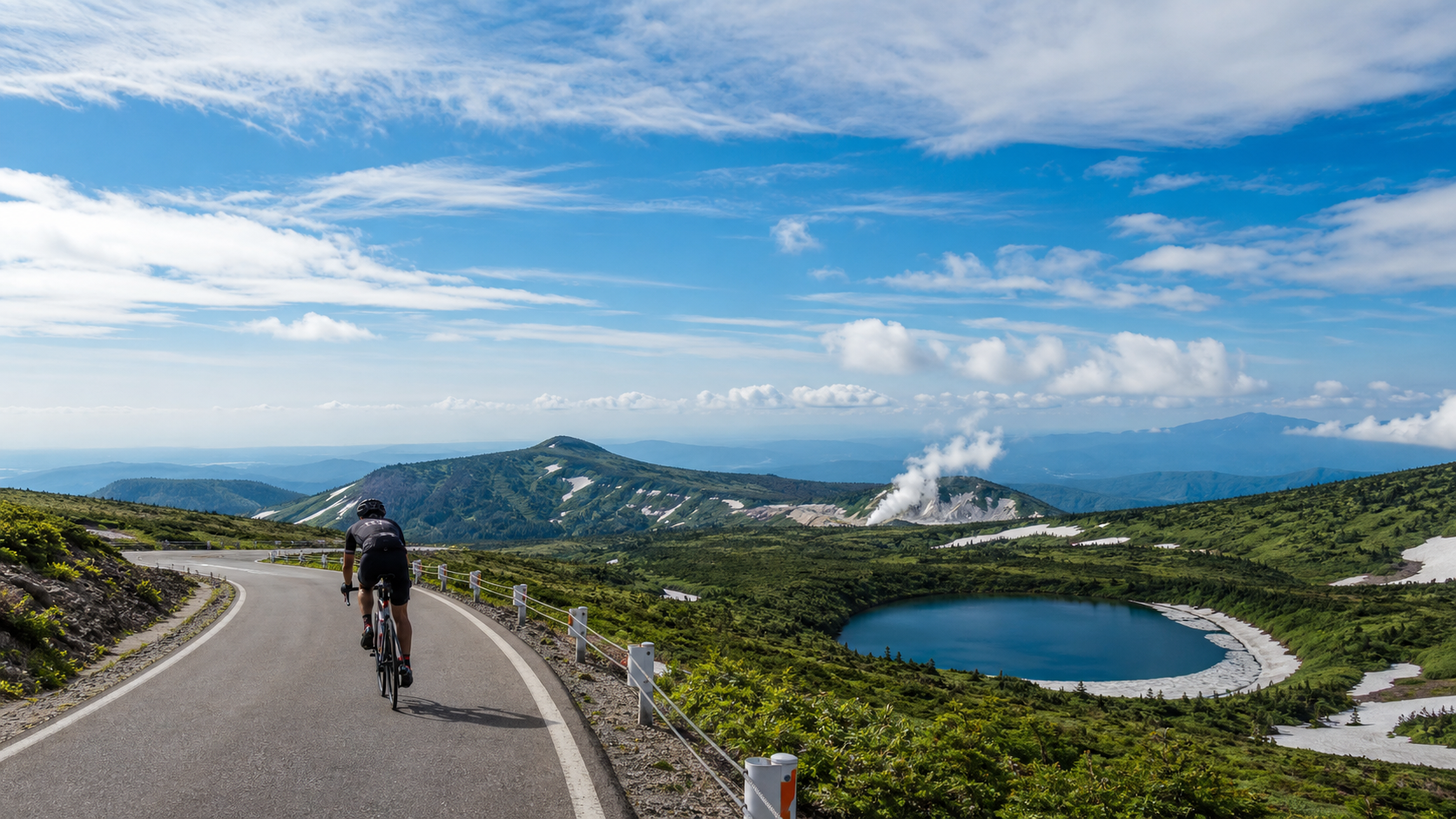
Some routes, once you’ve ridden them, are remembered by numbers—how many minutes it took, how many meters you climbed, how many seconds you shaved off a personal record. But other routes, once you’ve ridden them, linger in your mind as images: a sky suddenly opening wide, a blue-green marsh reflecting the lingering snow, a wisp of white steam drifting up from deep within the forest. The Hachimantai Aspite Line is the latter.
In this piece, I won’t talk about pacing or gear ratios. I want to take you on a ride through this road with your heart—to read the volcanic epic of the land beneath your wheels, to see the scenery along the way that will make you stop and forget the clock, and to taste the local flavors this land has nurtured.
1. The Name of a Shield Volcano: One Road, a Geologic History
Let’s start with the name of this road. “Aspite” is actually the Japanese transliteration of a German geological term, meaning “shield volcano”—a volcanic landform with gentle slopes, spread across the land like an upturned shield.
This name captures the character of Hachimantai in a single word. It is not a steep, solitary stratovolcano like Mount Fuji, but a vast, gentle, open highland. When you ride this road, you are not conquering a “peak” but traversing a “platform of the sky.” This is also why climbing Hachimantai feels so unique: the gradient is so gentle it almost feels tender, yet the views are so vast they feel almost extravagant.
The shield volcano’s terrain creates Hachimantai’s most fascinating contradiction—it is a “mountain that doesn’t look like a mountain.” You think you’re climbing, but when you look up, the sky is right before you, and the land spreads out beneath your feet like a green sea.
This mountain road, spanning Iwate and Akita Prefectures at roughly 35 kilometers in length, was opened as early as 1970 and has now stood for over half a century. It lies like a ribbon gently draped across the back of a shield volcano, connecting two prefectures and stringing together the most magnificent stretch of scenery in the Tohoku highlands. For fifty years, it has carried the footsteps of countless travelers, cyclists, photographers, and hikers, and has witnessed the seasonal color theater that Tohoku’s four seasons perform in turn across the same mountain plain.
2. The Moment You Fly Into the Sky: The Levitation of the Earth-and-Sky Corridor
If I had to sum up the core experience of riding the Hachimantai Aspite Line in a single word, I would say: levitation.
The highest point of this road, Mikaeri Pass, sits at approximately 1,541 meters, while the summit of Hachimantai itself is around 1,613 meters—a difference of only about 100 meters. This means that when you ride the section near the summit, you are almost “walking along the mountaintop.” No higher terrain blocks your view in any direction. After the midpoint, the forest gradually recedes, replaced by low alpine vegetation and an endless expanse of sky.
That moment is hard to describe precisely in words. You feel as though the pedals beneath your feet are treading on clouds, with the land on both sides receding in layered waves toward the horizon—mountain ridges like ocean swells, cloud shadows like flowing water. The wind blows across the open ridgeline, carrying the crisp chill unique to the highlands. You no longer feel like you are “climbing a mountain,” but rather “flying”—an illusion of gliding between heaven and earth.
Local riders call this stretch the “Earth-and-Sky Corridor,” meaning “a passageway between the earth and the sky.” These five characters are the most precise description of this road I have ever heard. As you ride through it, on one side is the endlessly unfolding earth, on the other the sky within reach, and you are the traveler threading the needle between the two.
The name Mikaeri Pass itself is also quite intriguing—“Mikaeri” means “to look back.” Legend has it that travelers who crossed this pass in ancient times would always stop here, unable to resist turning back to gaze at the magnificent scenery they had traversed. Hundreds of years later, we arrive at the same place on bicycles, doing the very same thing: stopping at the pass, looking back at the road we climbed inch by inch, and gazing at the sky we conquered through sheer persistence.
3. The Hidden Gem at the Summit: The “Dragon’s Eye” of Kagami-numa and the Marsh Ponds
When you park your bike in the parking area near the summit of Hachimantai, don’t rush to turn around and ride back. The top of this shield volcano hides the most magical natural spectacle of the entire journey—scattered across the Hachimantai summit are numerous marshes and ponds of various sizes, and the most famous among them is Kagami-numa, known as the “Dragon’s Eye.”
The “Dragon’s Eye” is a lingering-snow phenomenon that appears only in a specific season. Every year, as the snow melts in late spring, the snow in the center of Kagami-numa melts in a peculiar ring-shaped pattern: the snow at the center of the pond melts first, revealing deep blue water, while a ring of snow remains around the outer edge, and a small island of unmelted snow even floats in the middle. Viewed from above, the deep blue water, the encircling white snow, and the central snow island form the eye of a giant dragon, seemingly opening to gaze at the sky.
This spectacle is a rare and fleeting sight. Its timing varies each year depending on the progress of the snowmelt, and it is usually only perfectly visible for a brief window in late spring. Whether you get to see the “Dragon’s Eye” open depends partly on luck, and precisely because of that, it has become a seasonal dreamscape that countless travelers eagerly await and make special trips to witness.
Even if you miss the perfect moment of the “Dragon’s Eye,” the summit marshland itself is breathtakingly beautiful. Wooden boardwalks wind through the lush wetlands, alpine plants bloom with determination during the brief summer, and the ponds, reflecting the blue sky and white clouds, lie scattered across the land like mirrors. Lean your bike against a post, switch to the rhythm of walking, and take a short stroll along the boardwalk to immerse yourself fully in this highland sanctuary—this is a ritual of riding Hachimantai that should not be missed.
4. Forest Sea and Hot Springs: Where the White Steam Rises
The allure of Hachimantai lies not only in the openness of the summit, but also in the deep seclusion of the mountainside. The mid-to-low elevations of this shield volcano are covered in a dense forest sea—in summer, an interweaving of deep and light greens; in autumn, a blazing patchwork of reds and yellows. As you ride through it, sunlight filters through the branches and leaves into scattered specks of light, and the air carries the fresh scent of soil, resin, and vegetation.
And within this forest sea, what draws the most longing are the hidden hot springs that well up from beneath the earth, their white steam rising year-round.
The Hachimantai area is a renowned hot-spring district, and the most celebrated among them include Tōshichi Onsen, located at higher elevation, and Matsukawa Onsen, nestled on the mountainside. Tōshichi Onsen is famous for its rustic open-air bath at high altitude, where soaking in the pool makes you feel as though you’ve merged with the entire mountain plain; Matsukawa Onsen is known for its time-honored hidden-spring atmosphere and its distinctive milky-white water quality. When you’ve ridden a full day of climbs, with aching muscles and a weary body, if you can slip into such a pool fed by the volcanic depths, letting the heat steam away your soreness and the white vapor carry off the day’s fatigue—that satisfaction is something no sports drink can provide.
Volcano, forest sea, and hot springs are, in fact, three faces of the same thing. It is the shield volcano beneath your feet, still breathing, that turns geothermal heat into white steam, and white steam into a traveler’s healing. Riding Hachimantai, you ride not just a road, but a living volcano.
This is what makes riding in Tohoku so moving: challenge and healing are always so close together. You spend a whole morning battling the gradient, and a whole afternoon restoring yourself in a hot spring. Hardness and softness, sweat and hot water, conquest and surrender—all woven together completely within a single day.
5. A Theater of Four Seasons: One Road, Four Souls
The Hachimantai Aspite Line is a road that completely transforms with the seasons. The same stretch of asphalt, ridden in different months, offers you entirely different experiences for the soul.
Late Spring (early season opening): This road is closed in winter due to snow and reopens in late spring. In the early days after opening, towering snow walls often still loom on both sides of the road—white ramparts left behind after machinery carves a passage through the deep snow. Riding between snow walls, with snow barriers taller than a person on both sides and a clear blue spring sky overhead, the stark visual contrast is a stunning spectacle exclusive to spring. This is also the season when the “Dragon’s Eye” at the summit is most likely to open.
Midsummer (July–August): The season of the deepest greenery and the most stable weather. The forest sea is lush, the marshlands teem with life, and alpine flowers are in full bloom. This is the best time for a leisurely ride, fully savoring the levitation and the open views—and an excellent choice for escaping Taiwan’s scorching summer to enjoy a cool cycling getaway in the northern Tohoku highlands.
Early Autumn (roughly late September to early October): Hachimantai transforms into one of Tohoku’s premier autumn foliage destinations. The entire forest sea is dyed into a brocade of reds, oranges, and golds, and viewed from the summit, it looks like a burning sea of color. This is the annual highlight for photographers and riders alike, but temperatures drop sharply as well, so be sure to dress warmly.
As the seasons turn, this road dons one garment after another. Some come for the snow walls, some for the autumn leaves, and some simply for that pure green and blue of midsummer. No matter the season, Hachimantai will not disappoint—it will only make you think that you must return once more next season.
6. The Taste at the Foot of the Mountain: A Bowl of Morioka Reimen and the Flavors of Iwate
Memories of a ride are often sealed not only on the road, but also at the dinner table. Iwate Prefecture, home to Hachimantai, and especially the nearby Morioka area, is a treasure trove of Tohoku regional cuisine. After finishing this route, don’t forget to cap off your journey with a warm, satisfying local meal.
The one thing you absolutely cannot miss is Morioka Reimen (cold noodles). It’s one of Morioka’s “three great noodles,” characterized by its springy, chewy noodles and a clear, savory beef bone broth, typically garnished with cucumber, a boiled egg, and a slice of watermelon or fruit as the finishing touch. The interplay of sweet, sour, spicy, and salty is a symphony of flavors. For a body that has just finished a long climb and sweated profusely, that icy, spicy, and tangy broth with chewy noodles is nothing short of heavenly reward—the salt replenishes lost sodium, the cold soothes the heat, and the spice awakens tired taste buds.
Beyond reimen, Iwate’s regional table offers many other flavors worth exploring: the fun, never-ending refill culture of Wanko Soba (わんこそば), local set meals featuring regional ingredients, Tohoku sake, and local delicacies… Each one is a unique product of this land and climate. Sit down, enjoy a good meal, and listen to the shopkeeper greet you in Japanese with a Tohoku accent. That warmth of human connection will become one of the softest memories of your entire trip.
7. Suggested Side Trips: Turning One Road into a Journey
If you’ve traveled all the way from Taiwan to northern Tohoku just to ride this one road, that would be a shame. Hachimantai’s location actually makes it an excellent base for exploring Iwate and the entire Tohoku region. I suggest you weave this road into a more complete journey:
- Base yourself in Morioka: Morioka City is the capital of Iwate Prefecture, with convenient transportation and a wealth of accommodation and dining options. It’s the ideal gateway to Hachimantai. From Morioka, you can plan a day to ride Hachimantai, and spend the rest of your time strolling through the city’s historic streets and famous reimen shops.
- Stay overnight at an onsen: Instead of a day trip, consider staying a night at an onsen ryokan at the foot or halfway up Hachimantai. After the climb, a soak in the hot spring, a local meal, and a good night’s sleep will leave you fully recharged before you depart the next day.
- Extend to the Akita side: This road traverses Iwate and Akita prefectures. If you have the energy, explore the scenery on the Akita side to experience the different regional character of the same shield volcano across prefectural borders.
- Visit Iwate’s iconic sights: Iwate Prefecture is also home to Mt. Iwate, the “Southern Fuji” (another classic cycling and hiking destination), as well as the hometown landscapes immortalized by many literary figures. It’s worth staying a few extra days to savor them slowly.
8. The Spirit of a Race: The Hachimantai Hill Climb
The meaning of cycling lies not only in facing yourself alone, but also in joining a community of like-minded enthusiasts for a shared appointment. Since 2018, on this highland of Hachimantai, the city has hosted a cycling hill climb event called the “Hachimantai Hill Climb,” attracting several hundred riders each year to gather and challenge this volcanic sky corridor together.
I’ve always felt that hill climb events are the purest and most moving form of cycling. There’s no tactical maneuvering among groups, no dangerous jostling for sprint points. It’s just you, your bike, a climb, and the most honest conversation with gravity. In a hill climb, your biggest opponent is always yourself—the self that wants to give up, the self that loses pace control, the self that wants to dismount and walk during the wall.
Picture this: in the early morning at the foot of Hachimantai, hundreds of riders from across Japan and even overseas gather at the start line, the air thick with a mix of excitement and tension. The starting signal sounds, and the crowd surges up the mountain road like a stream, each finding their own rhythm. Some chase the podium, some just want to finish, and some are there specifically to create a shared memory on this beautiful road. And as you each fight your way up to Mikaeri Pass and look back at the road you’ve conquered, that collective feeling of “having accomplished something remarkable together” is something solo training can never replicate.
For Taiwanese riders, if your itinerary happens to align with such a local event (the actual date varies each year, so be sure to check the latest official announcements and don’t set it in stone), it will be a rare cultural experience—you’re not just riding this road; you’re writing a shared story with the people of this land, on the same morning, on the same climb. You’ll feel the delicate human touch of Japanese local races: the encouragement of volunteers along the way, the warmth of aid stations, and the greetings and hospitality of local residents after you finish. That warmth will transform this road in your heart from mere “asphalt” into a “memory.”
9. A Dialogue with the Land: Cycling as a Form of Meditation
Some roads are meant for racing; some are meant for quiet contemplation. The Hachimantai Aspite Line belongs to the latter.
When I ride this road, especially in the sections after the midpoint where the forest recedes and the view opens up, I often experience a strange sensation—as if the whole world has fallen silent, leaving only the rhythm of my breath, the turning of the pedals, and the sound of wind passing my ears. The road’s gentle gradient gives you the luxury of lifting your head and engaging in a dialogue with the land. You don’t have to stare at your bike computer, gasping for air. You can truly “see”—see how the land recedes layer by layer beneath your wheels, see how cloud shadows drift across distant mountains, see how the sky feels close enough to touch.
This is what I consider the most precious takeaway from riding overseas: it pulls you away from the busyness and anxiety of daily life, allowing you to rediscover your inner order through pure, isolated pedaling. On Hachimantai’s sky corridor, there are no work messages, no city noise, no others’ expectations—just you, your bike, and this magnificent landscape. Each pedal stroke is like a deep breath; each ascent, a form of mental settling.
When you reach Mikaeri Pass, stop your bike, and stand on that open ridgeline, letting the mountain breeze cool your sweat-soaked body—in that moment, you’ll suddenly feel that the things that made you anxious, worried, and unable to let go seem less important. You’re just standing small on top of a shield volcano, between earth and sky, feeling a long-lost, pure sense of calm. Perhaps this is the deepest meaning of “flying into the sky”—it lets you fly away not just from the ground, but also from the heavy, mundane, hard-to-let-go parts of yourself.
10. Gentle Reminders for First-Timers
If you’re planning your first ride up Hachimantai, beyond equipment and fitness preparation, I’d like to offer some gentle reminders that lean more toward “mindset”:
- Don’t just rush through: The most precious thing about this road isn’t how fast you ride, but how much you see. Be willing to stop your bike in front of beautiful scenery, take out your camera, or simply stand and gaze for a while—those paused moments are often the most vivid images in your memories later.
- Respect the land: This is an ecologically precious volcanic highland and wetland. Every plant and creature along the way deserves to be treated with care. Leaving no trash, not disturbing wildlife, and following trail and traffic rules are the most basic courtesies for every visitor.
- Accept the unpredictability of weather: Mountain weather in Tohoku changes in an instant. Fog rolling in, rain falling, wind picking up—these are all part of this land. Instead of complaining, accept and adapt to it. Sometimes, a sudden mountain mist can gift you a dreamlike, unforgettable riding memory.
- Treat it as a journey, not just a workout: Cycling is only part of the trip. The wetlands at the summit, the onsen on the mountainside, the reimen at the foot, the warmth of the locals—include all of these, and what you gain will be a complete, heartfelt journey, not just a route to check off a list.
Go slower, see more, feel deeper. Hachimantai isn’t a road for proving “how fast I am”; it’s a road for relearning “how to truly feel.”
Epilogue: Why Hachimantai?
Back to the original question—why travel all this way to ride a road that has almost no reputation in Taiwan?
Because the Hachimantai Aspite Line gives you a complete experience. With its gentle yet sustained gradient, it gives you the luxury to lift your head and take in the scenery, rather than staring at your bike computer gasping for breath; it gives you that floating sensation of “flying into the sky,” letting you feel a freedom close to flight with every pedal stroke; it uses the Dragon’s Eye at the summit, the hot springs and sea of trees on the mountainside, and the local cold noodles at the base to perfectly stitch together “challenge” and “healing,” “grandeur” and “warmth” into a single journey.
On this sky corridor of a shield volcano, what you conquer isn’t really the gradient—it’s rediscovering the version of yourself willing to push hard on the pedals for a view, for a feeling, for a pure and simple ride.
When you climb to Mikaeri Pass, stop your bike, and look back at the road you’ve traveled and the sky you’ve conquered—you’ll understand that some scenery is worth an entire long-haul flight, worth a full day’s sweat.
Hachimantai is exactly that kind of road. It’s not on your must-ride list, but once you’ve ridden it, it will take up residence in your heart, calling you back year after year.
11. On “Tohoku”: An Underrated Cycling Paradise
At this point, I’d like to say a few words on behalf of the Tohoku region.
When Taiwanese cycling enthusiasts plan a cycling trip to Japan, what comes to mind is often Mount Fuji, Lake Biwa, the Shimanami Kaido in Shikoku, or the grandeur of Hokkaido. In comparison, “Tohoku” at the northern tip of Honshu—the six prefectures of Aomori, Iwate, Akita, Yamagata, Miyagi, and Fukushima—is often hurriedly skipped over by travelers, becoming a vague blur on the map.
But that, precisely, is what makes Tohoku so captivating. It is an “underrated cycling paradise.”
Tohoku is vast and sparsely populated. What does that mean? It means open roads, sparse traffic, pristine nature, and a tranquility that has become rare in metropolitan areas. When you ride the sky corridor of Hachimantai, you’ll feel this “luxury of emptiness” intensely—no congested traffic, no noisy crowds, just you, your bike, and this seemingly endless expanse of land and sky. This purity is something you can never experience cycling in densely populated regions.
Tohoku also preserves Japan’s most原始 and profound natural and cultural heritage. Here you’ll find the famous Shirakami-Sanchi primeval beech forest, the dramatic Sanriku Coast, countless secret hot springs hidden deep in the mountains, warm and hospitable local hospitality, and a slower pace of life completely different from the cities. For a rider who truly seeks “deep travel” rather than “check-in tourism,” Tohoku offers a journey closer to the essence of the land, one that touches the soul more deeply.
Hachimantai is one of the most brilliant gems in this Tohoku cycling paradise. When you travel thousands of kilometers for it, what you gain is not just a road, but a key to the entire world of Tohoku. Perhaps this trip, you only rode Hachimantai; but after riding it, you’ll find yourself searching: next time, shouldn’t I challenge some mountain in Aomori? Shouldn’t I explore some coastline in Akita? Tohoku is exactly the kind of land that makes you “more and more addicted to riding.”
12. For Those Planning to Go: A Complete Vision of the Journey
Finally, let me help you sketch out the complete vision of this “Hachimantai journey.”
Imagine waking up in a lodging in Morioka on an early morning in late summer or early autumn. Outside the window is Tohoku’s characteristic crisp air, and that familiar mountain silhouette in the distance is waiting for you. After a hearty breakfast, you wheel out your beloved bike and head toward Hachimantai along roads bathed in morning light.
As elevation gradually rises, the city’s atmosphere is left behind, replaced by ever-deepening greenery and ever-fresher air. You enter the domain of that shield volcano. The early section’s slope welcomes you gently; you pedal at an unhurried pace, letting your body warm up and settle into a rhythm.
After the middle section, the trees recede and the sky opens up suddenly. That moment of “flying into the sky” makes you stop your bike, greedily taking in the layers of land receding into the distance before you. You pull out your phone, only to find that no lens can capture this vastness—some scenery is destined to be seen only with the eyes and remembered with the heart.
You continue climbing, all the way to the summit. You lock your bike, walk out onto the boardwalk of the wetlands, and see the marshes reflecting the blue sky and white clouds like scattered mirrors. If you’re lucky, you might even catch a glimpse of the “Dragon’s Eye” opening at some moment in late spring—that volcanic wonder where deep blue and pure white intertwine.
After descending, your body is sore but profoundly satisfied. You turn into a hot spring inn on the mountainside and sink into a pool fed by water welling up from beneath the volcano. Steam rises, wisps of white smoke curl upward, and a whole day’s fatigue melts away drop by drop with your sweat and the bath’s warmth. After your soak, you sit down and enjoy a bowl of ice-cold, tangy Morioka reimen—the taste, in your exhausted body, is sheer heaven.
At night, you lie on the tatami of the inn, listening to the mountain wind outside the window, savoring the day—that sky, that Dragon’s Eye, that wisp of steam, that bowl of cold noodles. You suddenly feel that this long journey was worth every kilometer.
This is the day Hachimantai can give you. It’s not just a road, but a complete journey—with sweat and healing, with challenge and gentleness. May you too have such a day, on the rooftop of Tohoku, flying into your own sky.
Related Reading
- Complete Guide to the Hachimantai Aspite Line Iwate Side: Climbing Data Analysis of the 19km, 1,083m Elevation Gain Volcanic Sky Corridor
- Riding into the Realm of Myth and Volcanoes: A Riding Chronicle of Ebino Kogen, a Highland Pilgrimage Through the Kirishima Mountain Range
- Riding the Borderline Between Heaven and Earth: The Scenic Vistas, Wind Turbines, and Serene Moments of the Shikoku Karst Sky Road
- Pilgrimage Beneath the Towering Wall: Mount Fuji Azami Line, Subashiri Trailhead, and a Test of Will on a Brutal Steep Climb
嘉義大埔、阿婆灣挑戰賽,美到以為在日本!ft. 環騎5 Cool 西拉雅188 / 公路車 / CT Yeh
7 個月前
台北闊瀨陡坡 騎旅 / 日本單車雜誌編輯車友臨時加入!/ 髮香才是最強的 / feat. 北迴歸線小隊 / 公路車 CT Yeh
6 個月前
秘境雪場 日本 八甲田 冰樹探險與滑雪體驗 ft. Q老師 & 運動生活
7 年前
公路車 | 塔塔加驚險員工旅遊 | 還好手腳快沒被抓交替!
5 年前
新竹羅平 x 天湖部落 大禹嶺級變態陡坡! 4K超高畫質 空拍 | 公路車
5 年前
水金九不厭五分 10度寒流冷到不願停!feat. 卡卡 / 公路車 / CT Yeh
6 個月前
虎豹潭!日本老師來台一日約騎 台灣車友熱情招待私房路線 / CT Yeh
20 天前
阿里山塔塔加 兩倍特濃版!全新隧道開通! 進喔!公路車 | CT Yeh
3 年前