West Fuji, East Tsukuba: Riding Toward the Twin-Peaked Sacred Mountain of a Thousand-Year Faith on the Kanto Plain
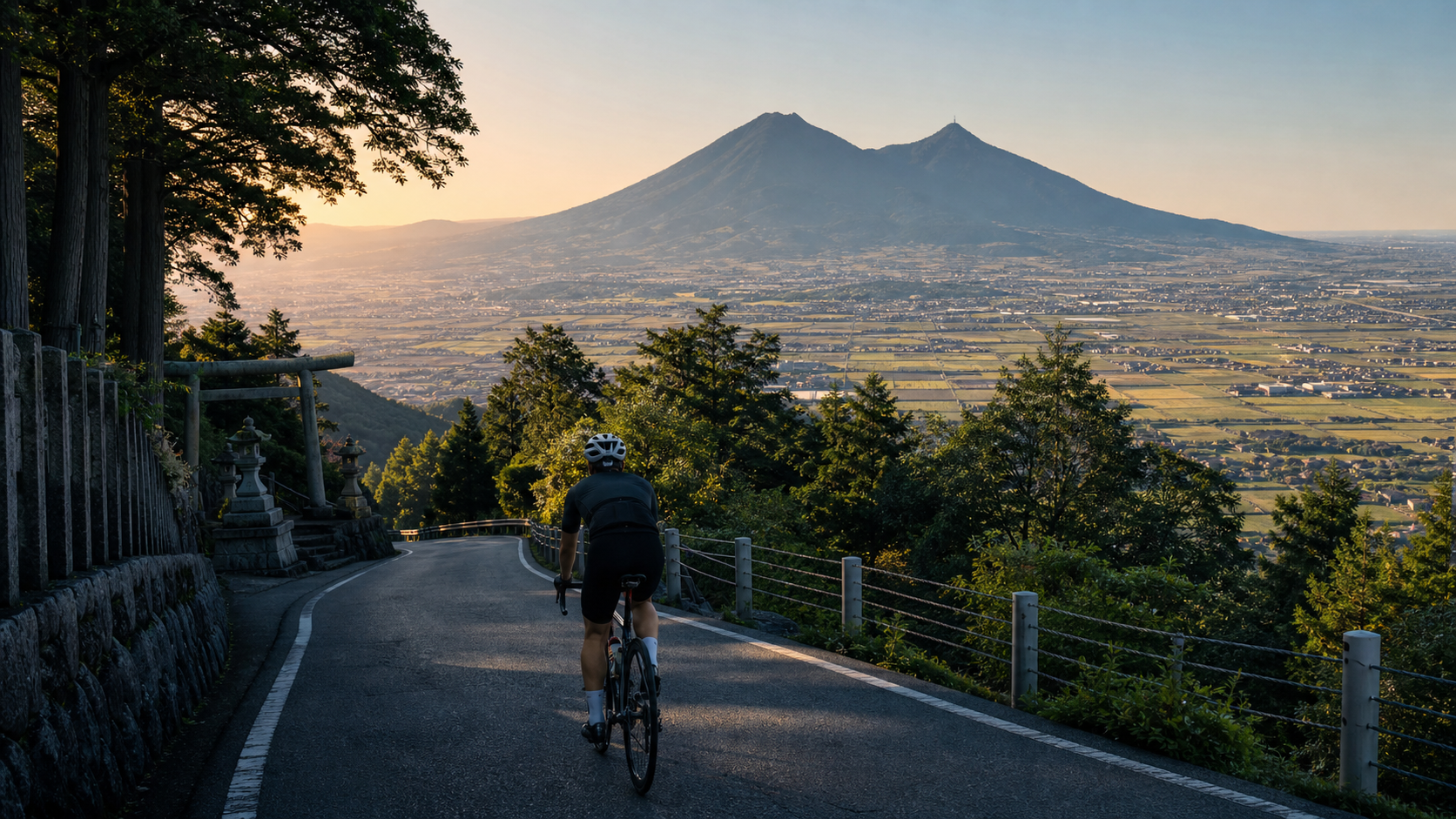
The Kanto Plain is a vast expanse of land so flat it borders on monotony. Riding north from Tokyo, you’ll pass through endless fields, orderly towns, and straight roads—then, after a certain turn, an elegantly shaped twin-peaked mountain suddenly rises from the edge of the plain, like an exclamation mark the earth has reserved just for you. That is Mount Tsukuba.
The first time I rode toward it was on a slightly cool morning. On the map, the climb up the front approach of Omotesando on the Tsukuba side is approximately 6.0 kilometers long, with an elevation gain of about 399 meters and an average gradient of 6.3%. The numbers aren’t intimidating, but as those twin peaks grew closer and larger in the morning light, I knew in my heart: what I was about to challenge wasn’t just a climb, but a mountain revered by the Japanese people for over a thousand years.
“West Fuji, East Tsukuba”: The Twin-Peaked Mountain of the Plain
When the Japanese describe the famous mountains of the Kanto region, there’s a long-standing saying: “West Fuji, East Tsukuba.” To the west stands Mount Fuji, the solitary peak known to everyone; to the east rises Mount Tsukuba, soaring from the Kanto Plain. To be mentioned alongside Fuji tells you just how much this mountain means to the people of Kanto.
What makes Mount Tsukuba most distinctive is its “twin-peak” formation. It isn’t a single summit, but two adjacent peaks—Mount Nantai at 871 meters and Mount Nyotai at 877 meters. One male, one female, one left, one right—the two peaks have been seen since ancient times as a symbol of yin and yang in harmony. It is precisely because of this unique form, combined with its solitary rise from the plain, that Mount Tsukuba—despite being under a thousand meters—has been listed among the “100 Famous Japanese Mountains.” This is a rare honor, as only a handful of mountains under a thousand meters have been selected.
The greatness of a mountain is never determined by its height alone. Mount Tsukuba’s solitary rise from the vast plain allowed it to enter people’s faith and poetry earlier and more deeply than many taller mountains.
A Mountain of Faith: Tsukubasan Shrine and the Poetry of the Manyoshu
Mount Tsukuba has been a “mountain of faith” since ancient times. Nestled within it is the historic Tsukubasan Shrine, which enshrines Izanagi-no-Mikoto and Izanami-no-Mikoto from Japanese mythology—this divine couple perfectly mirrors the imagery of the twin peaks. To the ancients, this twin-peaked mountain was itself a sacred presence.
Even more romantic is the fact that Mount Tsukuba is a celebrated landmark in the Manyoshu, Japan’s oldest anthology of poetry. The name “Tsukubane” appears in many ancient poems, sung repeatedly by poets. Imagine: over a thousand years ago, someone stood on the Kanto Plain, looked up at these twin peaks, and wrote their feelings into verse. And today, I’m on a bicycle, breathing hard, climbing the same mountain’s approach road—in a sense, I’ve joined this thousand-year-long procession of “gazing up at Tsukuba.”
When I occasionally looked up during the pain of the climb and saw light filtering through the gaps in the trees, I felt something subtle: this mountain has carried far more time than the soreness in my legs. It made every pedal stroke feel like it carried a little more weight.
A Training Mecca: The Second Home of Kanto Cyclists
If Mount Tsukuba was a matter of faith for the ancients, for modern Kanto cyclists, it’s a “second home.”
This area is the公认 training mecca for cyclists in the capital region. The reasons are simple yet compelling: it’s close enough to Tokyo, the gradients are good enough, and there are enough routes. Beyond the front approach, the surrounding area also offers Fudō-tōge (approximately 3.8 kilometers, average 7%, a shorter and steeper classic entrance) and Kazahaya-tōge (approximately 7.8 kilometers on the front side, average 6.3%, a longer challenge). One mountain, several ways to climb—enough to keep a cyclist training for years without getting bored.
During my climb, I encountered many local riders doing the same. Some were locals who’d come early in the morning for their third interval repeat; others, like me, were visitors drawn by reputation. We’d nod to each other on the slope, exchange brief pleasantries at the pass. That unspoken understanding of “gathering because of the same mountain” is a warmth unique to a training mecca. For Kanto cyclists, Mount Tsukuba is more than just a route—it’s a community, a way of life.
Local Specialties: Tsukuba Udon and Fukure Mikan Shichimi
After a climb, your stomach is always empty, and at the foot of Mount Tsukuba, there happen to be a few specialties worth going out of your way for.
The first is Tsukuba udon (つくばうどん)—the local udon noodles of this area, a great choice for replenishing energy after summiting. A steaming hot bowl goes down, and it feels like even your aching legs are soothed.
The second is even more interesting: a local small mandarin called fukure mikan (ふくれみかん), made into a unique shichimi togarashi (seven-spice blend). This shichimi, carrying the fragrance of mandarin, is a signature souvenir of Mount Tsukuba. Sprinkled on udon or taken home to use slowly, it’s a memory full of local flavor. The name “fukure” sounds auspicious—for a rider who’s just completed a climb, this blessing of “fortune arriving” is received with particular joy.
Every mountain worth riding has its own signature taste. Mount Tsukuba’s taste is a bowl of hot udon, topped with a pinch of mandarin-scented shichimi—simple, yet it makes you want to come back the next year.
Cable Car and Ropeway: Another Way to Reach the Summit
Mount Tsukuba also has a thoughtful feature: it’s equipped with the Tsukubasan Cable Car and Ropeway. This means if you’re traveling with family or friends who don’t ride, they can take the cable car up with ease and meet you at the summit after your hard climb, where together you can gaze out over the vast Kanto Plain.
This flexibility of “some ride, some take the cable car” makes Mount Tsukuba not just a hardcore training ground, but a famous mountain suitable for a family outing. Standing at the summit, looking back at the approach road you pedaled up, and watching the cable car rise slowly—you suddenly realize there are many ways to reach a summit, and the one you earn step by step with your own legs feels especially solid, especially sweet.
What This Mountain Taught Me
After finishing the front approach climb, sitting at the foot of the mountain eating udon, I kept thinking: why does this mountain—just over 800 meters, with a gradient of only 6.3%—bring so many people back again and again?
Then it hit me. The charm of Mount Tsukuba lies not in how hard it is, but in how “just right” it is. It’s just close enough that you can come often; just challenging enough that you gain something every time; just beautiful and storied enough that, amid the sweat, you can still be moved by a mountain’s thousand-year faith and poetry. It’s the first mountain you’d want to introduce to a beginner friend, and also a mountain you yourself will never tire of.
When that elegant pair of twin peaks rises at the edge of the plain, it seems to say to every passing rider: come on, there’s a just-right climb here, a just-right view, and a just-right bowl of hot udon waiting for you at the foot of the mountain.
Suggested Side Trips: Turning a Training Ride into a Mini Getaway
If you want to come to Mount Tsukuba, don’t treat it as just a cold, mechanical training session. Here’s my personal list of side-trip recommendations:
- Take advantage of convenient access: It’s close to Tokyo—a distance Kanto cyclists can cover “over a weekend”—perfect for a relaxed one-day or half-day trip.
- Climb both sides: Besides the front approach, if you have energy to spare, also experience Fudō-tōge and Kazahaya-tōge to feel the different personalities of the same mountain.
- Visit Tsukubasan Shrine: Beyond summiting, don’t forget this is a mountain of faith. Take a walk through Tsukubasan Shrine and feel the tranquility that has endured for a thousand years.
- Must-try local specialties: After descending, find a bowl of Tsukuba udon. If you see shichimi made from fukure mikan as a souvenir, bring a jar home so your taste buds can keep the memory of this journey.
- Bring family on the cable car: If someone in your group doesn’t ride, arrange for them to take the cable car or ropeway up to meet you, and enjoy the view of the Kanto Plain together from the summit—it makes a wonderful shared memory.
The best routes are the ones that, after you conquer them, you keep thinking about and want to bring friends back to. Mount Tsukuba is exactly that kind of mountain—it asks you “do you dare?” with a just-right climb, then makes you never want to come just once with a thousand years of faith, poetry, and a bowl of hot udon.
May you too, on some slightly cool morning, ride toward that twin-peaked mountain rising from the plain, measure this famous Kanto mountain with your legs, and then, at its foot, raise a steaming bowl of udon and say to yourself: “This ride was worth it.”
The Morning of Departure: A Quiet Appointment Between One Person and a Mountain
That morning, the sky wasn’t fully light yet, and a thin layer of mist hung over the Kanto Plain. I took my bike out of the bag, assembled it, and did the final checks—tire pressure, brakes, gear ratios, confirming each one. This was a quiet appointment between me and myself, and between me and that mountain.
After riding out of the city, the road gradually straightened, flanked by the endless fields characteristic of the Kanto Plain. I warmed up as I pedaled, letting my body slowly wake from the stiffness of the early morning. And at the end of the road, the outline of those twin peaks was slowly becoming clearer in the morning mist. Mount Nantai and Mount Nyotai, one left, one right, like two guardians standing shoulder to shoulder, quietly watching me draw closer.
Some say the most beautiful moment in cycling isn’t arrival, but the process of “drawing near.” That morning, I deeply understood that. When a mountain you’ve long yearned for slowly rises from the edge of the plain in the morning light, growing larger and more real with each turn of the wheel, that feeling of anticipation intertwined with awe is something no ride in a car can ever give you.
One person, one bike, one mountain. On that misty morning, the world was reduced to just these three things. And it was precisely this simplicity that made cycling feel almost like a form of meditation.
The Shifting Mindset Through Each Section of the Climb
When I actually started pedaling up those 6 kilometers of the front approach, my mindset shifted section by section, like a condensed version of life.
The first section was a tug-of-war between excitement and restraint. My legs were still fresh, my fighting spirit high, and I wanted to charge up alongside the local riders around me. But reason told me: hold back. I steadied my breathing, found my rhythm, and reminded myself that “today’s opponent is this mountain, not the people around me.”
The middle section was a practice in coexisting with pain. The gradient steadily devoured my energy, the burning sensation climbing from my thighs upward. This section tested not my legs but my mind—you have to learn not to resist the pain, but to accept it, to coexist with it, to narrow your focus to the two simplest things: breathing and cadence.
The final section was a time for self-dialogue. When fatigue accumulates to a certain point, that familiar voice pops into your head: “Want to take a break?” And the most precious reward of climbing is learning how to answer that voice—breaking down the distant, overwhelming goal of “summiting” into small tasks of “just finish the next 100 meters,” tricking yourself section by section, and surpassing yourself section by section.
The moment of summiting is a strange calm. There’s no imagined euphoria or shouting, only heavy breathing, a pounding heart, and a quiet, “ah, I did it” satisfaction. At that moment, the Kanto Plain spread out vast beneath my feet, and I knew I had brought myself here with my own legs.
The View of the Kanto Plain: Seeing the World from the Twin Peaks
Looking back from the summit of Mount Tsukuba is one of the most breathtaking scenes of this journey.
What makes Mount Tsukuba special is precisely that it’s a rare standalone peak on the Kanto Plain. With no other tall mountains blocking the view, when you climb up and look back from the heights, the entire vast Kanto Plain unfolds beneath you without reservation—fields, towns, rivers, the hazy horizon in the distance, all in full view. On clear days, the visibility extends very, very far. That sense of openness, of “seeing the whole plain from one mountain,” is something inland climbs surrounded by mountain ranges can never offer.
I leaned against the railing, letting the wind dry my sweat, quietly gazing at this land. Over a thousand years ago, the poets of the Manyoshu also climbed this “Tsukubane,” gazing at the same vast plain, writing their feelings into verses that would be sung for ages. At this moment, though I couldn’t compose poetry, I genuinely felt that thrill—spanning a thousand years, facing the same landscape. This mountain connects the ancients and the present, poetry and sweat, through the same view.
The Weight of Faith: A Mountain Revered for a Thousand Years
The more I learned about Mount Tsukuba, the more I felt it wasn’t just a “training mountain,” but a sacred mountain carrying the weight of profound faith.
The Tsukubasan Shrine within the mountain enshrines Izanagi-no-Mikoto and Izanami-no-Mikoto from Japanese mythology—the divine couple who created heaven and earth, perfectly mirroring the imagery of the twin peaks. To the ancients, this twin-peaked mountain, rising from the earth in yin-yang harmony, was itself a symbol of the sacred and of life’s vitality. Its inclusion in the “100 Famous Japanese Mountains”—as one of the few under a thousand meters—owes nothing to altitude alone, but to this deep-rooted faith and aesthetic that has endured for a thousand years.
When I walked into the shrine after summiting and felt the solemnity surrounded by ancient trees and stillness, the soreness from the day’s climb suddenly took on a deeper meaning. I hadn’t just climbed a mountain; I had stepped into a stream of faith that has flowed unbroken for a millennium. This fusion of “sport” and “culture” is the core reason Mount Tsukuba lingers in my memory. It gives the act of climbing an added weight of history and humanity.
A Memory of Taste: Fukure Mikan Shichimi and a Bowl of Hot Udon
If the summit view was the visual climax, the taste memory after descending was the warmest conclusion to this journey.
I found a shop at the foot of the mountain and ordered a steaming bowl of Tsukuba udon. The noodles slid into my stomach, emptied by the climb, and the warmth of the broth reached all the way to my heart—a satisfaction that can only be earned by giving everything you have. What impressed me most, though, was the jar of shichimi on the table, made from the local specialty fukure mikan. A sprinkle of it, and the noodles instantly gained a fresh mandarin fragrance—a unique flavor I’d never tasted anywhere else.
The name “fukure” sounds auspicious. For a rider who had just completed a climb and was rewarding himself, this blessing of “fortune arriving” tasted especially sweet. I later brought a jar home. Every time I sprinkle a little on my own dining table, that mandarin fragrance carries me back to that slightly cool morning at Mount Tsukuba, that gritted-teeth climb, that vast view. Taste is memory’s most faithful key, and fukure mikan shichimi is the key Mount Tsukuba handed me.
A truly good cycling journey feeds your legs, your eyes, and your stomach all at once. Mount Tsukuba accomplished this—it trained my legs with a just-right climb, awed my eyes with a thousand years of faith and a vast view, and finally, with a bowl of hot udon and a pinch of mandarin shichimi, gently set me back down into the human world.
The Faces of the Seasons: What Kind of Tsukuba You’ll Meet, Depending on When You Come
Mount Tsukuba wears different expressions throughout the year. Each season brings a different encounter.
- Spring: Fresh greenery sprouts, the climate is pleasant—the most comfortable riding season, and the busiest and most lively with cyclists. The mountain roads are full of vitality, ideal for first-time visitors.
- Summer: The plain is hot and humid, but it’s relatively cool at higher elevations, making it a good choice for a summer escape ride. Be mindful of possible afternoon thunderstorms and slippery descents.
- Autumn: The season of autumn leaves, when the entire mountain is painted in layers of color—a paradise for photographers. But temperatures drop quickly, so don’t skimp on warm layers for the descent after summiting.
- Winter: The air is crisp, and on clear days the views extend high and far; but the mountain area can be cold and icy, so assess conditions carefully.
I’m glad I chose to come in a slightly cool season—neither hot nor cold, with clear visibility, allowing me to firmly store the mountain’s most comfortable face in my memory.
This Mountain Will Always Be There Waiting for You
On the way back, I turned around again and again, watching the twin peaks gradually shrink and fade at the edge of the plain. A firm thought rose in my mind: I will come again.
Because Mount Tsukuba is exactly that kind of mountain—it doesn’t intimidate you with towering, frightening altitude, nor reject you with treacherous, difficult routes. It simply stands quietly on the Kanto Plain, with a just-right climb, a vast view, a thousand years of faith, and a warm bowl of udon, waiting for every person willing to ride toward it. It’s the first mountain you climb as a beginner, and also an old friend you’ll want to return to again and again after years of riding.
When that elegant pair of twin peaks rises once more at the edge of the plain, I seem to hear it say: take your time, I’m always here. And I know that as long as I can still ride, I will, again and again, on some slightly cool morning, ride back toward this twin-peaked mountain rising from the plain—a mountain I will never tire of.
The Human Warmth of a Training Mecca: Acquaintances Nodding on the Slope
Riding Mount Tsukuba, you rarely feel alone. Because on this premier training ground of the Kanto region, there are always fellow enthusiasts sharing the same climb with you.
That day on the slope, I met all kinds of riders. There were local experts with professional gear, already on their third interval repeat early in the morning, and visitors like me, drawn by reputation from elsewhere. When we passed each other on the slope, we’d often nod or exchange a hand gesture, and occasionally chat briefly while catching our breath at the pass. It’s a wonderful unspoken understanding—we might not fully share a language, might be complete strangers, but because we chose the same mountain and the same climb, we became comrades in that moment.
This human warmth of “gathering because of a mountain” is a warmth unique to a training mecca. For Kanto cyclists, Mount Tsukuba has long been more than a training route—it’s a community, a shared way of life. Week after week, year after year, countless riders sweat, improve, and grow older here, while new faces join. This mountain quietly witnesses generation after generation of stories between people and bicycles. I’m glad I got to briefly become a small page in that story.
The Cable Car and Family: One Mountain, Many Ways to Arrive
Mount Tsukuba has another particularly thoughtful feature that makes it belong not only to cyclists but to the whole family—it’s equipped with a cable car and ropeway.
This means that if you’re traveling with family or friends who don’t ride, they can easily take the cable car up and meet you at the summit after your hard climb. Picture this scene: you pedal up step by step with your own legs, drenched in sweat, legs burning; while your family rises gently on the cable car, smiling as they greet you at the top. Then you stand together on the observation deck, gazing out over the entire vast Kanto Plain—the same view, yet reached by completely different means.
This flexibility of “some ride, some take the cable car” makes Mount Tsukuba a rare mountain that can satisfy both hardcore riders and leisure families alike. There are many ways to reach a summit, and every one deserves respect. For me, the way of pedaling up with my own legs is certainly especially solid and sweet; but being able to reunite with family who came up by cable car, sharing the same view, brings a happiness that is a completely different flavor altogether.
Suggested Side Trips and Lodging: Turning a One-Day Ride into a Weekend Getaway
If Mount Tsukuba has moved you and you’d like to plan a more complete journey, here are my personal side-trip and lodging recommendations, upgrading a simple training ride into a flavorful weekend getaway.
- Take advantage of convenient access: Mount Tsukuba is close to Tokyo—a distance Kanto cyclists can cover “at a moment’s notice”—perfect for a one-day round trip, or a leisurely two-day stay.
- Nearby lodging: This area offers hot spring inns and various accommodation options. If you stay overnight, soaking in a hot spring and getting a good night’s sleep before heading up with fresh legs the next day is a very enjoyable rhythm.
- Climb both sides: Besides the front approach, if you have energy to spare, be sure to experience Fudō-tōge and Kazahaya-tōge to feel the different personalities and difficulties of the same mountain.
- Visit Tsukubasan Shrine: Beyond summiting, don’t forget to step into the heart of this mountain of faith—Tsukubasan Shrine—and feel the tranquility and solemnity that has endured for a thousand years.
- Must-try local specialties: After descending, find a steaming bowl of Tsukuba udon. If you see shichimi made from fukure mikan as a souvenir, bring a jar home so your taste buds can keep the memory of this journey.
- Nearby waterside excursions: The Tsukuba and Tsuchiura area is adjacent to vast bodies of water. If time permits, extending your itinerary to the surrounding areas will reveal another landscape where the Kanto Plain meets the water.
The best rides are never isolated exercise, but complete journeys that weave together mountains, water, food, lodging, and human warmth. Mount Tsukuba can offer all of this—it makes you sweat, and it makes you relax; it lets you face the climb alone, and lets you reunite with loved ones at the summit. This is why I recommend it to every cyclist.
Related Reading
- Riding a World Cultural Heritage Site: The Pilgrimage Road of Fuji Subaru Line and the Sea of Clouds for Those Who Strive
- Front Approach Tsukuba Guide: Pacing, Gear Ratios, and Training Guide for the 6km, 6.3% Average Gradient Training Mecca
- The Faith and Pastoral Scenes of Hakki Fuji: Daisen Circular Road, Kagikake-toge South Wall, and a Journey Through the Foothill Dairy Country
- Riding into a Land of Myth and Volcanoes: A Riding Account of Ebino Kogen, a Highland Pilgrimage Through the Kirishima Mountain Range
日本自助單車旅,茨城絕景路線/ 新手也可以體驗 / 4K空拍絕景 / 機票省錢大法 / 單車友善旅館 / 國家級霞之浦180K自行車道 / feat. 緯緯 / CT Yeh
1 年前
大武山後門26%歡樂陡坡!JJSC南台灣單車行Day2 / 被颱風追著跑 / 公路車 / CT Yeh
2 年前
嘉義大埔、阿婆灣挑戰賽,美到以為在日本!ft. 環騎5 Cool 西拉雅188 / 公路車 / CT Yeh
7 個月前
日本島波海道 EP1 / 五大絕景路線之一! / 私房溫泉 x 豪華單車客棧 / 今治 to 大三島 / 公路車 / CT Yeh
2 年前
日本島波海道 EP2 / 自行車神社拜什麼?/ 整天都大景 太離譜啦!/大三島 to 尾道/公路車 / CT Yeh
2 年前
2025 乘鞍 KOM 登山賽挑戰實錄 / 日本公路最高 ! 賽前探路篇 / 比富士山厲害,無敵絕景!/ 40週年 / 中文YT首發 / 公路車 / CT Yeh #乘鞍ヒルクライム
11 個月前
新竹羅平 x 天湖部落 大禹嶺級變態陡坡! 4K超高畫質 空拍 | 公路車
5 年前
大武山20%魔王陡坡【JJSC南台灣遊騎Day2】!屁股真的要裂開了...凡士林抹滿也沒用?神秘金教堂還有超便宜夜市
3 個月前