Walking the Path of Edo Travelers: Time on the Old Hakone Road, Nanamagari, and the Stone Pavement
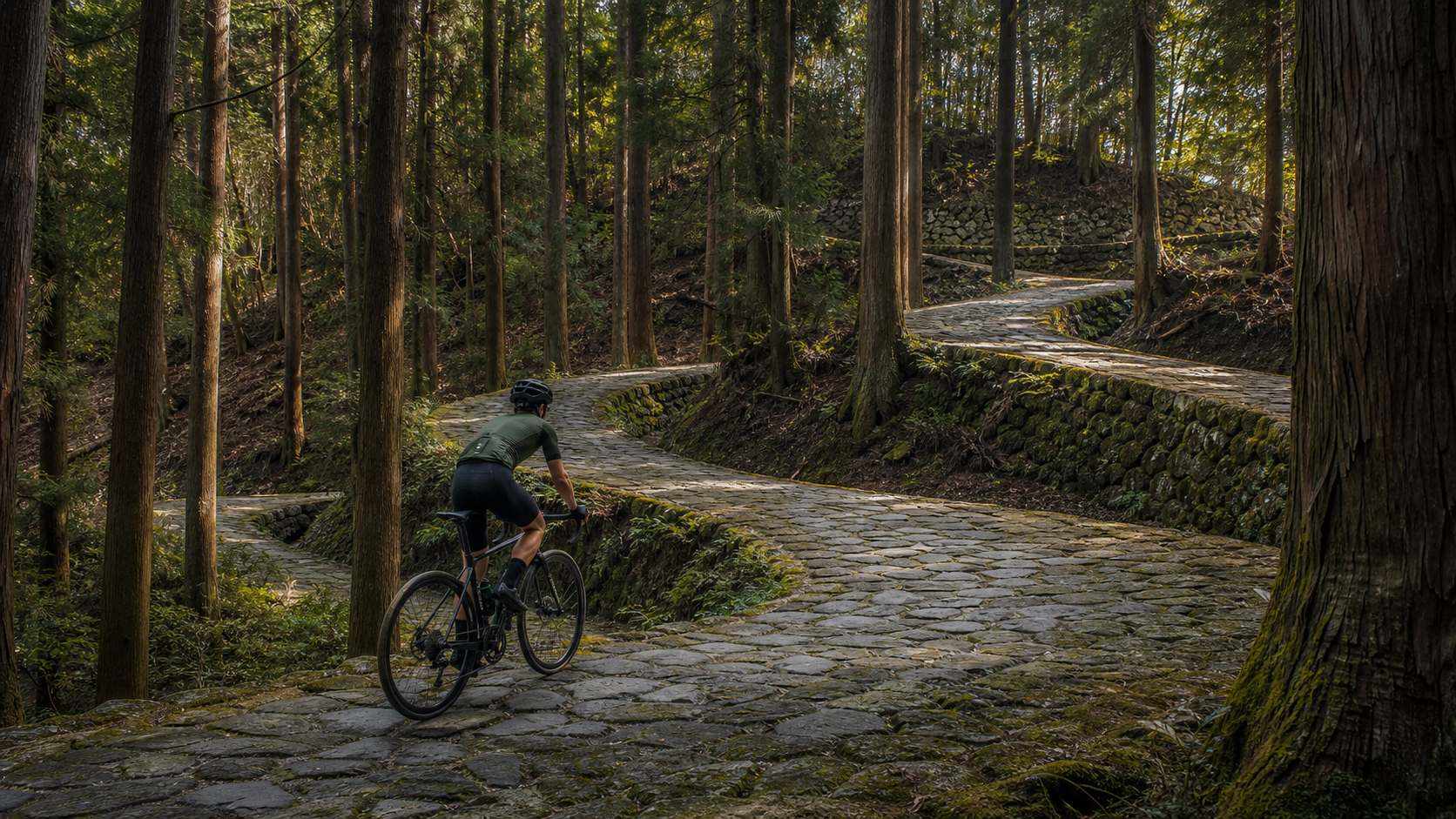
Walking the Road of Edo Travelers: Hakone Old Road, Nanamagari, and Time on the Stone Pavement
Distance 10.7 km, elevation gain 725 m, average gradient 6.6%, with the signature “Nanamagari” section of continuous hairpin turns stretching about 1.2 km at an average gradient exceeding 10%. This is the old Tōkaidō that Edo-era travelers used to cross Hakone before National Route 1 existed—a climb that ascends through history.
In the days before National Route 1 existed, there was only one way to cross Hakone—the old Tōkaidō. And today, I’m going to ride my bike along this very slope that Edo travelers once walked.
A Road with History
The Hakone Old Road follows the corridor of the old Tōkaidō. The Tōkaidō was the most important artery connecting Edo (Tokyo) and Kyoto during the Edo period, and Hakone was the most treacherous pass along this great lifeline.
Imagine this: hundreds of years ago, merchants carrying shoulder poles, daimyō processions on sankin-kōtai duty, wandering monks and poets—all had to cross this mountain on foot, step by step. “Hakone-goe” was the most dreaded obstacle of any journey in those days, so notorious that the folk song “Hakone Hachiri” was sung about its perils.
Now I’m riding a carbon-fiber bike along the same corridor, and every inch my wheels roll over is layered with hundreds of years of footprints. This sense of “walking alongside history” is the Hakone Old Road’s most unique charm—it isn’t just a climb; it’s a breathing time tunnel.
The Character of the Old Road: Short, Steep, and Serene
Compared to the bustling National Route 1, the Hakone Old Road is shorter, steeper, and quieter. The full route is about 10.7 km with roughly 725 m of elevation gain and an average gradient of 6.6%.
There’s no long, gradual warm-up like on the national route—the gradient quickly ramps up to 6–8%. The road is narrow, and there are ancient stone pavement sections—stone slabs laid down so travelers could walk through the mud in those days, now standing as witnesses to history. I ride over them carefully, feeling the dialogue between my tires and centuries-old stones.
Traffic is far lighter than on the national route, which adds a sense of stillness to the climb. Towering sugi namiki—the cryptomeria trees that lined the old Tōkaidō—interweave overhead into a green tunnel, with sunlight filtering through the gaps. In this moment, it’s easy to slip into an illusion: as if I’ve truly returned to that era of traveling on foot.
Nanamagari: The Soul of This Road
Then, I encountered Nanamagari.
“Nanamagari” is the Hakone Old Road’s most famous signature—about 1.2 km of continuous hairpin turns with an average gradient exceeding 10%. It’s the soul of the entire road, and its proving ground.
I take a deep breath and shift into my easiest gear. The corners come one after another, the inside lines brutally steep. I do my best to take the outside line to “steal” a gentler gradient, stay seated, prioritize a smooth cadence, and never stand up to sprint. Because I know all too well—those who stubbornly stand and power through Nanamagari will see their heart rate explode instantly, then wave the white flag at the next corner.
Sweat drips onto my head tube, one drop at a time. I count the corners, telling myself: get through Nanamagari, and the hardest part is behind you. That focus—pushing at the edge of my limits while still advancing inch by inch—quiets the entire world around me, leaving only my breathing and heartbeat.
After Nanamagari: Meeting Lake Ashi
Once I’ve survived Nanamagari, there are still sections above 10% in the latter part, but the hardest mental hurdle is already behind me. I maintain a steady rhythm, finishing off the remaining road segment by segment, eventually joining up with the direction of Lake Ashi.
The air at the summit is crisp. Looking back at the road I’ve climbed—those hairpins, those stone pavements, those cryptomeria trees—they aren’t just terrain; they’re vessels carrying hundreds of years of time. I suddenly understand that riding the Hakone Old Road and riding National Route 1 are two completely different things: one travels alongside modern tourism, the other holds a dialogue with ancient history.
“Hakone Hachiri”: A Song of the Pass Sung for a Century
To truly feel the weight of the Hakone Old Road, you first need to hear a song.
Japan has a famous school song called “Hakone Hachiri,” which opens with: “Hakone no yama wa, tenka no kewashi”—Hakone’s mountain is the steepest under heaven. This song sang the hardship of crossing Hakone into the hearts of generations of Japanese. The “hachiri” (eight ri) refers to the mountain roads stretching roughly four ri on each side of the Hakone checkpoint. In an era when people could only travel on foot, this stretch was the most dreaded obstacle on the entire Tōkaidō.
And the Hakone Old Road I’m riding today follows the very corridor of this “steepest pass under heaven.” As I hum the melody of “Hakone Hachiri” in my mind and look at the old road winding up the mountain before me, I suddenly feel the weight of hundreds of years on my shoulders—I’m not riding an ordinary climb; I’m retracing a history that was written into song, feared and conquered by countless travelers.
Stone Pavement, Cryptomeria Avenue, and the Checkpoint: Three Layers of Time on the Old Road
Riding the old road, the most moving things are the traces of history.
Stone pavement—stone slabs laid down during the Edo period so travelers could walk through the mud. As my tires roll over the uneven stone surfaces, they produce a sound completely different from asphalt. In that moment, you can almost hear the echoes of straw sandals stepping on stone hundreds of years ago.
Cryptomeria avenue—on both sides of the old Tōkaidō, people planted tall cryptomeria trees as roadside trees to shield walking travelers from sun and rain. Today, these old trees interweave overhead into a green tunnel, with sunlight filtering through the gaps, dappling the road. Riding through, coolness and stillness wrap around you, and time seems to slow down.
Checkpoint ruins—the Hakone checkpoint was once a vital post where the shogunate rigorously inspected travelers passing through. The strict control of “guns in, women out” was a microcosm of Edo-period politics. Passing these ruins, you realize this road isn’t just a geographical passage—it’s an artery of politics and history.
These three layers of time stack upon one another, making the Hakone Old Road a road that “speaks.” It’s steeper, narrower, and has less traffic than National Route 1—but it also has far more soul.
Nanamagari: The Soul and Trial of This Road
Then, I encountered Nanamagari.
“Nanamagari” is the Hakone Old Road’s most famous signature—about 1.2 km of continuous hairpin turns with an average gradient exceeding 10%. It’s the soul of the entire road, and the trial it gives every rider.
I take a deep breath and shift into my easiest gear. The corners come one after another, the inside lines brutally steep. I do my best to take the outside line to “steal” a bit of gentler gradient, stay seated, prioritize a smooth cadence, and never stand up to sprint. Because I know it all too well—those who stubbornly stand and power through Nanamagari will see their heart rate explode instantly, then wave the white flag in surrender at the next corner.
Sweat drips onto my head tube, one drop at a time, blurring the numbers on my cycling computer. I count the corners, telling myself: get through Nanamagari, and the hardest part is behind you. That focus—pushing at the edge of my limits while still advancing inch by inch—quiets the entire world around me, leaving only my breathing, my heartbeat, and the monotonous yet steady sound of rolling over the stone slabs.
A Dialogue with the Ancients
While climbing Nanamagari, one image kept surfacing in my mind: hundreds of years ago, those travelers crossing this place with heavy shoulder poles, supporting the elderly and leading children.
They had no easy gearing, no carbon-fiber frames, no energy gels—only a pair of straw sandals, a pair of shoulders, and the determination that they had no choice but to cross this mountain. Some traveled back and forth to make a living, some were compelled by sankin-kōtai duty, and some simply wanted to go to Kyoto or Edo to see the world on the other side of the mountain. Step by step, in the most primitive way, they trampled this “steepest pass under heaven” beneath their feet.
Compared to them, what is my little bit of hardship? That thought turned out to be the best painkiller. In the solitude of the climb, I felt as though I were engaged in a silent dialogue with the ancients from hundreds of years ago—separated by time, yet walking the same road, facing the same mountain, carrying the same will to “make it over, no matter what.” This sense of connection across time is the Hakone Old Road’s most precious gift—one that no brand-new highway can ever offer.
After Nanamagari, Meeting Lake Ashi
Having survived Nanamagari, there were still sections above 10% in the latter part, but the mentally toughest hurdle was behind me. With a steady rhythm, I finished off the remaining road segment by segment, eventually joining up with the direction of Lake Ashi.
The air at the summit was crisp and clear. Looking back at the road I had come—those hairpin turns, those stone pavements, those cedar-lined avenues—they were not just terrain; they were vessels carrying several hundred years of time. I suddenly understood deeply that riding the Old Hakone Road and riding National Route 1 are two completely different things: one brushes past modern tourism, the other communes with ancient history.
As I left, I bowed gently at the summit toward the direction I had come from—to that road, and to every person who had traversed it over the centuries. What the Old Hakone Road gave me was far more than the achievement of a climb; it was a lesson about time, about perseverance, about “how a person crosses a mountain through sheer will.” This lesson, I will carry in my heart for a long, long time.
The “Short but Steep” in Numbers
Back to the numbers: 10.7 kilometers, 725 meters of elevation gain, 6.6% average gradient. Compared to the neighboring National Route 1, the Old Hakone Road’s “short but steep” character is laid bare in these figures.
It is nearly 5 kilometers shorter than National Route 1, yet the elevation gain is comparable, and the average gradient is more than a full percentage point steeper. This means more concentrated suffering, less room to catch your breath—especially the “Nanamagari” section, which averages over 10% and stands as the apex of difficulty for the entire route. For riders seeking “pure climbing intensity,” the Old Road is far more “satisfying” than National Route 1.
But the value of the Old Road lies far beyond difficulty alone. Every degree of its steepness carries the accumulated weight of centuries of history; every one of its bends could be a place where ancient travelers rested, wiped their sweat, and sighed at the sight of the mountain. When you layer “the difficulty in data” with “the weight in history,” the Old Hakone Road becomes a climb like no other—it tests your legs, and it also questions your soul.
The Sense of Time on the Stone-Paved Road
I want to say more about that stone-paved section, because it is the most moving detail of the Old Road.
Modern asphalt roads are born for “speed”—smooth and even, allowing you to advance without hindrance. The stone paving of the Edo period, however, was born for “walking”—in the rainy, muddy Hakone mountains, laying stone slabs kept travelers in straw sandals from sinking into the mire. These two types of road surface represent two completely different conceptions of time: one pursues speed, the other simply seeks to keep walking steadily.
When my carbon-fiber tires rolled over those uneven stone surfaces, worn smooth and warm by centuries of wind and rain, the sense of time became strangely profound. The vibration of the tires seemed to hammer centuries of time into my body, beat by beat. I could almost feel that on the same stone slabs, straw sandals had trodden, wooden clogs had clacked, and the hurried footsteps of palanquin bearers had passed. This tangible sense of “sharing a road” with the ancients is something you could never experience riding on brand-new asphalt. The stone paving is not just a road surface—it is time made solid.
One Barrier Station, One Edo-Period History
When passing by the Hakone Checkpoint ruins, I always stop and carefully absorb the sternness that once prevailed here.
The Hakone Checkpoint was an important barrier established by the Edo shogunate on the Tokaido, famous for its control policy of “guns in, women out”—strictly preventing weapons (guns) from flowing into Edo, and strictly preventing the wives and daughters of feudal lords (held as hostages) from escaping Edo. Every traveler passing through had to undergo inspection here, and only with a travel permit (sekisho tegata) could they pass. A single small checkpoint encapsulated the entire political logic and social control of the Edo period.
Riding past here, I often wonder: centuries ago, what were those travelers thinking as they waited nervously before the checkpoint? Perhaps for their livelihood, for their families, for some reason they simply had to go, they summoned the courage to cross this “peril of the realm.” And the Old Hakone Road was the witness to their dreams, their anxieties, and their courage. The place I pass over easily on a bicycle was once the gateway to countless people’s fates. This weight of history lends the hardship of the climb a profound and moving hue.
For You Who Long for “Roads with Stories”
If you are a rider who is not satisfied with “just climbing” and yearns to touch history and humanity while riding, the Old Hakone Road was made for you.
It will test your legs mercilessly with the steep slopes of Nanamagari; and it will gently nourish your soul with the stone paving, the cedar avenues, and the checkpoint ruins. Every drop of sweat you shed on this road overlaps with that of travelers from centuries ago; every bend you conquer stands upon real history. This riding experience of “conversing with time” is something no modern highway can offer.
A few suggestions for you: choose a day with stable weather, because the stone paving becomes slippery and difficult after rain; slow down—don’t just focus on attacking Nanamagari’s time—pay attention to the historical relics along the way, for they are the true soul of the Old Road; and carry a humble heart to feel for those who crossed this mountain on foot, hundreds of years before you.
After finishing the Old Hakone Road, I bowed deeply at the summit toward the direction I had come from. I knew that what I had just completed was not merely a climb, but a journey through time. And what this journey taught me was the deepest understanding of “perseverance”—no matter how the times change, no matter how tools advance, when humanity faces a great mountain, that will to “make it over no matter what” remains unchanged. This, perhaps, is what the Old Hakone Road wants to tell every rider.
The Complete Memory of That Day
I chose a clear autumn afternoon to ride the Old Hakone Road alone. I chose the Old Road with its sparse traffic and deliberately avoided the crowds because I wanted to quietly spend time with this road of several hundred years of history.
After starting the climb, the Old Road quickly revealed its “short but steep” nature. There was none of the long, gradual approach of the national highway; the gradient jumped straight to 6–8%. The road narrowed, flanked by lush forest, with occasional stretches of ancient stone paving. When my tires first rolled over those uneven stone surfaces, a strange vibration traveled up—it was not just physical roughness; it felt more like centuries of time hammering into my body, beat by beat.
I slowed down, absorbing the history of this road. The towering cedars wove a green tunnel overhead, and autumn sunlight filtered through the gaps, dappling the road. The air carried the scent of the forest, so quiet that I could hear only my own breathing. Passing the checkpoint ruins, I stopped my bike and imagined the scene centuries ago, when travelers waited nervously for inspection here. This road has borne the fates and stories of so many people.
Then, Nanamagari came.
About 1.2 kilometers of consecutive hairpin turns, with an average gradient exceeding 10%. I took a deep breath, shifted to the easiest gear, and settled into position. The turns came one after another, the inside lines dauntingly steep; I did my best to take the outside line to steal a gentler gradient, never standing up to power through. Sweat fell drop by drop, blurring the bike computer. I counted the turns, telling myself: get through Nanamagari, and the hardest part is over.
During the most painful turns, what surfaced in my mind were the travelers of centuries ago who crossed this mountain carrying loads on shoulder poles. They had no easy gears, no carbon fiber—only straw sandals, their shoulders, and a determination that they absolutely had to cross this mountain. Compared to that, what was my little hardship? That thought became the best painkiller, pushing me upward inch by inch.
After enduring Nanamagari, there were still steep sections ahead, but the mental barrier was passed. I finished the remaining road with a steady rhythm and reached the summit. Looking back at the hairpin turns, the stone paving, and the cedar avenues I had come from, I bowed deeply in my heart to that road and to all who had walked it.
In Closing: On “Perseverance”
On the descent, I kept thinking about the word “perseverance.”
What moved me most about the Old Hakone Road is that it gives “perseverance” a connection that transcends time and space. For centuries, countless people have faced this “peril of the realm,” each with their own reasons, climbing step by step, gritting their teeth to cross it. Their perseverance and my perseverance on the slopes of Nanamagari today are essentially the same thing—that most primal and most moving will of humanity when facing enormous difficulty: “I must get through.”
Tools change, times change, but this will does not. The ancients used straw sandals; I use a bicycle. The ancients climbed for livelihood; I climb for passion. But when we both grit our teeth on the steepest slopes of this same mountain, we are connected. This tangible sense of “sharing the same perseverance” with the ancients elevates the climb of the Old Hakone Road beyond the realm of sport, turning it into a profound dialogue about humanity.
And this realization will give back to my own life. When I encounter seemingly insurmountable difficulties in life, I will think of the Old Hakone Road, of the travelers who crossed the mountain in straw sandals, of the version of myself on the slopes of Nanamagari who refused to give up. And I will tell myself: persevere, walk it inch by inch—no matter how high the mountain, it will eventually be crossed. This is the most precious lesson this ancient road wants to teach every rider.
For Those Planning to Come
- Road conditions: The road is narrow with stone paving, and it gets especially slippery after rain—be extra careful; traffic is light, but there are quite a few sightseers and hikers, so slow down and yield when taking blind corners.
- Nanamagari (Seven Curves): Shift to an easy gear before entering the curves, and focus on seated spinning rather than hard out-of-saddle efforts.
- Season: Spring greenery and autumn colors are the most beautiful; the cedar-lined avenue has a special charm in light mist; in winter, the summit is prone to icy conditions at low temperatures.
- Culture: Keep an eye out for the stone paving, checkpoint ruins, and other Old Tokaido heritage along the way—worth stopping to take a closer look.
When I left, I bowed at the summit toward the direction I had come from—to the road itself, and to all those who had traveled it over the centuries. The Hakone Old Road gave me not just a climb, but a lesson about time, about perseverance, and about “how people surmount a mountain.”
Traveler Q&A: Practical Planning for This Ride
How much time should I allow?
The Old Road is about 10.7 km, but the stone paving, cedar avenue, and checkpoint ruins along the way are all worth stopping to admire, so I recommend slowing down and giving yourself plenty of time. Pair it with Lake Ashi and the hot springs, and a full day is ideal.
How difficult is it? Who is it suitable for?
With an average gradient of 6.6% and the Nanamagari steep section averaging over 10%, it’s harder than the neighboring National Route 1, and it suits riders seeking “pure climbing intensity” and “historical atmosphere.” If beginners want to take on the challenge, be sure to bring the lightest gearing and aim simply for finishing.
How do I choose between it and National Route 1?
If you want light traffic, steep slopes, and a rich sense of history, choose the Old Road; if you want wide roads, gentler gradients, and complete tourist amenities, choose National Route 1. The two roads have completely different characters—if time allows, ride the Old Road one way and National Route 1 the other, and you’ll experience two entirely different faces of Hakone.
Final Words
For me, the Hakone Old Road was a lesson in “perseverance”—and one that spans centuries.
On the steepest curves of Nanamagari, what came to mind were the travelers of hundreds of years ago, carrying shoulder poles and helping the elderly and children as they crossed this mountain. With straw sandals, with their shoulders, and with a determination that they had no choice but to cross, they conquered this “peril of the realm.” And I, with a bicycle, with an easy gear, and with the same grit that refused to give up, retraced their path. The tools changed, the era changed, but the resolve to “make it over” when facing a great mountain remains exactly the same.
This sense of connection—of “sharing the same perseverance” with those who came before—is something no brand-new highway can offer. It elevates climbing beyond sport, turning it into a profound dialogue about human nature and willpower.
If you’re not satisfied with “just climbing,” if you long to touch history and question your own heart through riding, then go ride the Hakone Old Road. Feel the frozen time in the stone paving, and on the steep slopes of Nanamagari, recognize yourself in the travelers of centuries past. What you’ll take away is far more than the achievement of a climb—it’s a brand-new understanding of the word “perseverance,” etched deep into your bones.
Related Reading
- Hakone Old Road (Old Tokaido) Practical Guide: Segment Pacing and Gear Ratios for 10.7 km with 725 m of Climbing
- Climbing Along the Hakone Ekiden Route: Fuji from National Route 1, the Hot Spring Town, and Lake Ashi
- Hakone Pass (National Route 1) Practical Guide: Segment Pacing and Gear Ratios for 15.6 km with 846 m of Climbing
- The Weight of Nine Bends and Eighteen Turns: A Beilong Highway Memory from Spirit Money to Pedals
台北闊瀨陡坡 騎旅 / 日本單車雜誌編輯車友臨時加入!/ 髮香才是最強的 / feat. 北迴歸線小隊 / 公路車 CT Yeh
6 個月前
日本島波海道 EP1 / 五大絕景路線之一! / 私房溫泉 x 豪華單車客棧 / 今治 to 大三島 / 公路車 / CT Yeh
2 年前
2025 乘鞍 KOM 登山賽挑戰實錄 / 日本公路最高 ! 賽前探路篇 / 比富士山厲害,無敵絕景!/ 40週年 / 中文YT首發 / 公路車 / CT Yeh #乘鞍ヒルクライム
10 個月前
日本🇯🇵岡山&島波海道 單車之旅 (上集) / 機場停車省錢秘笈?/ 旅館有單車組裝室 / 差點上不了機場捷運 / 公路車 / CT Yeh
2 年前
大武山20%魔王陡坡【JJSC南台灣遊騎Day2】!屁股真的要裂開了...凡士林抹滿也沒用?神秘金教堂還有超便宜夜市
3 個月前
日本島波海道 EP2 / 自行車神社拜什麼?/ 整天都大景 太離譜啦!/大三島 to 尾道/公路車 / CT Yeh
2 年前
公路車 | 塔塔加驚險員工旅遊 | 還好手腳快沒被抓交替!
5 年前
精彩實錄) 舊陽金P字道 挑戰
10 年前