Riding into Zhongliao's Erjian Mountain: A Tea Town Reborn at the 921 Epicenter, Seeking Taiwan's Quietest Climb
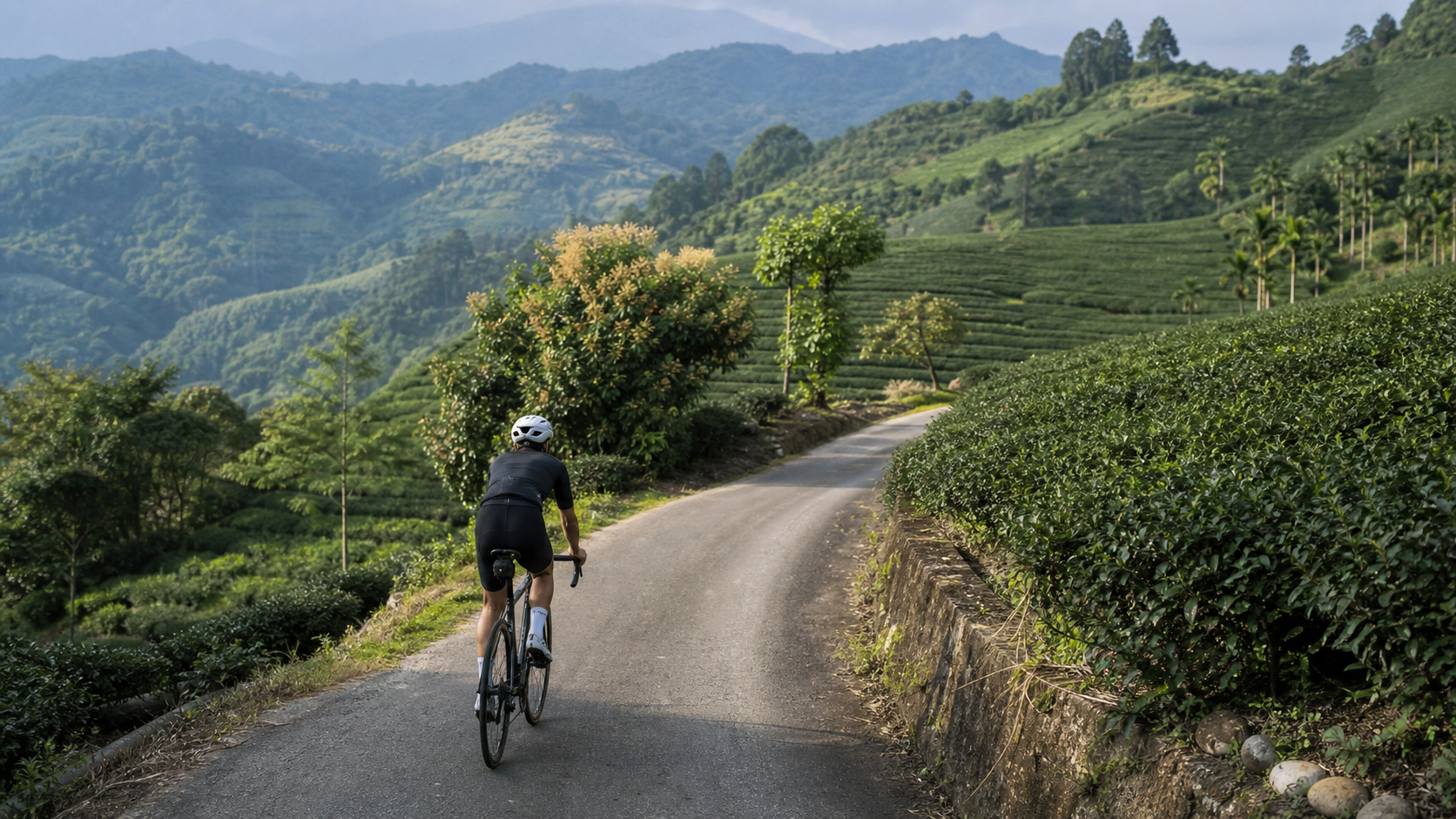
Riding into Zhongliao Erjian Mountain: A Tea Town Reborn at the Epicenter, Searching for Taiwan’s Quietest Climb
Some routes are ridden for the sake of results, while others are ridden for the sake of “simply existing quietly in some corner of the world.” Zhongliao Erjian Mountain belongs to the latter.
It hides deep in the hills of Nantou County—no tourist buses, no queues at cafés, and barely even much discussion among cyclists. As you push the pedals, lifting yourself round after round to an elevation of nearly 500 meters, and look back down at the layered mountain ridges and tea gardens spreading out like a green carpet, you suddenly understand why some veteran riders would rather give up the sense of achievement of the famous big climbs, only to return here again and again. This is a road about the land, about rebirth, about stillness. This article won’t talk about pacing or gear ratios; what I want to introduce you to is the soul behind the road of Erjian Mountain.
A Land That Rose from the Epicenter
To know Zhongliao, you cannot avoid mentioning the earthquake of 1999.
Zhongliao Township sits right near the epicenter of the 921 Earthquake. In the early hours of that autumn morning, the earth split and the sky collapsed. This township in the central hills of Nantou became one of the hardest-hit places in all of Taiwan. Houses toppled, roads broke apart, mountain forests slid away, and countless homes were reduced to rubble within seconds. For the people of Zhongliao, it was not just a natural disaster—it was a deep scar that cleaved “before” from “after.”
But the story of the land never stops at the moment of collapse. In the aftermath, Zhongliao slowly stood back up—brick by brick through residents’ rebuilding efforts, through farmers replanting their longan groves and citrus orchards, through tea growers setting new seedlings into the slopes once more. When you ride along the farm roads of Erjian Mountain today, every patch of verdant tea garden and every row of fruit-laden citrus trees is, in fact, proof that this land grew back from the ruins.
This backdrop gives cycling on Erjian Mountain a somewhat different weight. What you pedal over is not just asphalt, but a memory of land that has been stitched back together. When the wind blows across the tea gardens, carrying a faint fragrance of tea and the scent of soil, you feel an indescribable sense of groundedness—this land that was once wounded is still thriving, generation after generation.
Why It’s Called a “Hidden Gem”
In Taiwan, climbs that can truly be called “hidden gems” are growing fewer. Wuling is packed with pilgrimage traffic, and the feed stations at Fengguizui are always buzzing on weekends. But Zhongliao Erjian Mountain still retains that rare tranquility.
The reason isn’t hard to understand. Zhongliao Township isn’t on the main tourist routes; it has no top-ranked attractions and none of the buzz of influencer check-ins. This “lack of fame” might be a drawback for tourists, but for those who want to ride in peace, it’s the most precious gift.
On Erjian Mountain, you can often ride for several consecutive kilometers without encountering a single car. Your companions are only your own breathing, the steady sound of the chain turning, the rustle of wind passing through the tea gardens, and the occasional birdsong.
This quality of “solitude” is something the popular routes cannot offer. When everything around you falls quiet, you become even more attuned to the rhythm of your pedaling, the sensations of your body, and the scenery slowly unfolding before you. Many seasoned cyclists regard Erjian Mountain as a “soul-cleansing” route—not for chasing times, but for carving out a stretch of quiet climbing time that belongs entirely to themselves amid busy lives.
Scenery Along the Way: Tea Gardens, Ridges, and Layers of Green
The most captivating thing about Erjian Mountain is its sense of depth.
As the elevation rises bit by bit, the view opens up layer by layer. At the start, you’re surrounded by forests and farmland on both sides, unable to see far; but the higher you climb, the more the forest recedes, replaced by open tea gardens and distant ridgelines. The tea garden section in the middle is the most photogenic part of the entire route. Row after row of neatly trimmed tea bushes follow the curves of the hills, like contour lines brushed onto the earth in green paint. If a thin mist lingers in the early morning, the scene is so beautiful you can’t help but stop your bike.
When you climb to a point near the panoramic viewpoint of Erjian Mountain, the most magnificent scenery truly arrives. You can look down upon layer upon layer of mountain ridges stretching into the distance—range after range, with deep green up close and indigo-blue far away, presenting varying shades of ink under different light. On clear days with good visibility, you can even make out the silhouette of the Central Mountain Range further beyond. At that moment, all the gasping and soreness from the climb becomes worth it.
Across the seasons, this landscape changes its attire. In spring, the tea gardens are at their freshest new green; in summer, longan trees hang heavy with clusters of fruit; in autumn, the air is crisp, visibility is at its best, and the distant mountains are clearest; in winter, morning mist and slanting sunlight interweave, adding a touch of desolate yet serene beauty. This seasonal transformation of scenery means that even after climbing Erjian Mountain many times, every visit feels different.
Local Culture and Produce: The Homeland of Citrus, Longan, and Tea
Zhongliao isn’t just about scenery; it’s also a genuinely agricultural township.
This is an important production area for citrus, longan, and bananas in Nantou, and it’s also home to renowned tea gardens. Riding along the farm roads of Erjian Mountain, you’ll pass through orchards and tea fields—these aren’t tourist set pieces but the real livelihoods of local farmers. If you come during harvest season, you’ll often encounter farmers’ stalls at the foot of the mountain or along the roadside, selling just-picked seasonal fruit—plump, juicy ponkan oranges, sweet longan, or fresh bananas. Buying a bag as your supply not only supports local agriculture but also lets you taste the freshest flavors—a unique pleasure of riding this route.
Zhongliao’s longan deserves special mention. The place even has a place name like “Longan Grove,” showing just how long the history of longan cultivation goes back. Every longan harvest season, the entire mountain forest is filled with the sweet fragrance of longan blossoms and fruit, and beekeepers bring their hives to collect nectar, producing longan honey of excellent quality. Additionally, Zhongliao carries warm local folk-belief stories, such as the famous “Instant Noodle Earth God”—legend has it that devotees offer instant noodles to the Earth God, forming a simple yet amusing folk religious tradition that epitomizes Zhongliao’s human warmth.
These agricultural products, these beliefs, these smiling faces of farmers at their stalls—they form a more three-dimensional, warmer side of Erjian Mountain beyond just “the climb.” What you ride isn’t just a road; it’s a microcosm of an entire local way of life.
First Person: A Quiet Ascent
Let me take you, in the first person, through that morning ride once more.
Just past six in the morning, with the sky faintly brightening, I parked my car at a lane entrance in Zhongliao and did my final checks. At this hour, the small town was still half-asleep, with only a few breakfast shops emitting steam. I took a sip of water, drew a deep breath of air tinged with dew, and swung onto my bike.
The opening stretch of the climb didn’t greet me gently, but I deliberately held back my pace, unhurried. The chain turned steadily, and my breathing gradually matched the cadence of my pedaling. The forests on both sides were still wrapped in morning mist, the damp air clinging to my skin—cool and pleasant. Occasionally a bird or two flew from the treetops; apart from that, the whole world was quiet except for myself.
As the elevation rose, the forest receded and the tea gardens appeared. Morning light slanted across the tea bushes, dew drops reflecting golden rays. I slowed down a little, allowing myself the leisure to take in more of the view. In moments like this, you forget you’re “exercising” and simply feel yourself slowly melting into the scenery. Sweat ran down my cheeks, but my heart was extraordinarily calm.
Reaching the final steep pitch near the viewpoint, my legs began to ache and my breathing grew heavy. I shifted to the easiest gear and lifted myself up, turn after turn. Just as I was about to give out, the view suddenly opened wide—layers of mountain ridges spread out before me, range after range, the distant peaks glowing pale blue in the morning light. I stopped, straddling my bike, gasping for air, gazing at this grandeur. At that moment, all the fatigue transformed into a deep, profound satisfaction. No applause, no rankings, no one else—just me, my bike, and this mountain view so quiet it felt almost sacred.
The Meaning of the Route: Slowing Down to See Taiwan
In an era where everything demands speed, efficiency, and results, Erjian Mountain offers a rare kind of “slowness.”
It’s not the kind of famous mountain you can brag about finishing; what it gives you is something more internal—a stretch of time to be alone, to connect with the land, to let your heart slow down. When you temporarily set aside the obsession with chasing PRs, you actually see more: the resilience of rebirth after disaster, the tea gardens cultivated by farmers’ hard work, and the most authentic face of Taiwan’s hilly terrain.
This is also why I believe every cyclist deserves to keep a route like Erjian Mountain on their riding list. It reminds us that cycling isn’t only about getting stronger or faster—it can also simply be about “existing well upon this land,” feeling the wind, feeling the climb, feeling a landscape nurtured by time and human warmth alike.
Suggested Side Trips: Going Deeper into a Zhongliao Journey
If you’re planning a dedicated trip to Zhongliao to ride Erjian Mountain, consider making the itinerary richer, turning the journey into not just a climb but an in-depth exploration of Nantou’s hills.
Climb in the early morning, explore the surroundings in the afternoon. I’d suggest completing the Erjian Mountain ascent in the cool of the morning, then slowing down in the afternoon to explore the local scenery around Zhongliao. The township is dotted with many rustic farming villages, perfect for a leisurely ride to soak in the undisturbed rural pace.
Extend to Zhongxing New Village. Not far west of Zhongliao lies the well-known Zhongxing New Village. It preserves a unique garden-city layout and old dormitory clusters, and in recent years has become a creative hub with many distinctive shops and cafés. After the hard climb up Erjian Mountain, stopping here for a coffee and a stroll through the old lanes is the perfect pairing of exertion and relaxation.
Savor the local produce. Don’t forget to take home some of Zhongliao’s seasonal fruit or longan honey as souvenirs. These are the most authentic flavors of this land and the most practical way to support local agriculture.
Slow down and converse with the land. Zhongliao isn’t the kind of place you “check in for three hours and leave.” It suits a slower pace and careful savoring. If time allows, arrange an overnight trip to experience the beauty of dawn and dusk in this land reborn from disaster—it will make the memory of the entire journey even deeper.
Seasonal Scenery
Finally, a few “limited edition” versions of Erjian Mountain, so you know when to come to encounter the most special views.
Tea gardens in spring mist. On humid spring mornings, fog tends to form. When thin mist drifts through the tea gardens, the entire slope appears and disappears like an ink-wash painting. This is the scene photographers love most, but it’s a matter of luck—you can’t count on it.
The season of longan blossoms. In late spring and early summer, the longan trees bloom, filling the entire mountain forest with a clear, sweet floral fragrance while bees buzz about. This is a seasonal treat for the nose—remember to take a deep breath when you ride past the longan groves.
The crisp clarity of autumn. With low humidity and clear air, autumn is the season when the layered ridges are most visible. If you want to fully take in Erjian Mountain’s most expansive views, autumn is definitely the top choice.
The stillness of winter dawn and dusk. In winter, there are even fewer visitors and the mountain forest is quieter. The slanting morning sun casts long shadows, and everything slows down. If you want a ride that’s entirely your own and undisturbed, Erjian Mountain in winter will give you the purest answer.
The People You Meet on the Road
Having ridden Erjian Mountain so many times, what I remember most often isn’t the scenery but the people I’ve met along the way.
Once, during longan harvest season, I stopped at a roadside stall run by an elderly farmer to buy longan. Seeing me in full cycling kit and drenched in sweat, he smiled and tossed in an extra handful, saying, “Cycling is tiring, eat more to regain your strength.” That free handful of longan was sweet not just in flavor but in its unasked-for warmth of human kindness. In a rural place like Zhongliao, people still hold onto a simplicity and warmth that is gradually thinning out in the cities.
Another time, near the tea gardens, I met a tea farmer tending her bushes. I stopped to ask for directions, and she not only guided me carefully but also chatted about how this tea garden had been replanted bush by bush after the earthquake. She spoke in a plain tone, but the resilience of living with the land and refusing to give up left a deep impression on me. These chance encounters have made Erjian Mountain, for me, no longer just an abstract climbing route, but a real piece of land with warmth, stories, and human connection.
A large part of cycling’s charm lies precisely in this. You move at a speed closest to the land—slow enough to see the details of the scenery, slow enough to cross paths and converse with people along the way. This is something you can never experience while speeding past in a car. A route as quiet and unpretentious as Zhongliao Erjian Mountain is exactly the kind of place where people can most deeply connect with the land.
A Different Temperament from the Big Mountain Routes
If Taiwan’s climbing routes were people, then Wuling would be the star under the spotlight—dazzling but always surrounded by crowds. Zhongliao Erjian Mountain, by contrast, would be a reclusive hermit—quiet, reserved, yet carrying a self-sufficient composure that seeks nothing from outside.
The big mountain routes give you the sense of achievement from “conquering”; the hidden gem routes give you the emotion of “encountering.” Neither is superior to the other; they simply satisfy different needs at different moments. When you want to challenge your limits and earn a milestone to show off, you head for Wuling; but when you want to settle down, be alone, and hear your inner voice again in the quiet, Erjian Mountain is the better choice.
I know many veteran riders with decades of cycling behind them. In their youth, they frantically chased completion records on all the big mountains, but as they’ve aged, they find themselves returning more and more often to these quiet hidden routes. They say that when they were young, they rode to prove themselves; now they ride to please themselves. And Erjian Mountain is exactly the kind of road that purely pleases yourself. It doesn’t require you to prove anything—only to fully enjoy this ascent, this scenery, this tranquility.
One Road, One Attitude Toward Life
The longer you ride, the more you realize that the routes you choose reflect the attitude toward life you choose.
Some people chase only the famous big climbs their whole lives, enjoying the feeling of being seen and recognized; others increasingly favor these quiet hidden gems, conversing with themselves on empty mountain paths. Neither choice is right or wrong, but what Zhongliao Erjian Mountain represents is a cycling philosophy that turns “inward” rather than “outward.” It doesn’t clamor or show off, yet with every ascent, it quietly enriches your inner self.
This tea town reborn from the epicenter is itself a lesson in “resilience” and “rebirth.” When you ride here, looking at the tea gardens and orchards that grew back from the rubble, it’s hard not to think of life—each of us has experienced our own “earthquakes,” our own collapses and low points. And what Zhongliao tells us is this: collapse is not the end. As long as you’re willing to rebuild brick by brick, the land will grow green again, and life will find its rhythm once more.
Cycling, in a way, is the same. You suffer on the climb, gasp for air, almost want to give up—but as long as you keep pedaling, turn after turn, you will eventually reach that high place with the open view. Erjian Mountain writes this lesson into your legs and your breath in the gentlest and most truthful way. Perhaps this is what this quiet road most wants to tell every rider.
For Those Coming for the First Time
If this article has moved you and you’ve decided to make the trip to Zhongliao Erjian Mountain, here are a few gentle reminders.
Let go of your obsession with results. This road deserves to be felt with your heart, not stared at on a bike computer chasing times. On your first visit, ride slowly, stop often to enjoy the scenery, take photos, and chat with people you meet. As for results—you can chase them later, once you’ve fallen in love with this road.
Respect the land and its residents. You’re passing through farmers’ real orchards and tea fields, through the countryside where people live. Please slow down, don’t litter, don’t disturb the crops, and greet the people you meet with a smile. Every small kindness you show builds a good image for the cycling community.
Make basic preparations. Although this article doesn’t discuss technique, hidden routes have few people and vehicles, and resupply and rescue are inconvenient. Before setting out, be sure to check your bike’s condition, bring enough water and tire repair tools, and let someone know your itinerary. Safety is always the prerequisite for enjoying beautiful scenery.
Come with an open heart. You may not encounter breathtaking, jaw-dropping vistas here, and there won’t be any influencer-worthy cafés to check in at. But if you’re willing to slow down and open your senses, Erjian Mountain will repay you, in its quiet way, with an unforgettable riding memory. True beauty often hides in the unassuming details—a drop of dew hanging on a tea leaf, a sweet fragrance drifting through the longan grove, a farmer’s warm smile. These delicate moments of emotion require you to slow down and quiet your mind before they can truly be received.
Conclusion: Stillness Is Also a Kind of Strength
We tend to think the meaning of cycling lies in “conquering”—conquering higher mountains, steeper slopes, faster times. But what Zhongliao Erjian Mountain has taught me is a completely different kind of value: stillness is also a kind of strength.
In this tea town reborn from the epicenter, on this farm road where you barely meet another person or vehicle, you have the chance to switch off all the noise of the outside world, leaving only the dialogue between yourself and the land. You’ll look down upon layer upon layer of ridges, smell the fresh fragrance of the tea gardens, meet farmers at their stalls, and find a quiet, deep satisfaction on the final steep pitch.
So, if one day you grow tired of the famous big climbs, weary of the queues and the crowds, take a trip into the depths of Nantou’s hills. Let Zhongliao Erjian Mountain recharge you with its tranquility and beauty. After all, the best route is never the most famous one—it’s the one that lets you find yourself again.
And the next time you stand at that high place overlooking the layered ridges, panting, sweating, gazing at this green landscape reborn from the epicenter, perhaps you too will, like me, silently say thank you to this land—thank it for standing back up from the collapse, thank it for turning its wounds into scenery through tea gardens and orchards, thank it for allowing every rider willing to slow down to find a quiet and beautiful stretch of time here. This is what makes Zhongliao Erjian Mountain so moving. It is not just a climbing route; it is a piece of land worth getting to know slowly, with an entire morning and your whole heart. May you too ride out your own unique story here.
Related Reading
- Zhongliao Erjian Mountain Guide: A Complete Breakdown of Nantou’s 7.3% Hidden Gem Climb in the Hill Country Tea Town
- A Six-Kilometer Journey Through Time: The 921 Memories of Caoling Road, Tea Garden Light and Shadow, and Zhushan’s Human Warmth
- Maokong Zhanghu Traverse: Rediscovering the Leisurely Joy of Cycling Between Tea Aroma and Mist
- A Hill Road Scented with Coffee: A Cyclist’s Private Memories of Dongshan Coffee Road
一定要騎一次!阿里山最深處:里佳部落!單車旅行 | 2800m爬升 | 深度部落體驗:嗨翻晚會、螢火蟲、銀河 | feat. JJSC & 廢物伙伴 | 公路車 CT Yeh
10 個月前
微東進 太魯閣 蘇花 單車兩日遊 ! 颱風過後路況超刺激 行程大亂 | 最狂的鹹酥雞訂單 | CT Yeh | 4K 高畫質空拍絕景!
4 年前
大武山後門26%歡樂陡坡!JJSC南台灣單車行Day2 / 被颱風追著跑 / 公路車 / CT Yeh
2 年前
那瑪夏x茶山 阿里山系深山單車行 Day2 累積爬升6000M | 🥶超陡連續下坡 整路看隊友刷 | 爬升一座西進武嶺 | JJSC | 公路車 | CT Yeh
3 年前
藤枝二集團 單車行 Day1 | 南部小武嶺 | 爬坡爬到罵罵叫 | JJSC | 公路車 | CT Yeh
3 年前
新竹羅平 x 天湖部落 大禹嶺級變態陡坡! 4K超高畫質 空拍 | 公路車
5 年前
台北闊瀨陡坡 騎旅 / 日本單車雜誌編輯車友臨時加入!/ 髮香才是最強的 / feat. 北迴歸線小隊 / 公路車 CT Yeh
6 個月前
大武山20%魔王陡坡【JJSC南台灣遊騎Day2】!屁股真的要裂開了...凡士林抹滿也沒用?神秘金教堂還有超便宜夜市
3 個月前