Riding Where the Clouds Rise: Cloud Seas, Sacred Springs, and Wushe Memories from Lushan Hot Springs to Provincial Highway 14
Preface: Encountering a Road Where the Clouds Rise
Some routes, you forget after riding them. Others leave a lingering afterglow in your heart—years later, when you see a photo, you can still recall the smell of the air that day. The 12.23 kilometers from Lushan Hot Spring’s Yunlong Bridge to the terminus of Provincial Highway 14 is, for me, the latter.
It’s not Taiwan’s longest, highest, or steepest road—the total climb is just 535 meters with an average grade of 4.4%, a mere Category 3 on Strava. But what it passes through is a land wrapped in layers of clouds, hot springs, history, and Indigenous stories—Ren’ai Township, Nantou County. As you pedal, climbing from Yunlong Bridge toward Cingjing and Hehuan Mountain, you’re not just gaining elevation; you’re riding through the memory of an entire mountain region of Taiwan.
This article has no pace charts or gear ratio suggestions. I simply want to take you along this road at a different speed, and let you see it anew.
Lushan: The Place Called “Sacred Spring”
First, let’s talk about Lushan Hot Spring itself. It sits in Ren’ai Township, Nantou County, at an elevation of over 400 meters, surrounded by mountains. The moisture from the Tarowan River valley keeps the area shrouded in mist year-round—that’s the source of the ethereal quality in its name.
During the Japanese colonial era, this place wasn’t called Lushan. It was known as “Fuji Hot Spring” or “Pigeon Marsh Hot Spring.” When the Japanese discovered this spring, they treated it as a treasure, because its water quality was truly extraordinary:
A strongly alkaline sodium bicarbonate spring with a pH of about 9, a scalding water temperature of 87 degrees Celsius, and water that is crystal clear, colorless, and odorless. In that era, such water quality was regarded as nearly a “sacred spring.”
Clear, odorless, strongly alkaline—these are exceptionally high standards in the world of hot springs. Many springs carry a sulfur smell or a murky mineral tint, but Lushan’s water is as translucent as mountain spring water, just hot enough to burn. Its source lies hidden in the Tarowan River valley—a gift from this valley to the world.
After the war, it was renamed “Lushan,” taking its inspiration from the poetic line about Mount Lu in Jiangxi, China—“I cannot see the true face of Mount Lu, because I am within the mountain itself”—capturing that sense of deep clouds and hidden depths. The name changed, but the quality of being embraced by mountains and mist has never wavered.
The Lushan Hot Spring area is divided into old and new sections by the Lushan Suspension Bridge. Cross that bridge, with the river rushing below and steep cliffs rising on both banks, and you’ll naturally understand why the ancients felt this place held some kind of spiritual energy.
Yunlong Bridge: A Bridge, A Starting Point
The starting point of our route—Yunlong Bridge—is one of the most important landmarks in the area. Bridges are the lifelines connecting mountain settlements to the outside world, and for cyclists, they mark that invisible line where “the climbing begins.” Standing on the bridge and gazing into the depths of the valley, mist drifting along the mountainsides, that particular dampness and lush green unique to Taiwan’s mid-elevation mountains is something no photograph can capture.
When I wheeled my bike to the bridgehead, clicked into my pedals, and took a deep breath, I knew that every turn of the cranks from that moment on would carry me higher, quieter, and closer to the clouds.
A History That Cannot Be Overlooked: Wushe, and Those Names
If you treat this place merely as a climbing route, you’ll miss one of the heaviest and most moving chapters in Taiwan’s modern history.
This land is the homeland of the Seediq people. And it was in the mountains right around here that the “Wushe Incident” erupted in 1930, shocking all of Taiwan. Led by Mona Rudao, the Seediq people launched a desperate resistance against Japanese colonial rule in the area around Mahebo. It was a tragedy about dignity, hunting grounds, and how a people faces foreign oppression.
As you climb this road, passing through one Indigenous settlement after another, remember: every inch of ground beneath your wheels was once a hunting ground and homeland that a people guarded for generations.
I won’t recount the full details of that history here—it deserves a more serious length and a deeper reverence. But what I want to say is this: riding is never just exercise. When you know what happened in these mountains, every breath you take, every smile of a tribal child you pass, every place that commemorates this history carries a different weight. This stretch of Provincial Highway 14 heading toward Wushe is not just a road to the high mountains—it is also a road through memory.
Scenery Along the Way: Cloud Seas, Ridges, and That Shifting Light
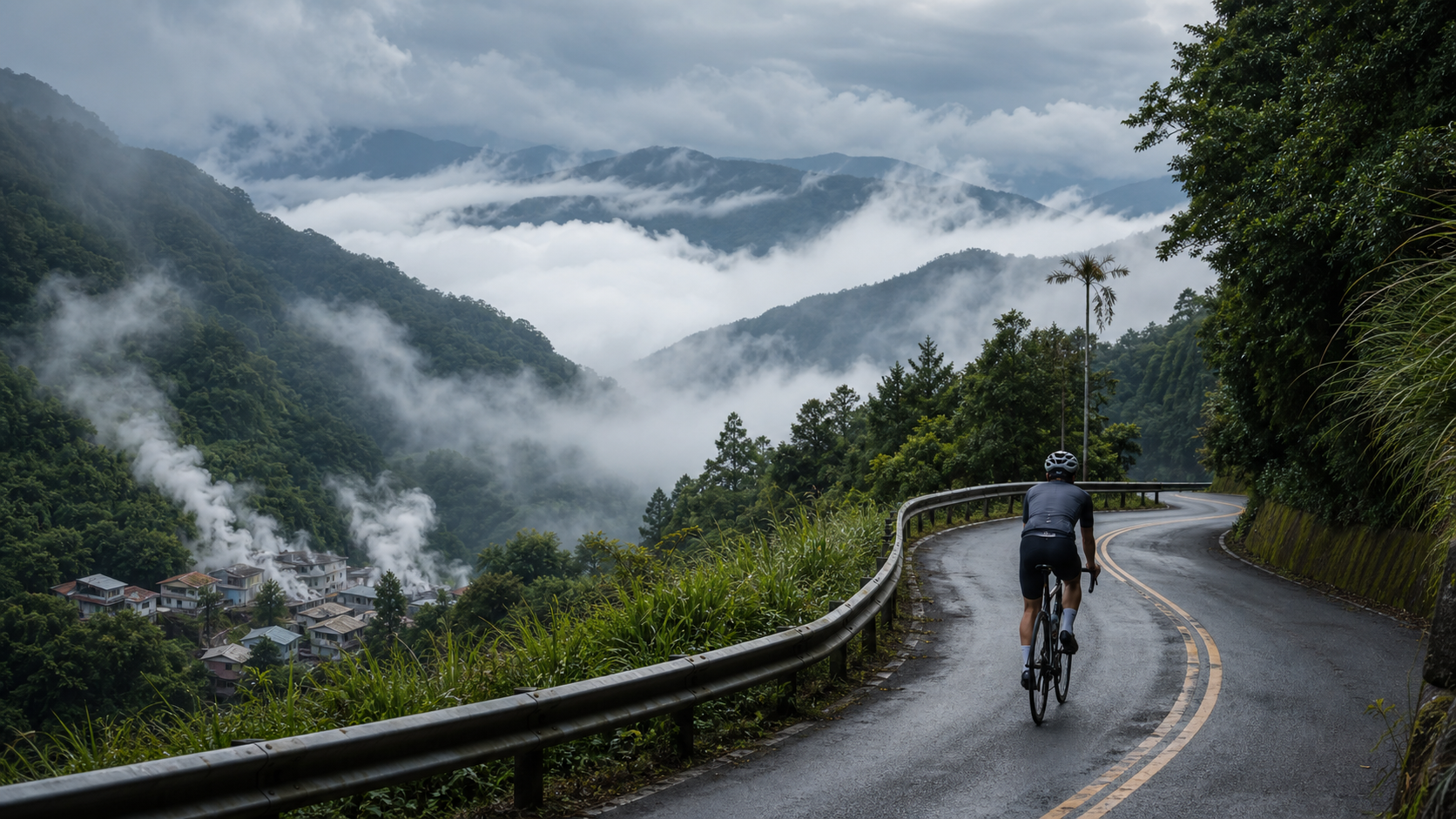
Now, let’s return to the pedaling itself. The most captivating thing about this road is its sense of vertical layering.
Starting from the 400-plus meters of the Lushan Hot Spring area, climbing steadily toward Wushe and Cingjing, you’ll watch the vegetation, the light, and the air transform layer by layer:
| Elevation Range | What You’ll See |
|---|---|
| Near the start | Hot spring settlements, river valley, lush bamboo groves and broadleaf forests |
| Mid-section | Layered green ridges, clouds and mist beginning to flow below and beside you |
| Approaching the Provincial Highway 14 main line | The view opens up dramatically—distant mountains in deep blue, cloud seas surging |
The phrase “layered green ridges” might be a mere adjective elsewhere; here, it’s a literal scene. Range after range of mountains, shades of green stacking deeper and deeper to the horizon, the farthest ridgeline nearly merging with the clouds.
And what takes your breath away most is the clouds and mist. The clouds around Ren’ai Township aren’t a static backdrop—they’re alive, breathing, moving. One moment it’s a clear blue sky; the next, a sheet of white fog surges up from the valley, wrapping the entire road in a dreamlike milkiness. Just when you think you might be lost, a gust of wind blows it apart, and sunlight pours through the gaps in the clouds, casting a moving band of light across the damp asphalt.
At that moment I stopped my bike, forgot to check my computer, forgot about pacing, and just stood there watching the clouds drift past me. After all these years of riding, the moments I’m most grateful for are these—the ones that make you stop.
Seasonal Delights: A Different Face in Every Season
This road wears a completely different expression in each of the four seasons, and it’s worth riding it multiple times just for the changing scenery.
- Spring: Mountain cherries and wildflowers bloom around the settlements and along the roadside, and the air carries a freshly washed clarity.
- Summer: Afternoon thunderstorms arrive fast and furious, but the cloud seas and rainbows after the rain are summer’s exclusive reward. Set out in the early morning, and you’ll enjoy a cool, peaceful climb.
- Autumn: My private favorite. The sky is high and crisp, visibility is superb, the ridgelines of distant mountains are as sharp as knife cuts, and the afternoon sun carries a golden warmth that bathes the entire mountain range in a cozy hue.
- Winter: Damp and cold, with low-hanging mountain mist—but if you’re lucky, you can chase cloud seas and a crystalline clarity higher up. And at times like this, the hot springs down below become the gentlest of invitations.
Suggested Side Trips: Turning a Road into a Journey
The best thing about this route is that it sits at a node in Taiwan’s most exquisite mountain road network. You can treat it as a standalone climbing workout, or weave it into a richer journey.
Heading upward, Provincial Highway 14 will take you through Wushe and on to the mist-wreathed Cingjing Farm—that high-mountain meadow known as the “Shangri-La Above the Clouds,” where sheep graze on green grass and which is one of Taiwan’s most famous resort destinations. Beyond that lies the heavenly road to Hehuan Mountain and Wuling, the highest pinnacle of Taiwan’s road network.
For local experiences, here’s what I’d suggest:
- After finishing the climb, detour on the way back to see the Lushan Suspension Bridge, and feel the character of that old bridge that divides the old and new hot spring districts.
- If time allows, find a local hot spring to soak in—let that pH 9, 87-degree-Celsius strongly alkaline sodium bicarbonate spring from the source soothe your legs after the climb. (Note: please follow on-site legal operations and safety guidelines when soaking.)
- Stop in a settlement, grab a local coffee or an Indigenous-style meal, and listen to the locals tell the stories of these mountains. (Specific establishments change over time, so we recommend exploring on-site.)
I’ve always believed that the best rides aren’t about how many kilometers you “conquer,” but about what you encounter and what you remember along the way.
A Journey Through Names: From Fuji, Pigeon Creek, to Lushan
I love tracing the origins of place names, because names often hold the memory of an entire era. The name of this hot spring is, in itself, a condensed history.
During the Japanese colonial era, it was called “Fuji Hot Spring” — clearly the Japanese projected their nostalgia for Mount Fuji back home onto this foreign landscape. The name “Pigeon Creek Hot Spring” also circulated. Whichever name it was, it carried the sentiment of the colonizers when they first encountered this valley — a mix of awe and a desire to possess it.
After the war, it was renamed “Lushan.” The name was borrowed from Lushan in Jiangxi, China, drawing on the famous poetic imagery of Su Shi’s timeless verse — “I cannot see the true face of Lushan, because I am right in the middle of the mountain.” It could not be more fitting here: when you find yourself in this valley shrouded in year-round mist, you truly cannot see its full form. You can only be surrounded, enveloped by it, until you climb to higher ground and look back down, only then realizing what a profound mountain you just passed through.
A place’s name changed three times, from Fuji, Pigeon Creek, to Lushan — each renaming marked the closing of one era and the opening of another. And this mountain has silently witnessed it all.
When you ride this road and recite these names, you are not just riding over asphalt — you are riding through a land that has been repeatedly named and given meaning by different eras and different peoples. This depth is the unique charm of many mountain routes in Taiwan.
The Science and Poetry of Hot Springs: Why Lushan’s Water Is So Special
I want to say a bit more about this spring, because it deserves it.
Most people’s impression of hot springs stops at “hot” and “smells like sulfur.” But Lushan’s spring completely breaks that stereotype. It is a strongly alkaline sodium bicarbonate spring, with a pH of around 9 — chemically, that’s close to the alkalinity of soapy water. It is precisely for this reason that soaking in this spring gives a smooth, silky texture. The older generation calls it “beauty water” — alkaline water softens the stratum corneum, leaving your skin smooth after a soak.
Now consider the temperature: the source reaches 87 degrees Celsius — nearly hot enough to brew tea. Such high temperatures indicate vigorous geothermal activity underground, and explain why the Japanese during the colonial era treated its discovery like finding treasure.
Imagine: in a river valley surrounded by mountains and veiled in mist, a clear, odorless spring emerges, silky to the touch and scaldingly hot. No wonder it was crowned with the name “Sacred Spring.”
For a rider who has just climbed 535 meters, the meaning of this spring could not be more direct — it is the gentlest recovery therapy the mountain has prepared for you. The warmth of the alkaline spring promotes blood circulation and soothes muscles tightened from the climb. Of course, before soaking, be sure to check the operating status and safety — mountain hot spring facilities can change with the environment.
Riding This Road with All Five Senses
I often tell my friends that a good route should be ridden with all five senses, not just with your legs. This road happens to be the perfect lesson in engaging all five senses.
- Sight: Layer upon layer of verdant mountains, drifting seas of clouds, ribbons of light piercing through gaps in the clouds. This is the most direct awe.
- Sound: The rushing water of the valley stream, the rustling of wind through bamboo groves and treetops, the occasional crowing of roosters and barking of dogs from distant villages. When you stop pedaling, the mountain is anything but quiet — it is full of the sounds of life.
- Smell: The freshness of earth and vegetation after rain, the humid moisture unique to mountain areas, the increasingly crisp and clean air as you climb higher.
- Touch: The faint dampness of drifting mist on your cheeks, the gradual drop in temperature with altitude, the vibrations of the road transmitted through the handlebars.
- Taste: If you stop at a village, the richness of a locally brewed coffee or the aroma of an indigenous meal will become the most memorable finale of your journey.
When you ride with all five senses, you realize: mileage and elevation gain are the least important parts of the journey.
The Moments I Stopped
While writing this article, I kept recalling the times I stopped my bike on that road that day.
The first time was on Yunlong Bridge. I leaned my bike against the railing and gazed into the depths of the valley. Mist drifted slowly along the mountainside, and the stream below cut through the deep gorge. The vastness of it left me speechless for a moment.
The second time was at a bend in the middle section. A wall of white fog surged up from the valley without warning, and within seconds, the entire road was swallowed into a milky dreamscape. I stopped the bike and watched my front wheel appear and disappear in the mist. In that moment, the silence was so complete that all I could hear was my own breathing.
The third time was near the junction with Provincial Highway 14, where the view suddenly opened up. A sea of clouds churned below my feet, distant peaks faded one after another, and the farthest ridgeline merged into the sky. I stood there for a long time — long enough for my heart rate to settle.
Some say we ride to become faster, stronger. But the more I ride, the more I realize that what cycling truly gives me are these moments “worth stopping for.” That is something speed can never buy.
For First-Timers: A Few Words from the Heart
If you are planning to ride this road for the first time, let me offer you, as someone who has been there, a few pieces of advice that have nothing to do with pacing and everything to do with mindset:
- Don’t rush. The beauty of this road lies in the details. Give yourself more time, and stop more often.
- Look up at the mountains, and also look down at the people. You will pass through indigenous villages, through lands where generations have lived. Approach with respect and curiosity, and this mountain will reward you with deeper emotion.
- Remember the story of this land. Wushe, Seediq, Mona Rudao — these names should not remain mere print in textbooks. When you ride through this mountain yourself, let that history carry weight in your heart.
- Be prepared to be teased by the weather. Mountain clouds come and go as they please. Instead of complaining, treat it as a surprise gift from the journey.
- After the ride, soak in a hot spring and thank your legs properly. They carried you to sights you could never see on flat ground.
A Reflection on “Disappearance and Rebirth”
At this point, I must honestly address something. Lushan Hot Spring has not had a peaceful time in recent years.
Because it sits on a geologically fractured zone, Typhoon Sinlaku in 2008 devastated the entire hot spring area. Landslides and riverbed siltation severely damaged this hot spring town once hailed as the “Sacred Spring.” Since then, discussions about Lushan’s future have persisted — including whether to transform the hot spring industry or even relocate it to areas like Cingjing or Fushoushan to create a so-called “New Lushan.”
As I rode this road, looking at the valley and the scars of its tug-of-war with nature, I felt a complex emotion. The mountain is both generous and merciless. It gives us seas of clouds, hot springs, and picturesque scenery, while constantly reminding us how insignificant we are in its presence.
Perhaps this is the deepest meaning of this route. It is not merely a climb in elevation; it is a lesson in reverence — reverence for nature, for history, and for the people who have lived on, guarded, and also lost on this land.
What the Mountain Taught Me
After years of riding and traversing mountains large and small across Taiwan, I have gradually come to understand that every road teaches me something. And the road to Lushan taught me humility.
It showed me how a hot spring town once hailed as a “Sacred Spring” could suffer devastation after a single typhoon; it taught me that in this mist-shrouded valley, a people once paid an immeasurable price for their dignity and homeland; and it allowed me, in countless moments of stopping, to feel how small we are before the great mountain.
We cyclists often use the word “conquer” — conquering a mountain, conquering a climb. But after riding this road, I like that word less and less. You cannot conquer a mountain that is tens of millions of years older and millions of times larger than you. All you can do is, in the weather it permits, pass through its body with reverence, leave safely, and carefully store the experience in your heart.
The mountain will not remember you, but you will forever remember the mountain. That is probably why, no matter how sore our legs or how bad the weather, we keep returning to these mountains again and again.
And so, when I see the various discussions about “New Lushan” — whether to relocate the hot spring industry to Cingjing or Fushoushan — I feel a complex emotion inside. The land will change, settlements will move, industries will transform, but this mountain, this cloud, this memory carved into the land will not disappear. And all we can do is, on every ride, take a good look at it and remember its appearance in this moment.
Conclusion: A Speed That Breathes
Back to the original question: why ride this road?
If all you want are numbers, a KOM, or a beautiful climbing record, there are more “worthy” routes in Taiwan. But if what you’re after is a journey that lets you slow down, take a deep breath, and rediscover why riding a bike captivates you—then this 12.23 kilometers from Lushan Yunlong Bridge to Provincial Highway 14 will give you far more than just 535 meters of elevation gain.
It will give you light flowing through drifting clouds, mountains stacked upon mountains, a weighty slice of history, the warmth of hot springs, and the awe of the great peaks.
So next time, before you point your handlebars toward Hehuan Mountain, take a moment on this stretch of Lushan to deliberately slow down. Don’t just stare at your computer—look up, see the clouds that breathe, see the mountains that have stood there all along, older than any of us. And then you’ll understand why some roads, once ridden, are never forgotten.
May you encounter scenery worth stopping for in every pedal stroke.
Afterword: On “Slowness”
In an age that chases KOMs, PRs, and all kinds of numbers, writing an article that encourages people to “slow down” is a bit contrarian.
But I increasingly believe that riding ultimately answers a question of “why.” Why do you ride? If the answer is simply faster times and shinier numbers, there’s nothing wrong with that—it’s a pure pursuit in its own right. But if you occasionally feel weary on the bike, wondering “what’s the point of all this,” maybe that’s your body telling you—you need a ride without looking at the computer.
The Lushan road exists for moments like that. It isn’t high enough, steep enough, or “worth bragging about,” but precisely because of that, it frees you from the race of numbers and lets you feel cycling itself in a pure, breathing way.
I imagine an early morning when you wheel your bike alone to the head of Yunlong Bridge, the valley fog still lingering, the air carrying the scent of dew. You click into your pedals, take a deep breath, and start climbing. No timing, no rivals, no goal you must achieve—just you, your bike, and the great mountains waking up around you.
A ride like that may never appear on any results sheet, but it will stay with you for a long, long time. And that is the real gift this road wants to give you.
The road is always there. The mountains are always there. All that’s left is whether you’re willing to ride across them slowly, at a speed that breathes.
Related Reading
- Lushan Yunlong Bridge to Provincial Highway 14 Summit: A 12.23K Practical Guide—Pacing Discipline and Gear Ratios for a 4.4% Average Grade
- Xitou to Shanlinxi: A Cloudy Journey Through Cedar Forests, Monster Village, and Songlongyan Waterfall
- The Central Cross-Island Highway Hub Above the Sea of Clouds: Riding to Lishan, a Mountain Highway Poem Across the Lanyang River and Dajia River
- Taiwan’s Classic Climbing Challenges: An In-Depth Guide to Wuling, Hehuan Mountain, and Cingjing Farm Routes
觀霧 變好騎了! | 北高車友爆笑大會師 | 公路車 | 單車旅遊 Taiwan Cycling Route GuanWu
6 年前
台北闊瀨陡坡 騎旅 / 日本單車雜誌編輯車友臨時加入!/ 髮香才是最強的 / feat. 北迴歸線小隊 / 公路車 CT Yeh
6 個月前
嘉義大埔、阿婆灣挑戰賽,美到以為在日本!ft. 環騎5 Cool 西拉雅188 / 公路車 / CT Yeh
7 個月前
一定要騎一次!阿里山最深處:里佳部落!單車旅行 | 2800m爬升 | 深度部落體驗:嗨翻晚會、螢火蟲、銀河 | feat. JJSC & 廢物伙伴 | 公路車 CT Yeh
9 個月前
新竹羅平 x 天湖部落 大禹嶺級變態陡坡! 4K超高畫質 空拍 | 公路車
5 年前
阿里山塔塔加 兩倍特濃版!全新隧道開通! 進喔!公路車 | CT Yeh
3 年前
#北橫 + #北進武嶺 最硬的員工旅遊 EP1 | #公路車 #拉拉山 | 明池 | 武嶺 | 武陵農場 | 雲海 | Taiwan Cycling Route Wulin
6 年前
大武山20%魔王陡坡【JJSC南台灣遊騎Day2】!屁股真的要裂開了...凡士林抹滿也沒用?神秘金教堂還有超便宜夜市
3 個月前