A Conversation with a Wall: Climbing from Guguan, the Most Honest Steep Slope Beside a Hot Spring Resort
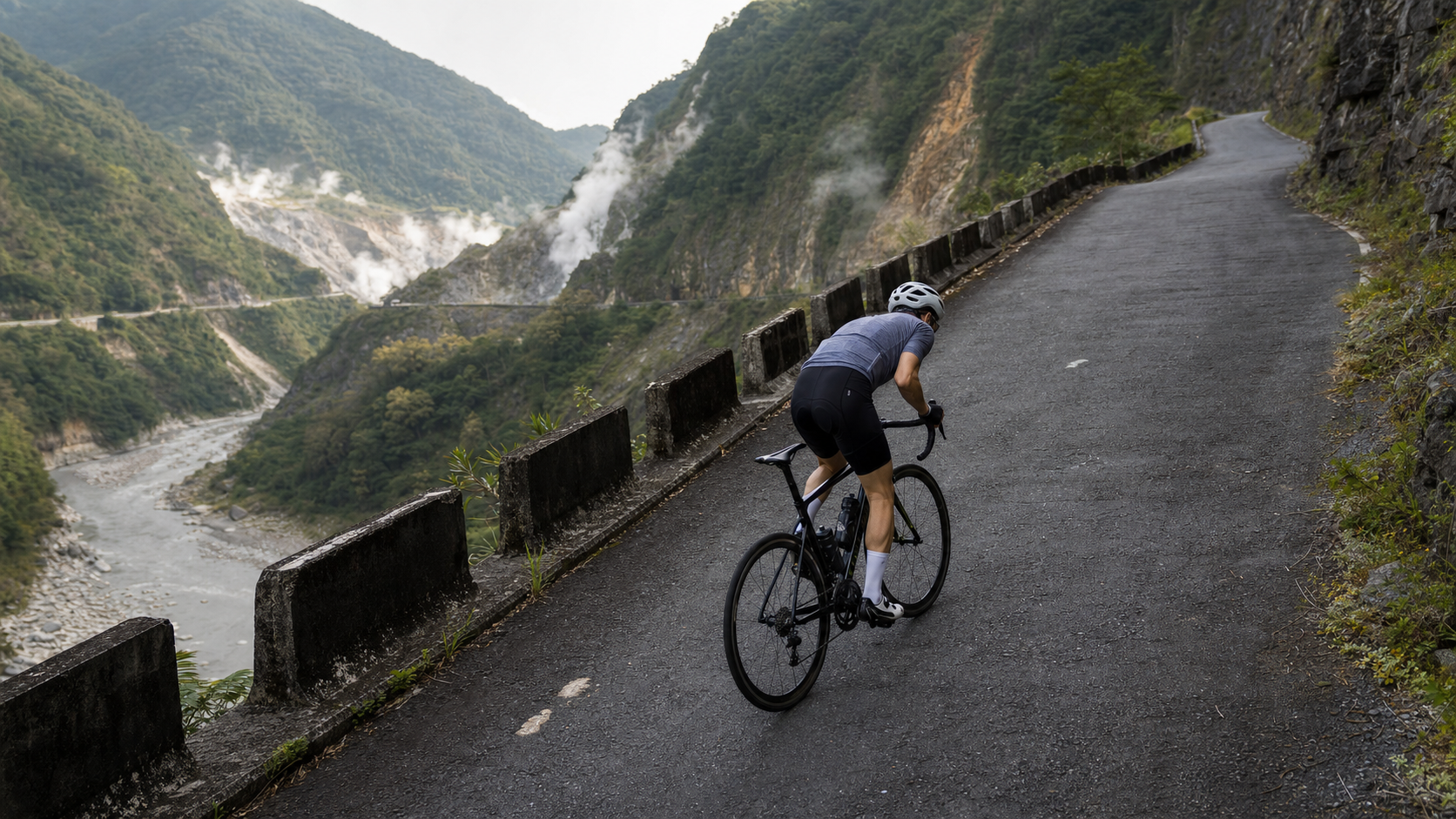
Some roads are meant to be enjoyed; others are meant to be honest with yourself. The climb from Guguan belongs to the latter.
This steep slope, marked by Strava as 4.43 kilometers with 533 meters of elevation gain and an average gradient of 11.7%, is hidden on the mountainside beside the Dajia River, around the hot spring resort of Guguan. The numbers are cold and impersonal, but anyone who has ridden it remembers that feeling of “breath being choked by the gradient.” This article isn’t about how to conquer it, but rather—on such a nearly vertical road, what kind of scenery and what kind of self you’ll encounter.
Guguan: A Hot Spring Resort in the Mountains
To understand the Guguan climb, you first need to understand Guguan itself.
Guguan is located in the upper reaches of the Dajia River, the most famous hot spring resort on the western section of the Central Cross-Island Highway (Provincial Highway 8). The terrain here is extremely dramatic—on one side is the Dajia River, a gentle stream in normal times but torrential during the rainy season; on the other side stands Mount Basianshan, rising over a thousand meters. The old Cross-Island Highway was carved inch by inch, hugging the riverbed and the mountainside. Guguan is renowned for its mildly alkaline carbonated hot springs. Many cyclists plan their trips like this: first, push hard on the mountain roads, then strip off all their gear and soak in the hot springs, letting tense muscles relax in the warm currents.
And the “Guguan climb”—this steep slope—is the toughest road in this mountain landscape. It’s not gentle like the Guguan hot springs. Its first impression is simply—steep, and the kind of steep that doesn’t hold back from the very start.
Songhe and Lileng: Indigenous Villages on the Road to Guguan
Before reaching Guguan, Provincial Highway 8 passes through two Atayal indigenous villages, Lileng and Songhe—the most heartwarming stretch of this road.
Songhe Village was formerly called “Jiulaoqi” and was renamed after the Dajia River, where egrets often foraged along the riverbed, after the Retrocession. The village still preserves century-old cypress plank houses and the historical traces of the Jiulaoqi Station of the Basianshan Forest Railway. After passing Songhe, you enter the area around Basianshan National Forest Recreation Area, with only about 4 kilometers left to Guguan.
Lileng Village sits with its back to the mountains and facing the river, with a comfortable climate. In recent years, hot springs were discovered along the Lileng Creek, making it another gentle waypoint on this road. These villages make the “Guguan climb” not just a lonely ascent, but a journey through mountains, forests, and human culture. Before you give it everything you have, you’ll first be gently soothed by these old cypress houses, Atayal totems, and cooking smoke rising from the valley.
First Person: A Conversation with a Wall
I remember the morning I first rode the Guguan climb. Starting from Guguan, the road ahead was still relatively gentle, with the sound of the Dajia River accompanying me all the way. Until I turned onto the climbing road—the gradient seemed to change personality in an instant, tilting up abruptly.
The numbers on my cycling computer jumped upward: 11%, 13%, 15%… I shifted down through my gears to the very bottom, yet my cadence kept dropping. My front wheel felt like it might lift off the ground, and my body instinctively leaned forward. Everything around me was quiet, leaving only my heavy breathing and the strained sound of the chain turning at its lowest gear ratio.
It was a strange kind of solitude. This road is short—less than 5 kilometers—yet it makes time feel unbearably long. You can’t think about “how much farther,” because that’s too hopeless; you can only think about “the next corner,” “ten more pedal strokes.” In that focus, which shrinks the world down to three meters in front of you, I actually felt a sense of calm—all distractions were wrung out by the gradient, and my mind was so clear that the only thing left was “keep going up.”
The moment I reached the top, there was no archway, no sea of clouds—just an ordinary intersection. But I sat by the roadside catching my breath for a long time, feeling deeply satisfied. Because I knew I hadn’t put a foot down, hadn’t given up—I had carried the conversation with this wall through to the end.
Scenery and Flavors Along the Way
Although the Guguan climb is steep, the mountain scenery along the way is anything but stingy. Bamboo groves, mixed forests, and banana trees form green tunnels on both sides of the slope, with sunlight filtering through the leaves and dancing on the asphalt. Occasionally, around a bend, the Dajia River valley and the ridgeline of Mount Basianshan suddenly unfold before you—that kind of “view earned through pain” is especially moving.
After the ride, don’t forget Guguan’s hot springs and food. The Baileng Ice Pops along the route are a classic summer treat for veteran cyclists—one bite of that old-fashioned ice pop and the heat from the climb instantly dissipates. The villages also offer local flavors like five-leaf pine juice and indigenous-style meals. And the most healing finale is always soaking in Guguan’s mildly alkaline carbonated hot springs—letting legs that endured 11.7% gradually unwind in the warm currents.
What This Road Means to Cyclists
The Guguan climb is not an “Instagram-worthy route”; it won’t appear on most people’s travel lists. But for serious climbing enthusiasts, it’s an honest touchstone.
What it teaches you is “facing things.” Facing a steep slope you know will hurt, with no way to escape; facing the urge to give up; facing the embarrassment and persistence of continuing to turn the pedals even when your speed is embarrassingly slow. When you’re willing to push one more stroke on an 11.7% gradient, you’re actually practicing a life skill—holding on one more second in the place where you most want to quit.
Many cyclists treat it as a training ground for repeated climbs, going up and down again and again. What they’re chasing isn’t the scenery, but the process of being drained and then standing back up. The meaning of this road lies hidden in that almost meditative repetition.
Seasonal Highlights
- Spring: Fresh greenery in the mountains, clear streams—the most comfortable season for a challenge.
- Summer: The river valley is muggy, but early mornings are cool. Paired with Baileng Ice Pops and Guguan hot springs, it’s a combination of “bitter first, sweet after.”
- Autumn: Crisp, clear weather with the best visibility—the ridgeline of Mount Basianshan is sharply defined.
- Winter: Cold mornings make the hot springs most tempting—perfect for a leisurely “challenge plus soak” trip.
Suggested Side Trips
To fit the Guguan climb into a one-day itinerary, here’s how you could arrange it:
- Morning: Start from Dongshi or Guguan, ride along Provincial Highway 8 through Lileng and Songhe, and soak in the village atmosphere.
- Noon: Take on the Guguan climb with everything you’ve got—treat it as the main course of the day.
- Afternoon: Return to Guguan for a hot spring soak, visit the cypress plank houses in Songhe and the Jiulaoqi Station ruins, and enjoy a local meal.
- Evening: Descend along the Dajia River on the way back, ending this “bitter first, sweet after” journey in the sunset.
The Guguan climb won’t make you love it easily, but it will make you remember it deeply. With its purest steepness, it forces you to see your limits—and also forces you to see that you can endure more than you ever imagined. Next time you come to Guguan for a hot spring, why not first make a trip to that wall? You’ll soak in the hot springs with sore, tired legs, and you’ll also head home with an indescribable sense of fulfillment.
The Western Section of the Central Cross-Island Highway: A Road Living with the River
The Guguan climb is part of the grand landscape of the western section of the Central Cross-Island Highway. To understand it, you need to understand the character of this entire western stretch of Provincial Highway 8—it’s a road that lives in symbiosis with the Dajia River.
From Dongshi to Guguan, Provincial Highway 8 always follows the Dajia River. On one side is the river, sometimes a gentle babbling stream, sometimes a surging torrent; on the other side are the mountains, with Mount Basianshan towering into the clouds, pressing the entire road into a narrow crevice between mountain and water. Every bend and every slope on this road was carved inch by inch by the original road builders, following the contours of the mountains and the flow of the water. Riding here, you can feel a balance struck between human effort and nature—the road doesn’t clash head-on with the mountain but gently winds around it; it doesn’t compete with the river for space but quietly follows alongside it.
The Guguan climb is the steepest ascent on this road that lives with the river. When you turn away from the Dajia River and begin climbing into the mountains, it feels like you’re leaving the river’s company and plunging headfirst into the mountain’s embrace. That transition from “following the river” to “heading up the mountain” is the most dramatic moment of the Guguan climb—one second you can still hear the sound of the Dajia River, and the next, all that remains is your own heavy breathing and the oppressive sensation of the gradient tilting up.
The Call of the Hot Springs: A Ritual of Sweet After Bitter
The most captivating thing about Guguan is that it places “the bitterest” and “the sweetest” side by side. The bitterest is that 11.7% steep slope; the sweetest is that pool of mildly alkaline carbonated hot spring water at the bottom.
Guguan is famous for its hot springs, with water quality that is gentle on the skin and highly effective for soothing muscles and relieving fatigue. For cyclists, this creates an almost ritualistic itinerary—first, use every ounce of strength to take on that brutal slope and push your body to its limits; then return to Guguan, strip off all your gear, and soak in the warm hot spring, letting your tortured legs relax inch by inch in the warm mineral water. That exhilarating feeling of sweetness after bitterness is something no ordinary ride can provide.
This rhythm of “bitter first, sweet after” carries a subtle metaphor for life. Life is the same—the sweetest fruits are often hidden behind the hardest efforts. Guguan, with its steep slope and its hot springs, has written this truth into a journey you can experience firsthand. No wonder so many cyclists willingly return to Guguan again and again—what they’re seeking isn’t just the achievement of the climb, but that complete experience of sweetness after bitterness, of body and mind both fully released.
Songhe and Lileng: Gentleness Before the Steep Climb
Before reaching Guguan and tackling that steep climb, Provincial Highway 8 passes through two Atayal tribal villages, Lileng and Songhe. They serve as a gentle prelude to this hardcore route—before you give it everything you’ve got, they first soothe you with mountain forests and local culture.
The Songhe tribe was formerly called Jiulaoqi, renamed after the war because egrets often foraged along the Dajia River. The village still preserves century-old cypress plank houses and traces of the Baxianshan Forest Railway’s Jiulaoqi Station. Past Songhe, you enter the area around Baxianshan National Forest Recreation Area, with only about 4 kilometers left to Guguan. The Lileng tribe, meanwhile, sits with mountains at its back and a creek at its front, enjoying a comfortable climate. Hot springs were recently discovered along the Lileng Creek, making it another gentle stop along the way.
These villages make the “Guguan climb” more than just a lonely ascent—it becomes a journey through mountain forests and culture. You’ll first be comforted by these old cypress houses, Atayal totems, and cooking smoke rising from the valley, and only then face that brutal climb. This buildup gives the entire ride a sense of depth—softness first, then hardness; culture first, then limits. And on the most painful part of the climb, you’ll still carry those warm images in your mind, becoming the strength that pushes you upward.
What This Road Taught Me: Hold On One More Second Where You Most Want to Give Up
Having ridden the Guguan climb so many times, what it has taught me isn’t really cycling technique—it’s an attitude toward facing difficulty.
It taught me to “face things.” To face a steep slope you know will hurt and from which there’s no escape; to face the thought of giving up; to face the embarrassment and persistence of continuing to turn the pedals even when your speed is embarrassingly slow. On an 11.7% grade, no one can pedal for you—you can only confront your own limits head-on. And when you choose, at the very moment you most want to quit, to push one more stroke, to hold on one more second, you’re actually training one of life’s most precious abilities—resilience.
This ability extends beyond cycling. When work hits a bottleneck or life sinks into a low point, you’ll remember that version of yourself on that wall in Guguan who didn’t give up, and tell yourself: “Hold on a little longer, and it’ll pass.” The Guguan climb, with its purest steepness, carves this lesson into your body and memory. It’s not a road you’ll love easily, but it will make you remember deeply, and it will make you stronger.
Seasons and Side Trips: Fitting the Steep Climb into a Day’s Journey
The Guguan climb has its own character in every season: in spring, the mountains are freshly green and the streams crystal clear—the most comfortable season for the challenge; in summer, the valley is sweltering, but the mornings are cool, and with Baileng popsicles and hot springs, it’s the perfect sweet reward after hardship; autumn brings crisp air and the best visibility; winter mornings are cold, and the allure of hot springs is strongest—ideal for a slow trip combining the challenge with a soak.
To fit the Guguan climb into a day’s itinerary, here’s how you might arrange it: set out in the morning from Dongshi or Guguan, ride along Provincial Highway 8 through Lileng and Songhe, taking in the tribal atmosphere; at noon, give the Guguan climb your full effort, treating it as the main course of the day; in the afternoon, return to Guguan for a hot spring soak, visit the cypress plank houses in Songhe and the Jiulaoqi Station ruins, and enjoy a local meal; in the evening, descend along the Dajia River, ending this bittersweet journey in the sunset. The Guguan climb won’t let you love it easily, but it will make you remember it deeply. With its purest steepness, it forces you to see your limits—and forces you to see that you can endure more than you ever imagined. Next time you come to Guguan for the hot springs, why not first make a pilgrimage to that wall? You’ll sink into the hot spring with aching legs, and head home with an indescribable sense of fulfillment.
First Person: A Conversation with a Wall
I remember that first morning I rode the Guguan climb. Setting out from Guguan, the road ahead was still relatively gentle, the sound of the Dajia River accompanying me all the way. Then came the turn onto the climb—the gradient changed as if it were a different person, rising up abruptly. The numbers on my cycling computer jumped upward—11%, 13%, 15%—and I shifted down through my gears to the very bottom, yet my cadence kept dropping. The front wheel felt like it might lift off the ground, and my body instinctively leaned forward. Everything around me was quiet, except for my heavy breathing and the labored sound of the chain turning at its lowest gear ratio.
It was a strange kind of solitude. This road is less than 5 kilometers long, yet it makes time feel unbearably long. You can’t think about how much farther there is—that’s too despairing; you can only think about the next bend, the next ten pedal strokes. And in this focus that shrinks the world down to three meters in front of you, I actually found a sense of calm—all distractions were wrung out by the gradient, and my mind was clean, left with only the single task of going upward. When I reached the top, there was no archway, no sea of clouds—just an ordinary intersection. But I sat by the roadside catching my breath for a long time, feeling deeply satisfied. Because I knew I hadn’t put a foot down, hadn’t given up—I had carried that conversation with the wall through to the end.
Scenery and Flavors Along the Way
Steep as the Guguan climb is, the mountain scenery along the way is anything but stingy. Bamboo groves, mixed forests, and banana trees form stretches of green tunnels on either side of the road, with sunlight filtering through the leaves and dancing on the asphalt. Occasionally, around a bend, the Dajia River valley and the ridgeline of Baxianshan suddenly open up before you—a view earned through pain, and all the more moving for it. This is also the biggest difference between cycling and driving—drivers whoosh past, never seeing the scenery hidden around these bends; while cyclists earn every view inch by inch with sweat, and therefore see it more deeply and remember it more firmly.
After the ride, don’t forget Guguan’s hot springs and food. Along the way, Baileng popsicles are a veteran rider’s summer staple—one old-fashioned popsicle down, and the heat of the climb instantly dissipates. The villages also offer local flavors like five-leaf pine juice and indigenous-style meals. And the most healing finish is always sinking into Guguan’s mildly alkaline carbonic hot springs, letting legs that have been tormented by 11.7% slowly relax in the warm current. Many riders treat this road as their training ground for repeated climbs, going up and down again and again. What they’re after isn’t the scenery—it’s the process of being wrung dry and standing back up. The meaning of this road lies hidden in that almost meditative repetition.
Guguan: A Hot Spring Haven in the Mountains
To understand the Guguan climb, you first need to know Guguan itself. Located in the upper reaches of the Dajia River, Guguan is the most famous hot spring resort on the western section of Provincial Highway 8, the Central Cross-Island Highway. The terrain here is dramatic—on one side, the Dajia River, a gentle stream in dry seasons and a torrent during the rains; on the other, Baxianshan rising over a thousand meters. The old Cross-Island Highway was carved inch by inch, hugging the riverbed and cliff face. Guguan is renowned for its mildly alkaline carbonic hot springs, and many riders structure their trips the same way: first, take on the mountain roads with full effort, then shed all their gear and soak in the hot springs, letting tense muscles unwind in the warm current.
And the Guguan climb—that steep slope—is the most hardcore road in this landscape. Unlike the gentle hot springs of Guguan, its first impression is steepness, and it’s the kind that doesn’t hold back from the very start. Before reaching Guguan, Provincial Highway 8 passes through two Atayal tribal villages, Lileng and Songhe, which are the most human stretches of this road. The Songhe tribe was formerly called Jiulaoqi, renamed after the war because egrets often foraged along the Dajia River; the village still preserves century-old cypress plank houses. The Lileng tribe sits with mountains at its back and a creek at its front, enjoying a comfortable climate, with hot springs recently discovered along the Lileng Creek. These villages make the Guguan climb more than just a lonely ascent—it becomes a journey through mountain forests and culture. Before you give it everything you’ve got, you’ll first be gently comforted by these old cypress houses, Atayal totems, and cooking smoke rising from the valley.
What This Road Means to Riders
The Guguan climb isn’t an Instagram-worthy route; it won’t appear on most people’s travel lists. But for serious climbing enthusiasts, it’s an honest touchstone. What it teaches you is to face things—to face a steep slope you know will hurt and from which there’s no escape; to face the thought of giving up; to face the embarrassment and persistence of continuing to turn the pedals even when your speed is embarrassingly slow. When you’re willing to push one more stroke on an 11.7% grade, you’re actually practicing a life skill—holding on one more second where you most want to give up.
Many riders treat this road as their training ground for repeated climbs, going up and down again and again. What they’re after isn’t the scenery—it’s the process of being wrung dry and standing back up. The meaning of this road lies hidden in that almost meditative repetition. With its steep slopes and Guguan’s hot springs, the climb binds together bitterness and sweetness, limits and relaxation. It makes you know yourself in the most painful place, and rewards yourself in the most healing hot spring. This complete experience of sweetness after hardship is something no ordinary ride can offer. No wonder so many riders keep returning to Guguan—what they come back for isn’t just the challenge of that wall, but also the irreplaceable sense of groundedness and satisfaction they feel soaking in the hot springs after conquering it.
Songhe and Lengleng: The Gentle Prelude on the Road to Guguan
Before reaching Guguan and tackling that steep climb, Provincial Highway 8 first passes through the two Atayal villages of Lengleng and Songhe, which serve as a gentle overture to this hardcore route. The Songhe tribe was formerly known as Jiuliangqi; after the Retrocession, it was renamed because egrets often foraged along the Dajia River. The village still preserves century-old cypress plank houses and traces of the Jiuliangqi Station of the Basianshan Forest Railway. Past Songhe, you enter the vicinity of Basianshan National Forest Recreation Area, leaving only about 4 kilometers to Guguan. The Lengleng tribe, meanwhile, sits with its back to the mountains and facing the creek, enjoying a comfortable climate—another gentle waypoint along the road.
These tribes make the climb to Guguan more than just a lonely ascent; they turn it into a journey through forests, mountains, and human culture. You are first soothed by the old cypress houses, Atayal totems, and cooking smoke rising from the valley, and only then do you face that brutal slope. This arrangement of softness before hardness gives the entire ride a sense of depth. It also lets you carry those warm images in your mind during the most painful stretches of the climb, giving you strength to push upward. The most beautiful part of cycling is often precisely this interweaving of soft and hard, of culture and极限—it transforms a mere climb into a complete journey with story, warmth, and challenge. This, exactly, is the charm of the Guguan landscape.
Related Reading
- The Guguan Climb Guide: A 4.4 km, 11.7% Average Pure Steep-Grade Textbook
- Lengleng Creek Deep in Guguan: A Forest-Road Journey into the Atayal Tribe and the Memory of the Dajia River
- Taichung Dajia River Basin Routes: The Complete Guide to Scenic Valley Cycling
- The Mountain Route from Guguan to Lishan in Taichung: A Cycling Version of the Cross-Island Highway
台北闊瀨陡坡 騎旅 / 日本單車雜誌編輯車友臨時加入!/ 髮香才是最強的 / feat. 北迴歸線小隊 / 公路車 CT Yeh
6 個月前
新竹羅平 x 天湖部落 大禹嶺級變態陡坡! 4K超高畫質 空拍 | 公路車
5 年前
嘉義大埔、阿婆灣挑戰賽,美到以為在日本!ft. 環騎5 Cool 西拉雅188 / 公路車 / CT Yeh
7 個月前
萬年峽谷! 30% 超激陡坡 里佳部落DAY2 還是很硬! | 公路車 | CT Yeh
3 年前
秘境雪場 日本 八甲田 冰樹探險與滑雪體驗 ft. Q老師 & 運動生活
7 年前
一定要騎一次!阿里山最深處:里佳部落!單車旅行 | 2800m爬升 | 深度部落體驗:嗨翻晚會、螢火蟲、銀河 | feat. JJSC & 廢物伙伴 | 公路車 CT Yeh
9 個月前
大武山20%魔王陡坡【JJSC南台灣遊騎Day2】!屁股真的要裂開了...凡士林抹滿也沒用?神秘金教堂還有超便宜夜市
3 個月前
司馬庫斯 | 單車員工旅遊 | 比武嶺還接近上帝的路 | 2021 全面實況 路況解析 | 空拍 櫻花炸開超濃密 | 財伯觀光果園 | CT Yeh
5 年前